
The Off-Grid Living Infrastructure Map and Why Electricity Is the Last Problem to Solve
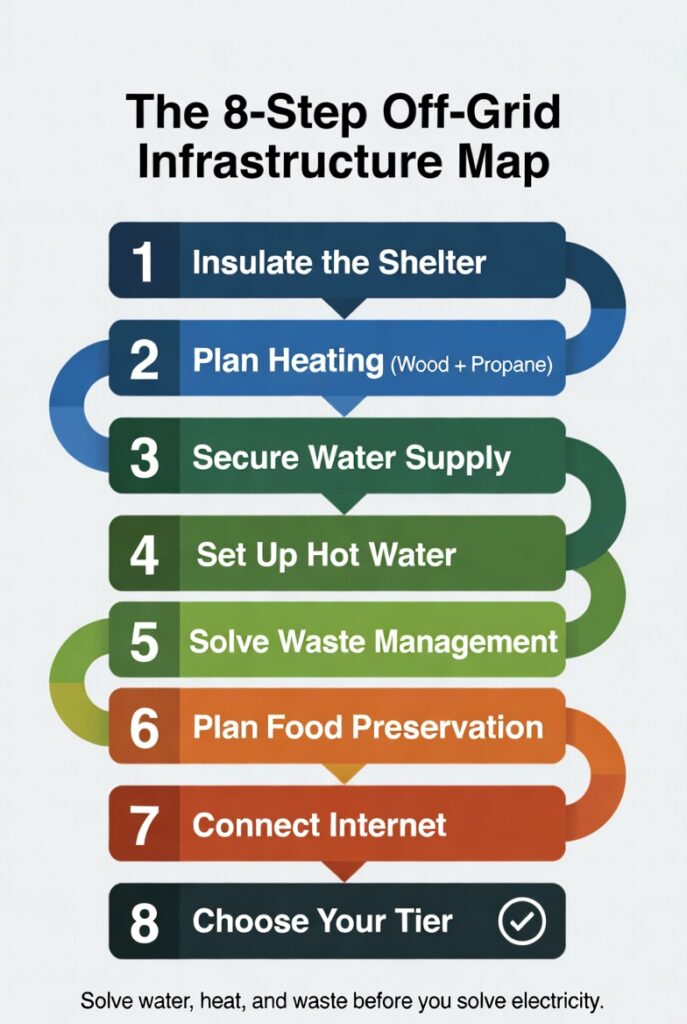
Planning for off-grid living in Ontario means solving water, heat, waste, food preservation, and internet before you solve electricity because a solar panel without a toilet is still an outhouse. Eight infrastructure systems determine whether your off-grid property is livable. Electricity is only one of them. Most people plan the solar panels and batteries first, then realize they forgot the toilet, the heat source, and the water supply.
The infrastructure map matters because water, heating, and waste management determine your electrical load. A house with R-24 walls and a wood stove needs 3,200Wh per day from the battery. The same house with no insulation and electric heaters needs 8,000Wh per day. Solving insulation and heating first cuts the solar system cost by more than half. Every dollar spent on infrastructure saves $3 to $5 on electrical capacity.
This off-grid living guide is the master map for the entire Off-Grid Living category. Each section covers one infrastructure system and links to the full detailed guide. Follow the 8 steps in order because each system affects the sizing of the next. For a broader system overview, see our solar generator Ontario guide.
Shelter, Insulation, and Heating as the Foundation of Ontario Off-Grid Living
Step 1 is insulation. R-24 walls and R-60 attic are the Ontario off-grid living minimum. Insulation reduces heating load by up to 60 percent compared to an uninsulated structure. A well-insulated cabin needs a smaller wood stove, burns less wood, and maintains temperature longer during overnight burns. The insulation cost of $2,200 saves $12,500 on solar system sizing because the electrical load drops from 8,000Wh to 3,200Wh per day. For the complete specification, see our off-grid insulation guide.
Step 2 is heating. Electric heaters draw 1,500W to 3,000W and drain any residential battery bank in 1 to 2 hours. A wood stove is the primary heat source for Ontario off-grid living because it draws zero amps from the battery. Propane is the backup for cooking, hot water, and supplemental heat. Propane also draws zero amps. Separating heating from electricity is the single most important decision in off-grid living design. For the complete guides, see our wood stove Ontario guide and our off-grid propane guide.
Off-Grid Living Water, Hot Water, and Waste Management for Ontario Properties
Step 3 is water supply. A well pump is the standard water source for rural Ontario off-grid living properties. Well pumps draw 800W to 1,500W during startup, which can trip a small inverter. A SoftStart Well reduces the startup surge by 70 percent, from 1,500W to 450W. A pressure tank reduces pump cycling, which saves energy and extends pump life. For the complete well pump guide, see our well pump Ontario guide. Step 4 is hot water. Propane on-demand heaters are the correct choice for off-grid living because they draw zero amps. Electric tankless heaters draw 4,500W to 7,000W, which exceeds the capacity of any residential off-grid inverter. For the complete guide, see our solar water heater guide.
Step 5 is waste management. A composting toilet costs $1,500 to $3,000 and requires no plumbing, no water, and no septic system. It is the simplest waste solution for seasonal cabins and small off-grid living builds. For full-time homes, a septic system requires a perc test and costs $10,000 to $25,000 depending on soil conditions. Greywater from sinks and showers can be diverted to garden irrigation with a simple filtration system. For the complete guides, see our composting toilet guide and our off-grid septic guide.
Food Preservation, Internet, and the Ontario Cabin Tier System
Step 6 is food preservation. A 12V DC fridge draws less power than an AC fridge because it eliminates the inverter conversion loss. A chest freezer averages 50W and is one of the most efficient large appliances for off-grid living. Cold chain planning for multi-day outages requires knowing exactly how many hours of runtime your battery provides at the fridge’s average draw. For the complete guide, see our off-grid fridge guide. Step 7 is internet and communication. Starlink draws 75W average with snow melt mode adding 120W extra during winter storms. The gray streak protocol manages power during consecutive cloudy days by scheduling Starlink for 8-hour windows instead of 24-hour continuous operation. For areas without Starlink coverage, cell boosters extend LTE signal to remote properties. For the complete guide, see our off-grid internet guide.
Step 8 is choosing your tier. Tier 1 covers a shed with LED lights and phone charging. Tier 2 covers a cabin with a fridge, LED lights, Starlink, and CPAP. Tier 3 covers a full home with complete independence including a well pump, full kitchen, and whole-house loads. Each tier has different infrastructure requirements and different costs. The tier system ensures you build only what you need and expand later as your budget and experience grow. For the complete breakdown, see our off-grid cabin guide.
The Rockwood Complete Infrastructure Build
A family in Rockwood planned their off-grid living build using this complete infrastructure map. They started with insulation at R-24 walls and R-60 attic before installing any solar equipment. They installed a wood stove as primary heat and propane on-demand for hot water and cooking. Their well pump used a SoftStart Well to reduce the startup surge from 1,500W to 450W.
Because they insulated first, their heating load dropped by 60 percent compared to an uninsulated structure. This meant their battery bank only needed to cover LED lights, the fridge, Starlink, and the well pump. The wood stove handled 100 percent of space heating with zero electrical draw. Their total electrical load dropped from 8,000Wh per day with electric heat to 3,200Wh per day without it. They built a Tier 2 system at $5,500 instead of the $18,000 Tier 3 system they originally quoted.
Insulating before sizing the solar system is like reducing the weight of a vehicle before choosing the engine. A lighter vehicle needs a smaller engine, less fuel, and cheaper components. The insulation cost $2,200. The solar savings from the smaller system were $12,500. Every dollar spent on R-24 walls saved $5.68 on solar capacity.
The Milton Electric Heat Disaster
A homeowner in Milton planned his off-grid living setup around electric heating because he wanted a clean modern system with no wood or propane. He installed two 1,500W electric space heaters as his primary heat source. His 4,096Wh battery bank was the largest available portable system. He expected the battery to handle heating through a January night.
Two 1,500W heaters draw 3,000W total. His 4,096Wh battery at 3,000W continuous draw lasted 82 minutes before hitting low-voltage cutoff. By 9 PM on the first cold night, the battery was dead and the house temperature dropped to 4 degrees C by morning. His family slept in the car with the engine running for heat. A $4,500 battery system could not replace a $500 wood stove for Ontario winter heating.
Using electric heaters on battery power is like running the air conditioning at full blast while driving uphill in low gear. The engine has enough power for one or the other, not both at the same time. Off-grid living in Ontario requires separating heating from electricity. Wood and propane handle heat. Solar and batteries handle everything else. The infrastructure map in this guide prevents this mistake at step 2 before you buy a single solar panel.
The Off-Grid Living Verdict and Why the Infrastructure Map Saves More Than the Solar System
Every dollar spent on insulation saves $5 on solar capacity. Propane handles heat and hot water at zero amps. A wood stove is the January non-negotiable for any Ontario off-grid living property. Solving the infrastructure map first means sizing the electrical system to match a reduced load instead of an inflated one. A Tier 2 cabin at $5,500 electrical serves the same family that would have spent $18,000 without the infrastructure planning.
The off-grid living infrastructure map connects directly to the electrical system. For wiring, see our off-grid electrical wiring guide. For battery selection, see our solar battery guide. For beginners starting from zero, see our beginner solar guide.
Frequently Asked Questions
Q: Can I heat an off-grid home with solar power alone?
A: No. Electric heaters draw 1,500W to 3,000W, which drains any residential battery bank in 1 to 2 hours. A wood stove is the primary heat source for Ontario off-grid homes with propane as backup. Separating heating from electricity makes your solar system affordable.
Q: What is the most overlooked system in off-grid living?
A: Waste management. Everyone plans the solar and forgets the toilet. A composting toilet costs $1,500 to $3,000 and requires no plumbing, water, or septic system. A full septic system requires a perc test and costs $10,000 to $25,000 depending on soil conditions.
Q: How much does a complete off-grid living setup cost in Ontario?
A: A Tier 1 shed with lights and phone costs $800 to $1,500 for the electrical plus $200 for basic infrastructure. A Tier 2 cabin with fridge and Starlink costs $5,000 to $8,000 including well pump and composting toilet. A Tier 3 whole home costs $30,000 to $60,000 including septic, wood stove, and full electrical.
NEC Article 702 covers optional standby systems for residential off-grid installations including grounding, bonding, and overcurrent protection requirements. All permanent off-grid installations must comply with local electrical code and inspection requirements. Current standards are published at nfpa.org.
CEC Section 64 governs off-grid residential installation requirements in Ontario including permits, inspections, and safety standards. All permanent installations require ESA approval before occupancy. The Electrical Safety Authority (ESA) provides current compliance guidelines at esasafe.com.
This build is engineered within the 48V DC Safety Ceiling. Diagnostic logic is based on 20+ years of technical service experience. All structural and electrical installations must be verified by a Licensed Professional and comply with your Local AHJ. See our legal and safety disclosure for full scope.
About the Author
Robert Bertrand spent 20 years as a service advisor in the automotive industry (Lexus and Nissan), where precision diagnostics, wiring integrity, and documentation standards were non-negotiable. He brings that same technical discipline to GridFree Guide, where he researches, tests, and documents off-grid solar systems for Ontario conditions. Based in Rockwood, Ontario, every article is built on verified specifications, manufacturer data, and the real-world climate constraints of Canadian off-grid living.
As an Amazon Associate I earn from qualifying purchases. This site also contains affiliate links to other products and services. GridFree Guide earns a small commission at no extra cost to you.