
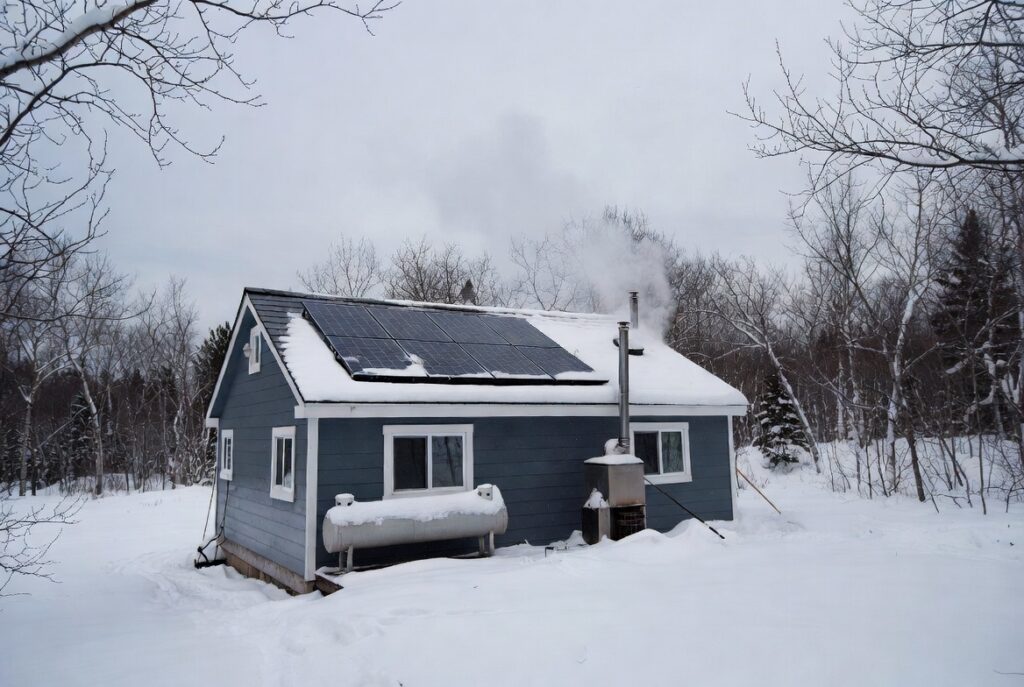
The most common Ontario off grid cabin mistake is specifying a Tier 1 system (200W panel, 100Ah LFP, 1,000W inverter) for what is actually a year-round build, then discovering on day 3 of the first January gray streak that the battery bank has dropped to 11.8V, the inverter has tripped its undervoltage protection, the propane furnace blower has lost power, and the cabin is cooling toward the ambient temperature of -15°C.
A property owner on Stone Street East in Guelph, Wellington County built a 200W/100Ah off grid cabin system in fall 2021, planning to use it year-round. His daily load was approximately 260Wh: LED lighting, laptop, DC fridge on a timer, and a propane furnace blower drawing approximately 80Wh per day. His Tier 1 system should have been adequate on clear days at 1.5 PSH: 200W × 1.5h × 0.85 efficiency = approximately 255Wh per clear day.
By day 3 of a 5-day January gray streak, his Victron SmartShunt showed 11.8V, the LFP flat discharge plateau had ended and the bank was entering deep discharge territory below approximately 10% SoC. The inverter tripped its undervoltage protection at 11.6V. Without the inverter, the propane furnace blower lost its 120V AC supply and shut down. He contacted me that evening from the cabin, which was at approximately 6°C inside and cooling toward the -15°C ambient. The cabin was not undersized by much, it was undersized by exactly the gray streak reserve that a Tier 1 system does not carry.
I specified an immediate upgrade: a 200Ah Battle Born heated LFP battery bank replacing the 100Ah unit, a second 200W panel to reach a 400W array, a 2,000W inverter replacing the 1,000W unit, and a SoftStart Well for his drilled well’s 1/2 HP submersible pump. Total Tier 2 upgrade cost: approximately $2,100 in components. The following January, the same 5-day gray streak reduced his SmartShunt to a minimum of 47% SoC, the furnace never lost power, the well never stopped working, and the off grid cabin operated exactly as specified. See our Ontario solar sizing guide before specifying any off grid cabin battery bank.
The off grid cabin tier decision: why Tier 1 fails in Ontario January and Tier 2 is the minimum year-round standard
| Specification | Tier 1 (seasonal) | Tier 2 (year-round) | Ontario verdict |
|---|---|---|---|
| Solar array | 200W monocrystalline | 400W monocrystalline | Size for 1.5 PSH January ✓ |
| Battery bank | 100Ah LFP (~960Wh usable) | 200Ah heated LFP (~1,920Wh usable) | Heated mandatory in Ontario ✓ |
| Inverter | 1,000W PSW | 2,000W PSW | Well pump surge needs 2,000W ✓ |
| Gray streak reserve | ~3.7 days (zero margin) | ~4.0 days + generator protocol | Generator fills the gap ✓ |
| Installed cost | $1,500 to $2,200 | ~$3,650 with ESA | $2,000 more buys year-round use ✓ |
| Jan gray streak result | 11.8V, furnace trips | 47-52% SoC minimum | Tier 2 is the only standard ✓ |
Important Safety and Permit Note: Any permanently installed off-grid solar system in a habitable Ontario cabin requires an ESA permit. All electrical work , including array wiring, battery bank connections, inverter installation, furnace blower circuit, and well pump branch circuit , must comply with CEC Section 64 and be inspected. Never attempt to install or modify the electrical system yourself. Contact esasafe.com before beginning any work. ESA documentation is required for home insurance on any habitable structure with an off-grid electrical system.
A 100Ah LFP bank at 12V has 960Wh of usable capacity at 80% DoD. At a typical 260Wh daily cabin load: 960 ÷ 260 = 3.7 days theoretical autonomy. That sounds sufficient, but theoretical autonomy assumes a fully charged bank and zero solar input. A January gray streak starts with a bank at some intermediate SoC after previous days of partial harvest, and the 3.7-day calculation provides exactly zero margin against an Ontario 5-day gray streak. The 100Ah LFP Tier 1 bank provides exactly zero gray streak reserve beyond the theoretical floor.
Tier 2 provides the gray streak reserve through two changes: a 200Ah heated LFP bank (1,920Wh usable) and a 400W monocrystalline array sized for the 1.5 PSH January standard. At 480Wh/day load: 1,920 ÷ 480 = 4.0 days theoretical autonomy. The array adds approximately 400 × 1.5h × 0.85 = 510Wh on a clear day, covering the daily load and providing bank recovery on any partially sunny day. The gray streak protocol supplements with a 90-minute generator run when the SmartShunt reads below 40% SoC. See our off grid costs guide for the full tier cost comparison including the Hydro One connection alternative.
The Ontario cabin design parameters: frost line, 1.5 PSH, -22°C, and 4-8°C groundwater
Four Ontario-specific parameters define any off grid cabin build in Wellington or Halton County. First: the frost line. Water supply lines must be buried to at least 1.2 metres depth, 1.5 metres is the correct design depth for this region. Any plumbing shallower than 1.2 metres will freeze in a January cold snap, converting the off grid cabin from a heated shelter into a frozen problem requiring a plumber in the worst weather of the year.
Second: the 1.5 PSH January array sizing rule. The array must produce enough energy on a clear January day at 1.5 PSH to cover the daily cabin load, not the July 4.5 PSH maximum. A 200W array at 1.5 PSH = 255Wh; a 400W array = 510Wh. That 255Wh difference is what separates a bank that recovers from one that continues to drain on a partial-sun day.
Third: the -22°C design temperature. All electrical connections in the utility room must function at -22°C ambient. Battle Born heated LFP batteries include self-heating elements that activate below 5°C to prevent charging damage in Ontario winter conditions. Non-heated LFP banks must not be charged below 0°C, charging a cold LFP bank causes lithium plating and permanent capacity loss. Fourth: 4 to 8°C groundwater year-round. That temperature rise to shower temperature (37 to 41°C required) makes electric tankless heating impractical at the Tier 2 inverter size, a 3,000W+ electric heater exceeds the 2,000W inverter.
A propane on-demand water heater draws only 25 to 60W for its electronics while delivering the same hot water on demand. See our water heater Ontario guide for the propane on-demand specification that pairs with any Tier 2 off grid cabin.
The off grid cabin Tier 2 specification: 400W array, 200Ah heated LFP, SoftStart Well, generator protocol
The Tier 2 off grid cabin specification for year-round Ontario occupancy: 400W monocrystalline array (four Renogy 100W panels in 2S×2P configuration), 200Ah Battle Born heated LFP bank, 2,000W PSW inverter, Victron MPPT 100/30 (cold Voc at -22°C = 51.7V for 2-panel series, within 100V limit), SoftStart Well for any drilled well, 2,500W propane generator connected to the existing bulk propane tank, and a Victron SmartShunt confirming daily harvest and SoC in real time. Total component cost: approximately $3,200. ESA permit: approximately $400 to $500. Installed total: approximately $3,650.
A property owner in Erin Township, Wellington County built a complete Tier 2 off grid cabin system from scratch in spring 2022. His daily load: 480Wh including LED lighting, DC chest freezer, laptop, propane furnace blower, well pump with SoftStart Well, and Starlink. He sized the battery bank to the 3-day gray streak formula: 480Wh × 3 ÷ 0.80 = 1,800Wh minimum = 150Ah at 12V, specifying 200Ah for margin.
His first January: a 4-day gray streak dropped the SmartShunt to a minimum of 52% SoC. His SmartShunt confirmed 310Wh clear-day harvest and 130Wh overcast-day harvest, consistent with the 1.5 PSH Ontario January standard and monocrystalline low-light performance. His comment at the one-year review: “The cabin just works. I’ve never thought about power since we turned it on.” See our well pump Ontario guide for the SoftStart Well specification that protects the Tier 2 inverter.
Pro Tip: The gray streak formula, daily load × 3 ÷ 0.80 = minimum battery bank Wh, gives the theoretical minimum. Add 20% buffer above that minimum for realistic year-round Ontario off grid cabin operation. For a 480Wh daily load: 480 × 3 ÷ 0.80 = 1,800Wh minimum. With 20% buffer: 2,160Wh = approximately 180Ah at 12V. Specifying 200Ah gives the correct real-world margin. The Stone Street East Guelph result confirmed this: 100Ah (960Wh usable, 3.7-day theoretical) hit LVD at day 3. The Erin Township 200Ah (1,920Wh usable) held 52% SoC through a 4-day gray streak, the 20% margin above theoretical minimum is what keeps the furnace running.
The gray streak protocol: what happens on day 3 and how to prevent the furnace from tripping
The gray streak protocol for a Tier 2 off grid cabin is triggered by SmartShunt SoC readings, not by counting overcast days. Days 1 and 2: SmartShunt harvest below 510Wh/day, bank drawing from reserve, normal loads continue. Day 2 to 3: SmartShunt reads below 40% SoC. Reduce non-essential loads, pause DC fridge cycling overnight to save approximately 80 to 120Wh, and minimize laptop use during peak draw hours. Run the propane generator for 60 to 90 minutes at 1,500W charger output to bring the bank back to 60% SoC. One 90-minute generator run adds approximately 2,250Wh to the bank, extending the gray streak reserve by approximately 4.7 days at 480Wh/day load.
The SoftStart Well is essential during gray streak generator operation. A 2,500W generator running a 1,500W charger simultaneously with a SoftStart-equipped 900W pump startup: 1,500 + 900 = 2,400W total, within the generator’s continuous rating. Without the SoftStart, the pump’s 2,800W startup surge plus 1,500W charger = 4,300W, well above any 2,500W generator. This is why every Tier 2 off grid cabin with a drilled well requires the SoftStart Well before the first gray streak event. See our off grid generator guide for the complete SoC trigger protocol.
NEC and CEC: Ontario permit requirements for off-grid cabin electrical installations
NEC 690 governs solar PV installations and applies to any off-grid solar system in an Ontario cabin regardless of grid connection status. The solar array wiring, charge controller connections, battery bank wiring, inverter connections, and all AC output circuits must comply with NEC 690 requirements, appropriately rated wire, overcurrent protection on each circuit, disconnects at the inverter and battery bank, and proper grounding for the array and system. Contact the NFPA at nfpa.org for current NEC 690 requirements for off-grid solar PV installations in residential applications.
CEC Section 64 governs electrical installations in Ontario. A permanently installed off-grid solar system in any habitable Ontario structure, including a year-round off grid cabin, requires an ESA permit. The permit application must cover the array wiring, charge controller, battery bank, inverter, and all AC output circuits including the propane furnace blower circuit and the well pump branch circuit. Most Ontario insurers require ESA documentation for any off-grid electrical system before issuing a home insurance policy on a habitable structure. ESA permits for Tier 2 systems typically cost $400 to $500. Contact the Electrical Safety Authority Ontario at esasafe.com before beginning any off-grid cabin electrical installation in Ontario.
The off grid cabin verdict: build for January, confirm with the SmartShunt, never size for July
- Ontario cabin owner who built a Tier 1 system for year-round use and experienced a January battery failure: calculate the gray streak gap and upgrade to Tier 2 before the next winter. Formula: usable bank Wh ÷ daily load Wh = maximum autonomy days. If below 3.5, the bank is undersized for year-round Ontario use. Upgrade path: add a second 100Ah heated LFP module to reach 200Ah, upgrade the inverter to 2,000W, add a second panel to reach 400W, and install a Victron SmartShunt to confirm the first January performance. The Stone Street East Guelph result: $2,100 upgrade, 47% SoC minimum following January, furnace never tripped again.
- Ontario property owner planning a new year-round off grid cabin: specify Tier 2 from day one and build to the January standard, not the July standard. 400W array in 2S×2P, 200Ah Battle Born heated LFP bank, 2,000W PSW inverter, MPPT 100/30, SoftStart Well, propane on-demand water heater, 2,500W propane generator. Apply the gray streak formula: 480Wh × 3 ÷ 0.80 = 1,800Wh minimum, specify 200Ah for margin. Confirm with SmartShunt in the first January, the Erin Township result confirms 310Wh clear day and 130Wh overcast day as the baseline for a correctly specified Tier 2 off grid cabin.
- Ontario cabin owner currently using the property seasonally who wants to upgrade to year-round: verify the building envelope and water system before specifying the electrical upgrade. The Tier 2 electrical upgrade at $3,650 installed makes year-round occupancy viable only if the property has a drilled well with frost-depth supply lines, a propane system, and structural insulation to R-20+ wall and R-40+ ceiling. If the property lacks frost-depth plumbing, adequate insulation, or a propane system, the electrical upgrade alone will not make it a year-round off grid cabin. Address the building envelope and water supply first, then add the Renogy 100W panels and heated LFP bank.
Frequently Asked Questions
Q: What solar system do I need for an off-grid cabin in Ontario?
A: The minimum year-round off grid cabin specification in Ontario is Tier 2: 400W monocrystalline array, 200Ah heated LFP battery bank, 2,000W PSW inverter, Victron MPPT 100/30, and a Victron SmartShunt to confirm January performance. Size the array for 1.5 PSH January (not the 4.5 PSH July maximum), and size the battery bank using the gray streak formula: daily load × 3 ÷ 0.80 = minimum bank Wh. For a 480Wh daily load: 1,800Wh minimum = 150Ah at 12V, specify 200Ah for margin. The Erin Township result confirms this specification delivers 52% SoC minimum through a 4-day January gray streak.
Q: Can a small off-grid cabin run year-round in Ontario?
A: Yes, with a Tier 2 electrical specification, the gray streak protocol, and a propane backup generator. The critical requirements are the battery bank sized to the 3-day gray streak formula, a propane on-demand water heater (electric tankless exceeds the 2,000W inverter capacity with 4 to 8°C Ontario groundwater), frost-depth plumbing to 1.5 metres, and Battle Born heated LFP batteries in any unheated utility room. The Stone Street East Guelph upgrade result, $2,100 in components, 47% SoC minimum the following January, confirms that a Tier 1 failure is a recoverable situation with the correct Tier 2 upgrade.
Q: How do I size a battery bank for a winter off-grid cabin?
A: Use the gray streak formula: daily load in Wh × 3 days ÷ 0.80 LFP DoD = minimum usable battery bank Wh. For a 480Wh daily load: 480 × 3 ÷ 0.80 = 1,800Wh minimum = 150Ah at 12V. Specify 200Ah (1,920Wh usable) to add a 20% margin above the theoretical minimum, this is the margin that kept the Erin Township off grid cabin at 52% SoC through a 4-day January gray streak while the theoretical minimum would have reached approximately 20% SoC. Always specify heated LFP for any battery bank in an unheated Ontario cabin utility room where ambient temperatures drop below 0°C.
This build is engineered within the 48V DC Safety Ceiling. Diagnostic logic is based on 20+ years of technical service experience. All structural and electrical installations must be verified by a Licensed Professional and comply with your Local AHJ. See our legal and safety disclosure for full scope.
About the Author
Robert Bertrand spent 20 years as a service advisor in the automotive industry (Lexus and Nissan), where precision diagnostics, wiring integrity, and documentation standards were non-negotiable. He brings that same technical discipline to GridFree Guide, where he researches, tests, and documents off-grid solar systems for Ontario conditions. Based in Rockwood, Ontario, every article is built on verified specifications, manufacturer data, and the real-world climate constraints of Canadian off-grid living.
As an Amazon Associate I earn from qualifying purchases. This site also contains affiliate links to other products and services. GridFree Guide earns a small commission at no extra cost to you.