
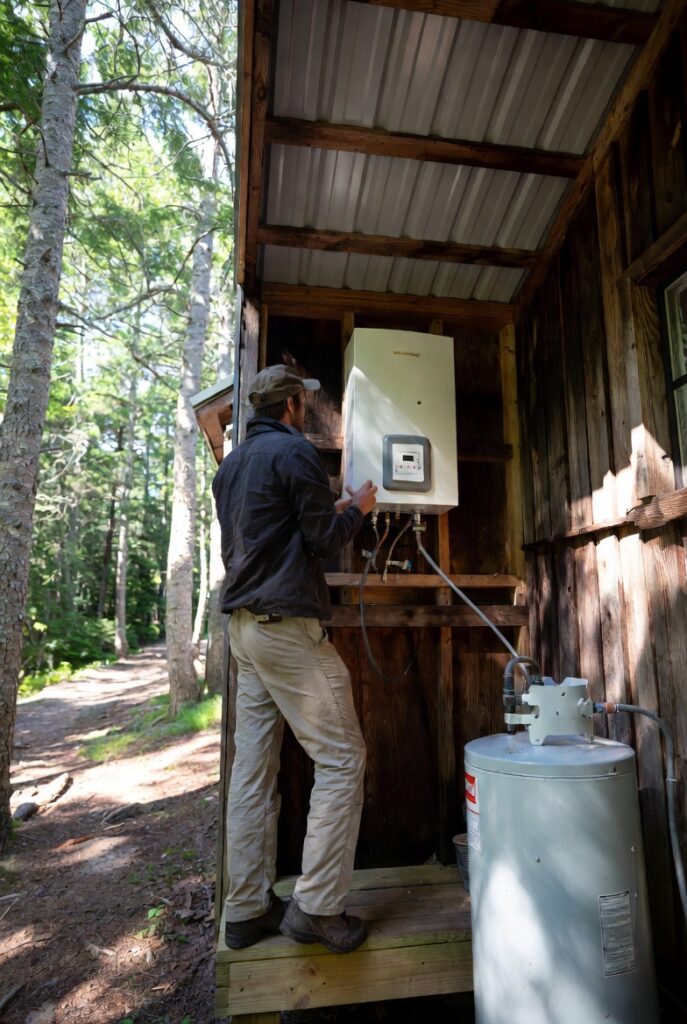
The most common water heater ontario off-grid installation mistake is purchasing a 3,000W electric tankless unit and discovering that every shower trips the 2,000W PSW inverter, a 3,000W element draws 150% of the inverter’s rated continuous output, triggering overload protection on the first hot water demand. This happened to a property owner on Crawford Street in Guelph, Wellington County, who installed a 3,000W electric tankless water heater ontario in her year-round off-grid cabin in fall 2023.
Her system included a 2,000W continuous PSW inverter, correctly sized for running loads of LED lighting 60W, laptop 65W, DC fridge 80W, phone charging 20W, and furnace blower 80W. On commissioning day, every attempt to draw hot water tripped the inverter’s overload protection within 3 seconds.
She contacted me the same day. The root cause was clear: her 2,000W continuous inverter had a 4,000W surge rating, but the tankless element required sustained 3,000W for the entire duration of a shower, not a brief startup surge. A 3-minute shower at 3,000W = 150Wh from the battery bank through the inverter. Her Victron SmartShunt confirmed the inverter’s protection circuit engaging at approximately 29A at 12V battery during the element draw.
The correct water heater ontario fix was not a larger inverter, it was a propane on-demand heater replacing the electric unit entirely. The propane on-demand unit draws approximately 25 to 60W for the gas valve solenoid, electronic igniter, and combustion fan during operation, essentially nothing from the battery bank. Her hot water load dropped from 3,000W continuous (trips every shower) to 28W (imperceptible on the SmartShunt). Total propane on-demand water heater ontario installation cost: approximately $650 for the unit plus $200 for the gas line connection by a TSSA G2 gas fitter. See our Ontario solar sizing guide before selecting any water heater ontario option.
The water heater ontario electric problem: why 3,000W tankless overwhelms a 2,000W inverter
| Water heater type | Peak electrical load | Inverter risk | Ontario off-grid verdict |
|---|---|---|---|
| Propane on-demand | 25 to 60W (solenoid/igniter/fan) | Zero | Correct for all system tiers ✓ |
| 3,000W electric tankless | 3,000W continuous | Trips any 2,000W inverter | Requires 4,000W+ continuous inverter ✗ |
| 11,000W electric tankless | 11,000W continuous | Requires 48V + 5,000W inverter | $7,800 infrastructure to avoid $130/yr propane ✗ |
| Electric tank (40 gal) | 2,500W for 45 to 90 min recovery | Sustained drain after each use | 3,750Wh recovery event per shower cycle ✗ |
A 3,000W tankless unit is the minimum residential electric water heater ontario size , and even this smallest available unit is a bad choice for most off-grid systems without a purpose-built high-capacity inverter and battery bank. Ontario groundwater arrives at approximately 7 to 10°C in winter, a 3,000W unit heats approximately 4 to 5 litres per minute from 8°C to 49°C. A 2,000W inverter has a continuous rating of 2,000W and a surge rating of typically 4,000W. The 3,000W element exceeds the continuous rating by 50% and triggers overload protection within 10 to 30 seconds of sustained draw.
The 4,000W surge rating handles the initial startup but cannot sustain the shower duration. Additionally, most electric tankless water heaters operate on 240V and draw 12.5A to 46A at the element , requiring a dedicated 240V split-phase circuit from the inverter. Most residential electric tankless water heaters operate on 240V , running them on a standard 120V-only off-grid inverter is not possible without a step-up transformer or split-phase inverter upgrade, adding $500 to $1,500 in additional electrical costs beyond the inverter itself.
A year-round off-grid property owner near Hwy 7 in Guelph was advised to run an 11kW electric tankless water heater ontario in fall 2022. The installer specified a 48V battery bank and a 5,000W PSW inverter. The 11kW unit at 48V draws approximately 229A of battery current during a shower, 2,750Wh per day for hot water alone. Two Ontario winters confirmed: the propane heating system cost approximately $380 per season; the electric water heating system required a $2,200 inverter and approximately $5,600 in Battle Born heated LFP batteries, $7,800 in electrical infrastructure to avoid approximately $130 per year in propane.
His comment: “I wish someone had told me to just put in a propane tankless.” See our solar inverter size guide for the inverter sizing that must account for any electric water heater ontario load.
The water heater ontario propane solution: 0.9L per day and 28W from the battery bank
Important Safety Notice: All propane appliances, including tankless water heaters, must be installed, vented, and commissioned by a licensed TSSA Gas Fitter (G2 or higher). Improper installation or venting can cause carbon monoxide poisoning or fire, both of which have caused fatalities in rural Ontario homes. Never install or modify a propane appliance yourself. Install working CO detectors on every level of the home and test them monthly. CO detectors are mandatory under the Ontario Fire Code for any home with a fuel-burning appliance.
A propane on-demand water heater ontario draws approximately 25 to 60W for the gas valve solenoid, electronic igniter, and combustion fan during operation, essentially zero from the battery bank.
For a 2-person household with 1 to 2 showers per day, propane consumption is approximately 0.9 litres per day. Ontario groundwater at 7 to 10°C in winter requires a correctly sized propane unit: most residential propane on-demand units rated at 120,000 to 180,000 BTU/h handle Ontario winter groundwater temperatures at normal flow rates of 8 to 10 litres per minute.
The TSSA-licensed G2 gas fitter installation is mandatory , never install or modify a propane appliance yourself, as improper installation can cause carbon monoxide poisoning or fire. The propane on-demand unit requires a dedicated outdoor exhaust vent (direct-vent or power-vent configuration rated for Ontario winter temperatures) and at least one CO detector on every level of the occupied structure. Installation cost: approximately $150 to $400 for the gas line connection plus approximately $500 to $900 for the unit.
The propane on-demand water heater ontario advantage extends beyond the electrical load. The hot water supply is entirely independent of the solar system’s state of charge, a 5-day January gray streak that drops the battery bank to 25% SoC has no effect on hot water performance. The propane tank supplies the water heater through any gray streak, cloudy period, or inverter issue without degradation. This independence is the defining advantage of the propane water heater ontario for year-round off-grid primary residence use.
A realistic off-grid shower flow rate is approximately 5 to 7 litres per minute , most residential propane on-demand units are rated for this range at Ontario groundwater temperatures. Hard well water in Wellington/Halton County causes mineral scale buildup inside the heat exchanger over time; descale the unit annually using a food-grade citric acid solution or white vinegar flush , a standard practice for Wellington/Halton County well water to prevent flow restriction and efficiency loss.
Most manufacturers recommend flushing every 12 months in hard water areas. Always calculate total propane demand before sizing the tank: space heating load + hot water 0.9L/day + cooking 0.3L/day + any propane generator load. See our propane tank Ontario guide for the 90-day tank sizing rule that correctly combines all propane loads.
Pro Tip: Before replacing an electric water heater ontario with a propane on-demand unit, check the SmartShunt’s daily load log for the current daily electrical consumption. Record the average daily kWh over one week in January. After the propane on-demand installation, record the same metric for one week. The Crawford Street Guelph result was immediate and decisive: 3,000W continuous draw (tripping the inverter) replaced by 28W solenoid draw, the daily hot water electrical load dropped from approximately 750Wh (2 showers at 3,000W × 15 min) to approximately 0.5Wh (28W solenoid × 1 minute ignition per shower). The SmartShunt daily load log provides the before-and-after comparison that confirms the propane on-demand installation is performing exactly as specified.
The electric tank recovery problem: 3,750Wh after every depletion
An electric tank water heater ontario installation creates a sustained, unpredictable battery drain after every significant hot water use. A 40-gallon (150L) electric tank depleted by two showers takes approximately 45 to 90 minutes to reheat at 2,500W element draw: 2,500W × 1.5h = 3,750Wh of recovery energy from the battery bank. This recovery occurs after every shower cycle and runs continuously at 2,500W until the tank reaches 49°C. For a January off-grid system with a 600Wh daily non-heating load, a 3,750Wh tank recovery event is a 6.25× daily load spike that can deplete a 200Ah 12V bank from 90% to below 20% SoC in a single recovery cycle.
The electric tank water heater ontario is not the correct choice for any off-grid system where the tank recovery draw exceeds 20% of the daily battery bank usable capacity. For a 3,750Wh recovery on a 200Ah 12V bank (1,920Wh usable at 80% DoD): 3,750 ÷ 1,920 = 195% of the usable bank, impossible in one event. For a 3,750Wh recovery on a 400Ah 24V bank (7,680Wh usable): 3,750 ÷ 7,680 = 49%, marginal if the system produces sufficient daily solar to recover. Electric tanks are the correct water heater ontario option only on grid-tied or very large off-grid systems with daily production well above 3,750Wh.
The SoftStart Well connection: well pump and hot water running simultaneously
A property with both a well pump and a propane on-demand water heater ontario encounters a simultaneous load condition on every shower: the well pump operates continuously to supply water to the heater at the required flow rate. Without a SoftStart Well, the well pump’s 2,800W startup surge occurs every time the shower demand cycles the pump. With a propane on-demand heater drawing 28W from the inverter, the combined startup event is approximately 2,828W, still at risk of tripping a 2,000W inverter on the pump startup surge even though the heater load is negligible.
The SoftStart Well reduces the pump startup surge from approximately 2,800W to approximately 900W, bringing the combined startup event to approximately 928W, well within any 2,000W inverter’s surge rating.
The SoftStart Well interaction with a water heater ontario installation is one of the most important but least discussed aspects of off-grid plumbing design. Without the SoftStart Well, an inverter correctly sized for the cabin’s running loads (2,000W continuous) may still trip during a shower because the pump surge event during hot water demand exceeds the inverter’s surge capacity. This trip is intermittent, it occurs only when the pump cycles during a shower, which makes the fault difficult to diagnose. Installing the SoftStart Well at the pump eliminates this failure mode entirely. See our off grid water guide for the SoftStart Well installation and the full pump surge calculation.
NEC and CEC: Ontario permit requirements for permanent water heater installations
NEC 690 governs the solar PV system that powers the inverter connected to any electric water heater ontario installation. The inverter’s AC output circuit to the water heater must comply with NEC 240 branch circuit requirements, the circuit must be sized for the water heater’s continuous operating current (3,000W ÷ 120V = 25A) and protected by a breaker rated at 125% of that current (31.25A, round up to 35A or 40A breaker).
The wiring from the inverter AC output to the water heater must be appropriately gauged for the 25A circuit, minimum 10 AWG, 8 AWG recommended for runs over 5 metres. Contact the NFPA at nfpa.org for current NEC 240 and NEC 690 requirements for inverter-connected appliance circuits in off-grid residential applications.
CEC Section 64 governs solar PV installations in Ontario. The inverter and battery bank that power any electric water heater ontario installation require an ESA permit. For a propane on-demand water heater ontario, the electrical permit covers only the low-voltage solenoid and igniter circuit, the gas line installation is covered separately under a TSSA permit from a G2 gas fitter. Both the ESA and TSSA permits are independent and both are required for a permanent propane on-demand water heater ontario installation in a habitable structure. Contact the Electrical Safety Authority Ontario at esasafe.com before beginning any permanent water heater ontario electrical installation.
The water heater ontario verdict: propane for most systems, electric only for large 48V builds
- Ontario off-grid cabin owner who has an electric tankless or electric tank water heater ontario that is tripping the inverter or draining the battery bank: replace it with a propane on-demand unit before the next winter. The Crawford Street Guelph result confirms the electric tankless failure mode: 3,000W draw on a 2,000W inverter trips on every shower. A propane on-demand water heater ontario at approximately $850 installed draws 28W from the battery bank, imperceptible on the Victron SmartShunt, and delivers unlimited hot water independently of the solar system’s state of charge through any January gray streak.
- Ontario off-grid property owner designing a new system who wants to include electric hot water: size the inverter and battery bank for the water heater load first, not last. A 3,000W electric tankless requires a 4,000W continuous PSW inverter minimum and a battery bank that can absorb 750Wh per day in hot water load in addition to all other loads. An 11kW unit requires a 48V system with a 5,000W inverter and 400Ah LFP bank, approximately $7,800 in electrical infrastructure to avoid approximately $130 per year in propane. The propane on-demand water heater ontario at approximately $850 total is the financially correct choice for any off-grid system where the water heater is the first or second largest electrical load.
- Ontario off-grid property owner who has a well pump and is adding a propane on-demand water heater ontario: install a SoftStart Well on the pump before the first winter with both loads running simultaneously. The pump startup surge at 2,800W during a shower draw trips a 2,000W inverter even with the propane heater’s negligible 28W electrical load. The SoftStart Well reduces the pump surge from 2,800W to 900W, the combined shower event drops from 2,828W (inverter trip risk) to 928W (comfortably within any 2,000W inverter’s rating).
Frequently Asked Questions
Q: What is the best water heater for an off-grid cabin in Ontario?
A: A propane on-demand water heater ontario is the correct choice for any Ontario off-grid system at any tier. It draws approximately 25 to 60W from the battery bank for the solenoid, igniter, and fan, imperceptible on the SmartShunt, and consumes approximately 0.9 litres of propane per day for a 2-person household. The hot water supply is entirely independent of the solar system’s state of charge, making it the only water heater option that continues operating normally through any January gray streak regardless of battery bank level.
The Crawford Street Guelph result: switching from a 3,000W electric tankless (trips every shower) to a propane on-demand unit ($850 installed) dropped the daily hot water electrical load from approximately 750Wh to approximately 0.5Wh.
Q: Can I use an electric tankless water heater off grid in Ontario?
A: An electric tankless water heater ontario is only practical on a purpose-built large off-grid system. A 3,000W unit requires a 4,000W or larger continuous PSW inverter, minimum $600 to $1,500, plus a battery bank sized to absorb 750Wh per day in hot water load in addition to all other system loads. An 11kW unit requires a 48V system with a 5,000W inverter and 400Ah LFP bank, approximately $7,800 in electrical infrastructure. Compare this to a propane on-demand water heater ontario at approximately $850 installed: for any system where the water heater is not already accounted for in the inverter and battery bank sizing, propane on-demand is the correct and financially superior choice.
Q: How much propane does an off-grid water heater use per day in Ontario?
A: A propane on-demand water heater ontario uses approximately 0.9 litres of propane per day for a 2-person household with 1 to 2 showers daily. At typical Wellington/Halton County propane delivery prices of approximately $1.00 per litre, the annual hot water propane cost is approximately $329 per year. This 0.9L/day is the session standard used in the propane tank Ontario guide for sizing the combined propane tank, add the 0.9L/day hot water load to the space heating and cooking loads to calculate the total daily consumption for the 90-day tank sizing rule. At the combined 3.5L/day peak winter standard (including heating and cooking), a 420L tank provides approximately 120 days of supply at the correct design load.
This build is engineered within the 48V DC Safety Ceiling. Diagnostic logic is based on 20+ years of technical service experience. All structural and electrical installations must be verified by a Licensed Professional and comply with your Local AHJ.
About the Author
Robert Bertrand spent 20 years as a service advisor in the automotive industry (Lexus and Nissan), where precision diagnostics, wiring integrity, and documentation standards were non-negotiable. He brings that same technical discipline to GridFree Guide, where he researches, tests, and documents off-grid solar systems for Ontario conditions. Based in Rockwood, Ontario, every article is built on verified specifications, manufacturer data, and the real-world climate constraints of Canadian off-grid living.
As an Amazon Associate I earn from qualifying purchases. This site also contains affiliate links to other products and services. GridFree Guide earns a small commission at no extra cost to you.