
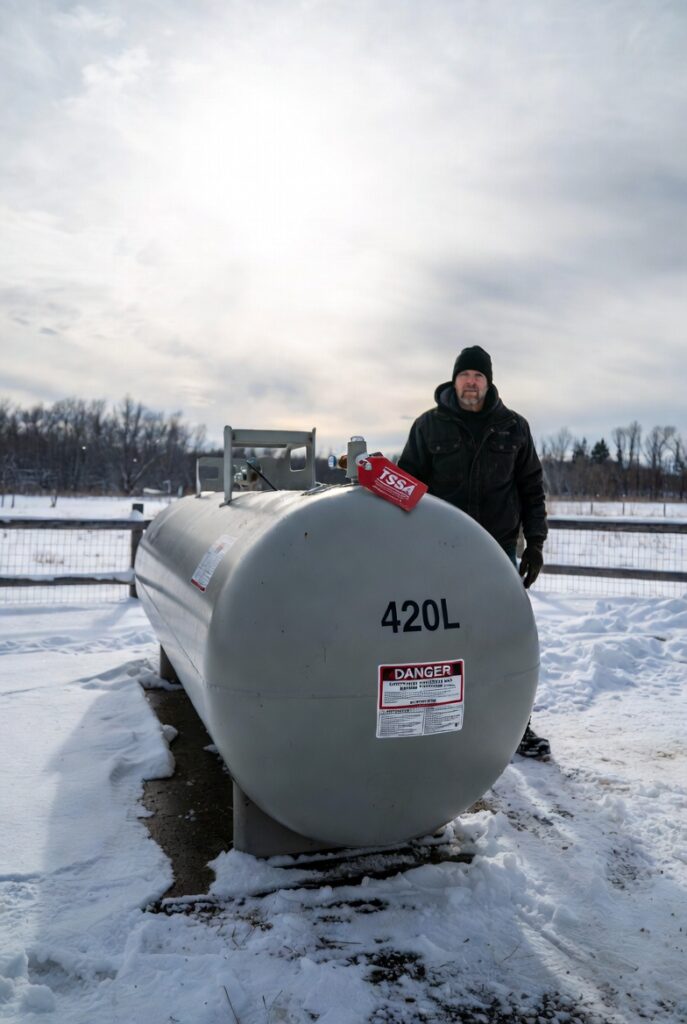
The most dangerous propane tank Ontario sizing mistake is purchasing a 120-litre tank for a year-round off-grid residence. A property owner on Watson Road South in Guelph, Wellington County installed a 120-litre vertical propane tank in fall 2022. Her planned loads included a propane forced-air furnace, a propane on-demand hot water heater, and a propane range. She received a full fill in November 2022 and estimated a 5 to 6-week supply. In February, the tank hit 5% on day 34. The driveway had 60 centimetres of packed snow. The delivery truck could not safely access the property for 3 days.
By February 3, 2023, the tank gauge read approximately 8%. She called her supplier, but the delivery truck was a heavy tanker requiring a cleared gravel driveway for safe access. Her driveway had 60 centimetres of packed snow and a soft shoulder from the previous week’s thaw. The supplier could not dispatch the tanker and scheduled delivery for three days later, when a plowing contractor could clear the access. By the evening of day two, the tank gauge read approximately 3%. She called a neighbour with a portable propane cylinder to bridge the gap.
I reviewed the propane tank Ontario installation in March 2023. The 120L tank was too small for year-round primary residence use in Wellington County. The correct minimum size for her combined loads was a 420L horizontal propane tank, providing a minimum 90-day supply at 3.5 litres per day peak consumption. Her Victron SmartShunt battery logs showed the Battle Born heated LFP batteries in the unheated utility room performed correctly throughout. The propane supply failure, not the solar system, was the critical gap. She upgraded to a 420L tank before the following winter. See our Ontario solar sizing guide before designing any off-grid heating system that relies on propane.
Propane consumption by load: heating, hot water, and cooking in an Ontario winter
| Tank size | Capacity (L) | Days at 3.5L/day | Ontario verdict |
|---|---|---|---|
| 120L vertical | 120L | ~34 days | Fails 90-day rule, seasonal use only ✗ |
| 420L horizontal pig | 420L | ~120 days | Correct for year-round primary ✓ |
| 500L horizontal | 500L | ~143 days | Correct for loads above 4L/day ✓ |
| 1,000L horizontal | 1,000L | ~286 days | Full-size residence or high-load ✓ |
A typical medium-sized off-grid cabin in Wellington or Halton County consumes approximately 3.5 litres of propane per day during peak winter conditions. Space heating with a propane furnace or radiant heater requires approximately 2.0 to 3.0 litres per day for a well-insulated 600 to 800 sq ft cabin at -15°C to -25°C. Hot water from a propane on-demand heater adds approximately 0.8 to 1.0 litre per day for two people. Cooking on a propane range adds approximately 0.2 to 0.4 litres per day. Combined peak winter total: approximately 3.0 to 4.5 litres per day. Use 3.5 litres per day as the planning standard for any propane tank Ontario sizing calculation.
The 3.5 litre per day estimate is a peak winter figure for late December through early February at -15°C to -25°C design temperature. Shoulder season consumption (October through November, March through April) is approximately 40 to 60% of peak. The annual average across the full heating season is approximately 1.5 to 2.5 litres per day. However, size the propane tank Ontario for peak consumption, not the annual average. Running out in January at peak demand is the failure mode, not running short in October. See our off grid heating guide for the full Ontario thermal load breakdown by heating system type.
The propane tank Ontario sizing formula: daily litres, tank capacity, and the 90-day rule
Three steps to size any propane tank Ontario installation. Step 1: calculate peak winter daily consumption in litres (space heating + hot water + cooking). Step 2: multiply by 90 for the minimum 90-day reserve. Step 3: round up to the nearest standard tank size above that minimum. For a 3.5L/day load: 3.5 × 90 = 315 litres minimum. The 420L tank is the nearest standard size above 315L. A 420L propane tank Ontario at 3.5L/day provides approximately 120 days, giving a 33% margin above the 90-day minimum. That margin is the correct buffer for any Wellington/Halton County year-round primary residence.
A property owner near 15 Side Road in Milton, Halton County sized his propane tank Ontario installation in spring 2023. His loads: workshop radiant tube heater 1.5L/day, forced-air furnace 2.0L/day, on-demand hot water 0.9L/day, range 0.3L/day, total 4.7 litres per day peak. Applying the 90-day rule: 4.7 × 90 = 423 litres minimum. He specified a 500L horizontal tank. A TSSA-licensed G2 gas fitter installed the 500L tank in May 2023 at 3.5 metres from the nearest building opening and 2 metres from the property line.
Two Ontario winters: gauge never fell below 28%, refilled once per season. His spring 2025 comment: “The 90-day rule was the best advice I received, I never worried about running out.” See our off grid bathroom guide for propane hot water heater budgeting alongside the full off-grid bathroom system.
Why the 90-day rule protects against winter delivery failures
The 90-day rule for propane tank Ontario sizing exists because Ontario winter delivery trucks require: cleared driveway access rated for heavy vehicle weight (typically 30 to 50-tonne tanker trucks), unobstructed approach to the tank within delivery hose reach (approximately 30 to 50 meters), and ground conditions that support the truck without creating a stuck-vehicle liability. A rural Wellington County property with a seasonal gravel driveway may be inaccessible to a delivery tanker for 3 to 14 days during a heavy snow winter. The Watson Road South Guelph result confirms this: a single snowfall blocked delivery for 3 days and drove the tank to 3%.
The 90-day standard covers three consecutive worst-case events: a 7-day delivery delay from a heavy snowfall, a subsequent 5-day cold snap that increases daily consumption above the planning estimate, and a second 7-day delay from a subsequent snowfall. Together these represent approximately 19 to 25 days of worst-case supply reduction within a 90-day window. A property owner who orders at the 50% gauge mark and plans 6 weeks ahead will rarely face a supply emergency. The propane tank Ontario must be large enough to accommodate that planning margin and still reach the next delivery window without risk.
Pro Tip: Set up automatic gauge monitoring if your propane supplier offers it. Most Wellington/Halton County suppliers can fit a telemetry cap to the tank gauge that sends a low-level alert by text or email when the tank drops below 30%. This eliminates the manual gauge-check routine and ensures the order goes in before the tank reaches the 90-day danger zone. The 15 Side Road Milton result confirms the correct order cadence: order when the gauge reaches approximately 40 to 50%, not when it reaches 20%. At 3.5L/day consumption and a 420L tank, the difference between a 40% order trigger and a 20% order trigger is 18 days of advance notice, easily enough time to schedule any delivery even during a busy Ontario winter period.
The propane tank Ontario TSSA requirement: licensed gas fitter, setback distances, and permits
Ontario TSSA regulations require a licensed gas fitter for all permanent propane installations. A G2 gas technician (the standard residential licence) is the minimum qualification for installing a permanent propane tank, the gas piping from the tank to the appliances, and all appliance connections. The G2 gas fitter designs the gas piping system, selects the correct pipe sizing for the appliance BTU loads, pressure tests all connections, and obtains TSSA approval for the installation. Any permanent propane system installed without a TSSA-licensed gas fitter does not comply with Ontario regulations. Home insurance coverage for fire claims may be void on a non-compliant installation.
Setback distances for propane tank Ontario residential installations: for tanks from 120L to 999L, a minimum of 3 metres (approximately 10 feet) from any building opening (doors, windows, vents), from any ignition source, and from any property line. Place the tank on a stable non-combustible pad (gravel, concrete, or compacted stone) and keep it accessible for delivery without the tanker needing to enter a confined space. Do not install any propane tank below grade or in a confined enclosure. Confirm exact setback distances with the TSSA for the specific tank size, as requirements vary by capacity. See our off grid cabin guide for the full Ontario regulatory checklist for year-round off-grid primary residence construction.
NEC and CEC: Ontario electrical and code requirements for propane-heated off-grid systems
NEC 690 governs the solar PV electrical system on any off-grid property that also uses a propane tank Ontario installation as the primary heating fuel. Size the solar system’s battery bank for the non-propane electrical loads: lighting, refrigeration, communications, water pump, and electronics, not for the heating and hot water loads that propane carries. A correctly sized propane tank Ontario installation removes the thermal loads from the solar system’s daily electrical budget. This typically reduces the battery bank sizing requirement from a 400Ah to 600Ah bank (for electric heat) to a 200Ah to 300Ah bank (for electronics and water pump only). Contact the NFPA at nfpa.org for current NEC 690 requirements for off-grid residential solar systems on propane-heated properties.
CEC Section 64 governs solar PV installations in Ontario. The solar electrical system on a propane-heated off-grid property requires an ESA permit for the permanent solar installation. TSSA governs the propane system (tank, gas piping, appliances), not CEC Section 64. The two permit streams are independent. Use the SoftStart Well on the well pump to reduce startup surge from approximately 2,800W to 900W, keeping the inverter and solar system load within the correctly sized battery bank that runs alongside the propane heating system. Contact the Electrical Safety Authority Ontario at esasafe.com before beginning any permanent electrical installation on a propane-heated off-grid property.
The propane tank Ontario verdict: 120L, 420L, and 1,000L for Ontario off-grid properties
- Ontario off-grid property owner whose current propane tank Ontario is 120L and who experienced a winter supply emergency or near-miss: upgrade to a 420L horizontal tank before the next winter. The Watson Road South Guelph result confirms the 120L failure mode: 34-day supply at 3.5L/day, delivery blocked by snow, tank at 3% on day 2. A 420L propane tank Ontario at 3.5L/day provides approximately 120 days, the correct minimum for any Wellington/Halton County year-round primary residence. Hire a TSSA-licensed G2 gas fitter for the tank upgrade and gas line reconnection. Install the Victron SmartShunt on the battery bank to confirm the electrical loads running alongside the propane system stay within the correctly sized daily budget.
- Ontario off-grid property owner designing a new propane heating system: apply the 90-day rule before ordering the propane tank Ontario. Calculate peak winter daily consumption (heating + hot water + cooking) and multiply by 90. Round up to the nearest standard tank size above that minimum. For combined loads under 4L/day: 420L is sufficient. For loads above 4L/day: 500L or 1,000L is the correct specification. The 15 Side Road Milton result: 4.7L/day, 500L specified, two Ontario winters never below 28% gauge, refill once per season. The Battle Born heated LFP batteries in the unheated utility room protect the battery bank through the same Ontario winters that the propane tank carries the heating load.
- Ontario off-grid property owner who wants to confirm whether an existing propane tank Ontario meets the 90-day rule: measure the actual daily consumption in January before committing to another season. Read the tank gauge at the same time each day for one week and calculate the daily percentage drop. Multiply by the tank’s total litre capacity to get daily litres consumed. Multiply by 90 for the minimum tank size required. If the existing tank is smaller than that minimum, the 90-day rule is not met. Plan the tank upgrade for the following spring. See our off grid heating guide for the full Ontario winter thermal load calculation that drives the daily propane consumption estimate.
Frequently Asked Questions
Q: What size propane tank do I need for an off-grid cabin in Ontario?
A: Apply the 90-day rule: calculate peak winter daily propane consumption (space heating + hot water + cooking) and multiply by 90. For a combined load of 3.5 litres per day, the planning standard for a medium well-insulated Ontario off-grid cabin, 3.5 × 90 = 315 litres minimum. That makes the 420L horizontal tank the correct propane tank Ontario specification. For loads above 4 litres per day, specify a 500L or 1,000L tank. The Watson Road South Guelph result confirms the failure mode: a 120L tank at 3.5L/day provides only 34 days, it fails the 90-day rule and leaves no margin for winter delivery delays.
A: Yes. Any permanent propane tank Ontario installation requires a TSSA-licensed gas fitter, either a G2 gas technician (standard residential) or G1 senior gas technician. The G2 gas fitter installs the tank, gas piping, and appliance connections, pressure tests the system, and obtains TSSA approval. Installing a permanent gas line without a TSSA-licensed gas fitter is not permitted under Ontario regulations and may void home insurance coverage for fire claims. The solar electrical system on the same property requires a separate ESA permit under CEC Section 64, the two permits are independent. Confirm specific requirements with your local TSSA office before any propane tank Ontario installation begins.
A: At a peak winter daily consumption of 3.5 litres per day (space heating + hot water + cooking for a medium off-grid cabin), a 120L propane tank Ontario lasts approximately 34 days, a 420L tank lasts approximately 120 days, and a 1,000L tank lasts approximately 286 days. The 90-day rule requires a minimum 315 litres of capacity at 3.5L/day, making the 420L tank the minimum correct specification for any year-round Ontario primary residence. The 15 Side Road Milton result at 4.7L/day required a 500L tank to meet the 90-day rule with margin: 4.7 × 90 = 423 litres minimum, 500L specified, gauge never below 28% through two Ontario winters.
About the Author
Robert Bertrand spent 20 years as a service advisor in the automotive industry (Lexus and Nissan), where precision diagnostics, wiring integrity, and documentation standards were non-negotiable. He brings that same technical discipline to GridFree Guide, where he researches, tests, and documents off-grid solar systems for Ontario conditions. Based in Rockwood, Ontario, every article is built on verified specifications, manufacturer data, and the real-world climate constraints of Canadian off-grid living.
As an Amazon Associate I earn from qualifying purchases. This site also contains affiliate links to other products and services. GridFree Guide earns a small commission at no extra cost to you.