
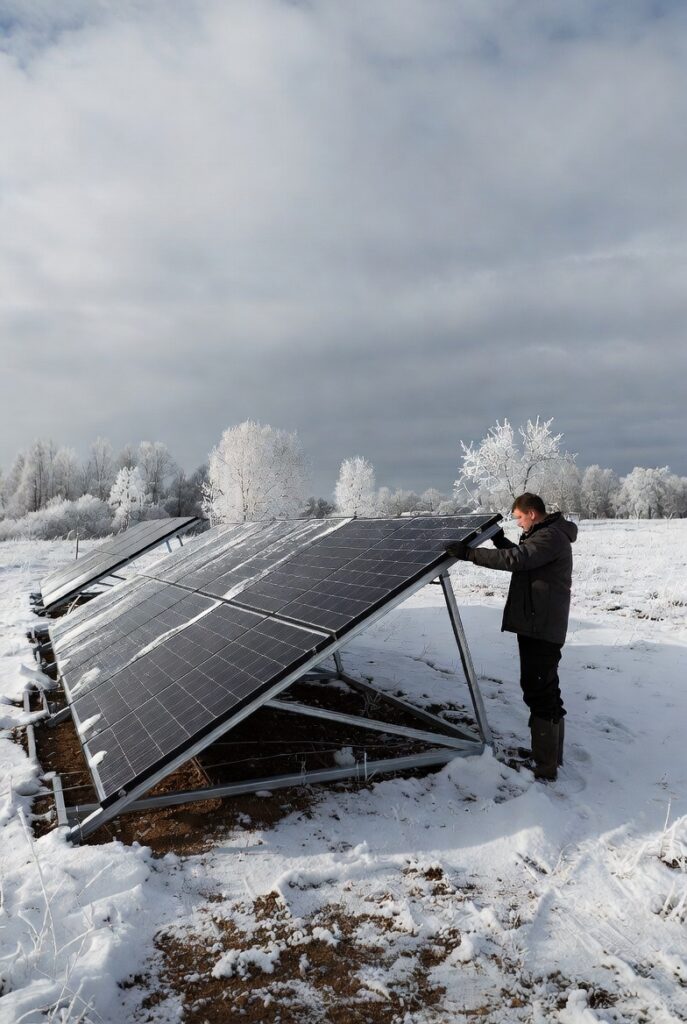
The most common solar panel mounting mistake in Ontario is following a low-slope roof installation guide and discovering that 6 inches of snow sit undisturbed on a 10-degree panel angle through every January snowfall, reducing production to zero on the days the battery bank needs it most. A property owner on Arkell Road in Guelph, Wellington County installed four 100W panels on his 10-degree cabin roof in fall 2022, following an installation guide designed for a US southern state where snow is rare.
The panels lay nearly flat against the roof surface, his system charged well through October and November. His first Ontario January confirmed the problem: after every snowfall the panels remained fully snow-covered, and without the steep angle to shed the snow, accumulation built with each successive storm.
By January 15, 2023, his panels were buried under approximately 15 centimetres of compacted ice-crusted snow. His Victron SmartShunt showed zero charging current for 11 consecutive days. He cleared the panels manually with a roof rake after each of those 11 days, a recurring safety risk on a cabin roof in Ontario winter conditions. His battery bank dropped from 92% to 31% SoC over the 11-day period despite daily manual clearing, because Ontario January diffuse light through clearing sessions produced only approximately 20 to 40% of the expected output.
I reviewed the system in February 2023 and recommended a complete solar panel mounting redesign for the following spring. He relocated to a 45-degree south-facing ground mount on a galvanized steel frame with posts sunk to 1.5 metres below grade. After the first January snowfall in 2024, the panels cleared themselves completely within approximately 90 minutes of sunrise, the steep angle and glass surface allowed the snow slab to slide off as it warmed at the panel face. His January 2024 production: approximately 120Wh per clear day per 100W panel, matching the 1.2Wh/W formula exactly. Total solar panel mounting upgrade cost: approximately $2,800. See our Ontario solar sizing guide before finalizing any solar panel mounting configuration.
The solar panel mounting tilt problem: why Ontario January demands 45 degrees minimum
| Mount type / tilt | Snow shedding | January yield (relative) | Ontario verdict |
|---|---|---|---|
| Roof mount 10 to 15° | None, accumulates | 0 to 40% of baseline | Wrong for Ontario winter ✗ |
| Roof mount 18 to 27° | Partial, wet snow only | 60 to 75% of baseline | Acceptable with manual clearing ✓ |
| Ground mount 45° | Reliable, 60 to 120 min | 100% (baseline) | Correct Ontario standard ✓ |
| Pole mount 60° | Excellent, 30 to 60 min | ~105% (best airflow) | Optimal for January ✓ |
Ontario latitude is approximately 43 to 44 degrees North. In January, the sun angle at solar noon reaches only approximately 22 to 25 degrees above the horizon. A panel at 10 degrees from horizontal receives sunlight at approximately 12 to 15 degrees angle of incidence, well off perpendicular, reducing effective irradiance to approximately 30 to 40% of what a 45-degree panel receives in the same conditions.
A panel at 45 degrees receives sunlight close to perpendicular, and a panel at 60 degrees is optimal for January at Ontario latitude. The 1.5 PSH January production estimate used throughout this session assumes a correctly oriented south-facing 45-degree solar panel mounting, a 10-degree mount delivers approximately 30 to 40% of that baseline in January even on a clear day with no snow.
The snow shedding difference between tilt angles is the dominant January production factor, it outweighs the angular irradiance calculation. A 45-degree panel with fresh snow on the glass surface starts producing immediately as the sun warms the glass, conducting heat to the snow contact layer until the snow slab slides off within 60 to 120 minutes. A 10-degree panel with the same fresh snow produces nothing until manually cleared, and if temperatures drop overnight after the snowfall, the snow base freezes to the glass surface, making manual removal difficult.
The Arkell Road Guelph result: 11 days of essentially zero production from a flat roof solar panel mounting that would have been approximately 660Wh per clear day from a 45-degree ground mount at the same location. See our solar panel angle guide for the full Ontario tilt angle calculation by month.
Snow shedding by tilt angle: what happens at 10, 30, 45, and 60 degrees
Ontario Building Code Ground Snow Load for Wellington/Halton County: approximately 1.4 to 1.9 kPa. For a 100W panel with a surface area of approximately 0.66 m²: 1.9 kPa × 0.66 m² = approximately 125 kg potential snow load on one panel. A 400W four-panel array: approximately 500 kg of potential snow load when panels are at low tilt. Solar panel mounting hardware must be rated for this structural load, galvanized steel or thick-wall aluminum racking is the correct specification for Ontario outdoor installation. Generic unrated brackets are not an acceptable specification for any permanent Ontario outdoor solar panel mounting system.
The four tilt angles and their Ontario winter behaviour. At 10 degrees: snow accumulates after every snowfall, no shedding, manual clearing required after each storm, ice crusting at the glass-snow interface after cold snaps. At 30 degrees: partial shedding on wet fresh snow, ice-crusted or heavy accumulations may stay, manual clearing often still required after heavy snowfalls. At 45 degrees: reliable automatic shedding on fresh snow within 60 to 120 minutes of sunlight, correct Ontario solar panel mounting standard. At 60 degrees: optimal shedding, heavy snowfall typically clears within 30 to 60 minutes of any sunlight, best January output and best airflow cooling in summer.
Pro Tip: After any Ontario winter solar panel mounting installation, compare the SmartShunt’s actual clear-day January production against the formula estimate (panel watts × 1.2Wh/W). If the SmartShunt consistently shows 50% or less of the formula estimate on confirmed clear days, snow accumulation on the panels is the likely cause, not system wiring or battery state. A 400W array at 45 degrees should produce approximately 480Wh on a clear January day. A 400W array at 10 degrees with snow accumulation may produce 0 to 150Wh on the same day. The SmartShunt log tells you exactly when the snow cleared from the panels, production jumps from near-zero to full output within the 60 to 120-minute shedding window.
The solar panel mounting ground option: frost heave depth, post specification, and orientation
For any year-round off-grid system where January production is critical, a south-facing 45-degree ground mount is the correct solar panel mounting specification. True south (180 degrees azimuth from geographic north) is optimal; up to 15 degrees east or west of south reduces January production by less than 5%. Post depth: 1.5 metres minimum, 1.6 metres recommended, in concrete footings. Frame: galvanized steel or structural aluminum rated for the array’s potential snow load.
Tilt: 45 degrees for year-round balance, 60 degrees for January-optimized. Cable run: underground conduit from the array to the charge controller buried below the 1.5-metre frost line to prevent conduit heave. Frost heave occurs when freeze-thaw cycles push shallower posts upward out of alignment, posts at 1.0 metre depth will move after the first full Ontario winter.
A first-time builder near Derry Road West in Milton, Halton County designed his 400W ground mount in spring 2023. He excavated four post holes to 1.6 metres below grade on a rented skid steer with a post-hole auger. He set 4-inch galvanized steel posts in concrete footings and mounted Renogy 100W monocrystalline panels at 47 degrees from horizontal on a galvanized steel racking system oriented at 185 degrees azimuth.
His SmartShunt commissioning log confirmed 480Wh of production on the first clear full day, matching the 400W × 1.5h × 0.80 = 480Wh peak production estimate. His solar panel mounting system survived two Ontario winters without frost heave displacement, posts remained within 2mm of original alignment in April 2024 and April 2025. After the first January 2024 storm (20cm of snow), the panels cleared completely within approximately 2 hours of sunrise. See our solar panel installation guide for the cable run and electrical connection following a correctly mounted array.
Roof and pole mount options for Ontario properties
Roof solar panel mounting is correct for properties where ground space is unavailable or where aesthetics require the panels out of sight. Ontario cabin roofs at 4:12 pitch (18 degrees) or 6:12 pitch (27 degrees) produce 20 to 35% less January energy than a 45-degree ground mount and require manual snow clearing after heavy snowfalls, a telescoping roof rake from the ground manages this without climbing. For curved or irregular surfaces such as metal roofing, Renogy flexible 100W panels are the correct specification, they conform to the surface without requiring rigid standoff mounts. Any roof penetration for cable runs requires a purpose-built sealed fitting rated for Ontario temperature ranges; a poorly sealed penetration admits water after the first freeze-thaw cycle.
Pole mounts, a single post with multiple panels on a fixed or adjustable-tilt head, are the correct solar panel mounting option for remote properties where ground frame excavation is impractical. A 200W to 400W pole mount typically uses a 4-inch to 6-inch schedule 40 steel pipe set in concrete at 1.5 metres below grade. The single post is easier to excavate and set than a four-post ground frame.
Fixed-tilt pole heads are typically set to 60 degrees for Ontario winter optimization. The elevated position improves airflow behind the panels, reducing panel operating temperature in summer and improving efficiency by approximately 2 to 5% compared to a surface-flush roof mount. See our solar panel size guide for the cold Voc calculation that applies to any solar panel mounting configuration.
NEC and CEC: Ontario requirements for permanent solar panel array installations
NEC 690 governs solar PV installations including the panel array solar panel mounting structure. The DC wiring from the panel array to the charge controller must comply with NEC 690 wiring requirements: wire gauge sized for the array’s short-circuit current plus 25% safety factor, outdoor-rated UV-resistant cable, and MC4 connectors rated for the array’s voltage and current. Any solar panel mounting structure permanently attached to a building (roof mount) is subject to the building’s structural loading requirements, which must account for the Ontario snow load of 1.4 to 1.9 kPa in addition to the panel array dead load. Contact the NFPA at nfpa.org for current NEC 690 requirements for solar panel mounting array installations in residential off-grid applications.
CEC Section 64 governs solar PV installations in Ontario. A permanently installed solar panel array, roof mount, ground mount, or pole mount, requires an ESA permit before permanent wiring begins. The permit application must identify the solar panel mounting structure type, array wattage, panel count, configuration (series/parallel), cold Voc calculation, and cable routing from the array to the charge controller. A solar panel mounting structure permanently attached to a building may also require a building permit from the local CBO, particularly for roof-mounted systems where the snow load on the roof structure must be verified. Contact the Electrical Safety Authority Ontario at esasafe.com before beginning any permanent solar panel mounting installation in Ontario.
The solar panel mounting verdict: roof, ground, and pole for Ontario off-grid systems
- Ontario off-grid cabin or property owner whose current solar panel mounting is a low-slope roof at less than 30-degree tilt: evaluate the January production loss before the next winter. Calculate the expected daily production (panel watts × 1.2Wh/W for a correctly tilted 45-degree mount) and compare it to the SmartShunt’s actual January daily production log. If the SmartShunt shows less than 50% of the formula estimate on clear days, shallow tilt and snow accumulation are the cause. A 45-degree south-facing ground mount on galvanized steel at 1.5m post depth restores full formula production and eliminates the manual clearing requirement. The Victron SmartShunt provides the before and after production comparison that confirms the upgrade impact.
- Ontario off-grid property owner designing a new ground solar panel mounting: specify the four correct parameters before purchasing any hardware. Tilt: 45 degrees for year-round balance or 60 degrees for January-optimized. Orientation: 180 degrees azimuth (true south), plus or minus 15 degrees acceptable. Post depth: 1.5 metres minimum below grade in concrete. Material: galvanized steel racking rated for Ontario snow load of 1.4 to 1.9 kPa. The Derry Road West Milton result confirms the specification: 1.6m posts, 47-degree tilt, 185-degree azimuth, zero frost heave after two Ontario winters, automatic snow clearing within 2 hours.
- Ontario off-grid property owner who needs a solar panel mounting solution for a curved or irregular roof, van, RV, or surface where rigid racking is impractical: specify flexible panels. Renogy flexible 100W panels conform to curved metal roofing, vehicle roofs, and non-planar surfaces without standoff mounts. Apply the same 45-degree south-facing tilt guideline where the surface geometry permits, and accept the reduced January production where it does not. The 1.2Wh/W formula still applies, measure actual production against it with the SmartShunt after the first clear January day to confirm the flexible panel installation is delivering the expected output.
Frequently Asked Questions
Q: What angle should I mount solar panels in Ontario?
A: 45 degrees from horizontal facing true south is the correct solar panel mounting angle for Ontario off-grid systems. At 43 to 44 degrees North latitude, a 45-degree tilt maximizes year-round production, provides reliable automatic snow shedding within 60 to 120 minutes of sunlight on the glass, and matches the 1.2Wh/W January production formula used throughout this site. A 60-degree tilt is optimal for January production and snow shedding but reduces summer production by approximately 10 to 15%.
A 10 to 15-degree roof pitch is the most common Ontario solar panel mounting mistake, the Arkell Road Guelph result confirms: 11 days of zero production in January 2023 from flat panels that would have produced 660Wh per clear day from a 45-degree ground mount.
Q: How deep should ground mount posts be in Ontario?
A: A minimum of 1.5 metres below grade, set in concrete footings. The Wellington/Halton County frost line reaches 1.2 to 1.5 metres below grade in a typical Ontario winter, a post set at 1.0 metres is above the frost expansion zone and will be pushed upward by the freeze-thaw cycle, changing the panel tilt angle. The correct solar panel mounting ground post specification is 1.5 metres minimum, 1.6 metres recommended, in concrete. The Derry Road West Milton result: posts at 1.6 metres depth, zero measurable frost heave after two Ontario winters, posts within 2mm of original alignment in April 2024 and April 2025.
Q: Can I mount solar panels flat on a roof in Ontario?
A: Not recommended for any Ontario off-grid system that depends on January production. A 10-degree panel receives approximately 30 to 40% of the irradiance that a 45-degree panel receives in January at Ontario latitude, and snow accumulation typically reduces this further to near zero after any snowfall until manually cleared. The correct solar panel mounting minimum for Ontario is 45 degrees from horizontal, achievable with a roof mount only if the roof pitch is 12:12 (45 degrees) or steeper, which is uncommon on Ontario cabins. For most Ontario roof pitches (4:12 to 6:12), a ground mount at 45 to 60 degrees delivers full January production without the snow clearing requirement.
This build is engineered within the 48V DC Safety Ceiling. Diagnostic logic is based on 20+ years of technical service experience. All structural and electrical installations must be verified by a Licensed Professional and comply with your Local AHJ.
About the Author
Robert Bertrand spent 20 years as a service advisor in the automotive industry (Lexus and Nissan), where precision diagnostics, wiring integrity, and documentation standards were non-negotiable. He brings that same technical discipline to GridFree Guide, where he researches, tests, and documents off-grid solar systems for Ontario conditions. Based in Rockwood, Ontario, every article is built on verified specifications, manufacturer data, and the real-world climate constraints of Canadian off-grid living.
As an Amazon Associate I earn from qualifying purchases. This site also contains affiliate links to other products and services. GridFree Guide earns a small commission at no extra cost to you.