
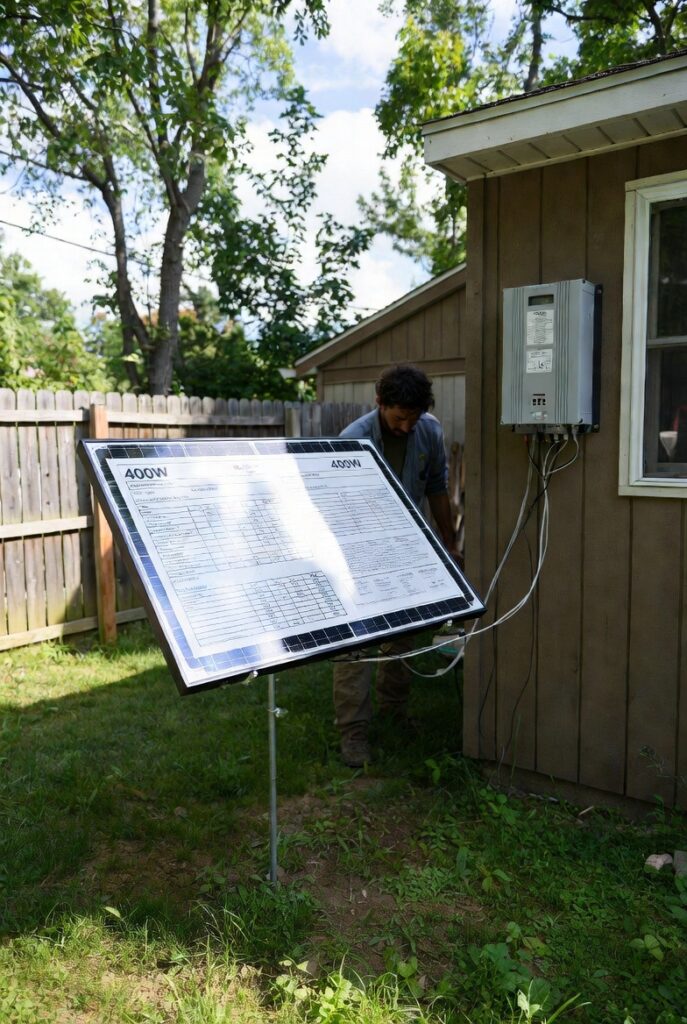
The most damaging solar panel size mistake in Ontario is wiring four 100W panels in series and connecting them to a budget MPPT charge controller with a 50V maximum input voltage, on a Guelph January morning at -20°C, four panels in series produce approximately 102V open-circuit, more than double the controller’s rated maximum, destroying the controller’s input stage instantly. A homeowner on Victoria Road in Guelph, Wellington County purchased four 100W panels to build his first off-grid system in fall 2022.
He chose a budget MPPT charge controller with a 50V maximum input voltage specification and wired all four panels in series, reasoning that series wiring would push more voltage into the controller for better efficiency. The system charged normally through November at room-temperature panel voltages of approximately 90V open-circuit.
In January 2023, on a clear cold morning at approximately -18°C, the controller failed to start. The LED indicators showed no activity despite the panels being in full sun. The cause was the cold voltage spike: at -18°C, each 100W panel’s open-circuit voltage increased from approximately 22.5V at STC to approximately 25.3V. Four panels in series: 4 × 25.3V = 101.2V, more than double the controller’s 50V maximum input.
I reviewed the system in January 2023. The controller’s input stage was destroyed by the over-voltage event. The correct solar panel size configuration for four 100W panels with a 50V maximum MPPT controller is 2 panels in series × 2 strings in parallel (2S × 2P): maximum series voltage is 2 × 25.3V = 50.6V, just within the controller’s limit even in Ontario cold. Alternatively, replacing the controller with a Victron MPPT 100/50 (100V maximum input) handles four 100W panels in series safely at any Ontario temperature. See our Ontario solar sizing guide before selecting any solar panel size and controller combination.
The solar panel size cold voltage problem: why Ontario winter destroys under-specified controllers
| Series configuration | Voc at STC (25°C) | Voc at -20°C (+13.5%) | 50V controller | 100V controller |
|---|---|---|---|---|
| 1 × 100W panel | 22.5V | 25.5V | Safe ✓ | Safe ✓ |
| 2 × 100W in series | 45V | 51V | Borderline ⚠ | Safe ✓ |
| 3 × 100W in series | 67.5V | 76.5V | Destroys ✗ | Safe ✓ |
| 4 × 100W in series | 90V | 102V | Destroys ✗ | Destroys ✗ |
| 2 × 400W in series | ~85V | ~96V | Destroys ✗ | Safe ✓ |
Monocrystalline silicon panels increase open-circuit voltage by approximately 0.30% per degree Celsius below STC (25°C). At -20°C, the 45-degree temperature drop produces a 13.5% Voc increase above the nameplate STC value. A 100W panel with 22.5V STC Voc reaches approximately 25.5V at -20°C. Four panels in series produce 102V, more than double a 50V controller’s maximum input and enough to destroy the controller’s input stage in a single startup event. The Victoria Road Guelph result: one -18°C morning, 101.2V into a 50V controller, controller failed and required full replacement.
The correct solar panel size configuration for any Ontario installation requires calculating the cold Voc before choosing the controller. For a 50V max MPPT controller: maximum 2 panels in series (2 × 25.5V = 51V at -20°C, borderline, 1 panel per string is safer). For a 100V max controller (Victron MPPT 100/50): maximum 3 panels in series safely (3 × 25.5V = 76.5V at -20°C, within spec). For a 150V max controller (Victron MPPT 150 series): up to 5 panels in series (5 × 25.5V = 127.5V, within spec). Always calculate the cold Voc from the specific panel’s temperature coefficient before specifying the controller. See our solar power system integration guide for the full controller selection sequence.
The solar panel size count formula: how many panels does your daily load actually require
The Ontario solar panel size count formula. Step 1: daily load in Wh. Step 2: divide by 1.2 (Ontario January 1.5 PSH × 0.80 derate = 1.2Wh per rated watt per clear day). Step 3: multiply by 1.25 (25% safety margin). Step 4: divide by the panel wattage and round up. For a 500Wh/day load: 500 ÷ 1.2 × 1.25 = 521W minimum, 6 × 100W (600W) or 2 × 400W (800W).
For a 1,000Wh/day load: 1,000 ÷ 1.2 × 1.25 = 1,042W minimum, 11 × 100W (1,100W) or 3 × 400W (1,200W). For a 1,200Wh/day load: 1,200 ÷ 1.2 × 1.25 = 1,250W minimum, 13 × 100W or 4 × 400W. The Victron SmartShunt confirms actual daily production against the formula estimate after commissioning, a correctly sized array at 1.2Wh/W per clear January day confirms the design in the first clear winter week.
The formula determines the total watts; the solar panel size choice determines how those watts are physically arranged and wired. A property owner who purchases eight 100W panels reasoning that “more is better” may end up with a series configuration that destroys the controller (as the Victoria Road Guelph result confirms), or a parallel configuration requiring MC4 branch connectors and complex wiring for no production advantage over a simpler 2 × 400W array. Spec the array watts from the formula first, then choose the panel size and configuration. See our solar panel watt guide for the complete 4-step Ontario January production formula. See also our solar panel angle guide for Ontario tilt optimisation.
Pro Tip: Before purchasing any MPPT charge controller, run the cold Voc check for your planned solar panel size and configuration. Take the number of panels in series, multiply by the panel STC Voc, then multiply by 1.135 (the cold voltage multiplier at -20°C for typical monocrystalline panels). The result is the worst-case open-circuit voltage your controller will see on any clear cold Ontario morning. Keep this number below 90% of the controller’s rated maximum input voltage for a safe operating margin. The Victoria Road Guelph result: 4 × 22.5V × 1.135 = 102V against a 50V controller limit, a 104% overload on the first cold morning. The correct controller for that solar panel size configuration was 100V or 150V maximum input, not 50V.
The MPPT controller voltage limit: the hard electrical constraint on series configuration
The MPPT charge controller is the hard electrical limit on solar panel size configuration. The controller’s maximum input voltage specification determines how many panels can be wired in series. Exceeding this limit on cold Ontario mornings destroys the controller’s input stage, a $100 to $500 repair or replacement on top of the panel array cost. The safe rule: calculate the cold Voc at -25°C (the conservative Ontario minimum) and verify the series string Voc stays below 90% of the controller’s rated maximum. The Victron MPPT 100/50 at 100V maximum input is the correct controller for Ontario installations using up to three 100W panels in series safely (3 × 25.5V = 76.5V at -20°C, well within spec).
For four or more 100W panels, use the Victron MPPT 150/35 or 150/45 at 150V maximum input, or switch to 400W panels in series which produce lower series Voc per dollar of panel cost. Two 400W panels in series typically produce approximately 85 to 90V nominal at STC, rising to approximately 96 to 102V at -20°C, within the 100V limit of a Victron MPPT 100/50. Confirm the specific panel’s temperature coefficient and Voc from the datasheet before finalising any solar panel size and controller combination. The datasheet’s temperature coefficient of Voc (listed in %/°C or mV/°C) is the verified number to use, not the 0.30% generic estimate from this guide.
The 100W vs 400W comparison: mounting points, MC4 connectors, and installation time
For fixed Ontario installations, the solar panel size argument favours 400W panels on three dimensions. First: mounting simplicity, two 400W panels require one racking section, 8 mounting bolts, and 4 MC4 connectors; eight Renogy 100W monocrystalline panels require two racking sections, 16 mounting bolts, and 18 MC4 connectors. Each additional MC4 connector is a potential arc fault failure point, the Woodlawn Road Guelph MC4 rework from the solar panel installation guide ($460 for 20 connectors) applies to every connector in any array.
Second: area efficiency, a single 400W panel covers approximately 2.0m² of glass while four 100W panels cover approximately 2.6m². Third: wiring simplicity, a 2 × 400W series string requires one DC cable pair; eight 100W panels require MC4 branch connectors for parallel wiring.
A first-time builder near James Street in Milton, Halton County designed his ground-mount system in spring 2023. He priced eight 100W panels at $80 each ($640 total) versus two 400W panels at $250 each ($500 total). His contractor quoted 4 to 5 hours for eight 100W panels versus 1.5 hours for two 400W panels. Eight 100W panels: two racking sections, 16 mounting bolts, 18 MC4 connectors.
Two 400W panels: one racking section, 8 mounting bolts, 4 MC4 connectors. He chose the 400W solar panel size. His system commissioned June 2023: 2.5 hours total installation versus the estimated 5 to 6 hours for the 100W equivalent. For portable, curved-surface, or solo-installer applications where 22kg 400W panels are impractical, the Renogy flexible 100W panels are the correct solar panel size choice.
NEC and CEC: Ontario requirements for solar panel array installations
NEC 690 governs solar PV installations. The solar panel size and wiring configuration determine the array’s DC output voltage and current, which determine the NEC 690 requirements for DC wiring gauge, overcurrent protection, and disconnecting means. NEC 690 requires all DC wiring to be sized for the array’s short-circuit current (Isc) plus a 25% safety factor. The cold Voc calculation is a NEC 690 design requirement, the system must be designed for the maximum expected open-circuit voltage at the minimum expected installation temperature. Contact the NFPA at nfpa.org for current NEC 690 requirements for solar panel size and configuration in residential off-grid installations.
CEC Section 64 governs solar PV installations in Ontario. A permanently installed solar panel array requires an ESA permit. The permit application must identify the panel array wattage, configuration (series/parallel), the cold Voc calculation at Ontario minimum temperatures, and the charge controller maximum input voltage specification. An ESA inspector may verify that the series string voltage does not exceed the charge controller’s rated maximum input. A solar panel size configuration that produces a cold Voc exceeding the controller’s maximum input specification is a code violation under both NEC 690 and CEC Section 64. Contact the Electrical Safety Authority Ontario at esasafe.com before permanently installing any solar panel array in Ontario.
The solar panel size verdict: 100W panels vs 400W panels for Ontario installations
- Ontario off-grid property owner who has wired 100W panels in series and experienced charge controller failure on a cold January morning: calculate the cold Voc before purchasing a replacement controller. Multiply the number of panels in series by the panel STC Voc, then multiply by 1.135 (the -20°C cold voltage multiplier). If the result exceeds the failed controller’s maximum input voltage, the same failure will repeat with an identical replacement. The fix is a higher-voltage controller (Victron MPPT 100/50 at 100V max, or MPPT 150 series at 150V max) or a rewired 2S × 2P configuration. Verify the cold Voc result stays below 90% of the new controller’s rated maximum input before connecting the panels.
- Ontario off-grid property owner calculating the solar panel size and panel count for a new array: use the verified count formula and choose 400W panels where physical installation permits. Formula: daily load ÷ 1.2 × 1.25 = minimum array watts, then divide by panel wattage and round up. The James Street Milton result: two 400W panels at $500 total plus 2.5 hours installation versus eight 100W panels at $640 total plus 5 to 6 hours installation. The 400W solar panel size is cheaper, faster to install, and has fewer MC4 failure points. Use the Victron SmartShunt to confirm actual January production against the formula estimate within the first clear winter week.
- Ontario off-grid property owner who needs portable, flexible, or curved-surface solar panel size options: 100W panels are the correct choice for these applications. The Renogy flexible 100W panels mount on curved surfaces, are manageable at 7kg for a single installer, and apply the same 1.2Wh/W/day Ontario January production formula as any other panel. Verify the cold Voc for the specific flexible panel’s temperature coefficient and limit the series string count accordingly for the MPPT controller’s maximum input voltage specification.
Frequently Asked Questions
Q: What size solar panels do I need for an off-grid system in Ontario?
A: Use the count formula: daily load ÷ 1.2 (Ontario January 1.5 PSH × 0.80 derate) × 1.25 (safety margin) = minimum array watts. Then divide by the panel wattage and round up. For a 500Wh/day load: 521W minimum, requiring 6 × 100W panels or 2 × 400W panels. For a 1,000Wh/day load: 1,042W minimum, requiring 11 × 100W panels or 3 × 400W panels. For fixed installations, 400W solar panel size is preferred, fewer mounting points, fewer MC4 connectors, and faster installation. For portable or curved-surface applications, 100W flexible panels are correct. After commissioning, use the Victron SmartShunt to confirm actual January production matches the formula estimate.
Q: Why did my charge controller fail on a cold Ontario morning?
A: The cold Voc spike caused the failure. At -20°C, each 100W panel’s open-circuit voltage increases from approximately 22.5V at STC to approximately 25.5V, a 13.5% increase due to the monocrystalline silicon temperature coefficient of approximately -0.30%/°C. Four panels in series produce 102V at -20°C. A 50V maximum input MPPT controller sees 102V on the first clear cold morning and its input stage is destroyed instantly. The fix is either a higher-voltage controller (Victron MPPT 100/50 at 100V max, or 150V max for larger arrays) or a rewired 2S × 2P configuration that keeps the series Voc below the controller’s rated maximum at Ontario minimum temperatures.
Q: Should I use 100W or 400W solar panels for my Ontario off-grid system?
A: For permanent fixed installations (ground mount or roof mount), 400W solar panel size is the practical choice. Two 400W panels require 4 MC4 connectors and one racking section versus 18 MC4 connectors and two racking sections for eight 100W panels. The James Street Milton result: 2.5 hours installation for two 400W panels versus 5 to 6 hours for eight 100W panels. For portable, van, boat, or curved-surface applications where handling a 22kg 400W panel is impractical, 100W flexible panels are the correct solar panel size. Both apply the same 1.2Wh/W/day Ontario January production formula, the difference is in installation complexity and controller voltage planning, not production per dollar.
This build is engineered within the 48V DC Safety Ceiling. Diagnostic logic is based on 20+ years of technical service experience. All structural and electrical installations must be verified by a Licensed Professional and comply with your Local AHJ.
About the Author
Robert Bertrand spent 20 years as a service advisor in the automotive industry (Lexus and Nissan), where precision diagnostics, wiring integrity, and documentation standards were non-negotiable. He brings that same technical discipline to GridFree Guide, where he researches, tests, and documents off-grid solar systems for Ontario conditions. Based in Rockwood, Ontario, every article is built on verified specifications, manufacturer data, and the real-world climate constraints of Canadian off-grid living.
As an Amazon Associate I earn from qualifying purchases. This site also contains affiliate links to other products and services. GridFree Guide earns a small commission at no extra cost to you.