
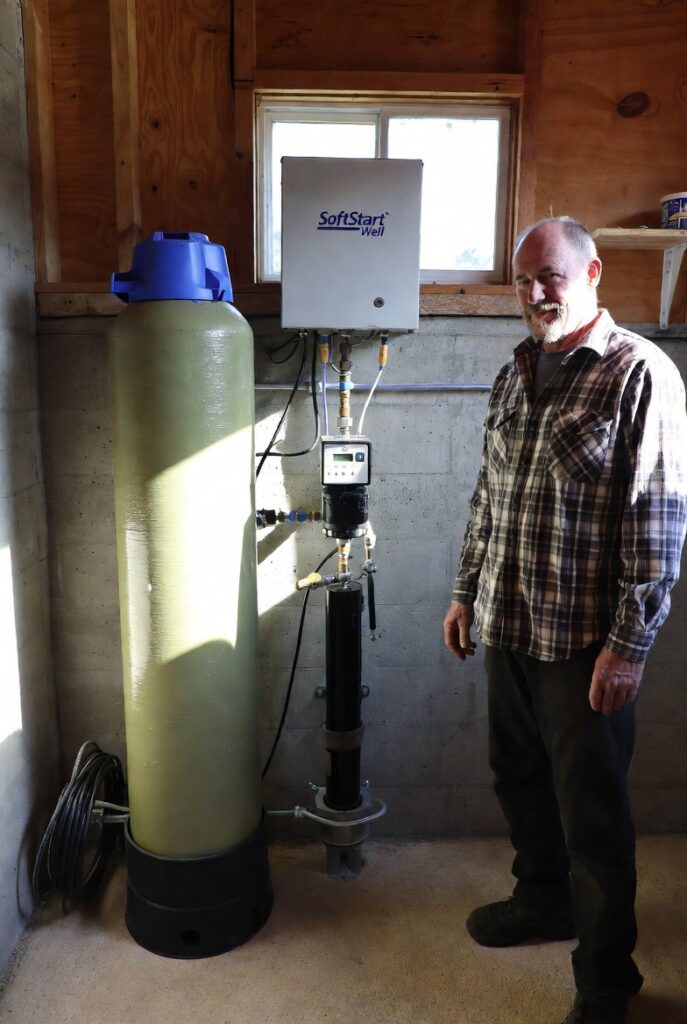
The most common off grid water mistake in Ontario is sizing the inverter for the well pump’s running wattage and ignoring the startup surge, a 1/2 HP submersible pump runs at approximately 600W but surges to approximately 2,800W for the first 300 milliseconds of every startup cycle, tripping any inverter sized below 3,000W rated output. A homeowner on Stone Road North in Guelph, Wellington County commissioned a year-round off-grid residence in fall 2022 with a 1/2 HP submersible well pump at 180 metres depth. His inverter was a 1,500W/3,000W surge PSW unit. The pump’s nameplate running draw was 600W, well within the 1,500W continuous output.
On the first morning after commissioning, every time the pressure tank dropped below the pump’s cut-in pressure and the pump started, the inverter’s overload LED flashed and the inverter temporarily shut down. He could not run water for more than 30 seconds before the pump triggered another restart and the inverter tripped again. His SmartShunt showed the current spiking to approximately 23A at 12V (approximately 2,800W) each time the pump started, far exceeding the inverter’s 3,000W surge capacity for more than its rated millisecond window.
I reviewed the system in November 2022. The fix was a SoftStart Well installed inline on the pump’s power supply. The SoftStart Well ramps the pump motor from zero to full speed over approximately 2 to 3 seconds instead of the instantaneous full-voltage start, reducing the startup surge from approximately 2,800W to approximately 900W. His Victron SmartShunt confirmed the peak current on pump startup dropped from 23A to approximately 7.5A at 12V after the SoftStart Well installation. The pump has started reliably on the same 1,500W/3,000W inverter every day since November 2022 through two Ontario winters without a single trip. See our Ontario solar sizing guide before designing any off grid water system.
The off grid water surge problem: why the well pump trips every inverter sized for running watts
| Off grid water method | Daily electrical load | Startup surge | Ontario verdict |
|---|---|---|---|
| Drilled well + AC submersible pump | 400 to 600Wh/day | 2,000 to 3,000W (AC induction) | Year-round homes; needs SoftStart ✓ |
| Cistern + 12V DC pressure pump | 60 to 120Wh/day | Minimal (DC motor) ✓ | Cabins; low solar; no drilling ✓ |
| Hauled water + transfer pump | 20 to 40Wh/day | Minimal | Remote/seasonal low-demand ✓ |
An AC induction motor draws 3 to 5 times its running wattage during the first 200 to 400 milliseconds of operation. The motor must overcome the inertia of the rotating shaft, impeller, and water column above the pump before reaching operating speed. Most 1,500W PSW inverters are rated for 3,000W surge for only 5 to 20 milliseconds, the well pump’s 200 to 400ms startup exceeds this specification. The Stone Road North Guelph result: 2,800W for approximately 300ms on every pressure-tank-triggered startup cycle, inverter tripping before the pump ever reaches running speed.
The inverter sizing trap for off grid water is predictable and preventable. A property owner who calculates 600W running draw × 1.25 safety margin = 750W and purchases a 1,500W inverter believing they have 2x headroom has not accounted for the 300ms surge window. The correct inverter for a 1/2 HP well pump without a soft starter is 3,000W continuous with a 6,000W surge rating, a significantly larger and more expensive unit. Alternatively, a 1,500W inverter paired with a SoftStart Well handles the same pump at approximately one-third the inverter cost. The SoftStart Well at approximately $300 is almost always the more economic solution than upgrading to a larger inverter.
The SoftStart Well: reducing pump surge by 60 to 70% on a 1,500W inverter
The SoftStart Well installs inline on the pump’s AC power supply between the inverter output and the pump pressure switch. It monitors the motor current during startup and gradually increases motor voltage from approximately 30% to 100% over 2 to 3 seconds. This controlled ramp eliminates the instantaneous full-voltage surge that causes inverter trips. A 1/2 HP pump that surged to 2,800W at instantaneous full voltage starts at approximately 900W peak with the SoftStart Well in circuit, a 68% surge reduction. The Stone Road North Guelph SmartShunt confirmed this in real measurements: 23A at 12V startup current dropped to 7.5A at 12V after SoftStart Well installation. For AC compressor applications with similar surge characteristics, the EasyStart performs the same function.
The SoftStart Well is a single-phase AC device compatible with standard 120V and 240V single-phase submersible well pumps, the most common residential pump type in Ontario. Confirm the pump’s phase specification before purchasing. Verify the SoftStart Well’s amperage rating matches or exceeds the pump’s nameplate full-load amperage. Installation is straightforward: inline on the hot wire of the AC supply to the pump pressure switch, taking approximately 30 to 60 minutes. The ESA permit for the pump circuit covers the SoftStart Well installation if the pump wiring is already permitted, confirm with the local ESA inspector whether a separate permit update is required for the added device.
Pro Tip: Before purchasing any inverter for an off grid water system with a submersible well pump, run the surge check first. Take the pump’s nameplate horsepower and multiply by 746W/HP to get the running wattage. Then multiply by 5 for the conservative startup surge estimate. For a 1/2 HP pump: 0.5 × 746 = 373W nameplate, × 5 = 1,865W conservative surge estimate. For the actual measured surge: 2,800W from the Stone Road North SmartShunt. Either way, the startup number far exceeds the running number. A 1,500W inverter can handle a 1/2 HP pump only with a SoftStart Well installed. Without it, the surge duration of 200 to 400ms exceeds the inverter’s surge rating window of 5 to 20ms, and the inverter trips on every pump startup cycle.
Ontario frost requirements: burial depth, heated utility room, and pressure tank location
Ontario frost line depth in Wellington/Halton County: 1.2 to 1.5 metres. Any water supply line from the well head to the building must be buried below this depth to prevent freeze-up during a Wellington County February. A supply line buried at 0.8 metres will freeze when prolonged cold pushes the frost line below that depth, typically during extended January cold snaps with little snow cover insulation.
The well casing (grouted steel or PVC) protects the pump cable and water column inside the well bore. The pressure tank, pressure switch, and all exposed supply lines inside the building must be in a heated space. In an off-grid cabin, the utility room temperature must stay above 0°C whenever the property is occupied in winter.
The cistern alternative eliminates the well line frost concern but introduces a different one: the cistern itself must be protected from freezing. A surface cistern above ground in an Ontario January will freeze solid and rupture. Correct options: below-grade installation below the frost line in an insulated enclosure at 1.5m or more depth, or an insulated above-grade tank inside the heated utility room if capacity permits. The Rockwood Road Guelph result: a 2,500L polyethylene tank in a below-grade frost-protected R-20 insulated enclosure maintained above 0°C through two Ontario winters without freeze-up. See our off grid cabin guide for the full four-season utility room specification.
The off grid water cistern alternative: 12V DC pump, 80Wh per day, no well drilling required
The off grid water cistern alternative eliminates the well pump surge problem, the well drilling cost, and the water line frost burial requirement simultaneously. A 12V DC pressure pump draws approximately 60 to 120W running and starts smoothly without AC induction surge, it connects directly to the 12V battery bank without requiring the inverter, eliminating both the inverter surge trip risk and the AC conversion loss. Daily off grid water electrical load with a 12V DC pump at 80W for approximately 1 hour: approximately 80Wh. Daily load with an AC well pump at 600W for approximately 45 minutes: approximately 450Wh. Difference: approximately 370Wh per day saved by the lower pump power draw and the eliminated inverter conversion stage.
An off-grid cabin owner on Rockwood Road in Guelph, Wellington County chose a 2,500-litre cistern for his off grid water supply in fall 2023 instead of drilling a well. The property’s bedrock geology required an estimated 60-metre drill depth at approximately $8,000 to $12,000 for the well, pump, pressure tank, and electrical installation. His cistern: a 2,500L polyethylene tank in a frost-protected below-grade R-20 enclosure, filled by water delivery truck approximately twice per month at approximately $80 to $120 per delivery, with a 12V DC pump at 80W drawing directly from the battery bank.
Total cistern system cost: approximately $2,800. Daily off grid water electrical load: approximately 80Wh. His SmartShunt confirmed 0.5 to 1.0A at 12V during pressurization cycles throughout the day. See our off grid appliances guide for how the cistern DC pump integrates into the five-category electrical load calculation.
NEC and CEC: Ontario electrical requirements for off-grid water pump systems
NEC 690 governs solar PV installations. For off grid water pump systems connected to a solar-powered inverter, the pump circuit at the inverter AC output must comply with NEC 240 branch circuit requirements for the motor load and circuit protection. A well pump’s continuous and surge current specifications determine the required wire gauge and breaker sizing for the pump branch circuit. The SoftStart Well does not change the branch circuit protection requirements, it reduces the startup surge the inverter sees, but the branch circuit must still be rated for the pump’s full-load current. Contact the NFPA at nfpa.org for current NEC requirements for branch circuits serving inductive AC motor loads in off-grid residential applications.
CEC Section 64 governs solar PV installations in Ontario. A permanently installed off grid water pump system powered by a solar inverter requires an ESA permit. The permit application must identify the inverter output circuit, the pump branch circuit wire gauge and overcurrent protection, and any soft starter devices in the circuit. A 12V DC pump connected directly to the battery bank is a DC load circuit that must comply with NEC 690 DC wiring requirements for overcurrent protection at the battery positive terminal and appropriate wire gauge for the pump’s maximum current draw. Contact the Electrical Safety Authority Ontario at esasafe.com before permanently installing any off grid water pump system in Ontario.
The off grid water verdict: which system matches your Ontario property and load
- Ontario year-round off-grid residence owner with a drilled well whose inverter trips on every pump startup: install the SoftStart Well before replacing the inverter. The Stone Road North Guelph result confirms the fix: 2,800W startup surge reduced to 900W on the same 1,500W/3,000W surge inverter, zero trips across two Ontario winters. The SoftStart Well at approximately $300 is far more economical than upgrading to a 3,000W continuous inverter at $800 to $1,200. Confirm the pump’s single-phase AC specification, install the SoftStart Well inline on the hot wire supply, and verify the SmartShunt startup current reading drops below 10A at 12V on the next pump cycle.
- Ontario off-grid cabin or cottage owner planning a new off grid water system who has not yet drilled a well: evaluate the cistern alternative before committing to drilling. The Rockwood Road Guelph result: $2,800 cistern system with 12V DC pump versus $8,000 to $12,000 for a drilled well system. The cistern daily off grid water electrical load is approximately 80Wh (12V DC pump) versus approximately 450Wh (AC well pump), a 370Wh/day reduction equivalent to the daily production of approximately 3 additional 100W panels in Ontario January. Use the Victron SmartShunt after commissioning to confirm the DC pump’s actual daily Wh contribution versus the estimate.
- Ontario off-grid property owner planning a drilled well system from the start: specify the SoftStart Well and inverter combination correctly before purchasing either component. A 1/2 HP submersible pump with SoftStart Well requires a 1,500W continuous PSW inverter with a 3,000W surge rating. Without SoftStart Well: requires a 3,000W continuous PSW inverter with a 6,000W surge rating. The SoftStart Well saves approximately $500 to $900 in inverter cost at current Ontario retail pricing and reduces the daily startup surge load on the battery bank on every pressure cycle. See our solar power system integration guide for how the well pump circuit integrates into the complete off-grid system design.
Frequently Asked Questions
Q: Can I run a well pump off solar power in Ontario?
A: Yes, but the inverter must be correctly sized for the pump’s startup surge, not just the running wattage. A 1/2 HP submersible pump surges to approximately 2,800W for 300 milliseconds on every startup cycle. A 1,500W inverter handles this surge only with a SoftStart Well installed inline. Without the SoftStart Well, the pump’s 300ms surge exceeds the inverter’s rated surge window of 5 to 20ms and the inverter trips on every startup. The Stone Road North Guelph result: same 1,500W inverter, same pump, SoftStart Well added, zero trips across two Ontario winters from a single $300 installation.
Q: What causes my solar inverter to trip when the well pump starts?
A: The AC induction motor in a submersible well pump draws 3 to 5 times its running wattage during the first 200 to 400 milliseconds of operation. Most 1,500W PSW inverters are rated for a 3,000W surge for only 5 to 20 milliseconds. The pump’s 200 to 400ms startup exceeds this window, causing the inverter to detect a sustained over-current condition and trip. The fix is a SoftStart Well, which ramps the motor voltage gradually over 2 to 3 seconds, reducing the startup surge from approximately 2,800W to approximately 900W and keeping the peak current within the inverter’s rated surge capacity for the duration of the startup window.
Q: What is the cheapest off-grid water system for a cottage in Ontario?
A: A cistern with a 12V DC pressure pump is the most cost-effective off grid water solution for Ontario cottages where well drilling is expensive or impractical. A 2,500L cistern system with DC pump costs approximately $2,800 versus $8,000 to $12,000 for a drilled well system. The cistern daily electrical load is approximately 80Wh from the 12V DC pump drawing directly from the battery bank with no inverter required.
Water delivery costs approximately $80 to $120 per truck fill approximately twice per month. The cistern approach also eliminates the well pump startup surge problem, the water line frost burial requirement, and the inverter sizing complication, making it the simplest and lowest-electrical-load off grid water solution available for Ontario seasonal and year-round cabin applications.
This build is engineered within the 48V DC Safety Ceiling. Diagnostic logic is based on 20+ years of technical service experience. All structural and electrical installations must be verified by a Licensed Professional and comply with your Local AHJ.
This article contains affiliate links. If you purchase through these links, I earn a small commission at no extra cost to you.