
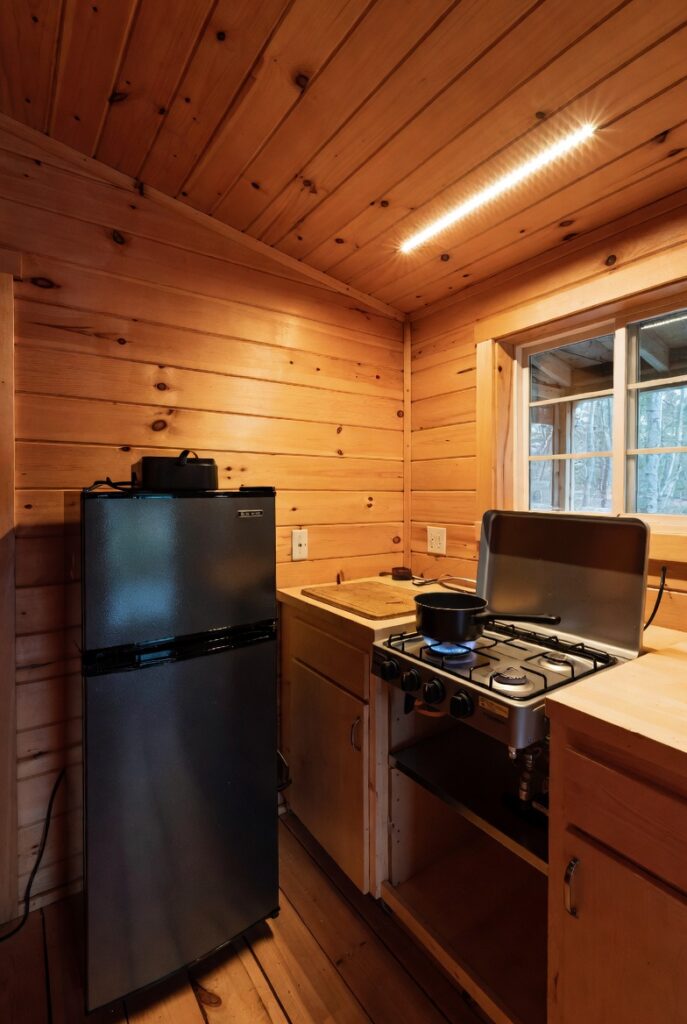
The most expensive off grid appliances mistake Ontario beginners make is building a load list from city habits, bringing an AC bar fridge, a microwave, a toaster, and an electric kettle off-grid and then wondering why the solar system costs $15,000 to power them. A homeowner on Woodlawn Road East in Guelph, Wellington County contacted me in spring 2023 for help sizing a solar system for his detached cabin.
His load list was built from current home habits: a standard AC bar fridge at approximately 720Wh per day, a microwave at 200W used 10 minutes per day, a toaster at 850W used 5 minutes daily, an electric kettle at 1,500W used 4 minutes daily, LED lighting at 60W for 5 hours, and phone and laptop charging at approximately 40Wh per day. Total daily load: approximately 1,900Wh.
When I ran the battery bank sizing calculation, his load required approximately 7,125Wh of usable solar battery storage to meet the 3-day gray streak standard at 80% LFP DoD. That required approximately 8,900Wh of rated bank at 48V, approximately nine 100Ah LFP batteries, plus a 2,000W or larger array to recharge reliably in Ontario January at 1.5 PSH. System cost estimate: approximately $12,000 to $15,000. He had budgeted approximately $3,000.
I reviewed the load list with him and identified three replacements. First: swap the AC fridge for a DC compressor unit at approximately 180Wh per day, saving 540Wh daily. Second: replace the microwave, toaster, and electric kettle with a propane two-burner cooktop, saving approximately 650Wh per day from cooking loads. Third: confirm all electronics were charged via DC or USB-C directly from the battery rather than through AC wall adapters. Total revised daily load: approximately 400 to 500Wh. His revised system cost: approximately $2,800. The Victron SmartShunt confirmed his revised daily draw stayed below 450Wh through the full June commissioning week. See our Ontario solar sizing guide before finalising any off grid appliances load list.
The off grid appliances inverter tax: why every AC load costs 15% more than the label says
| Load type | Battery draw for 100W device | Phantom standby | Ontario verdict |
|---|---|---|---|
| AC appliance via inverter | 115 to 125W | Inverter on: 10-30W always | Use only when no DC equivalent |
| DC-native 12V/24V appliance | 102 to 105W | Near zero when off | Correct first choice ✓ |
| USB-C/DC charging direct | ~103W | Near zero when off | Always preferred over AC adapter ✓ |
A pure sine wave inverter operates at approximately 90 to 95% efficiency at rated load, meaning every watt converted from DC battery power to AC incurs a 5 to 10% conversion loss. The AC appliance’s own internal switching power supply adds another 5 to 15% loss on top. Combined, a 100W AC device run through an inverter draws approximately 115 to 125W from the battery. A 100W DC-native device connected directly to the battery draws approximately 102 to 105W. Over a full day of typical off grid appliances use, the inverter tax accumulates significantly across every AC load on the system.
The inverter standby draw is often the largest single phantom load overlooked in off grid appliances audits. An inverter left powered on at low load draws 10 to 30W continuously from the battery even when no appliances are active. At 20W standby, that is 480Wh per day before a single appliance is turned on. For a correctly designed 400Wh/day DC-native cabin, the inverter standby alone can exceed the total intentional daily load. The correct approach: turn the inverter off at the battery disconnect when not needed, or use an inverter with a search mode that reduces standby draw to 1 to 5W. See our solar inverter types guide for inverter search mode specifications.
The phantom load trap: standby draws that never stop
Phantom loads accumulate silently in any Ontario off-grid cabin. A microwave with a digital clock draws approximately 3W continuously, 72Wh per day, and approximately 2,160Wh per month before the microwave is ever used for cooking. That monthly phantom draw exceeds the rated 1,200Wh stored in a 100Ah 12V LFP battery. A TV with remote control standby draws 3 to 10W, 72 to 240Wh per day. Combined phantom loads in a cabin that appears idle can reach 400 to 600Wh per day, approaching the total active load budget of a well-designed DC-native off grid appliances system.
The phantom load audit protocol: walk through the cabin with the Victron SmartShunt monitoring live current draw. With every AC device unplugged and the inverter off, the SmartShunt should show only the DC baseline loads: fridge compressor cycling, any DC devices actively charging, and lighting if on. Add each AC device one at a time and note the current increase on the SmartShunt display. An AC device that appears inactive but shows 0.2A at 12V is drawing 2.4W, 57.6Wh per day, 1,728Wh per month.
Kill it with a power bar switch. A power bar with individual per-outlet switches placed between the inverter output and all AC devices allows all phantom loads to be killed physically at bedtime without hunting for individual plugs.
Pro Tip: The single most revealing phantom load test takes two minutes. Before bed, check the SmartShunt current reading with every AC device you think is “off.” In a typical Ontario off-grid cabin that has never been audited, this reading is 0.5 to 2.5A at 12V, meaning 6 to 30W of phantom draw is running all night, every night. At 1.5A average, that is 18W x 8 hours of darkness = 144Wh drained while you sleep, before any morning loads begin. On a 100Ah LFP bank that is 15% of usable capacity lost to phantom loads overnight. Run this test once per season and after adding any new appliance to the cabin. The SmartShunt pays for itself in the first phantom load it exposes.
The five off grid appliances categories: which swaps deliver the most savings
Lighting is the easiest win: a 60W incandescent bulb replaced with a 7W LED equivalent saves 53W per bulb. A cabin with four lights used 5 hours per day saves 1,060Wh per day from lighting alone. Refrigeration is the largest single efficiency gain available in any Ontario off grid appliances audit. A standard AC bar fridge draws 720 to 1,440Wh per day. A DC compressor fridge draws approximately 150 to 200Wh per day in Ontario January and 300 to 480Wh per day in July. That swap alone saves 540 to 960Wh per day, the equivalent of eliminating half to two-thirds of the entire remaining cabin load.
Cooking on propane eliminates the entire electric cooking load. A propane two-burner cooktop, propane kettle, and propane oven have zero electrical draw. A cottage owner on Bronte Street South in Milton, Halton County built her cottage kitchen with zero AC cooking appliances in fall 2023. Her DC compressor fridge runs at approximately 200Wh per day. Her total daily electrical draw for the full cottage stays consistently between 280 and 320Wh. Her complete system, 200W panel, 100Ah LFP battery, 300W inverter, cost approximately $1,200. She has never required generator supplementation through any Ontario season. Water heating belongs with propane tankless, see our solar water heater guide for the full comparison.
Electronics charging via USB-C or 12V DC direct from the battery bank bypasses both the inverter conversion loss and the AC adapter loss. A 20W USB-C laptop charger drawing direct from the 12V battery draws approximately 21W from the battery. The same charger via AC inverter draws approximately 23 to 25W. For phones, tablets, and laptops: use a 12V USB port or USB-C direct charging connection to the battery bank rather than routing through the inverter and an AC wall adapter.
The saving per device is small, but eliminating AC adapters for every chargeable device in the cabin adds up to 5 to 15W of continuous evening load reduction. See our solar battery storage guide for how correctly audited off grid appliances loads translate directly into a smaller required battery bank.
The DC kitchen: propane cooktop, DC fridge, and zero inverter cooking
A DC kitchen means all cooking and refrigeration loads are removed from the AC load list entirely. A cabin where the inverter is off during the day has no AC cooking loads and no AC refrigeration draw. The DC compressor fridge runs directly from the battery at 12V or 24V at 150 to 200Wh per day in Ontario winter. The propane cooktop adds zero electrical draw.
The result is an off grid appliances configuration where the Battle Born 100Ah LFP battery bank can be sized for the actual daily load of 300 to 500Wh rather than the 1,900Wh that a city-habit AC appliance list requires. The Woodlawn Road East Guelph system cost: $2,800 with DC kitchen versus $12,000 to $15,000 with AC habits.
A permanently plumbed propane cooktop in Ontario requires a TSSA-licensed gas fitter for all gas line connections and must comply with the TSSA Act. A propane cooktop using a 20 lb portable cylinder without a permanent gas line does not typically require a TSSA permit but must comply with the manufacturer’s indoor use specifications and adequate ventilation requirements. See our propane guide for TSSA compliance requirements for permanent propane connections in Ontario.
NEC and CEC: Ontario requirements for off-grid appliance installations
NEC 690 governs solar PV installations. Off grid appliances connected to an inverter output are AC loads governed by NEC 240 branch circuit requirements, each appliance circuit must have appropriate overcurrent protection for the wire gauge and appliance rating. A dedicated DC circuit for a compressor fridge connected directly to the battery bank must be protected by a fuse or breaker at the battery terminal rated for the fridge’s maximum current draw plus a 25% safety margin. The inverter’s AC output panel must include a main breaker or fuse for the entire AC load and individual overcurrent protection for each branch circuit. Contact the NFPA at nfpa.org for current NEC requirements for residential off-grid appliance circuit installations.
CEC Section 64 governs solar PV installations in Ontario. An ESA permit is required for the permanent electrical wiring of any off-grid system, including the inverter output panel and the DC appliance circuits connected to the battery bank. Each appliance circuit, whether AC from the inverter or DC from the battery, must be identified on the permit application with the appliance load, wire gauge, and overcurrent protection specification. Portable appliances plugged into the inverter output via a standard power bar do not typically require separate ESA permit identification, but the inverter output circuit the power bar connects to must be permitted and protected. Contact the Electrical Safety Authority Ontario at esasafe.com before wiring any off-grid appliance circuit in Ontario.
The off grid appliances verdict: the load audit protocol for Ontario property owners
- Ontario off-grid property owner with a system budget under $3,000: audit the load list before purchasing any equipment. The Woodlawn Road East Guelph result confirms the stakes: unaudited AC city-habit off grid appliances produce a $12,000 to $15,000 system estimate. Correctly audited DC-native and propane loads produce a $2,800 system. Apply the five-category framework, swap the AC fridge for a DC compressor unit, move cooking to propane, and confirm electronics charge via DC or USB-C. Build the load list first, apply the 3-day gray streak rule to find the battery bank size, size the array to the bank, then purchase equipment in that order.
- Ontario off-grid owner with an existing system whose battery bank depletes faster than expected: run the phantom load audit immediately. Check the Victron SmartShunt current reading with every device appearing “off.” A total standby draw above 0.5A at 12V (6W) means phantom loads are consuming 144Wh per day before any active use. Identify each phantom source by adding and removing devices with the SmartShunt live. Kill confirmed phantom loads with power bar switches and verify the SmartShunt reading drops. The inverter standby draw is typically the largest single phantom load in any unaudited Ontario off-grid cabin.
- Ontario off-grid owner planning a year-round full-time residence: design the off grid appliances selection before sizing the solar system. Apply the five-category framework: LED lighting, DC compressor fridge, propane cooking, propane water heating, and DC/USB-C electronics. A correctly designed full-time Ontario off-grid home with these five categories operates on 600 to 1,200Wh per day, requiring a system in the $4,000 to $8,000 range. The Milton Bronte Street South result at 280 to 320Wh/day on a $1,200 system confirms what is achievable at the cottage scale. Size the system for the audited load, not the unexamined city-habit assumption.
Frequently Asked Questions
Q: What appliances work best for an off-grid cabin in Ontario?
A: The correct off grid appliances framework by category: DC-native LED lighting at 7W per bulb versus 60W incandescent, a DC compressor fridge at 150 to 200Wh per day versus an AC bar fridge at 720 to 1,440Wh per day, a propane two-burner cooktop at zero electrical draw versus electric cooking at 500 to 1,500Wh per day, propane tankless water heating, and USB-C or 12V DC direct charging for all electronics. The Woodlawn Road East Guelph result confirms the impact: an unaudited AC-habit load list at 1,900Wh/day required a $12,000 to $15,000 system. The correctly audited DC-and-propane load at 400 to 500Wh/day required a $2,800 system.
Q: Can I use a regular fridge off-grid in Ontario?
A: A standard AC bar fridge is the single most damaging off grid appliances choice for Ontario solar system sizing. At 720 to 1,440Wh per day, it typically exceeds the entire remaining cabin electrical load combined. Additionally, it requires the inverter to be running continuously, adding 10 to 30W of standby draw on top of the fridge’s own consumption. A DC compressor fridge at 150 to 200Wh per day runs directly from the battery bank without the inverter, produces no phantom standby draw, and requires a battery bank and array one-quarter to one-fifth the size of what the AC fridge demands.
The upfront cost premium of a DC fridge of approximately $500 to $1,200 CAD is returned through the reduced system cost within the first equipment purchase.
Q: How do I find phantom loads in my off-grid system?
A: Use the Victron SmartShunt phantom load audit protocol. With every AC device unplugged and the inverter off, the SmartShunt should show only DC baseline loads: the fridge compressor cycling (visible as a brief current spike), any DC devices actively charging, and LED lighting if on. Add each AC device one at a time and note the current increase. A device showing 0.2A at 12V is drawing 2.4W, 57.6Wh per day, 1,728Wh per month. Eliminate confirmed phantom loads with a power bar switch. Run the audit before bed with every device appearing “off”, a total reading above 0.5A at 12V indicates unresolved phantom loads consuming more than 144Wh overnight.
This build is engineered within the 48V DC Safety Ceiling. Diagnostic logic is based on 20+ years of technical service experience. All structural and electrical installations must be verified by a Licensed Professional and comply with your Local AHJ.
About the Author
Robert Bertrand spent 20 years as a service advisor in the automotive industry (Lexus and Nissan), where precision diagnostics, wiring integrity, and documentation standards were non-negotiable. He brings that same technical discipline to GridFree Guide, where he researches, tests, and documents off-grid solar systems for Ontario conditions. Based in Rockwood, Ontario, every article is built on verified specifications, manufacturer data, and the real-world climate constraints of Canadian off-grid living.
As an Amazon Associate I earn from qualifying purchases. This site also contains affiliate links to other products and services. GridFree Guide earns a small commission at no extra cost to you.