
The most expensive solar inverter mistake in Ontario is not buying the wrong wattage, it is buying the wrong waveform. A homeowner on Waterloo Avenue in Guelph, Wellington County purchased a 1,500W modified sine wave inverter to save approximately $80 over a comparable pure sine wave unit. He connected the inverter to his 100Ah LFP battery bank and plugged in his LED shop lights, a 12V cooler, and his CPAP machine for the first night at the off-grid cabin. The LED lights and cooler operated normally. His CPAP machine’s motor began running louder than usual within approximately 20 minutes and the machine’s display showed a temperature warning by the end of the first hour.
He unplugged the CPAP and left it to cool. The following evening he plugged it in again to the same inverter. The motor ran rough from the first minute and the CPAP shut down entirely after approximately 40 minutes with a permanent fault code. The machine was not repairable, the motor controller’s capacitors had been damaged by the modified sine wave distortion. His CPAP replacement cost was approximately $600. The $80 saving on the modified sine wave solar inverter cost him $600 in equipment damage in two nights of use.
I reviewed his corrected system at the commissioning check in May 2023 after he replaced the modified sine wave inverter with a pure sine wave unit. The pure sine wave output waveform is essentially identical to grid power from Hydro One, total harmonic distortion below 3% compared to 25 to 45% for a modified sine wave unit.
The CPAP machine, a second unit purchased as the replacement, has operated without fault or temperature warning for two full Ontario seasons on the pure Victron SmartShunt-monitored solar inverter system. The $80 difference between the two inverter types is the correct price for not damaging any appliance connected to the system. See our Ontario solar sizing guide before selecting any inverter type for your system.
The solar inverter waveform decision: pure sine wave vs modified sine wave
| Inverter type | Waveform quality | Total harmonic distortion | Safe for sensitive loads? | Ontario verdict |
|---|---|---|---|---|
| Pure sine wave (PSW) | Smooth sinusoidal | Below 3% | Yes, all loads ✓ | Required for all systems |
| Modified sine wave (MSW) | Stepped approximation | 25 to 45% | No, damages motors, CPAP, PSUs ✗ | Never purchase |
Pure sine wave output is essentially identical to Hydro One grid power in Guelph or Milton, total harmonic distortion below 3%. PSW is safe for all loads including motors, CPAP machines, variable speed drives, medical equipment, audio equipment, and switching power supplies. The cost premium is approximately $50 to $150 more than a comparable MSW unit at the same wattage. Modified sine wave output has total harmonic distortion of 25 to 45% and is safe only for simple resistive loads such as incandescent bulbs or basic heating elements.
The MSW failure mechanism explains the Waterloo Avenue result. Motor controller capacitors in sensitive equipment such as CPAP machines, variable speed drives, and laptop power supplies are rated for a clean sine wave. MSW distortion causes excessive current through these capacitors, overheating the motor controller and destroying the capacitors within hours to days of continuous use. In modern Ontario off-grid systems, virtually every load except an incandescent bulb is a sensitive load. Any device with a motor, power supply, capacitor, or variable speed control requires pure sine wave output. The correct specification for any Ontario off-grid solar inverter system is pure sine wave without exception. See our battery inverter guide for inverter sizing and installation.
String inverter vs microinverters: the Ontario shading reality
A string inverter receives power from all panels in the array through one central unit. Lower cost and simpler maintenance, one unit to purchase, one to service. The shading limitation: without power optimisers, when one panel’s output is reduced by shading, the string controller reduces the entire string’s output to approximately the shaded panel’s output level. A contractor on Trafalgar Road in Milton, Halton County installed a string solar inverter on a south-facing cottage roof in fall 2023.
The cottage chimney cast a shadow across the lower half of a three-panel string from approximately 2 PM to 4 PM in November through February. During that two-hour window the shaded string dropped from approximately 400W to approximately 240W, a 40% reduction. The total afternoon production loss across November through February was approximately 20 to 25% below expected array output.
The contractor retrofitted the shaded string with power optimisers rather than replacing the string solar inverter with microinverters. Power optimisers at approximately $40 per panel allow each panel to operate at its individual maximum power point regardless of adjacent panel shading. Post-retrofit production data confirmed the shaded string returned to within 5% of expected output, recovering the 20 to 25% winter production deficit. Microinverters at $80 to $150 per panel handle complex or full-panel shading more completely than power optimisers but at higher cost. For an unshaded south-facing Ontario array with no roof obstructions, neither optimisers nor microinverters provide measurable benefit, string inverter alone is the correct and lower-cost specification.
Standalone inverter vs inverter-charger: why the Victron MultiPlus changes the decision
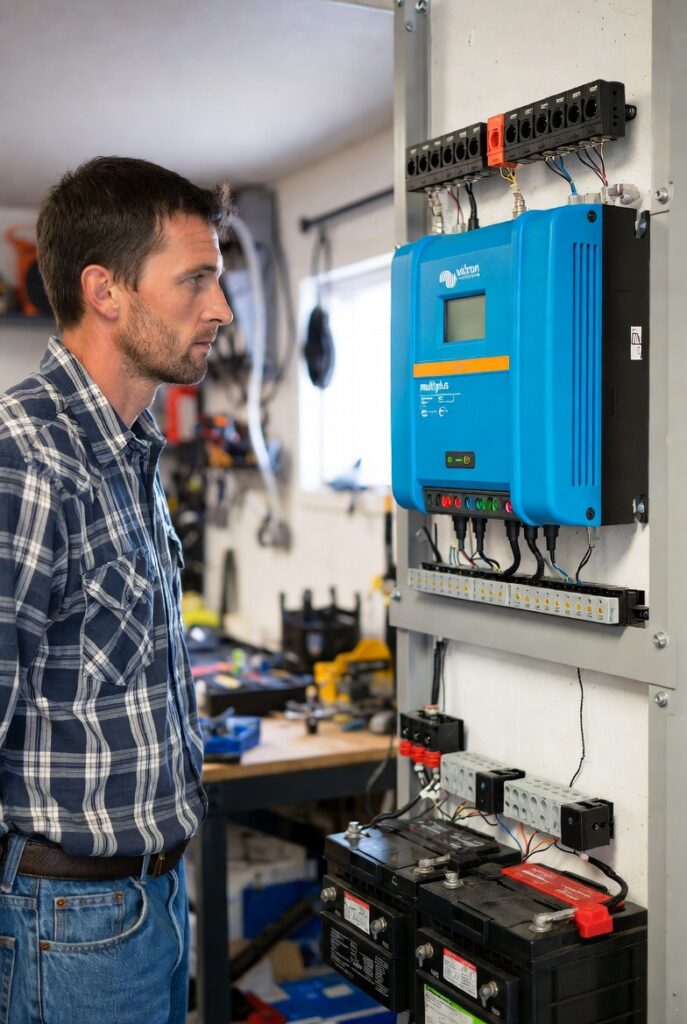
A standalone solar inverter converts DC battery power to AC output only and requires a separate battery charger for any AC charging input such as a generator or grid connection. An Victron MultiPlus-II inverter-charger integrates three functions: DC to AC conversion, AC to DC battery charging from any AC source, and an automatic transfer switch that switches loads between battery and incoming AC within 20ms without a perceptible break in power. When the generator starts the MultiPlus passes AC to the house loads and charges the battery bank simultaneously. When the generator stops it switches back to battery within 20ms.
For any permanent off-grid battery bank system with generator backup or a planned AC charging source, the inverter-charger is the correct specification. The standalone solar inverter requires a separate charger when a generator is used, adding complexity, cost, and manual transfer switching. The MultiPlus-II integrates these functions and adds automatic transfer switching that standalone inverters cannot provide. The cost premium over a standalone plus separate charger is approximately $200 to $400. For a pure solar-only system with absolutely no AC charging input ever planned, a standalone inverter is acceptable. See our solar battery bank sizing guide for how the inverter-charger fits into the full battery system design.
Pro Tip: Before finalising any solar inverter purchase, run the three-question check. First: will any load connected to this inverter contain a motor, a switching power supply, a capacitor, or variable speed control? If yes, pure sine wave is mandatory, stop considering MSW entirely. Second: does the solar array have any predictable shading from a chimney, dormer, or tree between 9 AM and 3 PM in November through February? If yes, budget for power optimisers at $40 per shaded panel before selecting a string inverter. Third: will a generator ever be used as a backup charging source? If yes, the inverter-charger configuration pays back its $200 to $400 premium at the first generator run through the automatic transfer switching alone. These three questions take approximately 5 minutes to answer and eliminate the three most expensive solar inverter selection mistakes in Ontario off-grid systems.
The solar inverter topology decision: which configuration fits your Ontario array
The three solar inverter decisions have clear Ontario verdicts. Waveform: pure sine wave for every system without exception, the Waterloo Avenue result confirms the MSW alternative costs $600 per sensitive appliance damaged. String vs micro: string solar inverter for unshaded arrays at lower cost; power optimisers ($40/panel) or microinverters ($80 to $150/panel) for arrays with predictable shading, the Milton Trafalgar Road result confirms optimisers recovered 20 to 25% winter production loss from a chimney shadow. Standalone vs inverter-charger: inverter-charger for any system with generator backup or planned AC charging; standalone acceptable for pure solar-only systems with no AC input ever planned.
Three non-negotiable solar inverter specifications for every Ontario system. First: pure sine wave output only, no MSW for any residential off-grid system. Second: surge rating minimum 2x continuous rated watts, a 1,500W solar inverter must have at least a 3,000W surge rating for any system running motor loads such as a fridge compressor, pump, or power tool. Third: battery voltage match, a 12V solar inverter on a 24V bank or a 24V inverter on a 12V bank will damage both the inverter and the battery within the first charging cycle. Confirm the bank voltage and the inverter input voltage specification from the manufacturer datasheet before purchasing. See our solar garage guide for how these specifications apply to motor-heavy workshop loads.
NEC and CEC: Ontario requirements for off-grid inverter installations
NEC 690 governs solar PV installations. A solar inverter permanently installed in an off-grid system must comply with NEC 690 requirements for inverter listing, installation, DC wiring, overcurrent protection, and disconnecting means. NEC 690.35 requires the inverter to be listed for the specific application and installed per manufacturer specifications. The DC battery cables connecting the battery bank to the solar inverter must be sized for the inverter’s maximum input current with appropriate overcurrent protection at the battery terminal. The AC output circuit must comply with NEC 240 branch circuit requirements with appropriate overcurrent protection for the connected loads. Contact the NFPA at nfpa.org for current NEC 690 requirements for solar inverter installation in residential off-grid systems.
CEC Section 64 governs solar PV installations in Ontario. A permanently installed solar inverter connected to a battery bank requires an ESA permit. The permit application must identify the inverter model, the battery bank configuration, the DC input wiring, and the AC output overcurrent protection. The inverter must be CSA-listed or equivalent for the Ontario installation. An inverter-charger such as the Victron MultiPlus-II requires the permit to identify the AC input connection and the automatic transfer switch function. Before installing any permanently wired solar inverter in Ontario, contact the Electrical Safety Authority Ontario at esasafe.com to confirm current permit requirements for the specific inverter configuration.
The solar inverter verdict: three non-negotiable specifications for Ontario systems
- Ontario off-grid owner choosing their first solar inverter for a cabin, cottage, or workshop: pure sine wave, inverter-charger configuration, battery voltage matched to the bank. The Waterloo Avenue Guelph result is the cost of the wrong choice: $80 saving on the MSW unit, $600 CPAP replacement after two nights. The pure sine wave premium of $50 to $150 is the cheapest insurance available for any solar inverter system that will connect electronics, medical equipment, or motor-driven appliances. Size the surge rating at minimum 2x the continuous wattage before purchasing.
- Ontario property owner planning a solar array on a roof with potential shading from a chimney, dormer, tree, or neighbouring structure: evaluate the shade pattern before choosing between string and microinverters. For a shadow covering one or two panels during a predictable window, power optimisers at $40 per shaded panel are the most cost-effective solution. For complex or full-panel shading across multiple panels, microinverters at $80 to $150 per panel recover more production. The Milton Trafalgar Road result: $40/panel optimiser retrofit recovered 20 to 25% winter production on a string solar inverter with a chimney shadow versus the $80 to $150/panel microinverter alternative.
- Ontario off-grid owner who currently has a standalone inverter and runs a generator manually during gray streaks: replacing the standalone with a Victron MultiPlus-II inverter-charger eliminates the manual transfer switching entirely. The MultiPlus-II manages the battery-to-generator transition within 20ms, charges the battery at maximum rate during the generator run, and returns to battery inverting seamlessly when the generator stops. Use the Victron SmartShunt to confirm the charging current and the 10A taper signal that indicates the generator can stop, the same protocol confirmed in the solar garage and propane generator articles for any Ontario off-grid system using generator backup charging.
Frequently Asked Questions
Q: What is the difference between a pure sine wave and modified sine wave solar inverter?
A: A pure sine wave solar inverter outputs a smooth sinusoidal waveform with total harmonic distortion below 3%, equivalent to Hydro One grid power. A modified sine wave inverter outputs a stepped approximation of a sine wave with total harmonic distortion of 25 to 45%. The practical difference: pure sine wave is safe for all loads including motors, CPAP machines, laptop power supplies, and variable speed drives. Modified sine wave damages or shortens the life of any load with a motor, capacitor, or switching power supply. The Waterloo Avenue Guelph result demonstrates the consequence: $80 saving on a modified sine wave solar inverter, $600 CPAP replacement after two nights of use.
Q: Do I need microinverters if my solar panels are partially shaded?
A: It depends on the shade pattern. For a predictable shadow covering one or two panels during a specific window, a chimney from 2 PM to 4 PM in winter, for example, power optimisers at approximately $40 per shaded panel are typically the most cost-effective solution and produce results within 5% of full microinverter performance. For complex or full-panel shading across multiple panels, microinverters at $80 to $150 per panel provide the most complete solution. For an unshaded south-facing Ontario array with no roof obstructions, neither power optimisers nor microinverters provide measurable benefit over a standard string solar inverter. Evaluate the actual shade pattern with a shade analysis tool before purchasing any shading mitigation hardware.
Q: What is a solar inverter-charger and do I need one?
A: A solar inverter-charger combines a DC to AC inverter, an AC to DC battery charger, and an automatic transfer switch in one unit. The Victron MultiPlus-II is the Ontario off-grid standard for this category. When a generator or grid AC source is present, the MultiPlus-II passes the AC to house loads and charges the battery bank simultaneously. When the AC source is absent, it inverts from the battery.
The transition is under 20ms and imperceptible to most electronics. You need an inverter-charger if your system includes a generator as backup, if a future grid connection is possible, or if you want to eliminate the manual transfer switching that a standalone solar inverter requires when starting a generator during a gray streak.
This build is engineered within the 48V DC Safety Ceiling. Diagnostic logic is based on 20+ years of technical service experience. All structural and electrical installations must be verified by a Licensed Professional and comply with your Local AHJ.
About the Author
Robert Bertrand spent 20 years as a service advisor in the automotive industry (Lexus and Nissan), where precision diagnostics, wiring integrity, and documentation standards were non-negotiable. He brings that same technical discipline to GridFree Guide, where he researches, tests, and documents off-grid solar systems for Ontario conditions. Based in Rockwood, Ontario, every article is built on verified specifications, manufacturer data, and the real-world climate constraints of Canadian off-grid living.
As an Amazon Associate I earn from qualifying purchases. This site also contains affiliate links to other products and services. GridFree Guide earns a small commission at no extra cost to you.