
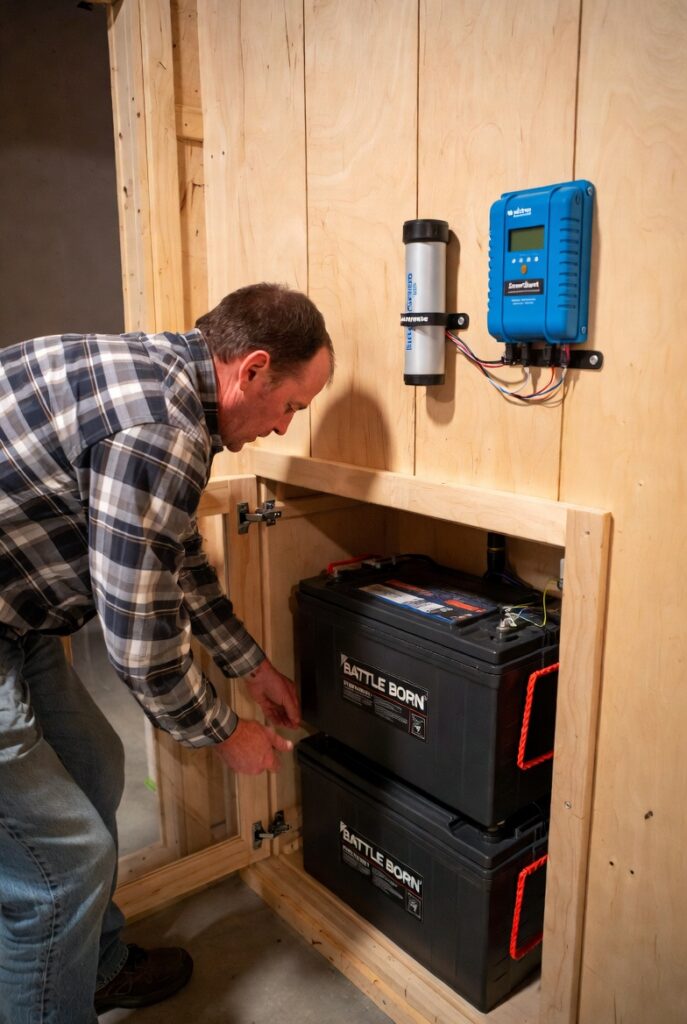
The most common Ontario solar battery bank sizing mistake is purchasing a 200Ah AGM bank to save money and discovering on the second day of a January gray streak that the SmartShunt is reading 12.1V, the low voltage disconnect has activated, and the 100Ah of capacity that remains is unavailable because the AGM bank’s 50% depth of discharge limit has already been reached. A property owner on Wellington Road 124 in Guelph, Wellington County commissioned a year-round off-grid cabin with a 200Ah AGM solar battery bank in fall 2022.
Her total daily load was approximately 480Wh, LED lighting 60W, laptop 65W, DC fridge 80W, phone charging 20W, and propane furnace blower 80W running approximately 4 hours per day. At 50% DoD the 200Ah 12V AGM bank provided 1,200Wh usable, approximately 2.5 days of load without any solar input.
On January 14, 2023, a 5-day gray streak began. Her Victron SmartShunt confirmed the bank voltage dropped from 12.8V to 12.1V over approximately 48 hours of minimal solar input. Her system’s low voltage disconnect activated at approximately 12.0V, the protection threshold set to prevent AGM cell damage below 50% DoD. At the LVD activation point, her solar battery bank still had approximately 100Ah of physical capacity remaining in the cells, but drawing below 50% DoD on AGM accelerates plate sulfation and permanently reduces capacity over subsequent cycles.
I reviewed the system in February 2023. Her daily load of 480Wh required a minimum solar battery bank of 480 × 3 ÷ 0.50 = 2,880Wh for a 3-day AGM reserve at 50% DoD, she needed a 240Ah AGM bank, not 200Ah.
Alternatively, a 200Ah LFP bank at 80% DoD provided 1,920Wh usable, covering 4 days of load and requiring only 200Ah of battery capacity. I specified a replacement with two Battle Born heated LFP batteries in her unheated utility room. The SmartShunt confirmed the first January gray streak after the LFP replacement: the bank reached a minimum of 58% SoC on day 3, above the LVD threshold with substantial reserve remaining. See our Ontario solar sizing guide before selecting any solar battery bank.
The solar battery bank sizing rule: 3 days of load, 80% DoD, and the January floor
| Metric | AGM (lead acid) | LFP (LiFePO4) | Ontario verdict |
|---|---|---|---|
| Usable DoD | 50% | 80% | LFP delivers 60% more usable energy ✓ |
| 200Ah usable capacity | 100Ah (1,200Wh) | 160Ah (1,920Wh) | Same Ah rating, 60% more usable ✓ |
| Cycle life | 300 to 500 at 50% DoD | 3,000+ at 80% DoD | LFP outlasts 6 to 10 AGM replacements ✓ |
| Weight per 100Ah | 25 to 30 kg | 13 to 15 kg | LFP easier to install solo ✓ |
| Cold performance at 0°C | 70 to 80% capacity | ~95% capacity | LFP far superior in Ontario winter ✓ |
| Charging below 0°C | Possible (reduced efficiency) | BMS blocks, heated LFP required | Heated LFP mandatory in cold spaces ✓ |
The 3-day gray streak sizing rule for any Ontario solar battery bank: daily load (Wh) × 3 ÷ DoD = minimum rated Wh, then divide by system voltage to get minimum Ah. For a 480Wh daily load at AGM 50% DoD: 480 × 3 ÷ 0.50 = 2,880Wh ÷ 12V = 240Ah minimum. For the same load at LFP 80% DoD: 480 × 3 ÷ 0.80 = 1,800Wh ÷ 12V = 150Ah minimum, specify 200Ah (nearest standard size above 150Ah). The 200Ah LFP solar battery bank outperforms the 240Ah AGM bank on every Ontario January metric: more usable capacity, longer cycle life, and lower weight.
The LFP usable capacity advantage compounds over the system’s lifetime. A 200Ah LFP solar battery bank at 80% DoD provides 1,920Wh usable, 60% more than the same 200Ah AGM at 50% DoD (1,200Wh usable). At 3,000+ cycles for LFP versus 300 to 500 cycles for AGM at 50% DoD, a 200Ah LFP bank in Ontario off-grid service will outlast approximately 6 to 10 replacement cycles of an equivalent-Ah AGM bank. The AGM’s lower upfront cost is offset by replacement frequency and the undersized usable capacity that requires a larger physical bank for the same effective 3-day reserve. See our solar energy storage guide for the full battery chemistry comparison and sizing methodology.
LFP vs AGM: usable capacity, cycle life, and the Ontario cold comparison
LFP provides approximately 80% usable depth of discharge versus AGM’s 50%, the same 200Ah rating delivers 160Ah from LFP versus 100Ah from AGM. LFP also maintains approximately 95% of rated capacity at 0°C ambient versus AGM’s 70 to 80% at the same temperature. Combined, a 200Ah LFP solar battery bank in an Ontario January outperforms a 200Ah AGM bank by approximately 90 to 100% in actual usable energy delivered under winter conditions. LFP weighs approximately 13 to 15 kg per 100Ah versus AGM’s 25 to 30 kg, relevant for any installation where battery weight requires manual handling.
AGM voltage sag under load is the second operational difference that matters for Ontario off-grid systems. AGM voltage drops from approximately 12.8V (100% SoC) to approximately 11.8V (50% SoC) under load, a 1V drop that can cause 12V appliances and inverters to report low-voltage warnings even when the bank is not near its DoD limit. LFP holds a flat voltage profile from 100% to approximately 20% SoC, approximately 13.2V under load across most of the usable range. This flat profile eliminates false low-voltage warnings and provides more predictable inverter and appliance performance through the discharge cycle.
Pro Tip: After any solar battery bank installation, AGM or LFP, use the SmartShunt to record the minimum SoC reached during the first three January gray streak events. If the minimum SoC on any event is below 30% for LFP or below 60% for AGM (the safe margin above the DoD limit), the bank is undersized for the actual daily load. The Wellington Road 124 Guelph AGM bank reached 50% SoC, exactly at the LVD threshold, on day 2 of a gray streak. A correctly sized bank should not approach its DoD limit until day 4 or later, confirming it provides the 3-day reserve with margin. The SmartShunt’s daily minimum SoC log is the only way to confirm correct sizing under real Ontario winter conditions.
The solar battery bank temperature problem: why unheated Ontario spaces require heated LFP
LFP battery chemistry cannot be safely charged below 0°C. Below this threshold, lithium ions plate directly onto the anode surface instead of intercalating into the graphite, a process that permanently reduces capacity and can create internal short circuit points in the cell. The LFP BMS detects cell temperature below 0°C and blocks incoming charge current to protect the cells. For a solar battery bank in a heated space (inside the cabin, above 5°C throughout winter), standard LFP is the correct specification.
For any battery in an unheated Ontario space, utility shed, exterior attached cabinet, unheated garage, the ambient can reach -5°C to -20°C during overnight cold snaps, and cell temperature will fall below 0°C, causing the BMS to block morning charging.
A first-time builder near Whitelaw Road in Guelph, Wellington County installed a 200Ah standard LFP solar battery bank in an unheated detached utility shed in spring 2023. He selected non-heated LFP to save approximately $300 versus the heated version. In November 2023, the shed dropped to approximately -5°C overnight, the BMS detected sub-zero cell temperature and blocked the MPPT 100/30’s morning bulk charge. His SmartShunt showed 0 charging current from sunrise until approximately 10:30 AM when the shed warmed above 0°C.
I specified replacement with Battle Born heated LFP batteries and a Victron BatterySense. His January 2024 charge log confirmed continuous charging from sunrise every clear morning through the entire winter. His comment: “The heated batteries were worth every dollar once I saw the charge log in January.” See our off grid cabin guide for utility room placement and temperature planning.
The Victron BatterySense: temperature compensation and charge blocking prevention
The Victron BatterySense is a small Bluetooth temperature sensor that attaches directly to the battery terminal and transmits real-time battery temperature to compatible Victron MPPT charge controllers via the VE.Smart network. Without temperature compensation, a charge controller programmed for 20°C operation applies a fixed charge voltage, at 0°C battery temperature, this fixed voltage is approximately 0.3 to 0.6V higher than the correct temperature-compensated target for AGM, causing accelerated electrolyte loss. For LFP, the BatterySense provides the temperature signal that allows the MPPT controller to pause charging when sub-zero temperatures are reported, preventing the charge blocking fault even before the BMS activates. The BatterySense pairs correctly with the MPPT 100/30 and MPPT 100/50 via VE.Smart.
The BatterySense is a worthwhile addition to any Ontario solar battery bank regardless of chemistry. For any system where the battery bank occupies a space with more than 20°C seasonal temperature variation, which describes every Ontario off-grid installation, temperature compensation improves both battery longevity and charge efficiency. The device costs approximately $45 and requires no wiring beyond attaching the sensor to the battery positive terminal. It is the lowest-cost, highest-return addition to any Ontario solar battery bank that pairs with a Victron MPPT charge controller. See our solar panel size guide for the array that feeds the correct charge current into the solar battery bank.
NEC and CEC: Ontario permit requirements for permanent battery installations
NEC 690 governs solar PV installations including the solar battery bank. The battery bank positive and negative cables to the inverter and charge controller must comply with NEC 690 battery circuit requirements, wire sized for the maximum discharge current and protected by overcurrent protection rated above that current. For a 2,000W inverter at 12V: maximum continuous current = 2,000 ÷ 12 = 167A, the battery positive cable must be rated above 167A and protected by a fuse or circuit breaker at approximately 200A (125% of 167A). Contact the NFPA at nfpa.org for current NEC 690 requirements for solar battery bank wiring and overcurrent protection in off-grid residential systems.
CEC Section 64 governs solar PV installations in Ontario. A permanently installed solar battery bank requires an ESA permit as part of the complete solar electrical system permit. The permit application must identify the battery bank chemistry (AGM or LFP), total capacity in Ah, system voltage, maximum continuous discharge current, battery bank location, cable routing from the battery bank to the inverter and charge controller, and overcurrent protection ratings on all battery circuit conductors. A solar battery bank installed in an unheated space requires identification of the space type and ambient temperature range in the permit application. Contact the Electrical Safety Authority Ontario at esasafe.com before beginning any permanent solar battery bank installation in Ontario.
The solar battery bank verdict: LFP for year-round, AGM for seasonal, heated for cold spaces
- Ontario off-grid cabin owner who currently has an AGM solar battery bank and experienced low voltage disconnects during January gray streaks: calculate whether the bank is correctly sized for the 3-day rule at 50% DoD. Daily load × 3 ÷ 0.50 = minimum rated Wh ÷ 12V = minimum Ah. If the existing AGM bank is undersized, replace with LFP at 80% DoD, typically a smaller physical bank covering the same 3-day reserve with fewer kilograms and more usable capacity. The Wellington Road 124 Guelph result: 200Ah AGM (100Ah usable) replaced with 200Ah heated LFP (160Ah usable), the replacement required no physical bank resizing but eliminated every LVD event in subsequent Ontario winters. Install the Victron SmartShunt to confirm the minimum SoC reached during each gray streak event.
- Ontario off-grid property owner designing a new solar battery bank for a year-round primary residence: specify heated LFP if the battery location drops below 5°C at any point during winter. Size the bank using the 3-day rule at 80% DoD: daily load × 3 ÷ 0.80 = minimum rated Wh ÷ system voltage = minimum Ah. For a 600Wh daily load: 600 × 3 ÷ 0.80 = 2,250Wh ÷ 12V = 187.5Ah, specify a 200Ah bank. The Battle Born heated LFP batteries are the correct specification for any Ontario utility room, shed, or exterior cabinet where winter ambient drops below 0°C. Add the Victron BatterySense to ensure the MPPT charge controller receives real-time battery temperature for charge compensation through every Ontario winter.
- Ontario off-grid property owner who has installed standard (non-heated) LFP in an unheated space and is experiencing charge blocking in cold weather: replace the batteries with heated LFP before the next Ontario winter. The Whitelaw Road Guelph result confirms the charge blocking failure mode: cells below 0°C, BMS blocks charging, no solar input from sunrise until 10:30 AM when the shed warms. The heated LFP internal heater activates below approximately 5°C, warming the cells before the BMS permits charging. The January 2024 charge log confirmed continuous charging from sunrise through the entire winter with no further blocking events. The $300 premium for heated LFP over standard LFP pays back on the first Ontario morning where the unheated shed would otherwise have blocked four hours of solar charging.
Frequently Asked Questions
Q: What is the best battery for an off-grid solar system in Ontario?
A: Battle Born heated LFP is the correct specification for any Ontario year-round off-grid solar battery bank in an unheated space. Heated LFP provides 160Ah usable from a 200Ah bank (80% DoD), charges safely below 0°C via the internal heater, delivers 3,000+ cycles versus 300 to 500 for AGM, and maintains approximately 95% of rated capacity at 0°C ambient versus AGM’s 70 to 80%. The Wellington Road 124 Guelph result confirms the practical difference: the 200Ah heated LFP replacement reached a minimum of 58% SoC on day 3 of the January gray streak, the 200Ah AGM it replaced had triggered the LVD at 50% DoD on day 2.
For seasonal cottages (May through September) with batteries stored indoors during winter, standard AGM at the correctly sized Ah is acceptable.
Q: How many batteries do I need for an off-grid solar system in Ontario?
A: Apply the 3-day gray streak sizing rule. Daily load (Wh) × 3 ÷ DoD = minimum rated Wh, then divide by system voltage for minimum Ah. For LFP at 80% DoD and a 480Wh daily load: 480 × 3 ÷ 0.80 = 1,800Wh ÷ 12V = 150Ah minimum, specify a 200Ah solar battery bank (two 100Ah 12V batteries in parallel). For AGM at 50% DoD and the same 480Wh load: 480 × 3 ÷ 0.50 = 2,880Wh ÷ 12V = 240Ah minimum. The Wellington Road 124 Guelph result confirmed that a 200Ah AGM bank (1,200Wh usable) was undersized for a 480Wh daily load by approximately 40%, the LVD activated on day 2 of a 5-day gray streak.
Q: Can I use AGM batteries for off-grid solar in Ontario?
A: AGM is acceptable for seasonal Ontario off-grid applications (May through September) where the solar battery bank is brought indoors or disconnected before winter. For year-round primary residences, AGM requires a larger physical bank for the same 3-day reserve (240Ah AGM versus 200Ah LFP for a 480Wh daily load), provides only 70 to 80% of rated capacity at 0°C ambient, and needs replacement every 300 to 500 cycles versus 3,000+ for LFP. The combination of lower usable capacity, cold weather performance degradation, and shorter service life makes AGM the wrong choice for any Ontario year-round off-grid solar battery bank, the LFP premium is justified by the total cost of ownership over the system’s lifetime.
This build is engineered within the 48V DC Safety Ceiling. Diagnostic logic is based on 20+ years of technical service experience. All structural and electrical installations must be verified by a Licensed Professional and comply with your Local AHJ.
About the Author
Robert Bertrand spent 20 years as a service advisor in the automotive industry (Lexus and Nissan), where precision diagnostics, wiring integrity, and documentation standards were non-negotiable. He brings that same technical discipline to GridFree Guide, where he researches, tests, and documents off-grid solar systems for Ontario conditions. Based in Rockwood, Ontario, every article is built on verified specifications, manufacturer data, and the real-world climate constraints of Canadian off-grid living.
As an Amazon Associate I earn from qualifying purchases. This site also contains affiliate links to other products and services. GridFree Guide earns a small commission at no extra cost to you.