
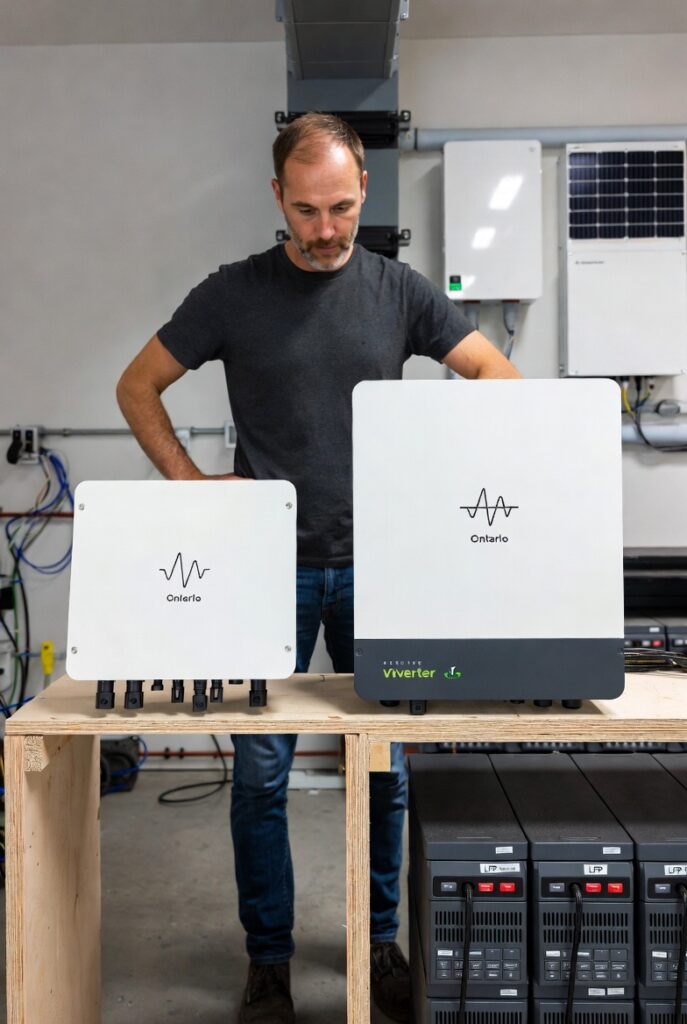
A battery inverter and a solar inverter are two different tools for two different jobs, and confusing them is the most common wiring mistake Ontario off-grid beginners make. A homeowner on Woodlawn Road West in Guelph, Wellington County set up his first off-grid system in the spring of 2024. He had a 100Ah LFP battery, a Victron MPPT charge controller, and a 1,000W modified sine wave inverter purchased from a hardware store for approximately $85. He used the inverter to power his home office desk, a laptop, a router, and a Starlink dish. Every 20 to 40 minutes the Starlink rebooted, disrupting his work.
He assumed the battery was undercharged or the MPPT was faulty. He ran a full diagnostic on both and found no faults. The problem was the modified sine wave output of the battery inverter. Starlink power supplies contain active power factor correction circuits that require a clean sine wave, the “blocky” modified sine wave caused the Starlink power supply to misread the input frequency and trigger a protective reboot. He replaced the $85 modified sine wave unit with a 1,000W pure sine wave battery inverter at approximately $180. The Starlink reboots stopped on the first day. His laptop stopped running warm and his router’s wireless signal stabilised.
The $95 difference between the two inverters was the cost of approximately 6 weeks of Starlink reboots and lost productivity. I walked him through the full Ontario off-grid component list after the swap: panels produce DC, the charge controller regulates that DC into the battery, the battery stores it, and the battery inverter converts it to AC for the loads. Each component does one job in the chain. Understanding which component is the battery inverter, and what it does differently from the charge controller, is the foundational knowledge that prevents the most common beginner hardware mistakes. See our Ontario solar sizing guide before selecting an inverter size for your load profile.
What a battery inverter actually does: DC to AC and nothing else
A standalone battery inverter converts 12V, 24V, or 48V DC from a battery into standard 120V AC for household loads. It does not charge the battery from solar, that is the charge controller’s job. It does not manage solar input. Its sole function is DC-to-AC conversion. The size of a standalone battery inverter is determined by the load wattage, not the battery capacity: a 1,000W pure sine wave battery inverter handles up to 1,000 watts of continuous AC load regardless of whether the battery behind it is 100Ah or 400Ah.
The most common beginner confusion is thinking the MPPT charge controller is the battery inverter because it is the most visible and expensive component in a small system. The controller is the fuel pump, it regulates solar input and charges the battery. The battery is the tank. The battery inverter is the engine that converts stored DC into usable 120V AC. A cottage owner on Tremaine Road in Milton, Halton County called her installer in the fall of 2024 asking why she could not run her cottage fridge from her solar system.
She pointed to her Victron SmartSolar MPPT and said her “inverter was working fine.” The installer confirmed the MPPT was working correctly, but no battery inverter had been installed. The controller output was 12V DC, and the fridge required 120V AC.
The installer quoted a 1,200W pure sine wave battery inverter plus installation at approximately $420. She chose to upgrade to a Victron EasySolar all-in-one unit at approximately $650 that combined a charge controller and a built-in pure sine wave battery inverter, replacing both needs in one device. The fridge has run without incident for two full Ontario cottage seasons. See our battery voltage guide for how 12V DC and 120V AC operate in the same system without conflicting.
Choosing a battery inverter type: standalone, all-in-one, or hybrid
| Type | Function | Best for | Trade-off | Cost range |
|---|---|---|---|---|
| Standalone battery inverter | DC to AC only | Existing systems adding AC | Requires separate charge controller | $80 to $600 |
| All-in-one combo | Charge controller + inverter | New cottage systems under 2,000Wh/day | Single point of failure | $300 to $1,500 |
| Hybrid (MultiPlus) | Grid + battery + solar | Full-time homes with grid backup | Higher cost, complex install | $800 to $3,000+ |
The all-in-one unit combines the charge controller and battery inverter into a single device. It accepts solar panel input, charges the battery, and converts DC to AC, all managed in one box. Brands including Renogy, AIMS, Growatt, and Victron EasySolar offer quality units in this category. All-in-one units are appropriate for Ontario cottage systems under approximately 2,000Wh daily load. The single-point-of-failure trade-off is the key limitation: if the unit fails, both solar charging and AC output stop simultaneously until the unit is repaired or replaced.
The hybrid category connects the battery inverter to grid, battery, and solar simultaneously. The Victron MultiPlus is the reference product for Ontario full-time off-grid systems with grid backup. During normal operation the grid supplies base load while solar charges the battery. During a grid outage the battery inverter transitions to battery power in milliseconds, maintaining load continuity. Budget $800 to $1,500 for a quality residential hybrid battery inverter and factor in a more complex ESA permit covering both the solar circuit and the grid connection points. See our solar battery lifespan guide for how battery cycling differs between cottage systems and full-time hybrid installations.
Pure sine wave vs modified sine wave: why the waveform determines what you can run
Pure sine wave output from a quality battery inverter produces smooth sinusoidal AC identical to utility grid power, with total harmonic distortion typically below 3%. Every load on the market, microprocessors, active PFC power supplies, variable-speed motors, CPAP machines, Starlink, and medical devices, is designed to run on pure sine wave power. Modified sine wave produces a stepped approximation of a sine wave with total harmonic distortion typically between 40 and 50%. It is compatible with resistive loads only: incandescent lights, simple heating elements, and basic unregulated battery chargers.
Any load with a microprocessor, active PFC circuit, or variable-speed motor treats modified sine wave output as a fault condition. Starlink’s active PFC power supply requires a pure sine wave to prevent protective reboots, exactly what the Guelph Woodlawn Road homeowner experienced every 20 to 40 minutes. CPAP machines use variable-speed motors and are incompatible with modified sine wave. Laptop power supplies with active PFC run hotter and less efficiently on modified sine wave output. The $95 premium for a pure sine wave battery inverter over a modified sine wave unit is the smallest possible investment for reliable operation of any modern electronics. See our pure sine wave vs modified sine wave guide for the full appliance compatibility breakdown.
Inverter idle draw: the overnight ghost tax on your LFP bank
A battery inverter draws power simply to remain active, even with zero load connected. A typical standalone 1,000W pure sine wave battery inverter consumes 8 to 15W idle draw. A 3,000W inverter draws 20 to 40W. Over an 8-hour overnight period at 30W idle, that is 240Wh consumed by the battery inverter with no load running. On a 100Ah LFP bank with 1,200Wh of usable capacity, those 240Wh represent 20% of the bank consumed by the inverter alone before a single load is powered. Over a 3-day Ontario November gray streak, idle draw accumulates to approximately 720Wh, more than half a 100Ah bank’s usable capacity gone to the inverter with zero productivity.
Two solutions address the idle draw tax. Enable Search Mode on Victron units or Eco Mode on compatible battery inverters, the inverter sends a small pulse every few seconds to detect a connected load rather than remaining fully active, reducing idle draw from 15 to 30W down to approximately 2 to 5W. The second option is a manual bypass switch that cuts power to the battery inverter entirely when no AC loads are needed, particularly useful for Ontario cottage systems where the AC circuit may be unused for 2 to 3 days between visits.
Right-sizing the battery inverter to actual continuous load also reduces idle draw: a 600W battery inverter idling at 8W overnight costs 64Wh versus a 3,000W unit idling at 35W overnight costing 280Wh for the same zero-load result.
Pro Tip: The fastest way to confirm whether a battery inverter problem is a waveform issue or a battery issue is to plug the load directly into a standard household outlet and confirm it runs normally. If the same Starlink, laptop, or CPAP that reboots or runs warm on the inverter runs without issue on utility power, the battery and charge controller are not the problem, the battery inverter waveform is. The Guelph Woodlawn Road homeowner spent two weeks suspecting his MPPT and battery before the installer identified the modified sine wave output in a 5-minute diagnostic. The test costs nothing and eliminates the two most expensive components from the fault chain before spending any money. Ontario off-grid beginners who buy the pure sine wave battery inverter from the start never have this conversation.
NEC and CEC: electrical code requirements for inverter installations in Ontario
NEC 690 governs solar PV installations. A battery inverter permanently connected to the battery system and supplying AC loads must be listed for the application under NEC 690.10. The output circuit of a battery inverter must be protected by overcurrent devices sized for the inverter’s rated output current. A 1,000W battery inverter at 120V output produces approximately 8.3A rated output, the circuit breaker on the AC output side must be rated for this current plus a service factor. Battery inverter input wiring from the battery bank must comply with NEC 690 conductor sizing requirements for DC systems at the battery bank voltage. Contact the NFPA at nfpa.org for current NEC 690 battery inverter installation and listing requirements.
CEC Section 64 governs battery installations in Ontario including battery inverter installations connected to battery banks. A permanently installed battery inverter requires an ESA permit in Ontario. The permit covers the inverter’s DC input wiring from the battery, the AC output circuit wiring to the loads, overcurrent protection on both the DC input and AC output sides, and the physical mounting and enclosure of the unit. A battery inverter installed without a permit is an uninsured installation, any fire or electrical fault associated with an unpermitted inverter may void the property insurance claim. Contact the Electrical Safety Authority Ontario at esasafe.com before installing any battery inverter as a permanent fixture in an Ontario off-grid system.
The battery inverter verdict: three Ontario installation profiles
- Ontario off-grid owner with a working MPPT charge controller and LFP battery who has no AC output yet: install a standalone pure sine wave battery inverter matched to your continuous load. Size it to the peak continuous load in watts, not to the battery capacity, a 100Ah LFP bank can support a 2,000W battery inverter for short durations but the continuous load determines the correct size. Confirm pure sine wave output is specified on the product page before purchasing. Enable Search Mode or Eco Mode to reduce idle draw to 2 to 5W. The Guelph Woodlawn Road result confirms the $95 premium for pure sine wave over modified sine wave is the most cost-effective decision in the entire component chain, it costs less than one month of a Starlink subscription and eliminates the most common failure point in a beginner off-grid system.
- Ontario cottage owner setting up a new system from scratch with modest AC load requirements under 2,000Wh daily: consider an all-in-one combo battery inverter unit. The Milton Tremaine Road cottage owner’s $650 Victron EasySolar replaced both the MPPT controller and the need for a separate battery inverter, reduced the installation complexity, and has run two full cottage seasons without issues. The single-point-of-failure trade-off is acceptable for a seasonal system where extended downtime during a repair cycle is not operationally critical. Confirm the all-in-one unit includes a pure sine wave battery inverter output, not all combo units in this price range do. A modified sine wave all-in-one is not a cost-effective compromise on any system that will power Starlink, a CPAP, or modern appliances.
- Ontario full-time off-grid homeowner or anyone who wants grid backup capability alongside solar: the hybrid battery inverter is the correct specification. The Victron MultiPlus connects grid, battery, and solar simultaneously and transitions from grid to battery power in milliseconds during a power outage, faster than most electronics can detect a supply interruption. Budget $800 to $1,500 for a quality hybrid battery inverter and factor in a more complex ESA permit covering both the solar circuit and the grid connection points. The modular component chain, separate MPPT charge controller plus separate hybrid battery inverter, is the preferred architecture for full-time Ontario systems because component failure affects only the failed unit, not the entire system.
Frequently Asked Questions
Q: What is the difference between a battery inverter and a solar charge controller?
A: A battery inverter converts DC stored in the battery to 120V AC for household loads, it is the last component in the chain before the load. A solar charge controller regulates the DC coming from the solar panels and manages the charging of the battery, it is the second component in the chain after the panels. The battery inverter does not manage solar input at all. The charge controller does not convert DC to AC at all. They are adjacent components doing entirely different jobs, and the Milton Tremaine Road cottage owner’s experience confirms that having one working perfectly does not mean the other exists or is functional.
Q: Why does my Starlink keep rebooting when I run it from my off-grid inverter?
A: The Starlink power supply contains an active power factor correction (PFC) circuit that requires a clean pure sine wave input. A modified sine wave battery inverter produces a stepped waveform with total harmonic distortion of 40 to 50%, significantly outside the tolerance of the Starlink PFC circuit. The PFC circuit interprets the waveform as a supply fault and triggers a protective reboot every 20 to 40 minutes, exactly as the Guelph Woodlawn Road homeowner experienced. Replacing the modified sine wave battery inverter with a pure sine wave unit resolves the reboots immediately. Confirm the replacement unit specifies pure sine wave output and total harmonic distortion below 3% before purchasing.
Q: How much power does a battery inverter use when nothing is plugged in?
A: A standalone 1,000W pure sine wave battery inverter typically draws 8 to 15W idle just to remain active with zero load connected. Larger 3,000W units draw 20 to 40W idle. At 30W overnight for 8 hours that is 240Wh consumed by the battery inverter with no load, 20% of a 100Ah LFP bank’s usable capacity. Enable Search Mode on Victron units or Eco Mode on compatible battery inverters to reduce idle draw to approximately 2 to 5W. The inverter pulses every few seconds to detect a connected load rather than remaining fully powered, delivering the same instant-on response when a load is connected while consuming roughly one-tenth the idle power.
This build is engineered within the 48V DC Safety Ceiling. Diagnostic logic is based on 20+ years of technical service experience. All structural and electrical installations must be verified by a Licensed Professional and comply with your Local AHJ.
About the Author
Robert Bertrand spent 20 years as a service advisor in the automotive industry (Lexus and Nissan), where precision diagnostics, wiring integrity, and documentation standards were non-negotiable. He brings that same technical discipline to GridFree Guide, where he researches, tests, and documents off-grid solar systems for Ontario conditions. Based in Rockwood, Ontario, every article is built on verified specifications, manufacturer data, and the real-world climate constraints of Canadian off-grid living.
As an Amazon Associate I earn from qualifying purchases. This site also contains affiliate links to other products and services. GridFree Guide earns a small commission at no extra cost to you.