
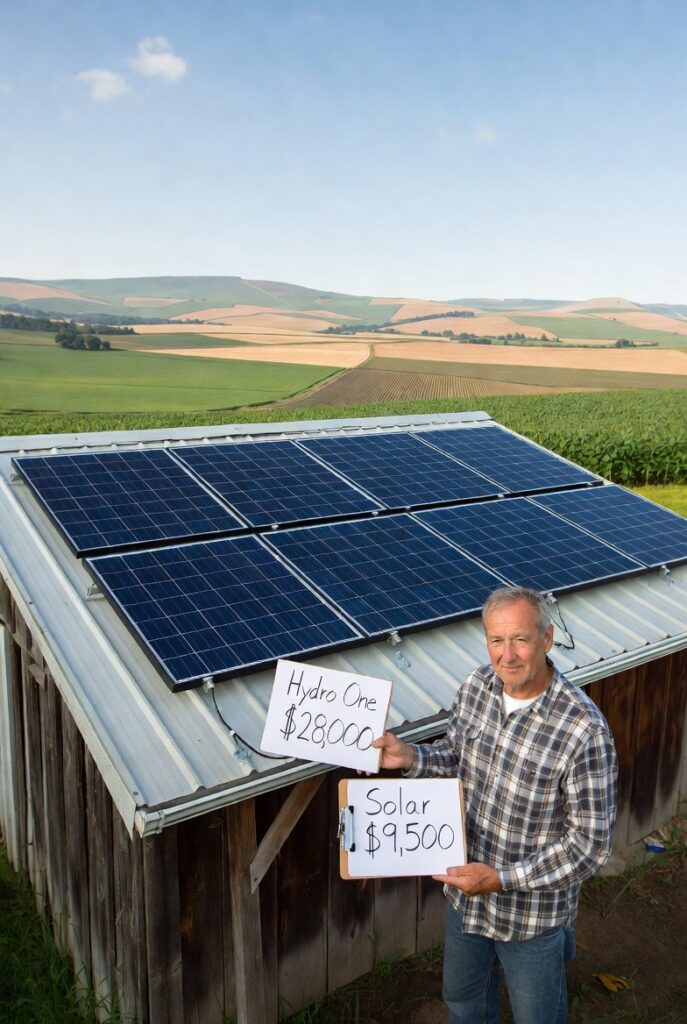
Off grid solar stops being a lifestyle choice the moment Hydro One quotes you $28,000 to run a wire to your property, at that point it becomes the only financially rational decision. A homeowner on Stone Road East in Guelph, Wellington County purchased a vacant rural lot in the spring of 2024 and planned to build a workshop. He called Hydro One for a connection quote. The quote came back at approximately $28,000 for a new service including poles, transformer, and trenching across the 200-metre setback from the road. He contacted an off-grid solar installer as a comparison.
A 1,500W panel array, 200Ah LFP battery bank, 2,000W pure sine wave inverter, Victron MPPT charge controller, mounting hardware, wiring, ESA permit, and installation came to approximately $9,500. He chose the off grid solar system. By month 12 his system had delivered approximately 1,800 kWh to the workshop, powering tools, lighting, a battery charger for his cordless equipment, and a small space heater in October and November.
His monthly utility cost was zero. Had he chosen the Hydro One connection at $28,000 plus an estimated $80 per month for delivery and service charges, his 12-month total would have been $28,960, a difference of approximately $19,460 in his favour before the system had generated a single watt of its second year of output.
I reviewed his SmartShunt data at the one-year mark. The system had operated within normal parameters every month, including two multi-day cloudy stretches in November when he used a small generator for 4 hours each to top up the bank. His total generator fuel cost for the year was approximately $35. His off grid solar system had recovered its installation cost against the Hydro One alternative on the day he declined the $28,000 quote. Every watt he has harvested since is net positive against that alternative. See our Ontario solar sizing guide before calculating the system size for your property.
Off grid solar vs Hydro One: the rural Ontario cost comparison
New rural service connection costs in Ontario range from $15,000 to $50,000 or more, depending on distance from the nearest transformer, terrain, and existing infrastructure. For a typical Ontario rural property with a 100 to 300-metre setback from the road, costs typically fall between $20,000 and $35,000. Monthly delivery and service charges after connection add $60 to $120 per month for a small property or seasonal cottage. Seasonal properties face additional reconnection fees of approximately $100 to $300 per season on top of the base monthly charge.
| Option | Upfront cost | Monthly ongoing | 10-year total |
|---|---|---|---|
| Hydro One rural connection (typical) | $20,000 to $35,000 | $80 to $120 | $29,600 to $49,400 |
| Off grid solar, Tier 1 | $2,500 to $4,500 | $0 | $2,500 to $4,500 |
| Off grid solar, Tier 2 | $5,000 to $9,000 | $0 | $5,000 to $9,000 |
| Off grid solar, Tier 3 | $15,000 to $30,000 | $0 | $15,000 to $30,000 |
The Guelph Stone Road comparison is not unusual, rural Ontario property owners routinely face utility connection costs that exceed the price of a complete off grid solar system. The comparison shifts for urban and suburban properties where existing grid connections cost $80 per month all-in: in those cases the off grid solar payback timeline extends considerably. The Hydro One cost comparison is financially decisive specifically for rural properties without an existing service connection, where the upfront connection cost alone exceeds an entire off grid solar system budget. See our Ontario load planning guide for sizing your system to the specific loads you plan to run.
Off grid solar system costs: three Ontario tiers and what each one buys
Ontario off grid solar systems fall into three practical tiers matched to three distinct use cases. Tier 1 at $2,500 to $4,500 installed covers a 400W to 500W panel array, 100Ah LFP battery, 1,000W pure sine wave inverter, MPPT charge controller, mounting hardware, ESA permit, and labour. An entry-level Renogy starter kit covers the panel and controller component in this tier. This system powers LED lighting, device charging, and an efficient small fridge but does not cover well pumps, electric heating, or high-current motors.
Tier 2 at $5,000 to $9,000 adds an 800W to 1,200W panel array, a 200Ah LFP bank using two Battle Born 100Ah LFP units, a 2,000W pure sine wave inverter, and a Victron MPPT 100/30 or better. This tier handles full cottage operation including fridge, water pump, Starlink, and standard appliances.
Tier 3 at $15,000 to $30,000 installed targets full-time year-round Ontario home use. The component list expands to a 3,000W to 4,000W panel array, 400Ah LFP bank, 3,000W to 5,000W hybrid inverter-charger, Victron MPPT 150/70 or larger, full electrical racking and wiring, and an ESA permit with engineering review. This tier supports all standard residential loads including well pump, Starlink, lighting, appliances, and limited EV charging.
The 10-year cost-per-kWh for a Tier 2 system at $7,500 installed producing 1,500 kWh per year works out to $0.50 per kWh in the first decade, declining to approximately $0.25 per kWh in year 20 as the system amortises against Ontario all-in utility rates of $0.20 to $0.26 per kWh. See our beginner solar panel guide for how to evaluate panel quality at each tier.
Tier 1: small cottage backup ($2,500 to $4,500 installed)
Tier 1 suits seasonal cottage owners with modest loads, backup power for rural homes, or outbuildings without grid access. The system covers LED lighting, phone and laptop charging, an efficient 12V or AC fridge, and Starlink, but not well pumps, electric heat, or motors above approximately 600W continuous draw. Professional installation of a Tier 1 system typically runs $400 to $800 in labour plus $150 to $250 for the ESA permit, with total installed cost averaging approximately $3,200 to $3,500 for a mid-spec build. DIY installation is possible for technically capable owners and reduces the cost to approximately $1,800 to $2,200 in components plus the permit.
A cottage owner on Britannia Road in Milton, Halton County installed a Tier 1 off grid solar system for approximately $4,200 and disconnected from Hydro One entirely. Her seasonal connection and delivery charge, which had been running approximately $180 per month, dropped to zero. Her annual charge saving of approximately $2,160 produces a simple payback period of approximately 23 months. By the end of her third full cottage season her off grid solar system will have paid for itself entirely from the delivery charge saving alone, before accounting for a single kWh it generated. She supplements with a portable generator on 3 to 4 cloudy days per season at a total fuel cost of approximately $60 per year.
Tier 2: full cottage system ($5,000 to $9,000 installed)
Tier 2 covers the majority of Ontario seasonal cottage owners who want full-service power, fridge running 24 hours, water pump on demand, Starlink always on, and standard appliances available throughout the day. The 200Ah LFP battery bank stores approximately 1,600Wh of usable capacity at 80% DoD, enough for most cottage overnight loads before the panels recharge in the morning. Professional installation of a Tier 2 system typically runs $800 to $1,500 in labour plus $200 to $350 for the ESA permit. Most Ontario installers quote Tier 2 builds as a package, and the $5,000 to $9,000 range reflects regional variation in labour rates across Wellington and Halton County.
The 10-year economics for a Tier 2 system at $7,500 installed are straightforward. At 1,500 kWh per year of production the cost-per-kWh over 10 years is $0.50, higher than the current Ontario all-in utility rate of $0.20 to $0.26 per kWh. However, for a rural property without an existing connection that would cost $20,000 to $35,000 to establish, the comparison is not the kWh cost but the total capital requirement.
A $7,500 Tier 2 off grid solar system versus a $27,500 mid-range Hydro One connection plus 10 years of monthly charges produces a 10-year cost of $7,500 versus approximately $38,500 for the connected alternative. The break-even point where off grid solar lifetime kWh cost falls below the ongoing grid rate, for properties that already have a grid connection, is approximately year 12 to 14.
Pro Tip: The fastest way to confirm whether a Tier 1 or Tier 2 off grid solar system suits your Ontario property is to add up your actual monthly Hydro One bill line by line and separate the two components: what you pay for electricity consumed, and what you pay regardless of consumption (delivery, regulatory, connection, and seasonal charges). For many rural and seasonal Ontario properties the non-consumption charges represent 40 to 60% of the total bill. Those charges continue every month whether or not the property is occupied and whether or not any electricity is used. An off grid solar system eliminates those charges entirely on day one of disconnection. The Milton Britannia Road cottage owner was paying $180 per month for a service she used 5 months of the year, $2,160 per year for which she received nothing 7 months out of 12. Her $4,200 off grid solar system recovered its cost in 23 months from that saving alone.
NEC and CEC: code and permit costs for Ontario off-grid installations
NEC 690 governs solar PV installations. All three tiers of off grid solar system require compliance with NEC 690 for conductor sizing, overcurrent protection, disconnecting means, and battery system listing. Tier 1 and Tier 2 systems with conductors under 50V DC and limited current may qualify for simplified NEC 690 requirements in some AHJ jurisdictions, but the permit process still requires documentation and submission for any permanently wired installation. A Tier 3 full-home off grid solar system requires full NEC 690 compliance including engineering sign-off in most Ontario AHJ jurisdictions. Contact the NFPA at nfpa.org for current NEC 690 requirements applicable to residential off grid solar installations.
CEC Section 64 governs battery installations in Ontario. An ESA permit is required for any off grid solar system with a permanently wired battery inverter, regardless of system size or tier. Permit costs range from approximately $150 for a simple Tier 1 system to $500 to $1,000 for a complex Tier 3 installation with engineering review. The ESA permit fee is a fixed cost that belongs in every off grid solar budget from the first planning conversation, it is not optional and cannot be retroactively added after installation.
A battery-based off grid solar system installed without an ESA permit is an uninsured installation: any fire or electrical fault associated with an unpermitted system may void the homeowner’s property insurance. Contact the Electrical Safety Authority Ontario at esasafe.com before beginning any off grid solar installation in Ontario.
The off grid solar verdict: which tier fits your Ontario property
- Ontario rural property owner facing a new Hydro One connection quote above $15,000: the off grid solar cost comparison is decisive. A Tier 2 off grid solar system at $5,000 to $9,000 installed delivers reliable power at a fraction of the connection cost with zero monthly delivery charge thereafter. The Guelph Stone Road result is the financial case: a $9,500 system against a $28,000 connection quote produces $18,500 in immediate capital retention on day one before generating a single watt. For Tier 3 rural properties at $22,000 versus a $30,000 connection plus $1,200 per year in ongoing charges, the 25-year total cost comparison is not close. The off grid solar system wins on the upfront comparison alone before the 10-year free operation period is factored in.
- Ontario seasonal cottage owner currently paying ongoing seasonal delivery and connection charges for a property vacant 4 to 6 months per year: Tier 1 off grid solar produces the fastest payback of any energy investment available. The Milton Britannia Road result confirms the math: $4,200 system, $2,160 annual charge saving, 23-month payback. No solar panel needs to generate a single kWh for this payback to occur, it comes entirely from eliminating charges being paid for nothing. Add the electricity generated during the 5 active months and the actual system value in year one exceeds the payback calculation. The critical step is auditing the current bill to separate consumption charges from standing charges before making the comparison. See our pure sine wave inverter guide for selecting the correct inverter type before purchasing your Tier 1 system.
- Ontario full-time rural homeowner planning a new build or considering grid independence: Tier 3 at $15,000 to $30,000 is a capital investment that competes directly with the 25-year cost of grid electricity plus delivery charges. A full-time household consuming 8,000 to 12,000 kWh per year at Ontario all-in rates of $0.20 to $0.26 per kWh spends $1,600 to $3,120 annually. The Tier 3 off grid solar system at $22,000 installed amortises at $880 per year over 25 years, competitive with current grid rates before annual utility rate increases are applied. For a property without an existing grid connection, the Tier 3 off grid solar capital cost is typically lower than the Hydro One rural connection cost alone, making the economic case for off grid solar immediate rather than amortised over decades.
Frequently Asked Questions
Q: How much does an off-grid solar system cost in Ontario?
A: Ontario off grid solar system costs fall into three tiers based on the loads and usage pattern. A Tier 1 small cottage backup system runs $2,500 to $4,500 installed, panels, 100Ah LFP battery, 1,000W pure sine wave inverter, MPPT, mounting, ESA permit, and labour. A Tier 2 full seasonal cottage system runs $5,000 to $9,000 installed with a 200Ah LFP bank and 2,000W inverter capable of running a fridge, water pump, and Starlink. A Tier 3 full-home year-round system runs $15,000 to $30,000 installed with a 400Ah LFP bank, 3,000W to 5,000W hybrid inverter-charger, and a 3,000W to 4,000W panel array. All three tiers require an ESA permit, which adds $150 to $1,000 depending on system complexity.
Q: Is off-grid solar cheaper than connecting to Hydro One in rural Ontario?
A: For rural Ontario properties without an existing grid connection, off grid solar is almost always less expensive than a new Hydro One service connection. New rural connections cost $15,000 to $50,000 depending on distance and terrain, plus $60 to $120 per month in ongoing charges. A Tier 2 off grid solar system at $5,000 to $9,000 installed covers the same power needs with zero monthly charges for the life of the system.
The Guelph Stone Road result is the concrete example: a $9,500 off grid solar system against a $28,000 Hydro One connection quote produced $18,500 in immediate capital retention. For properties with an existing low-cost grid connection, the economics are more nuanced and depend on current monthly bills and system sizing.
Q: How long does it take for an off-grid solar system to pay for itself in Ontario?
A: The payback period depends on what the off grid solar system is replacing. For rural properties avoiding a new Hydro One connection at $20,000 to $35,000, the payback is effectively immediate, the system cost is lower than the connection cost on day one. For seasonal cottage owners eliminating standing delivery and connection charges, the Milton Britannia Road result shows a 23-month payback from charge savings alone at $2,160 per year saved on a $4,200 system. For full-time homeowners with an existing grid connection calculating payback against ongoing utility bills, the break-even point for a Tier 2 system is approximately year 12 to 14 against current Ontario rates, with the payback timeline shortening as utility rates increase each year.
This build is engineered within the 48V DC Safety Ceiling. Diagnostic logic is based on 20+ years of technical service experience. All structural and electrical installations must be verified by a Licensed Professional and comply with your Local AHJ.
About the Author
Robert Bertrand spent 20 years as a service advisor in the automotive industry (Lexus and Nissan), where precision diagnostics, wiring integrity, and documentation standards were non-negotiable. He brings that same technical discipline to GridFree Guide, where he researches, tests, and documents off-grid solar systems for Ontario conditions. Based in Rockwood, Ontario, every article is built on verified specifications, manufacturer data, and the real-world climate constraints of Canadian off-grid living.
As an Amazon Associate I earn from qualifying purchases. This site also contains affiliate links to other products and services. GridFree Guide earns a small commission at no extra cost to you.