
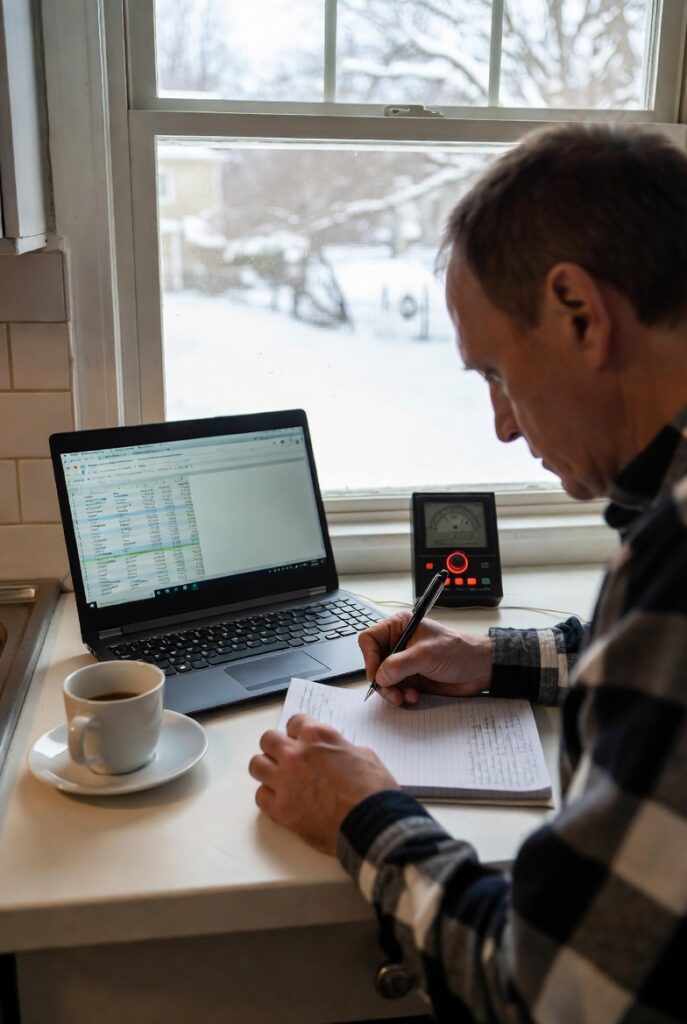
The most expensive mistake Ontario property owners make when they decide to go off grid is buying equipment before doing a load audit. A homeowner on Fleming Drive in Guelph, Wellington County decided to go off grid in the summer of 2023. He purchased a 4,000W panel array believing more panels meant more security. He installed the panels on his workshop roof before sizing his battery bank.
His installer, brought in after the fact to commission the system, identified the problem immediately: the array was producing approximately 3,600W on a clear August afternoon, but the battery bank was only 100Ah at 12V, approximately 1,200Wh of usable capacity. The array filled the battery in under 40 minutes on a good day and then went to waste.
Come November, his large array was irrelevant. At 1.5 peak sun hours per day it delivered only approximately 5,400Wh, and with a 1,200Wh battery, the system ran out of stored energy by 9:00 PM on the second cloudy day. The correct sequence would have identified the battery bank size first. His average daily load was approximately 2,800Wh. To go off grid reliably through a 3-day Wellington County gray streak he needed a battery bank of approximately 8,400Wh, 700Ah at 12V or 175Ah at 48V, not 100Ah. His 4,000W array was correctly sized to charge a large bank quickly, but without the correct battery the array was producing power that went nowhere.
He spent approximately $2,400 on additional battery capacity after the fact. I reviewed his system logs six months after the battery expansion, with the correctly sized 200Ah LFP bank the system performed within expected parameters through November and February. His two remaining cloudy-day shutdowns were caused by the electric kettle: an 1,800W load he had not included in his original load audit. Removing the kettle from the off-grid circuit solved the last failure mode. The load audit, done properly before a single component is purchased, prevents every mistake this homeowner made at an after-the-fact cost of $2,400. See our Ontario solar sizing guide before beginning your load audit.
The go off grid sequence: why order matters more than equipment
Every number in an off-grid system design is derived from one number: daily load in Wh. The battery sizing comes from it. The panel wattage comes from the battery size. The inverter rating comes from peak load. The wire gauge comes from the inverter current. Skipping the load audit and going straight to component selection is the equivalent of ordering a transmission before measuring the engine bay, the part may be high quality, but it will not fit the application. The Milton Louis St. Laurent example confirms the cost of skipping it from the other direction: not a too-small system, but a too-large one.
A cottage owner on Louis St. Laurent Avenue in Milton, Halton County hired an installer in the spring of 2024 without first doing a load audit. The installer quoted a “standard cottage package” at approximately $8,200, 1,500W of panels, 200Ah LFP battery bank, 2,000W inverter. The installation went smoothly and the system worked. However, at the end of the first season she reviewed her electricity log and realised her average daily consumption was approximately 800Wh: a fridge, Starlink, LED lighting, and occasional laptop charging.
The 200Ah LFP bank held 1,600Wh of usable capacity at 80% DoD, twice her daily load. She had paid for a system twice as large as necessary because no load audit had preceded the installer’s quote. A Tier 1 system at $3,500 to $4,000 would have met her actual needs. See our Ontario off grid solar cost guide for the full tier breakdown.
How to go off grid in Ontario: steps 1 through 3 (audit, size, select)
| Step | Task | Ontario-specific detail | Common mistake |
|---|---|---|---|
| 1 | Load audit | Include all seasonal loads and inverter idle draw | Forgetting kettle, well pump, space heater |
| 2 | Battery sizing | Daily Wh × 3 days ÷ 0.80 DoD = bank capacity | Sizing to summer load, not gray streak |
| 3 | Panel and inverter sizing | Daily load ÷ 1.5 hr (January) × 1.25 = minimum watts | Sizing to July sun hours |
| 4 | ESA permit application | Apply before ordering, 2 to 6 week timeline | Installing before permit approval |
| 5 | Installation | Min 5° tilt for snow shed; overcurrent on every DC positive | Flat roof mounts in Wellington County |
| 6 | Commissioning | Battery first, then controller, then panels, then inverter | Powering inverter before battery connected |
Step 1 load audit: list every electrical load on the property by wattage and daily hours of use. Calculate daily Wh for each load (watts × hours). Total all loads, this is the daily energy requirement that drives every downstream decision. Common Ontario omissions: inverter idle draw (8 to 35W continuous), router and modem (8 to 15W continuous), chest freezer defrost cycle (5-minute spike twice daily), and any electric heating used during shoulder season. Step 2 battery sizing: multiply the daily load by 3 for a gray streak buffer, then divide by 0.80 for the 80% DoD working limit. A 2,800Wh daily load requires a minimum bank of 10,500Wh, 875Ah at 12V or 218Ah at 48V.
Step 3 component selection for Ontario cold: LFP is the only battery chemistry appropriate for Ontario off-grid with cold climate exposure. Standard LFP BMS blocks charging below 0C to prevent lithium plating, this is correct behaviour, not a fault. For enclosures that drop below 0C in January, the Battle Born heated LFP self-heats to 5C before accepting charge current, extending the effective charging window into below-freezing mornings.
For enclosures that stay above 0C, standard LFP with BMS protection is sufficient. The Renogy 100W starter kit is the correct entry point for owners who want to learn on a shed or outbuilding before committing to a full property system. See our beginner solar panel guide for how to evaluate panel quality at each tier.
Steps 4 through 6: ESA permit, installation, and first commissioning
Step 4, the ESA permit, is required for any permanently wired battery-based off-grid system in Ontario regardless of system size. Apply before installation begins, the typical timeline is 2 to 6 weeks from application to inspection approval, and installers cannot begin wiring until the permit is issued. Permit costs range from approximately $150 for a simple Tier 1 system to $500 to $1,000 for a complex Tier 3 installation with engineering review. Hydro One disconnection is a separate process: contact Hydro One directly to schedule meter removal after the ESA permit is approved. Installing without a permit voids property insurance and may require costly remediation of completed work.
Step 5 installation for Ontario conditions: panel mounts require a minimum 5-degree tilt for snow shedding, flat-mounted panels accumulate snow cover that blocks production for days after a snowfall. Steeper angles of 30 to 45 degrees improve winter production and self-clear after snowfall. Overcurrent protection is required on every DC positive conductor. Battery enclosures must stay above 0C for standard LFP or use the heated variant. Step 6 commissioning sequence: connect the battery first, then the charge controller, then the panels, and finally the inverter. Allow a full absorb cycle to re-synchronise the SmartShunt coulomb counter before trusting the SoC reading. Test each load individually, confirm voltage holds and no unexpected shutdowns before declaring the system operational.
The Ontario solar ratio: sizing for January, not July
Guelph and Milton average 1.5 to 2.0 peak sun hours per day in January versus 5.5 to 6.0 in July. Sizing an off-grid system for July produces a system that is severely undersized for November through February, the months when the system matters most for full-time users. Sizing for January 100% self-sufficiency produces a massively over-panelled system that sits largely idle from May through September. The correct Ontario approach: size panels for the October-November shoulder season at approximately 2.5 to 3.0 peak sun hours, plan for generator supplement on 5 to 15 days per year in the darkest weeks, and accept that this is economically rational.
The formula: daily load ÷ 2.5 shoulder hours × 1.25 safety factor gives the correct panel wattage for Ontario conditions.
The heated battery decision follows the same shoulder-season logic. Standard LFP BMS protection below 0C is correct behaviour, it prevents lithium plating that permanently reduces cell capacity. A Wellington County outbuilding that drops to -15C overnight in January will block standard LFP charging from midnight until the enclosure warms past 0C, typically mid-morning. The Battle Born heated LFP eliminates this window by self-heating to 5C before accepting charge current, capturing the early-morning hours of the already short January charging day. For cottages with insulated utility rooms that stay above 5C, the standard LFP is sufficient and the heated premium is unnecessary. See our pure sine wave inverter guide before selecting your inverter type.
Pro Tip: The fastest way to do a load audit without a wattage meter is to pull the last 12 months of Hydro One billing history, find the three lowest-consumption months (typically May, June, September when heating and air conditioning are both minimal), and use the lowest monthly kWh as your baseline daily load calculation. Divide the lowest monthly kWh by 30 to get a daily Wh estimate. This is not a substitute for a proper appliance-by-appliance audit, but it gives you a defensible starting number within 30 minutes without any new equipment. The Milton Louis St. Laurent cottage owner would have identified her 800Wh daily load in under an hour this way, and the load audit would have preceded the installer quote rather than following the first full season. The $4,200 oversizing was entirely preventable with this one step.
NEC and CEC: permit and code requirements for Ontario off-grid installations
NEC 690 governs solar PV installations. All Ontario off-grid solar systems with permanently wired battery banks must comply with NEC 690 for conductor sizing, overcurrent protection, disconnecting means, and battery listing. NEC 690.71(A) requires that battery systems be listed or field-evaluated for the application. Roof and ground-mount structures must comply with applicable structural loading requirements including Ontario snow loads, Wellington County ground snow load design is approximately 2.4 kPa and mounting structures must be engineered to this standard. A permitted installation requires a single-line electrical diagram showing all components, conductor sizes, and overcurrent protection ratings. Contact the NFPA at nfpa.org for current NEC 690 requirements for residential off-grid solar installations.
CEC Section 64 governs battery installations in Ontario. The ESA permit for an off-grid solar installation covers the battery bank, inverter, charge controller connections, and all DC and AC distribution wiring. The permit application typically requires a description of system components, conductor sizing, and overcurrent protection scheme. The ESA inspection confirms that the installed system matches the permit application and that all connections are safe. After inspection approval the homeowner may proceed with Hydro One disconnection if full grid independence is the goal, this is a separate notification and scheduling process with the utility. Contact the Electrical Safety Authority Ontario at esasafe.com before beginning any Ontario off-grid solar installation to confirm current permit requirements.
The go off grid verdict: three Ontario property profiles
- Ontario rural property owner planning to go off grid on a new build or vacant property without an existing grid connection: follow the six-step sequence in order, starting with the load audit. The load audit determines every other number in the system, battery bank first, then panels, then inverter. Do not purchase a single component until the daily load in Wh is confirmed on paper and the gray-streak battery size is calculated. The Fleming Drive result is the cautionary example: $2,400 in corrective battery purchases and a full winter of underperformance from skipping Step 1. The correct sequence costs nothing and takes one afternoon with a notepad and a wattage meter. Every Ontario off-grid system that fails in November fails because the load audit was skipped or done after the components were purchased.
- Ontario seasonal cottage owner planning to go off grid to eliminate standing delivery and connection charges: begin with a billing history audit before speaking to any installer. Pull the 12 months of Hydro One bills, find the lowest consumption month, and calculate the daily Wh baseline. Then do a walk-through audit of every running load at the cottage. The Milton Louis St. Laurent result confirms the cost of skipping this step: an installer quote without a load audit produced an $8,200 system for an 800Wh daily load when a $3,500 Tier 1 system would have been adequate. The load audit takes 30 to 60 minutes and prevents paying for capacity that will never be used. Present the audited daily Wh number to the installer before the first quote conversation.
- Ontario homeowner or property owner who wants to go off grid on a shed or outbuilding as a first step before a full property system: the Renogy starter kit approach is the correct learning path. A $400 to $600 starter system on a shed teaches panel orientation, MPPT charge controller programming, battery SoC monitoring, and load management in a low-stakes environment. Every lesson learned on the shed, including the inverter idle draw calculation, the gray-streak battery sizing, and the winter production reality of 1.5 January peak hours, applies directly to the full property system design. The Fleming Drive homeowner’s $2,400 corrective purchase was expensive tuition. The shed system costs $600 and teaches the same lesson without the consequence of a $2,400 mistake at full scale.
Frequently Asked Questions
Q: What is the first step to go off grid in Ontario?
A: The first step is the load audit, listing every electrical load on the property by wattage and daily hours of use, then totalling the daily Wh requirement. This single number drives every downstream decision: battery bank size, panel wattage, inverter rating, and wire gauge. The most common reason Ontario off-grid systems fail in November is that the load audit was skipped or done after components were purchased. The Fleming Drive homeowner’s $2,400 corrective battery purchase and the Milton Louis St. Laurent cottage owner’s $4,200 oversizing were both caused by the load audit happening too late in the sequence. Do the audit before speaking to an installer or purchasing a single component.
Q: How many solar panels do I need to go off grid in Ontario in winter?
A: Use the October-November shoulder season as the sizing baseline, approximately 2.5 to 3.0 peak sun hours per day for Guelph and Milton. The formula is: daily load in Wh ÷ shoulder-season peak sun hours × 1.25 safety factor = minimum panel wattage. For a 2,800Wh daily load: 2,800 ÷ 2.5 × 1.25 = 1,400W minimum. Do not size to July (5.5 to 6.0 hours), the result is severely undersized for the months that matter. Do not size to January (1.5 hours) for 100% self-sufficiency, the result is massively over-panelled. Plan for generator supplement on 5 to 15 days per year during the darkest weeks and size for the shoulder season.
Q: Do I need an ESA permit to go off grid in Ontario?
A: Yes. An ESA permit is required for any permanently wired battery-based off-grid system in Ontario, regardless of system size or tier. Apply before installation begins, the typical timeline is 2 to 6 weeks from application to inspection approval. Permit costs range from approximately $150 for a simple system to $500 to $1,000 for a complex installation with engineering review. Installing without a permit voids property insurance and may require costly remediation of completed work. Hydro One disconnection, if full grid independence is the goal, is a separate process from the ESA permit, contact Hydro One directly to schedule meter removal after the ESA inspection is approved.
This build is engineered within the 48V DC Safety Ceiling. Diagnostic logic is based on 20+ years of technical service experience. All structural and electrical installations must be verified by a Licensed Professional and comply with your Local AHJ.
About the Author
Robert Bertrand spent 20 years as a service advisor in the automotive industry (Lexus and Nissan), where precision diagnostics, wiring integrity, and documentation standards were non-negotiable. He brings that same technical discipline to GridFree Guide, where he researches, tests, and documents off-grid solar systems for Ontario conditions. Based in Rockwood, Ontario, every article is built on verified specifications, manufacturer data, and the real-world climate constraints of Canadian off-grid living.
As an Amazon Associate I earn from qualifying purchases. This site also contains affiliate links to other products and services. GridFree Guide earns a small commission at no extra cost to you.