
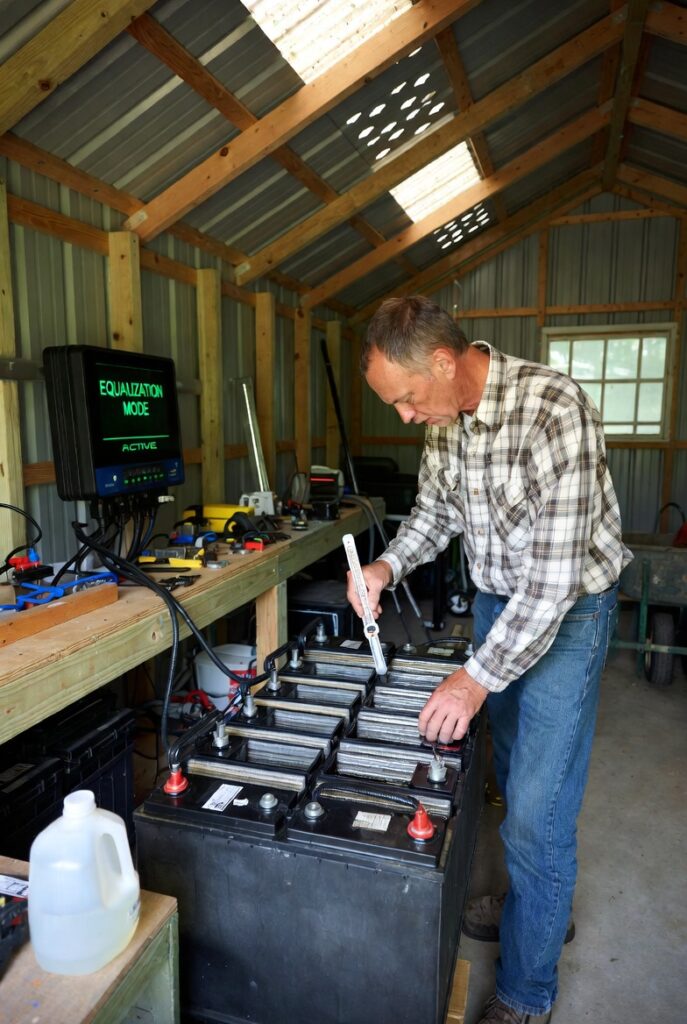
Knowing how to recondition lead acid batteries correctly is what separates a $400 recovery from a $1,600 replacement, but only when the sulphation is soft enough to reverse. A homeowner on Kortright Road West in Guelph, Wellington County had a 4-year-old flooded lead acid battery bank that had been carrying his off-grid workshop since the spring of 2020. By October 2024 his Victron SmartShunt was consistently showing peak SoC of approximately 60% even after full sunny days, down from the 90 to 95% peaks the bank had delivered in its first two years.
His installer walked him through the decision: try to recondition lead acid before spending $1,600 on a replacement bank, or replace immediately. They agreed to attempt a single equalization cycle.
The homeowner’s bank was flooded lead acid, the chemistry that tolerates controlled equalization at 15.5V. His charge controller was set to the flooded profile and the equalization function was enabled. The cycle ran for approximately 3 hours with the battery room ventilated, as equalization produces hydrogen and oxygen gas during the gassing phase. After the equalization cycle the bank was allowed to rest for 12 hours. The SmartShunt showed a peak SoC of 78% on the following clear day, an 18-percentage-point recovery. The bank was not restored to its original 95% capacity, but 78% was enough to carry the workshop loads through the winter without supplemental generator charging.
I reviewed the SmartShunt data over the following 3 months. The recovered 78% SoC held stable through November and December without further deterioration. In January, during a 4-day gray streak, the system ran to approximately 25% SoC before requiring a 2-hour generator top-up, consistent with expected performance from a partially recovered bank. The bank delivered two additional functional seasons before being replaced with a Battle Born 100Ah LFP in the spring of 2026. The decision to recondition lead acid rather than replace immediately saved approximately $1,200 in deferred replacement cost while delivering two additional years of service. See our Ontario solar sizing guide before sizing your replacement bank.
Sulphation: why Ontario winters kill lead acid banks before their time
Lead sulfate crystals form on battery plates whenever a lead acid battery sits at partial state of charge. Soft sulphation consists of fine crystals that formed recently, reversible with an equalization charge. Hard sulphation involves large crystals that have grown and hardened over months or years, not fully reversible, and capable of causing physical plate damage that no procedure will recover. Ontario winter scenario: a battery left at 40% SoC from November through April accumulates approximately 5 months of continuous sulphation. Solar panels under snow cover produce minimal charging current during the months when the bank needs it most, leaving the sulphation to compound unchecked until April.
| Sulphation type | Duration at partial SoC | Equalization result | Ontario winter risk |
|---|---|---|---|
| Soft (recoverable) | 2 to 8 weeks | 70 to 95% capacity recovery | October, November |
| Moderate | 2 to 4 months | 60 to 80% recovery (variable) | December, January |
| Hard (permanent) | 4+ months | Below 65% with no further improvement | February, April |
The practical identifiers of sulphation before attempting to recondition lead acid. The SmartShunt peak SoC declines by 5 to 15 percentage points per season without any obvious change in loads. Voltage drops more steeply under moderate loads than it did in year 1. On a flooded bank, specific gravity below 1.225 in individual cells (checked with a hydrometer) confirms sulphation. An AGM or flooded bank that takes a full sunny day to reach only 70% SoC on a charge controller that previously delivered 90% is exhibiting sulphation signature. See our battery voltage guide for how to interpret SoC from terminal voltage on a lead acid bank.
Flooded vs AGM: the equalization voltage difference that determines the procedure
Flooded lead acid tolerates and benefits from equalization at 15.0 to 16.0V. The high voltage drives a controlled gassing reaction that dissolves soft sulphate crystals and returns lead ions to the electrolyte. The battery room must be ventilated throughout the process, equalization produces hydrogen and oxygen gas continuously during the 2 to 8 hour cycle. AGM lead acid is fundamentally different: the cells are sealed with no gas venting capability and no liquid electrolyte. AGM does not tolerate 15.5V equalization. Applying 15.5V to AGM permanently damages the sealed absorbent glass mat separator and collapses cell capacity. AGM reconditioning requires pulse desulphation mode at a maximum of 14.8 to 15.0V using a smart charger’s dedicated desulphation function.
How to confirm the chemistry before attempting to recondition lead acid. Flooded cells have removable fill caps, with the cap open, liquid electrolyte is visible covering the plates. AGM cells are sealed with no fill caps or vent caps anywhere on the casing. If the battery has removable caps and visible liquid electrolyte, it is flooded, equalization at 15.5V with ventilation is the correct procedure. If the battery is sealed with no caps, it is AGM or gel, use pulse desulphation mode only, and confirm the battery manufacturer’s maximum reconditioning voltage in the product specification before any procedure.
Many AGM manufacturers specify no equalization at all. See our solar battery lifespan guide for how flooded and AGM lifespan compare over Ontario operating cycles.
How to recondition lead acid batteries: the three-step Ontario protocol
Step 1, electrolyte check on flooded cells: electrolyte should cover the plates by approximately 6mm. If the level is low, add distilled water only, never tap water, which introduces minerals that contaminate the electrolyte, and never add acid, which throws off the electrolyte balance. If cells are severely low, add water and allow 30 minutes for absorption before proceeding to equalization. Step 2, equalization charge: flooded profile at 15.5V for 2 to 8 hours with the battery room ventilated; AGM profile at 14.8V maximum pulse desulphation mode. Step 3, SmartShunt load test: allow a 12-hour rest after equalization, then charge fully on a clear day and record the peak SoC.
Interpreting the SmartShunt result after the recondition lead acid attempt. Recovery of 15 or more percentage points with peak SoC above 75% of rated capacity: successful, schedule a repeat equalization every 3 to 6 months as part of ongoing maintenance. Recovery of 10 to 15 percentage points with peak SoC between 70 and 75%: partial success, the bank has approximately 1 to 2 seasons of useful remaining life with occasional generator supplement.
Recovery below 10 percentage points, or bank still below 60% after equalization: hard sulphation is advanced and replacement is the financially correct decision. A cottage owner on Main Street in Milton, Halton County had her 6-year-old flooded bank recover to only 65% after a full equalization cycle, the maximum achievable after a 5-month winter at 20% SoC. The installer’s diagnosis was immediate: budget for LFP replacement before the following season.
When to recondition lead acid and when to replace: the SmartShunt test
The decision to recondition lead acid or replace comes down to three variables: bank age, post-equalization recovery percentage, and system growth plans. Recondition lead acid if: the bank is under 5 years old, post-equalization capacity reaches 70% or above, and the equalization cycle is available through the existing charge controller at zero additional cost. Replace with LFP if: the bank is over 6 years old, post-equalization capacity is below 70%, or the system is expanding beyond the bank’s original rated capacity. The Guelph Kortright Road result confirms the framework: a 4-year flooded bank recovering 18 percentage points to 78% was the correct recondition lead acid decision, two additional seasons at $600 per year in deferred replacement cost.
The 10-year LFP replacement economics close the financial case. A Battle Born 100Ah LFP at approximately $800 delivers 10 to 15 years of service with no sulphation, no water top-ups, no equalization cycles, and no progressive capacity testing. A 200Ah flooded lead acid bank at approximately $500 delivers 3 to 5 years of nominal Ontario service requiring annual equalization, semi-annual distilled water checks, and SmartShunt capacity monitoring each spring.
Cost per year of ownership: flooded approximately $100 to $167/year; LFP approximately $53 to $80/year. The recondition lead acid procedure defers LFP investment rationally when the bank is young and soft-sulphated, but it does not change the long-term economics that favour LFP for every Ontario off-grid system. See our LFP battery maintenance guide for the zero-sulphation service schedule LFP enables.
Pro Tip: The fastest way to confirm whether a recondition lead acid attempt succeeded is not to wait for the next full sunny day, it is to run the bank down to approximately 50% SoC under a known load immediately after the post-equalization full charge, then time how long it takes to return to 80% SoC on a partly cloudy day. Before reconditioning, the Guelph Kortright Road homeowner’s bank would reach 60% and plateau regardless of charging time. After reconditioning, the same sunny afternoon drove it to 78% and the charging current tapered properly at that level, confirming the extra capacity was real and not a voltage artefact. If the bank charges quickly to 70 to 75% and then the current tapers and terminates normally, the recondition lead acid procedure worked. If the bank charges quickly to 60 to 65% and then the current drops to near zero with the SmartShunt still showing 60%, the charger has run out of voltage headroom against a still-sulphated bank and another equalization cycle or replacement is the next step.
NEC and CEC: code requirements for lead acid battery maintenance in Ontario
NEC 690 governs solar PV installations. Battery maintenance procedures including equalization charging are part of the operational stewardship of a permitted installation and must not change the electrical configuration. NEC 690.71(A) requires battery systems be listed for the application, continuing to operate lead acid batteries beyond their rated service life while deferring maintenance may not comply with the requirement to maintain the installation within its permitted specifications. Annual SmartShunt capacity testing is the practical method for confirming the battery bank continues to meet the system’s energy storage requirements as specified in the original permit. Contact the NFPA at nfpa.org for current NEC 690 battery maintenance requirements.
CEC Section 64 governs battery installations in Ontario. Battery reconditioning procedures that do not change the electrical configuration of the installation do not require an ESA permit amendment. However, replacing a lead acid bank with an LFP bank of different voltage or capacity constitutes a configuration change that may require an ESA permit amendment. Before replacing a lead acid bank with LFP, contact the original installer to confirm whether the replacement falls within the original permit’s scope or requires an amendment documenting the new chemistry, voltage, and capacity. Contact the Electrical Safety Authority Ontario at esasafe.com before making any chemistry or capacity changes to a previously permitted Ontario battery installation.
The recondition lead acid verdict: three Ontario battery scenarios
- Ontario off-grid owner whose 3 to 5-year-old flooded lead acid bank shows 50 to 70% peak SoC after a full sunny day: attempt to recondition lead acid with one equalization cycle at 15.5V before spending on replacement. The Guelph Kortright Road result confirms the economics: a 4-year flooded bank at 60% recovered to 78% with a single cycle and delivered 2 additional seasons worth $1,200 in deferred replacement cost. The equalization cycle costs nothing if the charge controller includes an equalization function. If post-equalization SoC reaches 75% or above, schedule a repeat equalization every 3 to 6 months and plan LFP replacement at year 6 to 7. If recovery falls below 70%, the hard sulphation diagnosis applies, budget for replacement before the following Ontario winter rather than carrying a bank that will fail at full load during the next gray streak.
- Ontario cottage owner whose flooded lead acid bank was stored below 30% SoC through an Ontario winter: run the post-equalization test before making the replacement decision. The Milton Main Street 6-year flooded bank recovered to only 65% after a full equalization cycle, the hard sulphation limit after 5 months at 20% SoC. That 65% result is the limp-home signal: the bank can still run cottage lights, Starlink, and the refrigerator with modest generator supplement, but it cannot handle the well pump peak current without voltage collapse. Budget for LFP replacement in the current season rather than waiting for a complete failure mid-summer when replacement is most disruptive. The recondition lead acid attempt was worth doing, it confirmed the diagnosis and extended the season without a rushed emergency replacement.
- Ontario off-grid owner with an AGM lead acid bank showing declining peak SoC: do not attempt 15.5V equalization. Use the smart charger’s dedicated pulse desulphation mode at a maximum of 14.8 to 15.0V, and confirm the battery manufacturer’s maximum reconditioning voltage before applying any procedure. Many AGM manufacturers specify no equalization at all, applying 15.5V to a sealed AGM bank causes permanent cell damage that no subsequent procedure can reverse. If pulse desulphation at the correct voltage does not recover the AGM bank to 70% capacity within two treatment cycles, hard sulphation is advanced and replacement is the correct decision. The recondition lead acid economics apply equally to AGM, but the procedure and voltage limits are fundamentally different from flooded, getting this wrong does not fail to recondition the battery, it accelerates its destruction.
Frequently Asked Questions
Q: Can I recondition lead acid batteries that have been sitting at low charge all winter in Ontario?
A: Yes, but the success rate depends on how long the battery sat at low SoC and how severely the sulphation has hardened. A flooded lead acid bank stored at 40% SoC from November through April, 5 months, is likely to have progressed from soft to moderate or hard sulphation by April, particularly in the two coldest months. Attempt a single equalization cycle at 15.5V for flooded or pulse desulphation at 14.8V for AGM, then measure the SmartShunt peak SoC recovery.
The Milton Main Street cottage owner’s spring April equalization recovered a 6-year flooded bank to 65% after a 20% SoC winter, useful for a limp-home season, but not sufficient for full-load operation without generator supplement. The spring equalization result is the decision point: 75% or above justifies continued operation; below 65% after equalization confirms the replacement timeline.
Q: What voltage should I use to recondition lead acid AGM batteries?
A: Use the smart charger’s dedicated pulse desulphation or recondition mode, not the flooded equalization mode, at a maximum of 14.8 to 15.0V. Never apply 15.5V flooded equalization voltage to AGM cells: the sealed absorbent glass mat separator cannot handle the gassing pressure that flooded equalization produces, and the cells will be permanently damaged. Before applying any reconditioning voltage, check the battery manufacturer’s specification for the maximum reconditioning voltage and procedure. Some AGM manufacturers specify no equalization or desulphation at all and recommend only proper charging cycle restoration. If the manufacturer documentation is unavailable, contact the manufacturer directly before proceeding, guessing wrong on an AGM recondition lead acid attempt destroys the battery faster than sulphation would have.
Q: When should I replace my lead acid solar battery instead of trying to recondition it?
A: Replace rather than recondition lead acid if any of four conditions apply: the bank is over 6 years old and has been through multiple Ontario winters; the post-equalization SmartShunt peak SoC is below 65% and showed less than a 10-percentage-point improvement from the pre-equalization baseline; the system’s load requirements have grown beyond the bank’s original rated capacity; or one or more cells are shorted, producing voltage imbalance visible in individual cell testing.
The recondition lead acid procedure is a deferral tool, it buys 1 to 2 additional seasons at zero or near-zero cost when the bank is young and the sulphation is soft. It is not a permanent fix, and the long-term economics of LFP ownership at $53 to $80 per year versus flooded at $100 to $167 per year make the LFP replacement decision increasingly clear with each passing season.
This build is engineered within the 48V DC Safety Ceiling. Diagnostic logic is based on 20+ years of technical service experience. All structural and electrical installations must be verified by a Licensed Professional and comply with your Local AHJ.
About the Author
Robert Bertrand spent 20 years as a service advisor in the automotive industry (Lexus and Nissan), where precision diagnostics, wiring integrity, and documentation standards were non-negotiable. He brings that same technical discipline to GridFree Guide, where he researches, tests, and documents off-grid solar systems for Ontario conditions. Based in Rockwood, Ontario, every article is built on verified specifications, manufacturer data, and the real-world climate constraints of Canadian off-grid living.
As an Amazon Associate I earn from qualifying purchases. This site also contains affiliate links to other products and services. GridFree Guide earns a small commission at no extra cost to you.