
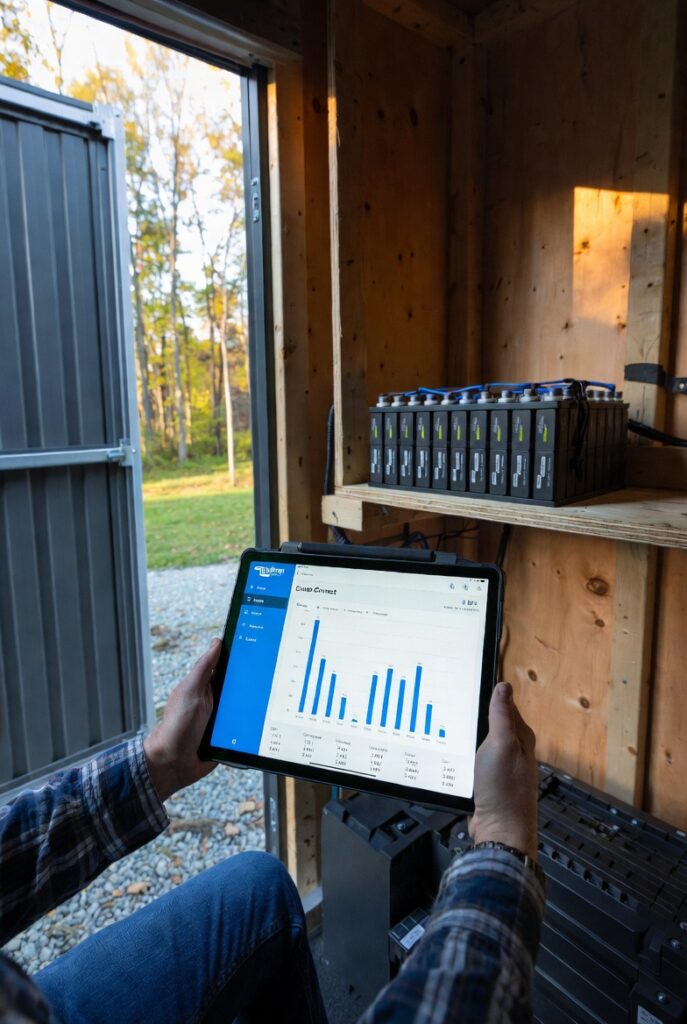
LFP battery maintenance is simpler than lead acid maintenance by an order of magnitude, but it is not zero, and the four tasks that matter are easy to miss precisely because LFP asks so little of its owner most of the time. A homeowner on Stone Road West in Guelph, Wellington County had a 200Ah LFP bank installed in the spring of 2023. He knew LFP was low-maintenance and ran the system without any scheduled attention for approximately 18 months.
In the fall of 2024 he noticed his system was shutting down when his Victron SmartShunt still showed 15% state of charge, the BMS cutoff was triggering while the display still indicated usable capacity remaining. He called the installer assuming cell failure. The installer asked one diagnostic question: when was the last time the battery reached a full 100% absorption charge? The homeowner could not remember. The SmartShunt had been running coulomb-counting since installation without a re-synchronisation event, and over 18 months of partial-state-of-charge cycling it had drifted approximately 12 percentage points from actual battery state.
The fix required no new hardware and took one afternoon. The installer adjusted the charge controller’s absorption endpoint to hold the battery at 14.4V until the charge current dropped below 2A, the standard full-charge endpoint for a 200Ah LFP bank. The battery reached that endpoint after approximately 3.5 hours of clear November sun. The SmartShunt re-synchronised to 100% at that absorption endpoint and reset its coulomb counter to zero.
The following morning the LFP battery maintenance result was unambiguous: the bank was delivering its full rated 160Ah of usable capacity again, and the 15% shutdowns stopped entirely. One full absorb cycle, the single most important recurring LFP battery maintenance task, recovered 24Ah of apparently lost capacity with no new hardware. See our Ontario solar sizing guide before adjusting your charge controller’s absorption parameters.
LFP battery maintenance task 1: the shunt re-sync every 30 days
The SmartShunt uses coulomb counting, measuring current in and out to track cumulative Ah removed from the last 100% baseline. Small measurement errors accumulate over time. LFP self-discharge of approximately 1 to 3% per month is not always perfectly measured by the shunt’s current sensor. If the battery never reaches a full charge endpoint, the shunt never re-synchronises its baseline to zero. After months of partial-state-of-charge cycling, the SoC reading diverges from actual battery state by 5 to 15 or more percentage points, exactly the 12-point drift the Guelph Stone Road homeowner experienced after 18 months.
Re-synchronisation happens automatically when charge current drops below the tail current threshold, typically 2% of rated Ah, which is 4A for a 200Ah bank, at the absorption voltage of 14.4V. Ontario systems from November through February may never hit that threshold through solar alone if production is insufficient. In those months, use a shore power charger to complete the monthly re-sync. Set the charge controller to hold absorption at 14.4V, watch the SmartShunt current readout, and wait until the current drops below 4A and holds for 15 minutes. The process takes 30 minutes to 4 hours depending on starting SoC and array size. See our battery voltage guide for the connection between accurate SoC readings and reliable system behaviour.
Storage SoC: why 50 to 60% is the correct Ontario winter protocol
LFP cells at 100% state of charge hold their cathode material at maximum lithium ion concentration, a higher electrochemical stress state that accelerates calendar aging during extended storage. At 50 to 60% SoC the cells are in their most chemically stable configuration and calendar aging is minimised. The concern is not as dramatic as with NMC or cobalt lithium chemistries, but it is measurable over multiple Ontario winters. Do not store below 20% SoC either, LFP self-discharge of approximately 1 to 3% per month means a 15% SoC bank in October may reach 0% before April, triggering BMS deep-discharge protection.
A seasonal cottage owner on Trafalgar Road in Milton, Halton County had been leaving her Battle Born heated LFP bank at 100% state of charge each October before closing the cottage. After two seasons she noticed her effective capacity had drifted from approximately 95% to approximately 88% of original rated capacity, measurable accelerated calendar aging from the high-SoC storage. Starting in October 2024 she charged to exactly 55% SoC before closing, approximately 110Ah on a 200Ah bank, then disconnected all loads including the always-on inverter.
She returned in April 2025 to find the bank at 47% SoC, an 8-point loss over 6 months consistent with LFP self-discharge at 1 to 2% per month. Her capacity held stable at approximately 88% with no further degradation. The calendar aging that had been occurring at 100% SoC had stopped. See our solar battery lifespan guide for how storage SoC connects to total 10-year battery cost.
LFP battery maintenance task 3: annual BMS cell balance at spring re-commissioning
LFP cells within a bank naturally accumulate small voltage differences over hundreds of charge and discharge cycles. When one cell charges faster than the others, it hits the BMS high-voltage cutoff, typically 3.6V per cell, before the slower cells have completed their charge. The BMS interprets this as a full bank and terminates charging, but the slower cells may only be at 80 to 90% of their capacity.
Over time this pattern reduces total usable bank capacity as the faster cell dictates the endpoint for the entire bank. The BMS passive balancing circuit addresses this by bleeding charge from high cells through resistors when the cell voltage spread exceeds approximately 20 to 30mV, but only while the bank is held at or near full absorption voltage.
The correct annual cell balancing procedure is straightforward. After the spring re-sync, when the SmartShunt first reaches 100% following winter storage, continue holding absorption at 14.4V for a further 2 to 4 hours. During this extended hold the BMS balancing circuit runs continuously, slowly equalising the high cells toward the pack average. Open the Victron Connect app via Bluetooth after the 4-hour hold and check the individual cell voltages.
A healthy balanced bank shows a spread below 20mV at full charge. A spread above 50mV after a 4-hour hold indicates either a cell requiring further balancing sessions or a BMS balancing circuit issue. Repeat the 4-hour absorption hold the following clear day before concluding there is a hardware problem. See our battery temperature performance guide for how cell temperature affects balancing speed on cold Ontario spring mornings.
Enclosure temperature: the summer check before the first heat event
The enclosure temperature check is the most time-efficient LFP battery maintenance task on the annual schedule, one thermometer, one afternoon, no tools. Tape a $15 digital min-max thermometer inside the enclosure at battery height in April or May, before the first June heat event, and leave it for one full week including at least one clear sunny day. If the July peak reading exceeds 45C, the manufacturer’s upper limit for charging operation, the enclosure needs modification before summer.
Add white exterior paint, 50mm of closed-cell foam insulation on all sides, and a 12V thermostat-controlled fan set to exhaust at 30C. This enclosure modification costs approximately $80 and reduces a dark shed’s peak from 55 to 65C down to 30 to 38C.
The pre-winter check follows the same principle in reverse. Leave the thermometer in the enclosure overnight during the first cold snap of October and check the minimum reading. If the overnight low drops below 0C inside the enclosure and the system uses standard LFP, either upgrade the insulation to retain 3 to 5C above ambient or specify a heated LFP unit for the next replacement cycle. The enclosure temperature check is a two-step annual event with zero cost if the numbers are in range, and approximately $80 in materials if they are not. It is the LFP battery maintenance task most Ontario owners skip, and the one that produces the most significant long-term lifespan impact when neglected.
| Maintenance task | Frequency | Time required | Cost if action needed |
|---|---|---|---|
| Shunt re-sync (full absorb) | Monthly / after storage | 30 min to 4 hours | $0 (use shore power if needed) |
| Storage SoC protocol | Pre-winter (October) | 15 minutes | $0 (controller adjustment) |
| BMS cell balance | Annual, spring re-commissioning | 2 to 4 hours hold | $0 (automatic via BMS) |
| Enclosure temperature check | Pre-summer (April-May) | 1 afternoon | ~$80 if modification needed |
NEC and CEC: electrical maintenance documentation for Ontario off-grid systems
NEC 690 governs solar PV installations including ongoing maintenance. NEC 690.4 requires that the system be maintained in compliance with the installation standards throughout its operational life. This includes ensuring overcurrent protection devices remain correctly rated for the installed equipment, cable insulation remains intact and undamaged, and battery terminals are free from corrosion that could increase resistance under high current. Annual visual inspection of terminal connections, cable insulation condition, and overcurrent device physical condition is consistent with NEC 690.4 compliance. The four LFP battery maintenance tasks described in this article do not involve electrical configuration changes and fall within routine system stewardship. Contact the NFPA at nfpa.org for current NEC 690 maintenance documentation requirements.
CEC Section 64 governs battery installations in Ontario. Ontario off-grid battery installations are not subject to mandatory periodic re-inspection by the ESA after the initial installation sign-off, but the permit holder remains responsible for maintaining the system within the permitted specifications throughout the installation’s life. Changes to the system configuration, replacing a battery with a different chemistry or voltage rating, adding a new charging source, or changing overcurrent protection, may require a new ESA permit or permit amendment.
Annual LFP battery maintenance that does not change the electrical configuration, shunt re-sync, storage SoC adjustment, BMS app checks, and enclosure temperature management, does not require ESA involvement. Contact the Electrical Safety Authority Ontario at esasafe.com before making any configuration changes to a previously permitted Ontario battery installation.
Pro Tip: The fastest way to confirm whether your LFP bank needs its annual cell balance is the Victron Connect app during a charge event rather than after. Open the app when the battery is at approximately 95% SoC and watch the individual cell voltages as the bank approaches full charge. If all cells rise together and the spread stays below 20mV through the final absorption phase, the bank is well-balanced and the 4-hour extended hold is not urgent, though still worth doing. If you see one cell voltage pulling ahead of the others by 30 to 50mV and the BMS terminating the charge before the other cells finish, that is the imbalance signature that the extended absorption hold addresses. The Guelph Stone Road homeowner did not have the Victron Connect app configured when his shunt drifted, he was reading a number with no context. The app turns that number into a diagnostic picture. It takes 30 seconds to open and is the most underused LFP battery maintenance tool available at zero cost.
The LFP battery maintenance verdict: four tasks and the Ontario service schedule
- Monthly during active season: allow the battery to reach a full absorption endpoint at 14.4V with current below 4A to re-synchronise the SmartShunt coulomb counter. The Guelph Stone Road result confirms the consequence of skipping this task: 18 months without a re-sync produced a 12% shunt drift, 24Ah of apparently lost capacity, and a homeowner conserving loads on a bank that had more usable energy than the display was showing. On Ontario dark months from November through February when solar cannot reach full absorption, use a shore power charger to complete the monthly re-sync. This single task is the foundation of accurate LFP battery maintenance, every other task depends on knowing the actual state of charge.
- Pre-winter in October: charge to 55% state of charge, disconnect all loads including always-on inverters, and store at that level through the winter. The Milton Trafalgar Road result confirms that two seasons of 100% SoC storage produced measurable capacity loss from accelerated calendar aging, while switching to 55% storage stopped the degradation entirely. On return in April, check SoC before re-connecting any load, if SoC has dropped below 20% from unexpected draws, recover charge before running anything. The 55% winter storage protocol is the LFP battery maintenance task that pays the most obvious return for Ontario seasonal cottage owners with systems that sit unattended for 5 to 6 months.
- Annual at spring re-commissioning: after the first full re-sync of the season, hold absorption at 14.4V for a further 2 to 4 hours and confirm cell voltage spread below 20mV in the Victron Connect app. This extended hold allows the BMS passive balancing circuit to equalise cells that have drifted over the previous season’s cycling. A spread above 50mV after a 4-hour hold requires a repeat hold the following day. If the spread does not improve after two sessions, contact the battery manufacturer before concluding hardware failure. Annual cell balancing is the LFP battery maintenance task most owners have never heard of, and the one that prevents the gradual capacity loss that comes from one fast cell dictating the endpoint for the entire bank.
- Pre-summer in April or May: tape a digital min-max thermometer inside the enclosure, leave it for one week, and confirm the July peak will stay below 45C. If the peak exceeds 45C, add white exterior paint, 50mm of closed-cell foam insulation, and a 12V thermostat fan before June. If the winter overnight minimum drops below 0C, upgrade insulation or specify a heated LFP for the next replacement cycle. This enclosure temperature check is one afternoon of LFP battery maintenance that prevents the Arrhenius heat degradation and cold-morning BMS charging blocks that the battery temperature performance guide documents in detail.
Frequently Asked Questions
Q: How often do I need to perform LFP battery maintenance on my Ontario off-grid system?
A: The full LFP battery maintenance schedule involves four tasks at four different frequencies. Monthly: allow the battery to reach full absorption endpoint at 14.4V below 4A tail current to re-sync the SmartShunt. Pre-winter in October: discharge to 55% SoC, disconnect all loads, and store. Spring re-commissioning: after the first monthly re-sync of the season, hold absorption for 2 to 4 hours for BMS cell balancing and confirm cell spread below 20mV in Victron Connect.
Pre-summer in April or May: thermometer check of the enclosure temperature with a commitment to modify if the July peak will exceed 45C. Total active time across all four tasks is approximately 4 to 6 hours per year. LFP asks little of its owner, but these four tasks are the difference between a 10-year bank and a 15-year bank.
Q: Why does my SmartShunt show 15% state of charge when the battery is actually empty?
A: The SmartShunt is reading a drifted coulomb counter, accumulated measurement errors over months of partial-state-of-charge cycling without a re-synchronisation event. The shunt cannot see self-discharge or tiny current measurement offsets; it only resets to an accurate baseline when the battery reaches a full charge endpoint at 14.4V with current below the tail current threshold. The Guelph Stone Road homeowner experienced exactly this: 18 months without a re-sync produced a 12% drift, meaning his “15%” reading corresponded to approximately 3% actual remaining capacity. Run one full absorb cycle, hold 14.4V until current drops below 4A for 15 minutes, and the SmartShunt will reset to 100% and recalibrate its full range. The 15% shutdowns stop immediately after the re-sync.
Q: What state of charge should I store my LFP battery at for an Ontario winter?
A: Store at 50 to 60% state of charge, 55% is the practical Ontario cottage target. At 100% SoC the cells are at maximum lithium concentration in the cathode, a higher-stress state that accelerates calendar aging during extended storage. At 50 to 60% SoC the cells are in their most chemically stable configuration and aging is minimised. The Milton Trafalgar Road result confirms that switching from 100% to 55% storage stopped ongoing capacity degradation across two subsequent seasons. Do not store below 20% SoC, LFP self-discharge of 1 to 3% per month means a 15% SoC bank in October may reach 0% before April, triggering BMS deep-discharge protection that requires a recovery charge before normal operation resumes.
This build is engineered within the 48V DC Safety Ceiling. Diagnostic logic is based on 20+ years of technical service experience. All structural and electrical installations must be verified by a Licensed Professional and comply with your Local AHJ.
About the Author
Robert Bertrand spent 20 years as a service advisor in the automotive industry (Lexus and Nissan), where precision diagnostics, wiring integrity, and documentation standards were non-negotiable. He brings that same technical discipline to GridFree Guide, where he researches, tests, and documents off-grid solar systems for Ontario conditions. Based in Rockwood, Ontario, every article is built on verified specifications, manufacturer data, and the real-world climate constraints of Canadian off-grid living.
As an Amazon Associate I earn from qualifying purchases. This site also contains affiliate links to other products and services. GridFree Guide earns a small commission at no extra cost to you.