
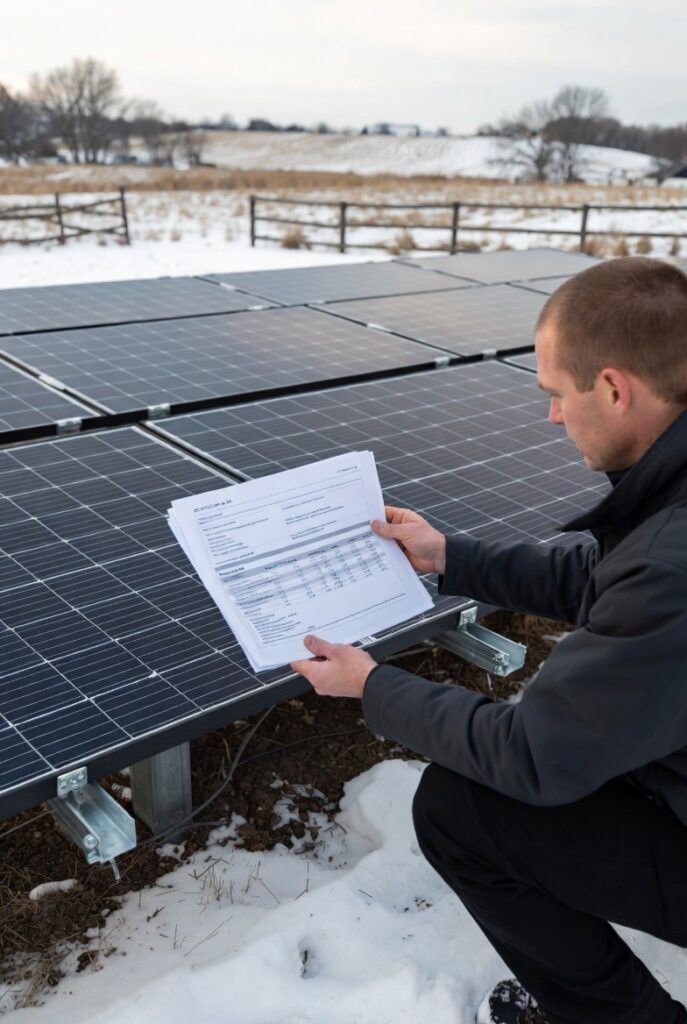
The best solar panels for an Ontario off-grid system are not the ones with the highest STC wattage rating, they are the ones that maintain output integrity when the temperature is -15C and the roof has 30cm of wet April snow on the frame. A homeowner on Edinburgh Road South in Guelph, Wellington County installed a 1,200W panel array in spring 2023. He chose budget panels rated to 2,400 Pa front load pressure, approximately 240 kg per square metre.
In April 2024 a heavy wet snowfall deposited 25cm of snow on the array. Two of the four panels developed micro-cracks across the cell strings under the wet snow load. The micro-cracks were invisible to the naked eye but appeared in the SmartShunt production data as a 22% output reduction from those two panels on every subsequent clear day.
The IEC 61215 standard for residential panel snow and wind loading requires a minimum 5,400 Pa front load for panels intended for permanent outdoor installation. His budget panels were rated to 2,400 Pa front load, exactly the minimum rear load standard, not the minimum front load standard. The distinction costs approximately $0.05 per watt more on a quality-tier panel. On his 1,200W array, choosing IEC 61215-compliant panels would have added approximately $60 to the original purchase price. The two damaged panels required replacement at approximately $280 each, a $560 repair on a $60 prevention.
I reviewed the replacement panel spec sheets with him after the incident. The replacement panels were monocrystalline PERC cells with full IEC 61215 certification including the 5,400 Pa snow load test. Their temperature coefficient of power was -0.35%/°C, standard for quality monocrystalline. At -15C, which is 40 degrees below the 25C STC rating, the power reduction is approximately 14%. The higher Voc in cold partially offsets this through improved MPPT harvesting efficiency, but the net cold-weather output for a quality monocrystalline panel is approximately 84 to 92% of STC wattage at -15C, a predictable, documented reduction, not a catastrophic failure.
Ontario winter production shortfalls come from 1.5 peak sun hours per day and snow cover, not from cold voltage instability. See our Ontario solar sizing guide before calculating your panel wattage requirement.
Best solar panels for Ontario: the three performance criteria that matter
Three specifications separate a best solar panels choice from one that is not: snow load rating, temperature coefficient of power, and LID resistance. Snow load: the IEC 61215 front load minimum of 5,400 Pa is the Ontario threshold, the Guelph Edinburgh Road result is the evidence for what happens when the frame meets only the 2,400 Pa rear load standard. Temperature coefficient of Pmax: quality monocrystalline at -0.35 to -0.45%/°C delivers approximately 84 to 92% of STC output at -15C, predictable, manageable, and far from the voltage instability that budget panels may exhibit.
LID: standard PERC cells lose 1.5 to 3% efficiency in their first 100 hours of operation, LID-treated PERC and TOPCon cells reduce this initial loss to below 1%.
| Specification | Budget tier | Mid-range tier | Premium tier |
|---|---|---|---|
| Snow load (IEC 61215) | 2,400 Pa (rear load only) | 5,400 Pa ✓ | 5,400 Pa ✓ |
| Temperature coeff. Pmax | -0.40 to -0.50%/°C (typical) | -0.35 to -0.40%/°C | -0.30 to -0.35%/°C |
| LID initial degradation | 2 to 4% (often undisclosed) | 1.5 to 3% PERC | Below 1% (TOPCon) |
| Cell technology | Polycrystalline or base PERC | Monocrystalline PERC | TOPCon or HJT |
| Bifacial option | Rarely available | Available ✓ | Available ✓ |
| Cost per watt (approx.) | $0.40 to $0.60 | $0.55 to $0.75 | $0.80 to $1.20 |
How to read these three specs on a panel data sheet. Find “Mechanical Load” in the specifications, the front load number must be 5,400 Pa or higher. Find “Temperature Coefficient of Pmax”, quality monocrystalline should be -0.35 to -0.45%/°C. Find “Initial LID” or “First Year Degradation”, if this line is absent entirely, the manufacturer has not characterised the degradation, which is a red flag for a long-term Ontario installation. See our beginner solar panel guide for how to compare panel data sheets before purchasing.
Snow load ratings: why 5,400 Pa is the Ontario minimum
The April wet snow event is the structural test that separates the best solar panels from budget options in Ontario. Dry January snow is light, 10 to 15cm of dry powder may load a panel at only 20 to 30 kg/m². Wet April snow is dense, 25cm of wet snow loads a panel at 300 to 400 kg/m² on a low-tilt surface. Budget panels rated to 2,400 Pa, approximately 245 kg/m², fail under this load. A quality IEC 61215-certified panel at 5,400 Pa, approximately 550 kg/m², handles the April wet snow event within its design envelope without frame deformation or cell micro-cracking.
The best solar panels still depend on correct tilt angle for optimal snow performance. At 30 degrees or above, wet snow slides more readily off the surface and the load that accumulates on the frame is lower. The Edinburgh Road South failure occurred on a 15-degree low-pitch installation where snow accumulated on the panel face with no natural slide path, the full wet snow load transferred to the panel surface.
A 45-degree installation of the same budget panel might have survived the same April event because the snow would have cleared before reaching the 2,400 Pa frame limit. However, the correct solution is a panel that meets the 5,400 Pa IEC 61215 front load standard, not relying on tilt angle to compensate for inadequate frame certification.
Cold temperature coefficient: what -0.35%/°C actually means for your winter output
Selecting the best solar panels for Ontario means understanding how cold temperature changes output, this is photovoltaic physics, not a panel quality variable. The MPPT charge controller harvests this higher Voc more efficiently than the lower Voc at STC. However, the temperature coefficient of Pmax is negative: output power is lower in cold than at 25C STC. At -15C, a quality monocrystalline panel with a -0.35%/°C coefficient delivers approximately 86% of STC power (40 degrees × 0.35% = 14% reduction). The net result after MPPT Voc compensation is approximately 84 to 92% of STC depending on the specific panel and controller combination, a modest predictable reduction, not a catastrophic loss.
The LID connection matters when choosing the best solar panels for Ontario long-term performance. A panel that has not undergone LID treatment loses 1.5 to 3% of initial efficiency in its first 100 hours of sun exposure, every panel, every season. A standard PERC panel at 3% LID that then operates at 86% of post-LID capacity in cold delivers approximately 83% of its original STC rating in a Guelph January.
A LID-treated PERC or TOPCon panel at 0.5% LID that then operates at 88% of post-LID capacity in cold delivers approximately 87.5% of original STC. The 4 to 5 percentage point difference accumulates every winter for 25 years. Over 25 Ontario winters, a 4% annual advantage in cold-weather output represents meaningful additional kWh from the same roof area.
Best solar panels for bifacial albedo: the Ontario snow bonus
The best solar panels for bifacial gain capture irradiance from both surfaces. Bifacial panels have active cells on both front and rear surfaces, capturing reflected irradiance from the ground and adjacent surfaces. Snow albedo, the reflectance of snow-covered ground, is 0.80 to 0.90, meaning snow reflects 80 to 90% of incident sunlight back upward. A bifacial panel on a ground mount or elevated bracket system in Ontario sees this reflected irradiance on its rear surface and converts it to additional electricity. The practical December and January albedo bonus from snow-covered Ontario ground: approximately 10 to 20% above the STC front-face rating on clear days with active snow cover.
A cottage owner on Regional Road 25 in Milton, Halton County installed a ground-mounted bifacial array in spring 2025 on a bracket system approximately 600mm above the lawn. In December 2025 her SmartShunt showed daily production totals well above what the array’s STC wattage would produce in Ontario’s 1.5 to 2.0 peak sun hours per day. On a clear December day with 20cm of snow cover the bifacial panels were capturing both direct and reflected irradiance, producing approximately 15 to 18% above the rated STC output.
Her 1,600W nominal bifacial array was delivering production equivalent to approximately 1,840 to 1,885W on clear snow-cover days. By February as the ground under the array lost snow cover, the bifacial gain dropped to approximately 8 to 10%. See our 400W panel guide for how bifacial panels compare against standard 400W monofacial units in an Ontario system. Bifacial gain only materialises on ground mounts or elevated roof mounts, flush-mounted roof panels see no rear surface irradiance and the bifacial premium is wasted in that configuration.
Pro Tip: The fastest way to check whether a panel you are considering actually meets IEC 61215 front load requirements is not to read the product listing headline, it is to download the full data sheet and find the “Mechanical Characteristics” or “Mechanical Load” table. The headline on a budget panel listing will often say “IEC 61215 certified” while the mechanical load table shows 2,400 Pa front load, which meets only the rear load portion of the IEC 61215 test suite. The full IEC 61215 snow load test requires 5,400 Pa front load. Both numbers appear in the data sheet under the same certification banner. The Edinburgh Road South homeowner’s panels said “IEC 61215” on the listing. The data sheet showed 2,400 Pa. The 5,400 Pa panels he replaced them with also said “IEC 61215.” The data sheet showed 5,400 Pa. One line in the mechanical load table is the difference between a $60 prevention and a $560 repair.
NEC and CEC: code requirements for Ontario solar panel installations
NEC 690 governs solar PV installations. Panel selection must comply with NEC 690.9 listing requirements, panels must be listed or field-evaluated for the application and must carry a recognised certification mark. IEC 61215 is the internationally recognised standard for crystalline silicon panels covering electrical performance, mechanical durability including snow and wind load, and environmental endurance. NEC 690 installations require panels to be installed per the manufacturer’s specifications, if a panel is rated for a 30-degree minimum tilt and the installer puts it at 10 degrees, any structural failure may fall outside the manufacturer’s warranty coverage and the installation may not comply with the original permit. Contact the NFPA at nfpa.org for current NEC 690 panel listing and installation requirements.
CEC Section 64 governs solar PV installations in Ontario. The ESA permit application for a panel installation must identify the panel model and certification standard, IEC 61215 certification documentation may be requested by the ESA inspector to confirm the panels are appropriate for the installation environment. Ontario roof and ground-mount structures must comply with applicable structural engineering requirements including snow and wind loading per the Ontario Building Code.
The panel’s IEC 61215 snow load rating confirms the panel itself is rated for the load the structure will experience, but it does not substitute for structural engineering of the mounting system. Contact the Electrical Safety Authority Ontario at esasafe.com before purchasing panels for a permitted Ontario solar installation to confirm current certification documentation requirements.
The best solar panels verdict: three tiers for Ontario off-grid systems
- Ontario off-grid owner selecting best solar panels for a shed, workshop, or small backup system: the budget tier from a quality manufacturer with full IEC 61215 front load certification is the correct entry point. The Renogy 100W monocrystalline carries full IEC 61215 certification including the 5,400 Pa front load test, standard PERC cells, and a verified ASIN with Canadian availability. The Edinburgh Road South homeowner’s panel failure came from selecting a budget panel that did not carry full IEC 61215 front load certification, not from selecting a budget panel per se. A quality budget panel from a manufacturer that publishes the full mechanical load table in its data sheet is the appropriate entry point for any Ontario off-grid system. See our flexible panel guide for van and RV applications where rigid frame ratings differ.
- Ontario seasonal cottage owner installing a ground mount or elevated bracket system where bifacial gain is achievable: the mid-range bifacial tier produces a meaningful Ontario advantage that a monofacial panel at the same wattage cannot match. The Milton Regional Road 25 result confirms the December and January albedo bonus: 15 to 18% above STC on clear snow-cover days from a ground mount with 600mm of clearance. Over a full Ontario cottage season, a bifacial ground mount produces approximately 8 to 12% more annual energy than a monofacial installation of identical rated wattage. The 20 to 30% per-panel premium over budget monofacial recovers through the albedo bonus within 3 to 5 Ontario winters. The one condition: the installation must have open rear clearance. A bifacial panel mounted flush to a dark roof delivers no bifacial gain and is not worth the premium in that application.
- Ontario full-time off-grid homeowner with a constrained roof area who needs maximum wattage in minimum space: the premium TOPCon tier is the correct specification. High-efficiency TOPCon cells at 22% or above deliver more wattage per square metre of roof area than standard PERC at 19 to 20%, the critical variable when the roof area is fixed. The LID advantage compounds over a 25-year lifespan: a 1% LID difference at installation grows to approximately 2 to 3% cumulative advantage by year 10 as the LID-free TOPCon panel retains more of its initial efficiency rating. For a roof with 12 square metres of available panel space, a TOPCon array at 22% efficiency delivers approximately 2,640W rated versus a standard PERC array at 20% efficiency delivering approximately 2,400W, a 240W advantage from the same physical footprint.
Frequently Asked Questions
Q: What solar panel specifications matter most for Ontario winters?
A: Three specifications determine whether a panel is appropriate for Ontario off-grid installation. First: the IEC 61215 front load rating, it must be 5,400 Pa or higher to handle April wet snow events without frame or cell damage. Find this number in the data sheet’s “Mechanical Load” or “Mechanical Characteristics” table, not in the product listing headline. Second: temperature coefficient of Pmax, quality monocrystalline at -0.35 to -0.45%/°C delivers approximately 84 to 92% of STC output at -15C.
Third: initial LID, standard PERC cells at 1.5 to 3% initial degradation versus LID-treated or TOPCon cells at below 1%. The IEC 61215 front load rating is the most immediately consequential for Ontario buyers because one April wet snow event on an under-rated frame can produce the micro-crack scenario from the Edinburgh Road South result.
Q: Do bifacial solar panels actually work better in Ontario winter conditions?
A: Yes, but only when the installation configuration enables the rear surface to see reflected irradiance. A bifacial panel on a ground mount or elevated bracket system with 600mm or more of clearance behind the panel captures the albedo bonus from snow-covered Ontario ground, which reflects 80 to 90% of incident sunlight. The Milton Regional Road 25 result confirms a 15 to 18% production bonus above STC on clear December days with active snow cover, equivalent to adding a 240 to 288W panel to a 1,600W array at no additional hardware cost.
A bifacial panel flush-mounted on a dark roof sees no rear surface irradiance and produces no bifacial gain. The bifacial premium is worth paying only when the mount configuration actually enables the albedo effect.
Q: What is IEC 61215 and why does it matter for Ontario solar panel selection?
A: IEC 61215 is the international standard for crystalline silicon photovoltaic modules covering electrical performance, mechanical durability, and environmental endurance. For Ontario specifically, the mechanical load section is the critical component: the standard requires panels to pass a 5,400 Pa front load test simulating heavy snow and wind loads. Budget panels that carry an IEC 61215 designation but only meet the 2,400 Pa rear load portion of the test are not adequate for Ontario April wet snow events.
The test results appear in the data sheet’s mechanical characteristics table. A panel that passes the full IEC 61215 test suite including the 5,400 Pa front load is a panel that the manufacturer has submitted to independent testing and that the independent tester has confirmed meets the standard for permanent outdoor installation in demanding climates.
This build is engineered within the 48V DC Safety Ceiling. Diagnostic logic is based on 20+ years of technical service experience. All structural and electrical installations must be verified by a Licensed Professional and comply with your Local AHJ.
About the Author
Robert Bertrand spent 20 years as a service advisor in the automotive industry (Lexus and Nissan), where precision diagnostics, wiring integrity, and documentation standards were non-negotiable. He brings that same technical discipline to GridFree Guide, where he researches, tests, and documents off-grid solar systems for Ontario conditions. Based in Rockwood, Ontario, every article is built on verified specifications, manufacturer data, and the real-world climate constraints of Canadian off-grid living.
As an Amazon Associate I earn from qualifying purchases. This site also contains affiliate links to other products and services. GridFree Guide earns a small commission at no extra cost to you.