
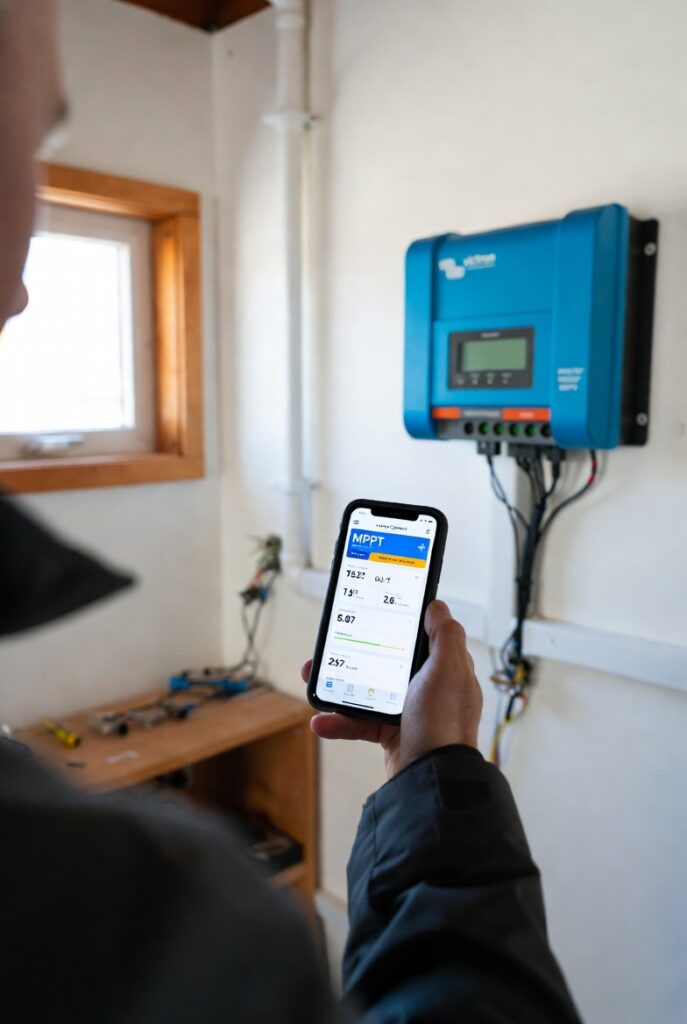
An MPPT charge controller is the component that determines how much of your panel’s available power actually reaches your battery, and in Ontario’s November low-light conditions, the difference between MPPT and PWM is approximately 28% of every watt your array produces. A homeowner on Clairfields Drive in Guelph, Wellington County installed a 400W panel array with a $35 PWM charge controller in spring 2023. He assumed the cheaper option was adequate.
His panels had a Vmp of approximately 18V and a Voc of 22.5V, while his battery bank was 12V nominal. The PWM controller clamped the panel operating voltage to approximately 14.4V, discarding the gap between 14.4V and the panel’s 18V Vmp. Each panel operated at approximately 65 to 72% of its rated wattage.
In November, with 1.5 to 2.0 peak sun hours per day, his 400W array delivered approximately 260 to 285W of effective harvest through the PWM controller instead of the 380 to 390W a quality MPPT charge controller would extract from the same panels. Over a clear November week at 1.8 peak sun hours, his PWM system produced approximately 3,276Wh. An MPPT charge controller on the same array would have produced approximately 4,704Wh, 1,428Wh more from the same panels, the same sun, and the same number of hours. He replaced the PWM controller with a Victron SmartSolar MPPT 100/30 in December for approximately $120.
I reviewed his November versus December production data side by side. The November average with PWM: 468Wh per day. The December average with the MPPT charge controller, a month with approximately 10 to 15% less peak sun than November: 589Wh per day. The MPPT charge controller overcame a shorter solar day and still delivered 26% more energy from the same panels. The $120 controller had effectively added the output of a fifth panel to his 400W array without a single new solar panel being installed.
The $35 PWM had been costing him approximately 120Wh per day across the entire active season, power he had been attributing to cloudy weather rather than a controller efficiency problem. See our Ontario solar sizing guide before calculating your array wattage and controller sizing.
Why your MPPT charge controller recovers 28% that PWM leaves behind
PWM forces the panel to operate at battery voltage rather than at the panel’s maximum power point. On a 12V battery system with panels rated at 18V Vmp, the PWM controller clips the panel to the 14.4V absorption voltage, approximately 80% of the panel’s Vmp. At that operating point the panel delivers approximately 65 to 72% of its rated wattage depending on irradiance. In Ontario November low-light conditions, the gap between battery voltage and panel Vmp represents a larger percentage of the available harvest, so PWM losses are worst exactly when every watt counts most. The result is a controller that costs $35 but spends the Ontario winter quietly discarding 28% of every panel’s potential.
An MPPT charge controller tracks the panel’s maximum power point continuously using electronic measurement and adjusts in real time as irradiance changes. It uses DC-DC conversion to step the higher panel voltage down to battery voltage while increasing current, delivering approximately 93 to 98% of the panel’s available power to the battery. The Ontario November gain over PWM is typically 25 to 35% depending on the specific panel Vmp-to-battery voltage gap. The Clairfields Drive 28% result falls squarely within this expected range. See our Ontario solar panel guide for how panel Vmp and Voc specifications affect MPPT charge controller selection.
How to size your MPPT charge controller for Ontario cold Voc and array wattage
| Victron tier | Max input V | Max charge A | 12V array max | 24V array max | Ontario use case |
|---|---|---|---|---|---|
| SmartSolar 75/15 | 75V | 15A | ~150W | ~300W | Shed, van, starter system |
| SmartSolar 100/30 | 100V | 30A | ~288W | ~576W | Ontario cottage standard |
| SmartSolar 100/50 | 100V | 50A | ~480W | ~960W | Full cottage, large systems |
The MPPT charge controller sizing formula: (array wattage x 1.25 safety factor) divided by system voltage = minimum controller charge current. For a 400W array on a 12V battery: (400 x 1.25) divided by 12 = 41.7A, which requires the MPPT 100/50 (50A), not the MPPT 100/30 (30A). For the same 400W array on a 24V battery: (400 x 1.25) divided by 24 = 20.8A, and the MPPT 100/30 (30A) is adequate with headroom. Moving from 12V to 24V halves the required controller current for the same array wattage, which is one of the practical reasons 24V systems use smaller MPPT charge controllers for the same solar output.
The cold Voc calculation is the step most Ontario buyers skip. Every monocrystalline panel has a temperature coefficient of Voc, typically -0.27 to -0.34 percent per degree C. Voc increases as temperature decreases. A Renogy 100W panel with a 22.5V Voc at 25C STC reaches approximately 25.4V at -20C (45 degrees below STC x 0.29% = 13.05% increase). In a three-panel series string: 25.4V x 3 = 76.3V, within the 100V limit.
In a four-panel string: 101.6V, exceeding the 100V input limit and triggering over-voltage shutdown. The Ontario cold morning rule: Voc at STC x 1.15 safety factor x number of series panels must be below the controller’s max input voltage. See our Ontario off-grid roadmap for how MPPT charge controller sizing fits into the full six-step system design sequence.
The cold morning Voc spike: Ontario’s most missed string voltage calculation
A cottage owner on Regional Road 9 in Milton, Halton County had a 3-panel string of 36V nominal panels wired in series feeding her MPPT charge controller. Her panels had a rated Voc of 44.5V at STC. In series, the string Voc at 25C was 44.5V x 3 = 133.5V, already exceeding the 100V max input of the Victron MPPT 100/30 at room temperature, before any cold morning adjustment. On a clear cold January morning at approximately -15C, the string voltage reached approximately 44.5V x 1.12 = 49.8V x 3 = 149.4V. The controller triggered its over-voltage protection shutdown every clear morning before the panels warmed up, producing zero output on the best production days of the month.
Her installer identified the string voltage issue during a spring commissioning check. The three-panel string exceeded the 100V input limit at every temperature from STC downward. The cold morning spike made it dramatically worse. The solution: reduce to 2 panels in series (2 x 49.8V = 99.6V cold Voc, still close to the limit) or move to a Victron 150V input controller. She moved to 2 panels in series with the third panel in a separate parallel string. The cold-morning shutdowns stopped immediately. The 1.15 safety factor applied at design stage catches this scenario before installation: three 44.5V Voc panels x 1.15 = 153.4V, immediately flagging the need for a 150V input controller or a reduced string length.
Pro Tip: The fastest way to identify whether a system is suffering from PWM efficiency loss or a cold Voc shutdown is to check the Victron SmartShunt production logs for two specific patterns. PWM loss shows as consistently lower daily harvest in November through February compared to summer, proportionally lower than the sun hour reduction alone would explain. Cold Voc shutdown shows as zero production on clear cold mornings until approximately 10 AM, then normal production once the panels warm above 0C. PWM loss is gradual and seasonal. Cold Voc shutdown is abrupt and morning-specific on clear days only. Both patterns are visible in the SmartShunt history with a 5-minute review. If you see either, the fix is a controller upgrade, not more panels.
NEC and CEC: code requirements for charge controller installations in Ontario
NEC 690 governs solar PV installations. The MPPT charge controller is part of the PV source circuit and must be listed for the application under NEC 690.35 or equivalent. NEC 690 requires that the controller’s maximum input voltage rating equal or exceed the open circuit voltage of the connected PV source circuit under the coldest expected temperature conditions, specifically the cold morning Voc spike that Ontario installers must calculate before selecting a controller.
An MPPT charge controller whose max input is exceeded by a cold-morning Voc spike is not in compliance with NEC 690 voltage rating requirements, and any failure resulting from overvoltage is outside the manufacturer’s warranty coverage. Contact the NFPA at nfpa.org for current NEC 690 requirements for charge controller voltage ratings in residential PV installations.
CEC Section 64 governs solar PV installations in Ontario. The MPPT charge controller must be installed in accordance with the manufacturer’s specifications as documented in the ESA permit application. The permit must identify the controller model, its maximum input voltage, and the connected string configuration, including the calculated cold Voc to confirm the string voltage does not exceed the controller’s rated input at Ontario minimum temperatures. An ESA inspector reviewing a permitted installation may ask the permit holder to demonstrate that the string voltage calculation accounts for cold morning conditions. Contact the Electrical Safety Authority Ontario at esasafe.com before purchasing an MPPT charge controller for a permitted Ontario solar installation to confirm current documentation requirements.
The MPPT charge controller verdict: three Victron tiers for Ontario off-grid
- Ontario off-grid owner currently using a PWM controller: replace with an MPPT charge controller before the next November. The Clairfields Drive result quantifies exactly what the upgrade is worth: approximately 120Wh per day of recoverable harvest abandoned to PWM inefficiency across every low-light hour of the Ontario winter. A Victron SmartSolar MPPT 100/30 at approximately $120 returns its cost in recovered harvest within 4 to 6 weeks of Ontario winter operation and then delivers that additional harvest for the remaining 10 to 15-year lifespan of the system. Confirm the sizing formula before purchasing: a 400W array on a 12V battery requires the MPPT 100/50, not the 100/30. The sizing error is as common as the PWM-to-MPPT upgrade itself.
- Ontario off-grid owner planning a new system: run both calculations before ordering the MPPT charge controller. First: (array wattage x 1.25) divided by system voltage = minimum controller charge current. Second: Voc at STC x 1.15 x number of series panels, confirmed below the controller’s max input voltage. These two calculations together take 5 minutes and prevent both the cold-morning Voc shutdown that the Milton Regional Road 9 owner experienced and the undersized controller problem that clips summer harvest. The MPPT 100/30 is the Ontario cottage standard for 24V systems up to approximately 576W. The MPPT 100/50 handles larger arrays. Both include Bluetooth monitoring through the Victron Connect app, so you can check production from inside the cottage on a cold January morning without visiting the equipment room.
- Ontario off-grid owner whose system shuts down on cold clear mornings: the cold Voc spike is the most likely cause. Check the controller’s max input voltage specification. Calculate Voc at STC x 1.15 x number of series panels and compare to the input limit. If the result is at or above the limit, either reduce the series string length or upgrade to a 150V input controller. The SmartShunt production log will show the pattern clearly: zero output on clear cold mornings until approximately 10 AM, then normal production as the panels warm. That signature is immediately distinguishable from genuine cloudy-day low output. See our battery inverter guide for how the MPPT charge controller integrates with the full system component chain.
Frequently Asked Questions
Q: What is the difference between MPPT and PWM charge controllers for Ontario off-grid systems?
A: An MPPT charge controller tracks the panel’s maximum power point electronically and uses DC-DC conversion to step higher panel voltage down to battery voltage while increasing current, delivering approximately 93 to 98% of the panel’s available power to the battery. A PWM controller forces the panel to operate at battery voltage, discarding the voltage gap between the panel’s Vmp and the battery’s absorption voltage. In Ontario November conditions with 1.5 to 2.0 peak sun hours per day, the MPPT charge controller delivers approximately 25 to 35% more harvest from the same panels.
The Clairfields Drive result, 468Wh per day PWM versus 589Wh per day MPPT on the same 400W array, is a real-world confirmation of the efficiency gap that Ontario winters make most visible.
Q: How do I calculate the cold morning Voc spike for my Ontario solar array?
A: Multiply the panel’s rated Voc at STC by 1.15 as a safety factor for Ontario cold mornings down to approximately -20C. Then multiply that result by the number of panels wired in series in the string. Confirm the final number is below the MPPT charge controller’s max input voltage rating. Example: three panels at 44.5V Voc each: 44.5V x 1.15 = 51.2V x 3 = 153.5V, which exceeds the 100V input limit of the Victron MPPT 100/30 and requires either a 2-panel string or a move to a 150V input controller.
The Milton Regional Road 9 cold-morning shutdown was produced by exactly this scenario. The calculation takes 2 minutes and prevents a system that shuts down on the best production days of the Ontario winter.
Q: What size Victron MPPT charge controller do I need for my system?
A: Calculate (array wattage x 1.25) divided by system voltage = minimum controller charge current in amps. A 400W array on a 12V battery: (400 x 1.25) divided by 12 = 41.7A, which requires the MPPT 100/50 (50A rated). The same 400W array on a 24V battery: (400 x 1.25) divided by 24 = 20.8A, and the MPPT 100/30 (30A) is adequate. Moving to 24V halves the controller current requirement for the same array. Then confirm the cold Voc calculation: Voc per panel x 1.15 x number of series panels must be below the controller’s 100V max input. Both calculations are required as an undersized controller clips summer harvest, and an under-rated input voltage trips on cold Ontario winter mornings.
This build is engineered within the 48V DC Safety Ceiling. Diagnostic logic is based on 20+ years of technical service experience. All structural and electrical installations must be verified by a Licensed Professional and comply with your Local AHJ.
About the Author
Robert Bertrand spent 20 years as a service advisor in the automotive industry (Lexus and Nissan), where precision diagnostics, wiring integrity, and documentation standards were non-negotiable. He brings that same technical discipline to GridFree Guide, where he researches, tests, and documents off-grid solar systems for Ontario conditions. Based in Rockwood, Ontario, every article is built on verified specifications, manufacturer data, and the real-world climate constraints of Canadian off-grid living.
As an Amazon Associate I earn from qualifying purchases. This site also contains affiliate links to other products and services. GridFree Guide earns a small commission at no extra cost to you.