
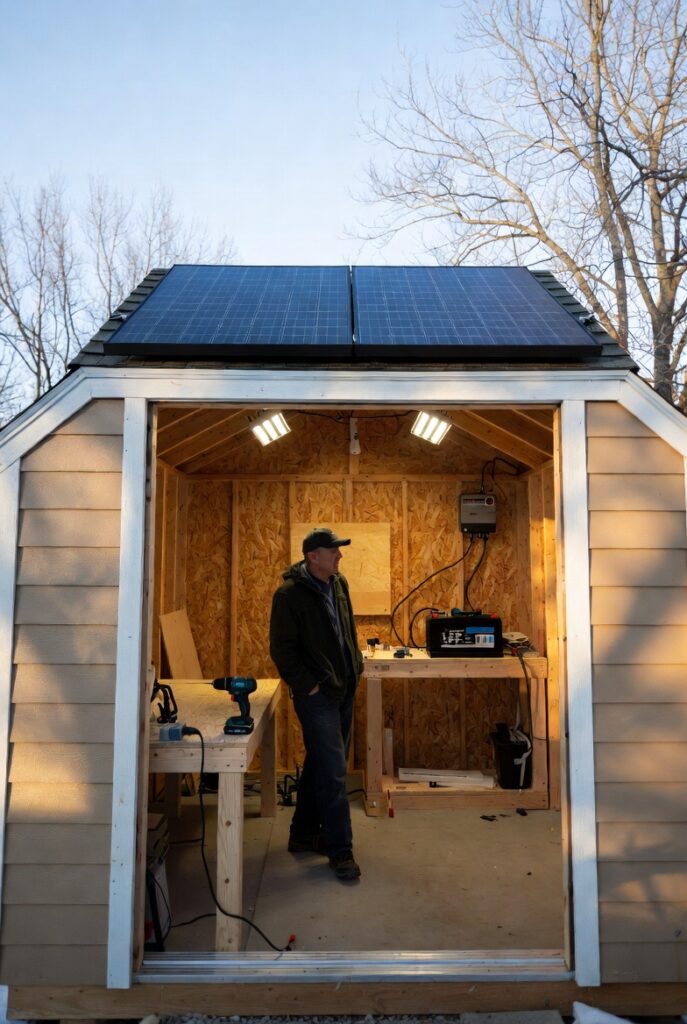
A solar power shed system in Ontario almost always costs less than burying 60 metres of cable from the house, and it produces electricity for free for the next 25 years. A homeowner on Kortright Road East in Guelph, Wellington County had a 12 by 16-foot workshop shed approximately 60 metres from his house. He called an electrician for a quote to run a proper 15A circuit to the shed. The quote came back at approximately $1,800 for cable, conduit, trenching, and the permit for a buried 60-metre run. He decided to price a solar option instead.
Two Renogy 100W monocrystalline panels, a 100Ah LFP battery, a Victron SmartSolar MPPT controller, and a 500W pure sine wave inverter came to approximately $650 in components plus approximately $120 for the ESA permit on the roof mount. His total solar power shed cost was approximately $770, less than half the trench quote. The solar power shed system has been running for two full Ontario seasons since spring 2023. His daily workshop load is approximately 120 to 180Wh: LED shop lights for 3 hours at 36W, a Milwaukee rapid charger for 1 hour at 75W, and a phone charger for 2 hours at 10W.
I reviewed his January production logs at the one-year mark. His worst week, four consecutive overcast days in mid-January, pulled the battery from 95% to 32% SoC before clearing. The LED lights and tool charging continued through the entire stretch without interruption because the 100Ah LFP bank holds approximately 80Ah of usable capacity at 80% DoD, enough for approximately 3 days of his 120Wh daily load before the generator was needed.
He runs the shed year-round, pays nothing for the electricity, and spent approximately $770 total for a system the electrical trench quote alone would have cost $1,800 to establish. The solar power shed system will still be producing in 2048. See our Ontario solar sizing guide before calculating your specific shed load.
What a solar power shed system can and cannot run in Ontario
| Load | Wattage | Daily use | Daily Wh | Tier 1 compatible? |
|---|---|---|---|---|
| LED shop lights | 20 to 40W | 3 to 4 hrs | 60 to 160Wh | Yes ✓ |
| Phone / tablet charging | 10W | 2 hrs | 20Wh | Yes ✓ |
| Cordless tool rapid charger | 60 to 90W | 1 hr | 60 to 90Wh | Yes, pure sine wave required |
| Laptop | 45 to 65W | 2 hrs | 90 to 130Wh | Yes ✓ |
| Dremel / rotary tool | 35W | 30 min | 17Wh | Yes ✓ |
| Electric space heater | 1,500W | Any | N/A | No, exceeds system |
| Table saw | 1,800 to 3,500W surge | Any | N/A | No, inverter trip |
| Shop vac (8 gal) | 1,200 to 1,400W | Any | N/A | No, overcurrent risk |
A Tier 1 solar power shed system handles the typical Wellington County workshop daily load of approximately 120 to 300Wh: shop lighting, phone and tablet charging, cordless tool rapid chargers, a Dremel, and a laptop. The one critical rule for tool chargers: DeWalt and Milwaukee rapid chargers contain active power factor correction circuits that require a pure sine wave inverter. A modified sine wave inverter may damage or fail to charge an $80 to $150 cordless tool battery pack. The pure sine wave requirement is non-negotiable for any solar power shed system powering modern cordless tool chargers. See our beginner solar panel guide before selecting panels for your shed roof.
A Tier 1 solar power shed system cannot support high-draw tools or heating loads. A space heater at 1,500W exceeds the inverter and battery capacity within minutes. A table saw at 1,800 to 3,500W surge immediately trips the inverter peak protection. An 8-gallon shop vac at 1,200 to 1,400W creates overcurrent risk for both the inverter and the BMS. An air compressor with a tank draws 1,000 to 1,500W at startup, exceeding the Tier 1 inverter continuous rating. These loads require a Tier 2 or Tier 3 system with a larger inverter and battery bank. The Tier 1 solar power shed system is the right tool for lighting and tool charging, not for power-hungry shop equipment.
The four-component Tier 1 build: panel, controller, battery, inverter
The panel is the foundation of the solar power shed system. Two Renogy 100W monocrystalline panels provide 200W total, which is the minimum for reliable Ontario winter operation including tool charging. One 100W panel is adequate only for lighting and phone charging, it cannot sustain tool charging during January gray streaks at 1.5 to 2.0 peak sun hours. The Renogy 100W starter kit includes a PWM controller as a convenient bundle, but for Ontario winters an MPPT controller upgrade is worth the additional $80 to $120, it recovers approximately 25 to 30% more harvest in November through February, the months when every watt matters most.
The battery should be 100Ah LFP for 80Ah of usable capacity at 80% DoD. Lead acid is acceptable for budget builds at 50Ah usable. A 500W pure sine wave inverter is the minimum for tool charger compatibility. See our MPPT charge controller guide for the full Ontario winter efficiency comparison.
Total cost ranges for a Tier 1 solar power shed system. DIY component sourcing: 200W panels, MPPT controller, 100Ah LFP battery, 500W pure sine wave inverter: approximately $620 to $700. Starter kit approach with MPPT upgrade: approximately $650 to $750. Add professional installation at $300 to $500 in labour and $150 to $250 for the ESA permit. Total professionally installed Tier 1 solar power shed: approximately $1,100 to $1,500, still below the Guelph $1,800 trench quote for a 60-metre buried circuit. The DIY owner with basic electrical skills can install the surface-mounted components themselves, with the ESA inspection confirming the wiring before the permit is closed.
Solar power shed vs the trench: the Ontario cost comparison
The 10-year cost comparison makes the solar power shed case clearly. A $1,800 trench with $70 per month in hydro delivery and consumption charges: Year 1 = $2,640, Year 5 = $6,000, Year 10 = $10,200. The solar power shed at $770 installed: Year 1 = $770, Year 5 = $770, Year 10 = $770 plus approximately $120 in generator fuel for winter supplement. The solar power shed pays for itself against the trench option in the first month of operation.
The Milton Derry Road cottage owner spent $280 on a bunkie starter system, discovered her actual load profile (laptop drew 65W, not the phone charger she had assumed as her heaviest load), and avoided a $4,000 oversizing error on the main cottage solar system that spring.
The trench is the right choice in three specific scenarios. If the shed is within 15 metres of an accessible electrical panel, the trench cost drops to approximately $400 to $600 and the solar advantage narrows. If the shed requires 240V for a table saw, welder, or air compressor above 20A, a grid connection is the only viable option as Tier 1 solar power shed systems do not support 240V loads.
If the shed is a commercial workspace with daily high-draw tool use, a Tier 3 system at $15,000 to $30,000 may be required and the economics shift. For a weekend Wellington County workshop with 120 to 300Wh of daily load and more than 30 metres from the house, the solar power shed system wins the cost comparison decisively in year one. See our Ontario off-grid solar cost guide for the full tier comparison from Tier 1 through Tier 3.
Pro Tip: Before buying a single panel for a solar power shed system, spend one weekend in the shed with a simple plug-in watt meter attached to each tool and appliance you plan to power. Write down the wattage of each load and how many hours per day you actually use it. The Milton Derry Road bunkie owner discovered her laptop drew 65W, double the phone charger she had budgeted as her heaviest load, and her fridge startup surge immediately tripped the inverter she had planned to use. That $280 learning experience prevented a $4,000 mistake on the main cottage system. The shed system is the lowest-stakes environment available for learning what your loads actually draw. Use it before committing to a full system design.
NEC and CEC: Ontario permit requirements for shed solar installations
NEC 690 governs solar PV installations including shed-mounted systems. A permanently installed solar panel and battery system on a detached shed is a solar PV installation under NEC 690 regardless of building type. NEC 690 requires appropriate overcurrent protection on all DC conductors, a disconnecting means for the battery and panel circuits, and listed equipment throughout. The shed structure’s attachment points for panel mounting must comply with applicable structural loading requirements including Ontario snow load. A permitted installation requires a single-line diagram showing the panel, controller, battery, and inverter connections with conductor sizes and overcurrent protection ratings. Contact the NFPA at nfpa.org for current NEC 690 requirements applicable to residential shed solar installations.
CEC Section 64 governs battery installations in Ontario. A permanently mounted solar panel and battery system on a detached shed requires an ESA permit regardless of system size. Plug-and-play portable systems placed temporarily on a flat surface may not trigger the permit requirement, but any installation involving roof penetrations, conduit runs, or permanent battery wiring connections requires a permit. The ESA permit covers the panel mounting, charge controller connections, battery wiring, and inverter output circuit.
Without a permit the installation is uninsured, and any electrical fault or fire involving an unpermitted shed system may void the homeowner’s property insurance for both the shed and its contents. Contact the Electrical Safety Authority Ontario at esasafe.com before installing any permanent solar power shed system in Ontario.
The solar power shed verdict: three Wellington County property profiles
- Ontario property owner with a workshop shed 40 metres or more from the house facing a trench quote above $1,200: a Tier 1 solar power shed system at $770 to $1,500 installed is the financially rational choice. The Guelph Kortright Road result is the proof: $770 total, two full seasons of LED lighting and cordless tool charging, approximately 8 generator days per month in January and February, and free electricity from May through October. The system produces until at least 2048 with no monthly bill. The trench quote runs to $10,200 by year 10 including ongoing hydro charges. Request the trench quote for due diligence, but run the solar numbers first, starting with the load audit from the table above.
- Ontario cottage or property owner who wants to build a larger solar system but has no experience with solar components: use the shed or bunkie as a learning system first. The Milton Derry Road result confirms the value: $280 starter kit, real load measurements, $4,000 oversizing error avoided on the main cottage build. The bunkie teaches battery depletion rates in real Ontario conditions, inverter overload limits from real startup surges, and load audit discipline at low stakes where a wrong guess costs $280, not $8,000. Every lesson from the shed transfers directly to the full system design. The Renogy 100W starter kit is the correct entry point for this learning path.
- Ontario property owner who wants a solar power shed system that can eventually expand to the main house: start with a 24V system architecture from day one. A 24V shed system with a 100Ah LFP bank expands by adding a second battery in parallel for a 200Ah bank, adding a second panel string to the MPPT controller, and upgrading the inverter, all within the existing 24V architecture. A 12V shed system that outgrows its components requires a full rebuild to reach 24V for a whole-home application. The architectural decision on day one costs nothing and preserves the full expansion path. Confirm the MPPT controller selected handles both the current shed string wattage and the future expanded array wattage before purchasing.
Frequently Asked Questions
Q: How much does a basic solar power shed system cost in Ontario?
A: A Tier 1 solar power shed system costs approximately $770 DIY-installed or $1,100 to $1,500 professionally installed including the ESA permit. The DIY component list for a 200W array, MPPT controller, 100Ah LFP battery, and 500W pure sine wave inverter runs approximately $620 to $700 in parts. The Renogy 100W starter kit at approximately $120 provides the panel and cables in a convenient bundle, add an MPPT controller separately for Ontario winter efficiency. The ESA permit adds $150 to $250. Compare this total to the electrician trench quote for a 60-metre buried circuit, which typically runs $1,500 to $2,500 in Ontario before ongoing monthly hydro charges.
Q: Can I run cordless tool chargers from a solar power shed system?
A: Yes, with one non-negotiable requirement: the inverter must be a pure sine wave model. DeWalt and Milwaukee rapid chargers contain active power factor correction circuits that require clean sine wave power. A modified sine wave inverter may damage the charger electronics or fail to charge the battery pack reliably. A 500W pure sine wave inverter handles a rapid charger at 60 to 90W with substantial headroom remaining for LED shop lights and other small loads simultaneously. Budget approximately $80 to $150 for a quality 500W pure sine wave inverter, the cost of one cordless tool battery pack that a modified sine wave inverter could destroy in a single charging session.
Q: Do I need an ESA permit for a solar power shed installation in Ontario?
A: Yes, for any permanent installation. Any solar power shed system involving roof penetrations for panel mounting, conduit runs through the shed wall, or permanent battery wiring connections requires an ESA permit in Ontario. A plug-and-play portable kit sitting on a flat surface inside the shed may not trigger the permit requirement, but it is also an uninsured installation, any fire or electrical fault associated with an unpermitted system may void the property insurance on the shed and its contents. The ESA permit for a Tier 1 shed system costs approximately $150 to $250 and includes an inspection that confirms the installation is safe. Contact esasafe.com before any permanent installation.
This build is engineered within the 48V DC Safety Ceiling. Diagnostic logic is based on 20+ years of technical service experience. All structural and electrical installations must be verified by a Licensed Professional and comply with your Local AHJ.
About the Author
Robert Bertrand spent 20 years as a service advisor in the automotive industry (Lexus and Nissan), where precision diagnostics, wiring integrity, and documentation standards were non-negotiable. He brings that same technical discipline to GridFree Guide, where he researches, tests, and documents off-grid solar systems for Ontario conditions. Based in Rockwood, Ontario, every article is built on verified specifications, manufacturer data, and the real-world climate constraints of Canadian off-grid living.
As an Amazon Associate I earn from qualifying purchases. This site also contains affiliate links to other products and services. GridFree Guide earns a small commission at no extra cost to you.