
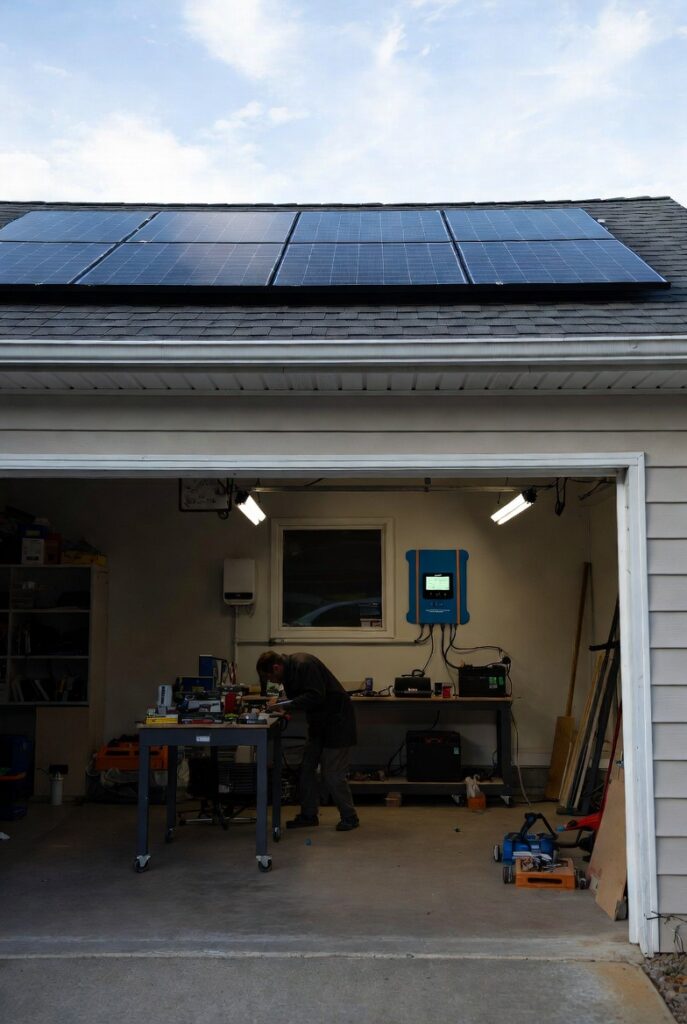
A solar garage system in Ontario is one of the most cost-effective first projects available to a property owner, a detached garage has no existing electrical service, no panel upgrade required, and no utility permission needed for a self-contained off-grid installation. In spring 2023, a homeowner on Woodlawn Road West in Guelph, Wellington County installed a 200W solar panel array and a 1,000W pure sine wave inverter on his detached woodshop garage.
His system powered LED shop lighting at approximately 60W, a battery charger for his 18V drill at approximately 40W, and a small Bluetooth speaker at approximately 5W without any issues. Total daily load: approximately 300 to 400Wh per day, well within the 200W array output on clear Ontario days.
In September he added a small 1HP air compressor to blow off the workbench and pressurize a nail gun. The first time he started the compressor with the inverter running his lighting and charger, the inverter tripped its overload protection. He reset it and tried again, it tripped again. He replaced the 1,000W inverter with a 2,000W unit at approximately $180 additional cost. The 2,000W inverter with a 4,000W surge rating handled the 1HP compressor startup without a single trip.
I reviewed the corrected system at the commissioning check in October 2023. The 1HP air compressor draws approximately 800 to 900W while running but surges to approximately 1,800 to 2,200W for 0.3 to 0.5 seconds at startup. A 1,000W inverter with a 1,500W surge rating cannot absorb a 2,200W motor inrush without tripping. The correct specification for any solar garage running motor loads is to size the inverter surge rating above the highest motor startup draw in the workshop. The Victron SmartShunt confirmed the compressor’s startup current spike: a sharp 180A spike at 12V lasting approximately 0.4 seconds, equivalent to 2,160W. See our Ontario solar sizing guide before selecting an inverter for any solar garage with motor loads.
The three solar garage load tiers: match your system to your tools
| Tier | Array | Battery | Inverter | Typical loads | System cost |
|---|---|---|---|---|---|
| Tier 1: Basic shed | 100 to 200W | 50 to 100Ah LFP | 300 to 600W | LED lights, phone, speaker | $300 to $700 |
| Tier 2: Active workshop | 200 to 400W | 100Ah LFP 24V | 2,000W/4,000W surge | + Tools, angle grinder, compressor | $700 to $1,500 |
| Tier 3: Full service bay | 600W+ | 200Ah+ LFP 24V | 2,000-3,000W/6,000W surge | + Fridge, EV trickle, heavy tools | $2,000 to $4,000 |
Tier 1 suits the casual hobbyist who needs visibility and device charging. A 100 to 200W array with a 50 to 100Ah LFP battery and a 300 to 600W inverter powers LED shop lights, phone charging, and a Bluetooth speaker at approximately 200 to 400Wh per day. A single Renogy 100W monocrystalline panel mounted on the garage roof handles this tier on most Ontario clear days. No motor loads, no surge risk, and total system cost of approximately $300 to $700, often less than running a trench from the main panel.
Tier 2 is the active workshop sweet spot for most Ontario DIY owners. A 200 to 400W array, 100Ah LFP at 24V (1,920Wh usable), and a 2,000W/4,000W surge inverter covers LED lighting, cordless tool charging, angle grinder, and occasional compressor. A cottage owner on Main Street South in Milton, Halton County planned a Tier 2 solar garage from the start in 2024. His system: 400W array, 100Ah LFP at 24V, 2,000W/4,000W surge inverter.
He confirmed his surge rating exceeded the compressor startup draw before purchasing. Total system cost: approximately $1,100, versus a $3,800 trench quote for conventional electrical service. His solar garage ran one full Ontario year without a single inverter trip. Tier 3 for full service bays adds a Battle Born 100Ah LFP bank at 200Ah or more with a 6,000W surge inverter for compressors, fridges, and EV trickle charging. See our battery inverter guide for surge rating selection at each tier.
The solar garage compressor problem: why motor surge trips undersized inverters
A 1HP electric motor is rated at approximately 746W but draws approximately 800 to 900W while running. Startup inrush (LRA, Locked Rotor Amperage) is typically 3 to 5 times the running current, resulting in a startup wattage of approximately 1,800 to 2,200W for 0.3 to 0.5 seconds. The Woodlawn Road West Guelph result confirms the physics: 180A spike at 12V equals 2,160W of startup demand, confirmed in the SmartShunt logs. A 1,000W inverter with a 1,500W surge rating cannot absorb this inrush. A 2,000W inverter with a 4,000W surge rating handles it with comfortable headroom.
The sizing calculation is straightforward. Check the compressor nameplate for LRA or startup watts. Multiply LRA by voltage to get startup wattage. Add a 25% safety margin. Select a solar garage inverter with a surge rating above this number. A table saw, dust collector, and air compressor all carry motor loads, if the solar garage will run multiple motor loads, size the inverter for the highest single motor startup plus the combined running load of all concurrent loads. The Woodlawn Road West $180 upgrade from a 1,000W to a 2,000W inverter is the cost of skipping this calculation upfront.
Pro Tip: The SmartShunt is the best tool for sizing a solar garage inverter for motor loads you haven’t measured yet. Connect the SmartShunt to the battery bank and run each motor load one at a time while watching the real-time current reading. The maximum current spike during startup in amps, multiplied by the battery voltage, gives the startup wattage in watts. A 180A spike on a 12V bank is 2,160W. A 250A spike on a 24V bank is 6,000W. Read the actual startup wattage for every motor in the workshop before finalising the inverter specification, the compressor and the table saw will likely surprise you. This measurement takes approximately 5 minutes per tool and eliminates every inverter trip that would otherwise happen after installation.
The Ontario winter reality: January production and workshop scheduling
A 200W array on a clear Ontario January day at 1.5 peak sun hours produces approximately 200 x 1.5 x 0.80 = 240Wh. That covers approximately 4 hours of 60W LED lighting. For active workshop use including tool charging and occasional hand tools, a Tier 2 400W array produces approximately 480Wh on a clear January day, enough for approximately 2.5 hours of active workshop load at 200W average. January is the planning constraint, size the battery bank for the intended hours of workshop use on a fully overcast day, not just the average daily production.
The correct Ontario winter solar garage scheduling approach: run energy-intensive loads (angle grinder, compressor) during midday when the array is producing at peak. Reserve lighting-only use for evenings from stored battery energy. A 100Ah LFP at 24V provides 1,920Wh of usable stored energy, enough for approximately 3 to 4 hours of active Tier 2 workshop use from storage alone. On a clear January day with 480Wh of solar production and a full bank, the solar garage can support a full afternoon of active work. See our solar battery bank sizing guide for the full 3-day reserve formula.
The electric heater trap: why 38 minutes ends your workday
A 1,500W electric space heater draws 1,500W continuously. A 100Ah LFP battery at 12V with 960Wh of usable capacity reaches low-battery cutoff in approximately 38 minutes at that draw. The heater consumes the entire clear January day’s solar production from a 200W array in approximately 16 minutes. Electric space heaters are the single fastest path to a dead solar garage battery bank in Ontario winter, eliminating the stored energy that should be reserved for lighting and tools.
The correct Ontario winter garage heating solution is propane for warmth and solar for light and power tools. A small propane heater on a 20 lb tank provides several hours of workshop warmth at minimal cost without drawing a single watt from the battery bank. See our propane guide for how a propane supply system can serve both the workshop heater and a backup generator from the same tank. Reserve solar garage production for LED lighting, cordless tool charging, and the compressor, the loads that propane cannot replace.
NEC and CEC: Ontario requirements for detached garage solar installations
NEC 690 governs solar PV installations. A solar garage off-grid system permanently installed on a detached garage must comply with NEC 690 requirements for panel mounting, DC wiring, overcurrent protection, disconnecting means, and battery storage. The DC wiring from the panels to the charge controller and battery bank must be sized for the panel short-circuit current (Isc) plus a 25% safety factor. The inverter output circuit must comply with NEC 240 branch circuit requirements with appropriate overcurrent protection for any AC loads.
If the solar garage system is the only electrical service to the detached garage, no utility interconnection is involved and no net metering application is required. Contact the NFPA at nfpa.org for current NEC 690 requirements for standalone off-grid solar PV installations on residential structures.
CEC Section 64 governs solar PV installations in Ontario. A permanently installed solar garage system on a detached garage requires an ESA permit. The permit application must identify the panel array, charge controller, battery bank, inverter, and overcurrent protection at each circuit. A solar garage system entirely self-contained with no connection to the home’s main electrical panel or utility grid is simpler to permit than a grid-tied or hybrid system. The ESA permit covers the electrical installation; a building permit may be required for the panel roof mount depending on local municipality requirements. Contact the Electrical Safety Authority Ontario at esasafe.com before installing any permanent solar garage system in Ontario.
The solar garage verdict: which tier fits your Ontario workshop
- Ontario property owner with a detached garage used for basic storage, occasional lighting, and phone charging: Tier 1 is the correct specification. A single Renogy 100W panel with a 50 to 100Ah LFP battery and a 300 to 600W inverter provides reliable LED lighting and device charging for approximately $300 to $700 installed. This typically costs less than running even a short trench from the main panel for a new dedicated circuit. The solar garage Tier 1 system installs in half a day with no motor loads and no surge risk. No ESA permit is required for portable use, though a permanent installation requires one.
- Ontario property owner with an active weekend workshop including cordless tools, an angle grinder, and occasional compressor use: Tier 2 is the correct specification. The Milton Main Street South result confirms the numbers: 400W array, 100Ah LFP at 24V, 2,000W/4,000W surge inverter, $1,100 total, no inverter trips in one full year versus a $3,800 trench quote. Size the inverter surge rating above the compressor startup wattage before purchasing. The Woodlawn Road West result shows the cost of skipping this: $180 for an inverter replacement after installation. Use the SmartShunt to measure actual motor startup wattage before selecting the inverter.
- Ontario property owner running a full automotive or professional service bay with a compressor, fridge, multiple power tools, and year-round use: Tier 3 is the correct specification. A 600W or larger panel array with 200Ah or more of LFP at 24V and a 2,000 to 3,000W/4,000 to 6,000W surge inverter handles the full workshop load including compressor startup. The electric heater trap applies at this tier too: do not add electric space heating to the Tier 3 load calculation. Propane handles Ontario winter garage warmth at a fraction of the battery cost. A correctly sized Tier 3 solar garage system delivers workshop power at total system cost below what many Ontario electricians quote for running a new service from the main panel to a detached garage.
Frequently Asked Questions
Q: How many solar panels do I need for a detached garage in Ontario?
A: One 100W panel covers Tier 1 basic lighting and phone charging at approximately 200 to 240Wh per clear Ontario day. Two 100W panels (200W total) provide adequate Tier 1 production with reserve for overcast days. A Tier 2 active workshop requires 200 to 400W, two to four 100W panels or equivalent. A Tier 3 full service bay requires 600W or more. For each tier, confirm January production first: 200W x 1.5 PSH x 0.80 = 240Wh per clear winter day. Build the battery bank to bridge the gap between solar production and daily workshop load on overcast days.
Q: Can I run an air compressor on solar power in my garage?
A: Yes, with the correct inverter. A 1HP air compressor surges to approximately 1,800 to 2,200W at startup and draws 800 to 900W while running. Your solar garage inverter must have a surge rating that exceeds the startup wattage, a 2,000W continuous / 4,000W surge inverter handles a standard 1HP compressor reliably. The Woodlawn Road West Guelph result confirms the failure mode: a 1,000W/1,500W surge inverter trips every time the 1HP compressor starts. Check the compressor nameplate for LRA (Locked Rotor Amperage), multiply by voltage to get startup watts, add 25%, and select a solar garage inverter with a surge rating above that number.
Q: Why does my inverter keep tripping when I start my tools?
A: Motor startup inrush current is the cause. Every electric motor draws 3 to 5 times its running current for a fraction of a second when starting, producing a wattage spike that exceeds the inverter’s surge protection threshold. If the inverter surge rating is below the motor’s startup wattage, it trips the overload protection. The fix: replace the inverter with one whose surge rating exceeds the highest motor startup wattage in the solar garage. Use the SmartShunt to measure the actual startup current spike in amps for each motor, multiply by battery voltage to get startup watts, then select an inverter rated 25% above the highest reading.
This build is engineered within the 48V DC Safety Ceiling. Diagnostic logic is based on 20+ years of technical service experience. All structural and electrical installations must be verified by a Licensed Professional and comply with your Local AHJ.
About the Author
Robert Bertrand spent 20 years as a service advisor in the automotive industry (Lexus and Nissan), where precision diagnostics, wiring integrity, and documentation standards were non-negotiable. He brings that same technical discipline to GridFree Guide, where he researches, tests, and documents off-grid solar systems for Ontario conditions. Based in Rockwood, Ontario, every article is built on verified specifications, manufacturer data, and the real-world climate constraints of Canadian off-grid living.
As an Amazon Associate I earn from qualifying purchases. This site also contains affiliate links to other products and services. GridFree Guide earns a small commission at no extra cost to you.