
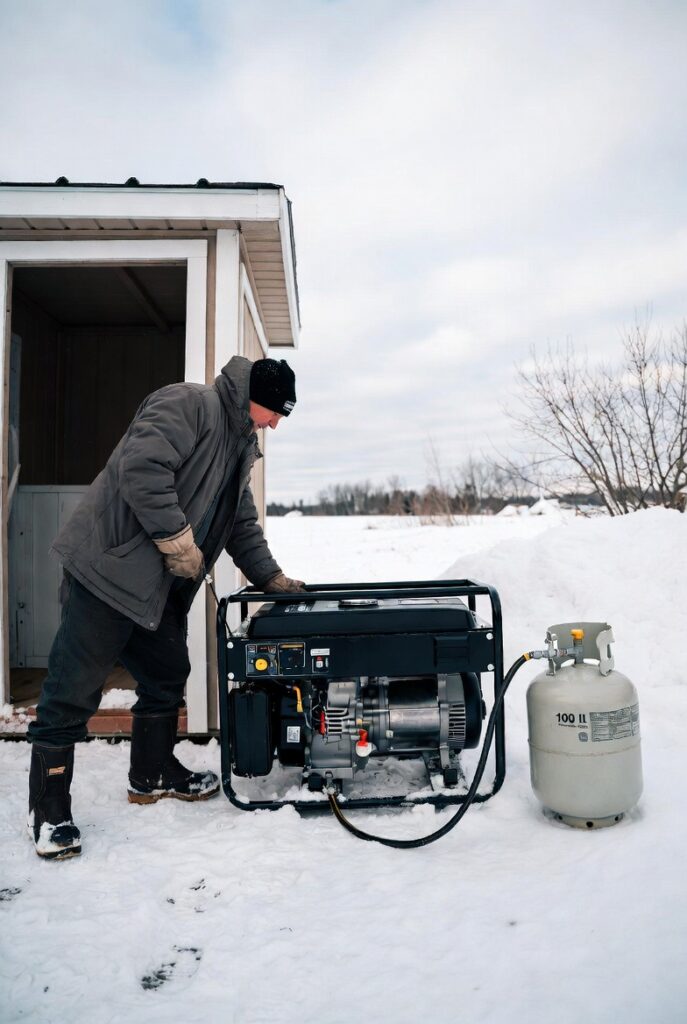
A propane generator starts on the first pull at -15C in a Wellington County February when a gasoline generator with six-month-old fuel will not start at all. A homeowner on Kortright Road in Guelph, Wellington County installed a 2,500W gasoline generator as his backup power source when he commissioned his off-grid shed system in August 2023. He tested it in September and it started on the second pull and ran cleanly.
He did not use it again until a 4-day February gray streak in 2024. On the morning of day 3 the battery bank had dropped to 22% SoC. The generator would not start after approximately 30 pull cord attempts, the carburetor was gummed with oxidised E10 ethanol fuel sitting since September.
He removed the carburetor, brought it inside to warm up, spent approximately 4 hours disassembling, cleaning, and reassembling it, and attempted to start again the following morning. The generator started but ran rough and cut out under load. He charged the battery bank partially before the engine died again. Total repair and partial charging time: approximately 8 hours across two days, during which the battery bank reached the low-voltage cutoff twice. He replaced the gasoline unit with a 3,000W propane generator the following spring and has not had a cold-start failure in two subsequent Ontario winters.
I reviewed his corrected system at the commissioning check in April 2024. The propane generator drew from his existing 100 lb tank shared with his propane tankless water heater, requiring no new fuel infrastructure. E10 ethanol gasoline begins to phase-separate and gum carburetor jets in as little as 30 to 60 days in humid storage conditions. Propane stores indefinitely with no degradation. His new propane generator starts on the first pull at any Ontario ambient temperature down to approximately -42C, the point at which propane liquefies in the tank.
The Victron SmartShunt confirmed the first post-swap gray streak charge cycle completed in 2.5 hours at 55% to 95% SoC. See our Ontario solar sizing guide before designing a backup generation strategy.
The Ontario gasoline failure: what happens when the carburetor gums in February
| Comparison | Propane generator | Gasoline generator |
|---|---|---|
| Cold-start at -15C | First pull ✓ | May not start ✗ |
| Fuel shelf life (untreated) | Indefinite | 30 to 60 days |
| Fuel shelf life (with stabiliser) | Indefinite | ~12 months |
| Carburetor gumming risk | None (no ethanol) | High (E10 ethanol) |
| Shared appliance supply | Yes (LP line) | No (separate fuel) |
| 4-day gray streak fuel cost | ~$7.20 | ~$60 to $80 |
E10 ethanol gasoline phase separation occurs because ethanol absorbs water from the air. In humid Ontario winter storage the water-ethanol mixture settles at the bottom of the fuel tank. A cold-start attempt draws this water-contaminated fuel into the carburetor jets, which are sized for fuel and not water. Gumming from oxidised ethanol clogs the main jet in 30 to 60 days in humid storage without fuel stabiliser. For a seasonal property owner who stores the generator from August through a February gray streak, six months of untreated E10 in the tank is the reliable path to the Kortright Road scenario.
The fuel stabiliser workaround requires active management that seasonal property owners typically miss. Sta-Bil or similar stabiliser extends gasoline shelf life to approximately 12 months if added at the time of storage with a fresh full fuel fill. The stabiliser must go in at shutdown in August, not after gumming has already occurred in February. Propane eliminates this maintenance cycle entirely: it stores indefinitely without treatment, contains no ethanol, and leaves no residue in the fuel delivery system. See our solar generator vs battery bank guide for how backup generation fits into the overall off-grid storage strategy.
Why a propane generator outperforms gasoline for Ontario off-grid backup
Propane remains liquid and fully vaporisable to approximately -42C, ensuring cold-start reliability at any Ontario ambient temperature. Gasoline carburetors do not gel at Ontario winter temperatures but carburetor icing in humid cold air is a documented small-engine failure mode at -10C and below. The Kortright Road result is the data point: 30 pull cord attempts on a gasoline generator at -15C versus first-pull start on propane at the same temperature. Fuel shelf life advantage is indefinite for propane versus 30 to 60 days for untreated E10 gasoline in humid storage.
The one-tank system advantage compounds the reliability benefit. A propane generator connects to the same LP supply line as the propane tankless water heater, absorption fridge, or space heater already on the property. One 100 lb or 420 lb tank services all propane appliances simultaneously. One delivery, one tank, one fuel management task. The shared supply means a 420 lb tank filled once in September provides backup generator fuel, hot water, and refrigeration through an entire Ontario winter without a second delivery. See our off-grid propane appliances guide for TSSA compliance requirements when connecting multiple propane appliances to a single Ontario supply system.
The propane generator charge strategy: fill the bank, not the loads
The correct backup generation approach is to run the propane generator for 2 to 3 hours per day during a gray streak to charge the battery bank from approximately 40 to 50% SoC to 90 to 95% SoC, then shut it off and let the battery bank power all house loads silently. A cottage owner on Trafalgar Road in Milton, Halton County ran a 5,000W gasoline generator continuously for 8 to 10 hours per day during gray streaks in 2022 and 2023, attempting to power loads directly from the generator output.
The generator consumed approximately 3 to 4 litres per hour at partial load, approximately 30 to 40 litres per day. His fuel cost for a 4-day gray streak: approximately $60 to $80 at $1.80/litre Ontario gasoline pricing, and the generator noise made the cottage uninhabitable during run hours.
In spring 2024 he replaced the gasoline unit with a 2,500W propane generator sized to his Victron MultiPlus 12/3000 charger, which draws approximately 1,500W AC input at maximum charge rate. He now runs the propane generator for 2 to 3 hours per morning during gray streaks to charge the bank from 40% to 90% SoC and shuts it off. His Victron SmartShunt confirms the charge cycle is complete when the battery current taper drops below 10A.
The propane cost for a 4-day gray streak using approximately 6 litres of propane at $1.20/litre is approximately $7.20, versus $60 to $80 in gasoline. His cottage is quiet for 21 to 22 hours per day during gray streaks instead of running a generator all day.
Pro Tip: The SmartShunt is the tool that tells you when to stop running the generator. During the bulk charging phase, the current from the generator charger into the battery bank stays high, typically 50 to 100A depending on charger rating. As the bank reaches 90% SoC, the charger enters the absorption phase and the current tapers. When the SmartShunt shows the charging current has dropped to approximately 10A or below, the bulk phase is complete. Stopping the generator at this point and letting the next day’s solar handle the remaining 5 to 10% saves approximately 30 to 45 minutes of propane generator runtime per session, approximately 0.3 to 0.5 kg of propane per session, or 1 to 2 kg per gray streak. Over a full Ontario winter with 6 to 8 gray streak events, that is approximately 6 to 16 kg of propane saved, approximately $15 to $30 at current Ontario propane retail pricing.
The sizing calculation: match the backup charger, not the house load
Size the propane generator to the battery charger’s maximum AC input draw, not to the total house load. A quality multi-stage charger such as a Victron MultiPlus draws a specific AC wattage to deliver its rated DC charge current to the Battle Born 100Ah LFP battery bank. The Victron MultiPlus 12/3000 in charge-only mode draws approximately 1,000 to 1,500W AC input at configurable charge current. A propane generator rated at 125 to 150% of this charger input draw provides adequate headroom without oversizing: a 1,500W charger requires a 1,875 to 2,250W generator, making a 2,500W propane generator the correct specification.
Running the propane generator at 60% of rated load keeps it in its efficiency zone, reduces engine temperature, and extends service intervals compared to running at 90% or above. A 2,500W propane generator at 50% load (1,250W) consumes approximately 0.5 to 0.6 kg of propane per hour. A 100 lb (45 kg) propane tank provides approximately 75 to 90 hours of operation at this load, sufficient for 37 to 45 charging sessions of approximately 2 hours each.
For a Wellington County property with 6 to 8 gray streak events per Ontario winter at 2 sessions per event, one 100 lb tank comfortably covers a full winter of backup charging. See our solar battery bank sizing guide for the battery bank formula that determines the bank size the propane generator needs to restore.
NEC and CEC: Ontario requirements for backup generator installations
NEC 690 governs solar PV installations. NEC 700 and NEC 702 govern emergency and optional standby power systems, which include backup generator connections in residential off-grid systems. A propane generator connected to the home electrical panel via a transfer switch must comply with NEC 702 optional standby system requirements. The transfer switch must be rated for the generator output and must prevent backfeed to the solar inverter or battery system during generator operation.
The DC battery bank charging circuit from the generator is governed by NEC 690 battery storage requirements when the charger is part of the solar-connected system. Contact the NFPA at nfpa.org for current NEC 690, NEC 700, and NEC 702 requirements for residential backup generator installations connected to solar PV systems.
CEC Section 64 governs solar PV installations in Ontario. A propane generator permanently connected to an off-grid system requires an ESA permit for the electrical connection. The permit application must identify the generator, the transfer switch, the connection method to the battery charger or inverter-charger, and the overcurrent protection at each circuit. A portable propane generator using a 20 lb tank and plugged into an extension cord does not typically require an ESA permit, but any permanently wired connection from the generator to the home electrical panel or battery charger does.
The TSSA Act governs propane gas connections in Ontario, a fixed LP supply line connecting the propane generator to an on-site tank must be installed by a TSSA-licensed gas fitter. Contact the Electrical Safety Authority Ontario at esasafe.com before permanently wiring any backup generator into an Ontario off-grid installation.
The propane generator verdict: sizing and fuel savings for Ontario gray streaks
- Ontario off-grid property owner whose gasoline backup generator failed to start during the last gray streak: replace it with a propane unit sized to 125 to 150% of the battery charger’s maximum AC input. The Kortright Road Guelph result is the cost of the gasoline alternative: 8 hours of repair time and two low-voltage cutoffs during a critical February gray streak. A 2,500W to 3,000W propane generator sized to a Victron MultiPlus charger provides first-pull reliability at any Ontario ambient temperature and eliminates the carburetor maintenance cycle that six months of E10 storage creates. The existing 100 lb propane tank already supplying the tankless water heater extends to the generator without a second tank or delivery.
- Ontario off-grid owner currently running a generator for extended hours to power loads directly: switch to the charge-the-bank strategy immediately. The Milton Trafalgar Road result quantifies the improvement: $7.20 in propane per 4-day gray streak versus $60 to $80 in gasoline, and 21 to 22 hours of quiet per day versus continuous noise. Size the propane generator to the charger AC input, run it 2 to 3 hours per morning to reach 90 to 95% SoC, monitor the SmartShunt current taper to approximately 10A as the stop signal, then shut down. The battery bank powers all house loads silently for the remainder of the day.
- Ontario off-grid owner building a new system: include a propane generator as insurance but do not size the battery bank for generator dependency. Size the battery bank to survive a 4-day gray streak on solar production alone using the 3-day reserve formula from our solar battery bank sizing guide. The propane generator is the emergency reserve for gray streaks longer than 4 days, not the daily power source. A correctly sized solar-battery system with a 2,500W propane generator in reserve handles every Ontario winter scenario without daily generator runs.
Frequently Asked Questions
Q: Why does a propane generator start better than gasoline in Ontario winters?
A: Propane remains liquid and fully vaporisable to approximately -42C, providing reliable fuel delivery at any Ontario ambient temperature. Gasoline carburetors are susceptible to icing in humid cold air at -10C and below, and E10 ethanol gasoline stored without stabiliser begins to phase-separate and gum carburetor jets in 30 to 60 days in humid conditions. A gasoline generator stored from August through a February gray streak has six months of untreated E10 in the system. The Kortright Road Guelph result confirms the failure mode: 30 pull cord attempts on a -15C morning with a gummed carburetor versus first-pull start on propane at the same temperature and ambient conditions.
Q: How do I size a propane generator for my off-grid battery bank?
A: Size the propane generator to 125 to 150% of the battery charger’s maximum AC input draw, not to the total house load. Identify the charger’s maximum AC input wattage from the manufacturer datasheet, a Victron MultiPlus 12/3000 draws approximately 1,500W AC input at maximum charge rate. Multiply that figure by 1.25 to 1.50 to get the minimum generator rated wattage: 1,500W x 1.25 = 1,875W minimum, making a 2,500W propane generator the correct specification. Running the generator at 60% of rated load (1,500W charger on a 2,500W generator) keeps it in its peak efficiency zone and reduces engine wear compared to running at 90% or above.
Q: How much propane does a backup generator use during an Ontario gray streak?
A: A 2,500W propane generator at 50% load (1,250W) consumes approximately 0.5 to 0.6 kg of propane per hour. Running 2 to 3 hours per day during a 4-day gray streak consumes approximately 4 to 7 kg of propane total, at a retail propane cost of approximately $5 to $9 at current Ontario pricing. A 100 lb (45 kg) propane tank provides approximately 75 to 90 hours of operation at 50% load, sufficient for approximately 37 to 45 two-hour charging sessions. For a Wellington County property with 6 to 8 gray streak events per Ontario winter, one 100 lb tank comfortably covers a full season of propane generator backup charging without a refill mid-winter.
This build is engineered within the 48V DC Safety Ceiling. Diagnostic logic is based on 20+ years of technical service experience. All structural and electrical installations must be verified by a Licensed Professional and comply with your Local AHJ.
About the Author
Robert Bertrand spent 20 years as a service advisor in the automotive industry (Lexus and Nissan), where precision diagnostics, wiring integrity, and documentation standards were non-negotiable. He brings that same technical discipline to GridFree Guide, where he researches, tests, and documents off-grid solar systems for Ontario conditions. Based in Rockwood, Ontario, every article is built on verified specifications, manufacturer data, and the real-world climate constraints of Canadian off-grid living.
As an Amazon Associate I earn from qualifying purchases. This site also contains affiliate links to other products and services. GridFree Guide earns a small commission at no extra cost to you.