
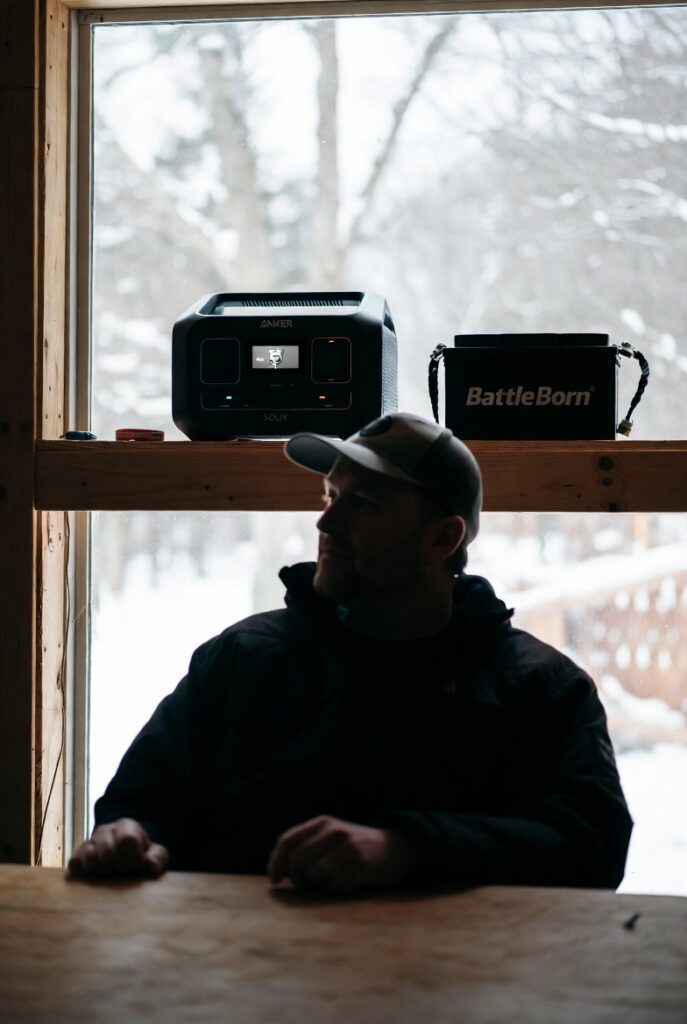
A solar generator and a custom LFP battery bank both store solar energy, but they answer different questions for Ontario off-grid buyers, one answers the question of convenience and the other answers the question of survival through a 4-day November gray streak. A homeowner on Woodlawn Road East in Guelph, Wellington County purchased an Anker SOLIX C1000 Gen 2 solar generator in spring 2024 for approximately $1,050 to power his off-grid cottage.
He connected a single 200W panel to the SOLIX solar input and used the system for four summer weekends with excellent results. The 1,056Wh LFP battery powered a small DC fridge at approximately 180Wh per day, Starlink at approximately 600Wh per day across 8 hours of use, and LED lighting at approximately 50Wh per day, approximately 830Wh total per day. On clear July days producing approximately 720Wh, the SOLIX maintained 85 to 95% SoC through each cottage weekend.
The first November gray streak changed the calculation entirely. Four consecutive overcast days produced approximately 120Wh per day from the 200W panel at 1.5 peak sun hours. His daily load of approximately 830Wh exceeded panel production by approximately 710Wh. By the afternoon of day 2 the SOLIX was below 20% SoC. By the morning of day 3 the low battery protection had shut down the AC output and the fridge, Starlink, and lighting were offline. He spent the remainder of the gray streak without internet or light until a clear day arrived on day 5. The solar generator had worked exactly as specified, but 1,056Wh of storage was approximately 25% of what a 4-day Ontario November gray streak actually required.
I reviewed the correct specification with him at the commissioning check in December 2024. The 4-day gray streak sizing formula: daily load x 4 days divided by DoD = rated battery capacity required. His calculation: 830 x 4 divided by 0.80 = 4,150Wh rated. The solar generator provided 1,056Wh, leaving him 3,094Wh short. The correct specification was a custom LFP battery bank: four Battle Born 100Ah LFP batteries at 24V provide 4,800Wh rated and 3,840Wh usable at 80% DoD, enough for 4.6 days at his load. See our Ontario solar sizing guide before selecting either option.
The solar generator option: what it does well and where it fails Ontario winters
| Feature | Solar generator (Anker SOLIX C1000 Gen 2) | Custom LFP battery bank (4 x Battle Born) |
|---|---|---|
| Rated capacity | 1,056Wh | 4,800Wh (4 x 1,200Wh) |
| Usable capacity (80% DoD) | ~1,056Wh (LFP, full rated) | 3,840Wh |
| Cost per Wh rated | $0.85 to $1.04/Wh | $0.67/Wh |
| Gray streak survival (830Wh/day) | ~1.2 days | 4.6 days ✓ |
| Setup time | 5 minutes | 6 to 8 hours |
| ESA permit (permanent) | Not required (portable) | Required |
| Expansion | Proprietary ~$700-$900/1,000Wh | Universal $0.67/Wh rated |
The Anker SOLIX C1000 Gen 2 solar generator delivers genuine convenience. Zero wiring, plug-and-play setup in approximately 5 minutes, 1,200W continuous AC output with a 2,400W surge, and solar input up to 600W. No ESA permit is required for portable use. At $900 to $1,100 CAD, the cost is approximately $0.85 to $1.04 per Wh rated. For a seasonal Ontario cottage with May through September occupancy, loads below 1,000Wh per day, and no winter exposure, the solar generator is competitive at this scale and is genuinely the correct first choice.
The solar generator fails when the use case shifts to year-round Ontario occupancy. The 1,056Wh covers approximately 1.2 days of an 830Wh daily load before entering low battery protection. Expansion is proprietary: the Anker SOLIX BP1000 adds 1,000Wh at approximately $700 to $900 per expansion pack. At 3,000Wh total with two expansion packs the system costs approximately $2,500. A custom LFP bank with three Battle Born batteries provides 3,600Wh rated for approximately $1,600. The cost crossover between the solar generator path and the custom bank path occurs at approximately 2,000Wh of desired capacity. See our battery inverter guide for the inverter sizing that pairs with a custom LFP bank.
The custom LFP battery bank: expandable, universal, and cheaper at scale
A property owner on Regional Road 25 in Milton, Halton County built a custom LFP battery bank in fall 2024. His system: 400W panel array, two Battle Born 100Ah batteries at 24V (2,400Wh rated, 1,920Wh usable at 80% DoD), Victron MPPT 100/30 controller, and a Victron SmartShunt for consumption monitoring. The build took approximately 8 hours including wiring, fuse installation, and initial configuration. His total system cost was approximately $2,100 including panels, batteries, controller, SmartShunt, wiring, and enclosure.
His December SmartShunt data showed the system surviving two consecutive 3-day gray streaks without dropping below 35% SoC, with the 400W array recovering the bank to 85% within two clear days following each gray streak. His cost at this scale, approximately $2,100 for 1,920Wh usable, works out to approximately $1.09 per usable Wh, comparable to the solar generator at small scale. At his next expansion to four Battle Born batteries (3,840Wh usable), the cost per usable Wh drops to approximately $0.55.
A solar generator with two proprietary expansion packs reaches approximately 3,000Wh usable at approximately $2,500, or $0.83 per usable Wh. The custom bank costs less per usable Wh at every scale above 2,000Wh. See our solar battery bank sizing guide for the full 3-day and 4-day reserve formula.
The 4-day gray streak test: the Ontario sizing calculation that decides the winner
The gray streak formula: (daily load Wh x 4 days) divided by 0.80 DoD = minimum rated battery capacity required. For the Woodlawn Road East Guelph load of 830Wh per day: 830 x 4 divided by 0.80 = 4,150Wh rated capacity required. The solar generator at 1,056Wh covers approximately 1.2 days, 25% of the requirement. Four Battle Born batteries at 24V provide 4,800Wh rated and 3,840Wh usable, covering approximately 4.6 days. The formula is the deciding test: any system intended for Ontario year-round operation must pass it on paper before any hardware is purchased.
Wellington County and Halton County experience gray streaks of 3 to 7 consecutive overcast days in November through February. A 200W panel produces approximately 120 to 240Wh per clear winter day at 1.5 to 2.0 peak sun hours. For conservative sizing, assume zero panel input during a gray streak, the system must survive entirely on stored energy. A solar generator at 1,056Wh cannot be expanded to pass this test without proprietary packs that cost more per Wh than a custom LFP bank. For any Ontario load above approximately 350Wh per day (the maximum the SOLIX can cover for 3 days), the custom battery bank is the only path to gray streak survival.
Pro Tip: Before purchasing either option, run the Ontario gray streak formula for your specific load profile. Step 1: add up your daily Wh load, fridge, Starlink or router, lighting, phone charging. Step 2: multiply by 4 (days of gray streak). Step 3: divide by 0.80 (LFP depth of discharge). The result is the minimum rated battery capacity you need. If that number is below 1,200Wh, the solar generator may be adequate. If it is above 2,000Wh, the custom LFP bank is the only cost-effective path. If it lands between 1,200Wh and 2,000Wh, compare the cost of one SOLIX expansion pack ($700-$900) against one additional Battle Born battery ($800 for 1,200Wh rated with universal compatibility), at that scale the numbers are close and the decision comes down to whether you want portable or permanent.
The solar generator vs battery bank cost comparison: cost per Wh at every scale
At 1,000Wh: the solar generator costs approximately $1,050 ($1.00/Wh rated). A custom bank at one Battle Born plus MPPT and wiring costs approximately $1,070 ($0.89/Wh rated), roughly equal. At 2,000Wh: the solar generator plus one expansion pack costs approximately $1,750 to $2,000 ($0.88 to $1.00/Wh), while two Battle Born batteries in a custom bank cost approximately $1,600 ($0.67/Wh rated). At 4,000Wh: the solar generator plus three expansion packs costs approximately $3,200 to $3,800 ($0.80 to $0.95/Wh), while four Battle Born batteries cost approximately $3,200 ($0.67/Wh rated). The custom bank offers a 20 to 30% cost advantage at the 4,000Wh scale.
The decision framework is straightforward once the capacity requirement is known. Below 1,500Wh desired capacity and seasonal or portable use: solar generator. Above 2,000Wh desired capacity or year-round Ontario property: custom LFP bank. Between 1,500Wh and 2,000Wh: calculate the expansion pack cost versus Battle Born cost at the next increment and choose based on whether portability or universal compatibility matters more for the specific property. See our Ontario off-grid cost guide for full Tier 1 through Tier 3 system cost breakdowns.
NEC and CEC: Ontario requirements for off-grid power storage installations
NEC 690 governs solar PV installations. A solar generator used as a portable device without permanent wiring is not subject to NEC 690 permit requirements, but any panel permanently mounted and wired to any charging input must comply with NEC 690 DC wiring requirements for overcurrent protection, wire sizing, and disconnecting means. A custom LFP battery bank permanently installed must comply with NEC 690 for the solar input wiring and NEC 480 for the battery installation, including battery enclosure, ventilation, and overcurrent protection at the battery terminals. Contact the NFPA at nfpa.org for current NEC 690 and NEC 480 requirements for residential solar PV and battery storage installations.
CEC Section 64 governs solar PV installations in Ontario. A permanently installed custom LFP battery bank connected to a solar array requires an ESA permit. The permit application must identify the panel array, the charge controller, the battery bank configuration, the battery enclosure, and the overcurrent protection at each circuit. A portable solar generator without permanent wiring does not typically require an ESA permit, but any permanent DC wiring connecting panels to a fixed charging input does. Before permanently mounting panels and wiring them to either a solar generator or a custom battery bank, contact the Electrical Safety Authority Ontario at esasafe.com to confirm the permit requirements for your specific Ontario installation.
The solar generator verdict: which Ontario property profile fits each option
- Ontario seasonal cottage or rental property owner with May through September occupancy and loads below 1,000Wh per day: the solar generator is the correct choice. The Anker SOLIX C1000 Gen 2 at $0.85 to $1.04/Wh rated requires zero electrical work, delivers 1,056Wh of LFP storage in a portable form factor, and powers a full cottage weekend on summer Ontario solar production. The November gray streak failure is not a concern if the property is closed before November. Add a second 200W panel to the SOLIX solar input if summer production is insufficient for all loads, the 600W solar input capacity has headroom for expansion within the solar generator ecosystem.
- Ontario year-round off-grid property owner with daily loads above 1,500Wh and a requirement to survive November through February: the custom LFP battery bank is the correct specification. The 4-day gray streak formula requires four Battle Born batteries at 24V for an 830Wh daily load, providing 3,840Wh usable at approximately $0.55/Wh usable at that scale. The cost per Wh advantage over the solar generator proprietary expansion path grows at every increment above 2,000Wh. Budget the 8-hour initial build time and the ESA permit accurately, these are real costs but one-time costs, while the lower cost per Wh compounds over the system life.
- Ontario property owner who wants to start with a solar generator for immediate power and expand to a custom bank after one full year of measured load data: this Phase 1 and Phase 2 strategy is valid. Use the solar generator for one full Ontario year, read the SmartShunt or SOLIX app data to confirm the actual daily load profile through each season, then size the custom LFP bank to the measured load rather than the estimated load. The Battle Born 100Ah LFP batteries remain available at the same price point when Phase 2 begins, and the 200W panel from Phase 1 becomes the foundation of the Phase 2 charging array.
Frequently Asked Questions
Q: Is a solar generator enough for a year-round Ontario off-grid cabin?
A: A solar generator at 1,056Wh is not sufficient for year-round Ontario use with typical continuous loads. The 4-day gray streak formula for a modest cabin load of 830Wh per day requires 4,150Wh rated capacity, the solar generator provides approximately 25% of that. Proprietary expansion packs can add capacity but at a higher cost per Wh than a custom LFP bank above 2,000Wh. For year-round Ontario use with a fridge, Starlink, and lighting running continuously, a custom LFP battery bank sized to the 4-day gray streak formula is the correct specification. The Woodlawn Road East Guelph result confirms the consequence of undersizing: 48 hours without power during a 4-day November gray streak.
Q: What is the cost per Wh of a solar generator vs a custom battery bank?
A: The Anker SOLIX C1000 Gen 2 solar generator costs approximately $0.85 to $1.04 per Wh rated at $900 to $1,100. A custom LFP bank using Battle Born 100Ah batteries costs approximately $0.67 per Wh rated at $800 per battery (1,200Wh rated). At 1,000Wh total desired capacity the costs are roughly equal. At 2,000Wh the custom bank costs approximately $1,600 ($0.67/Wh rated) versus the solar generator plus one expansion pack at $1,750 to $2,000 ($0.88 to $1.00/Wh). The custom bank cost advantage grows at every scale above 2,000Wh because each Battle Born battery adds 1,200Wh rated at $0.67/Wh with universal compatibility, while each solar generator expansion pack adds approximately 1,000Wh at $0.70 to $0.90/Wh within a proprietary ecosystem.
Q: How many batteries do I need to survive a 4-day Ontario gray streak?
A: Use the formula: (daily load Wh x 4 days) divided by 0.80 = rated battery capacity required. For an 830Wh daily load: 830 x 4 divided by 0.80 = 4,150Wh rated. Four Battle Born 100Ah LFP batteries at 24V provide 4,800Wh rated and 3,840Wh usable, covering approximately 4.6 days. For a lighter 400Wh daily load: 400 x 4 divided by 0.80 = 2,000Wh rated, two Battle Born batteries at 24V provide 2,400Wh rated, adequate for a 4-day gray streak with that load. Always run the formula for your specific measured daily load before purchasing any battery capacity, whether solar generator or custom LFP bank.
This build is engineered within the 48V DC Safety Ceiling. Diagnostic logic is based on 20+ years of technical service experience. All structural and electrical installations must be verified by a Licensed Professional and comply with your Local AHJ.
About the Author
Robert Bertrand spent 20 years as a service advisor in the automotive industry (Lexus and Nissan), where precision diagnostics, wiring integrity, and documentation standards were non-negotiable. He brings that same technical discipline to GridFree Guide, where he researches, tests, and documents off-grid solar systems for Ontario conditions. Based in Rockwood, Ontario, every article is built on verified specifications, manufacturer data, and the real-world climate constraints of Canadian off-grid living.
As an Amazon Associate I earn from qualifying purchases. This site also contains affiliate links to other products and services. GridFree Guide earns a small commission at no extra cost to you.