
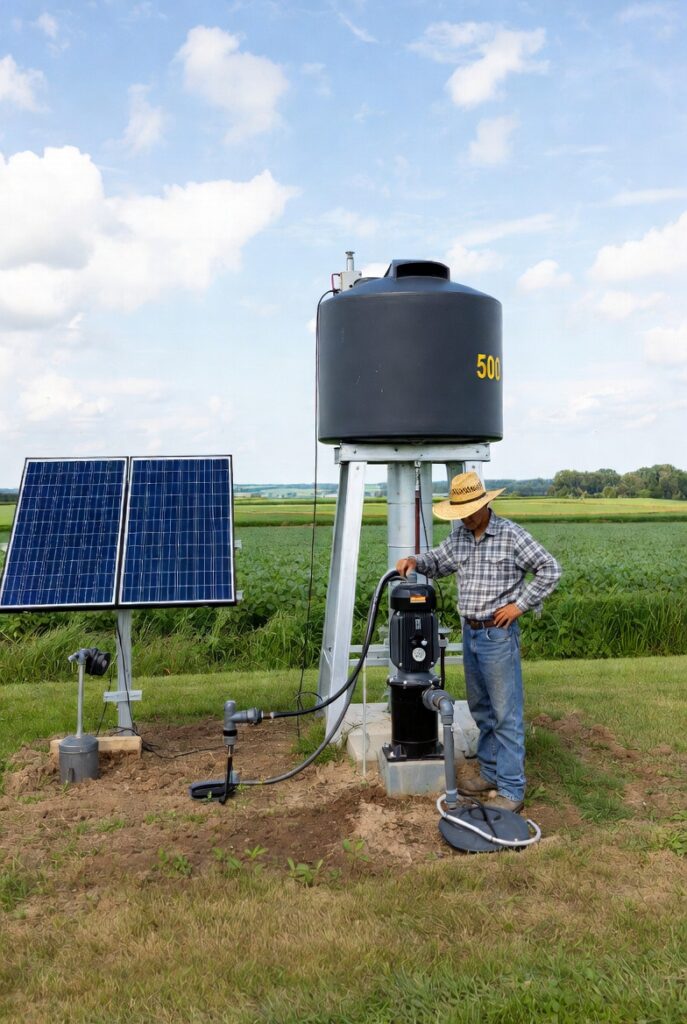
Off grid solar without a battery is not a compromise, for three specific Ontario use cases it is the more efficient, lower-cost, and lower-maintenance approach than any battery-buffered system. A farmer on Stone Road East in Guelph, Wellington County needed water for livestock at a paddock approximately 90 metres from his well. A battery-buffered off grid solar system with a 400W array, 100Ah LFP, MPPT controller, and DC pump would have cost approximately $2,200. Instead he installed a direct-coupled system: two Renogy 100W monocrystalline panels connected directly to a DC surface pump and a 500-gallon gravity-fed storage tank on an elevated platform for approximately $400 total.
His system has been running for two full Ontario seasons with zero battery maintenance. The pump starts automatically when panel voltage rises above the motor minimum start voltage, typically within 30 to 45 minutes of sunrise on clear days. The 500-gallon tank provides approximately 3 days of livestock water supply, so a 3-day Ontario gray streak does not interrupt the water supply as long as the tank was full at the start of the overcast period. He has never managed a battery SoC, replaced a cell, or configured a charging voltage.
I reviewed his system at the end of his first full summer of operation. His pump logs showed approximately 4.5 hours of daily operation on clear summer days at the 4.5 peak sun hours Ontario July average. The tank filled completely by approximately 2 PM on clear days and the float valve shut off the pump automatically. His off grid solar installation cost $400 and has delivered two years of continuous livestock water supply with no battery, no BMS, no inverter, and no charge controller settings to manage. The $1,800 saved over the battery-buffered approach funded two additional paddock improvements. See our Ontario solar sizing guide before designing any direct-coupled system.
The three off grid solar applications that work without a battery
| Application | How battery is avoided | Ontario cost (battery-free) | Works at night? | Gray streak tolerance |
|---|---|---|---|---|
| DC water pump | Gravity tank stores water | $300 to $600 | Gravity feed ✓ | Tank capacity days |
| Ventilation fan | Only needed in daylight | $100 to $200 | Not needed ✓ | Fan stops, acceptable |
| Grid-tied offset* | Grid is the storage medium | $800 to $2,000 | Grid power ✓ | Grid covers gaps ✓ |
*Grid-tied offset requires a Hydro One grid connection and net metering approval, it is NOT true off-grid solar.
The first battery-free off grid solar application is DC water pumping. The panel output connects directly to a DC pump motor, and the gravity-fed tank stores potential energy as water at height rather than electrical energy. The pump operates during daylight when panels produce adequate voltage, and a float valve controls the tank fill automatically. Wellington County applications include livestock watering, irrigation, garden pond circulation, and rain barrel pressurization. The key specification: the DC pump minimum start voltage must be below the panel morning output voltage, check the pump datasheet before purchasing. At 400W driving a pump at 5 gallons per minute, a 500-gallon tank fills in approximately 100 minutes on any clear Ontario summer day.
The second application is solar ventilation fans. A DC fan wired directly to the panel output runs when the sun heats the space and shuts off automatically at dusk, no timer, controller, or battery required. The fan runs hardest when the sun is strongest and the space is hottest, exactly when ventilation is most needed. Ontario applications include attic ventilation, greenhouse cooling, shed ventilation, and root cellar air circulation.
The third application is grid-tied daytime offset, which uses micro-inverters to feed panel output back to the home’s electrical panel with the Hydro One grid serving as the storage medium. This requires a grid connection and a Hydro One net metering agreement before commissioning, it is not standalone off grid solar but it eliminates the physical battery bank. A Victron MPPT 100/30 in battery-less mode stabilises output voltage for sensitive DC equipment without a battery connected, useful for loads with electronic motor controllers. See our MPPT charge controller guide for the full battery-less mode setup procedure.
What you give up with off grid solar without a battery: the honest trade-offs
Three loads cannot run on direct-coupled off grid solar. First: nighttime power. Panels produce nothing after sunset, any load that needs power after dark requires a battery bank. Second: continuous loads that must not be interrupted. A cottage owner on Derry Road in Milton, Halton County attempted to run his Starlink terminal directly from a 200W panel without a battery in spring 2024. Starlink draws approximately 50 to 75W continuously. On clear mornings the system worked from approximately 9 AM through 7 PM. The first cloud that reduced panel output below the micro-inverter minimum input threshold caused the Starlink terminal to lose power and begin rebooting, a cycle lasting approximately 90 seconds.
On a partly cloudy Ontario day the terminal rebooted approximately every 15 to 20 minutes through the afternoon. He added a 50Ah LFP battery at approximately $320 in May 2024 and the terminal has operated continuously through every subsequent Ontario partly cloudy day. The lesson: communications, security cameras, medical devices, and refrigeration are battery-dependent loads regardless of solar system size. Third: gray streak resilience beyond the tank’s stored water.
In Wellington County November, a single 200W panel may produce only 240Wh, enough to run a pump for approximately 1.5 to 2 hours per day. If livestock water demand exceeds what 2 hours of pumping can fill, the system cannot meet demand in January without tank reserves built during clearer days. See our solar battery bank sizing guide for when adding battery storage in Phase 2 makes economic sense.
Pro Tip: The fastest way to determine whether your specific use case qualifies for battery-free off grid solar is to answer two questions. First: does the load only need to run when the sun is shining? A ventilation fan and a water pump both pass this test. Starlink and a fridge both fail it. Second: can the load tolerate brief interruptions when clouds pass or the sun is low? A pump that pauses for 30 seconds when a cloud reduces panel voltage still fills the tank, the load is cloud-tolerant. A Starlink terminal that reboots for 90 seconds when panel voltage dips below the minimum is not cloud-tolerant, the load requires a buffer. If both questions answer yes, battery-free is viable. If either answers no, a battery is required and the Ontario 3-day gray streak sizing standard applies.
The cost comparison: battery-free vs battery-buffered systems
A direct-coupled 400W panel system for water pumping: panels at $150 to $200, DC pump at $80 to $150, float valve at $20, basic wiring and mounting at $50, approximately $300 to $420 total. A battery-buffered equivalent: panels at $150 to $200, MPPT controller at $120, 100Ah LFP battery at $400 to $800, DC pump at $80 to $150, enclosure at $50 to $100, approximately $800 to $1,350 total. The battery-free approach costs approximately 35 to 55% less for the same pumping function. The savings scale: a 1,200W direct-coupled pump system costs approximately $600 to $800, while the battery-buffered equivalent reaches $2,000 to $3,000.
The maintenance advantage compounds the cost saving over time. An LFP battery requires SoC monitoring, temperature management in Ontario winters (0C charging cutoff), annual capacity checks with a battery analyser, and eventual replacement at 8 to 14 years of service. A direct-coupled water pump system requires panel cleaning, float valve inspection, and tank maintenance, mechanical tasks with no electronics to configure or chemistry to monitor. For a rural Wellington County property owner who wants reliable livestock water without managing battery chemistry, the direct-coupled off grid solar system is the correct long-term approach. See our Ontario off-grid roadmap for how direct-coupled systems fit into the full six-step build sequence.
NEC and CEC: Ontario requirements for direct-coupled solar installations
NEC 690 governs solar PV installations. A direct-coupled off grid solar installation connecting panels directly to a DC load must comply with NEC 690 requirements for DC wiring, overcurrent protection, and disconnecting means. The DC wiring between the panel and the load must be sized for the panel short-circuit current (Isc) plus a 25% safety factor. An appropriately rated fuse or circuit breaker must be installed at the panel output and at the load input. The panel mounting must comply with NEC 690 structural and grounding requirements regardless of whether a battery is present in the system. Contact the NFPA at nfpa.org for current NEC 690 requirements for direct-coupled solar PV installations.
CEC Section 64 governs solar PV installations in Ontario. An off grid solar installation without a battery still requires an ESA permit if it is permanently installed. The permit application must identify the panel array configuration, the DC load wiring, and the overcurrent protection at each circuit. For a grid-tied daytime offset system using micro-inverters, a separate Hydro One net metering agreement is required in addition to the ESA permit, the net metering application must be submitted and approved before the system is commissioned and any power is fed to the grid. Contact the Electrical Safety Authority Ontario at esasafe.com before installing any permanent direct-coupled or grid-tied off grid solar installation in Ontario.
The off grid solar without battery verdict: which loads qualify
- Ontario rural or agricultural property owner needing water at a remote location: direct-coupled off grid solar water pumping is the correct specification. A 200 to 400W panel array driving a DC pump with a gravity-fed storage tank costs approximately $300 to $600 installed, 40 to 60% less than a battery-buffered equivalent. The tank stores energy as water at height, serves the load through the night from gravity, and tolerates multi-day gray streaks as long as the tank was full at the start of the overcast period. The Guelph Stone Road East result: $400 total cost, two full seasons of reliable livestock watering, zero battery maintenance. Start with the pump manufacturer minimum start voltage specification and size the panel array to reach that voltage before 9 AM on a clear Ontario day.
- Ontario greenhouse, shed, or attic owner needing daytime ventilation: direct-coupled off grid solar ventilation is the correct specification. A single Renogy 100W panel driving a DC fan costs approximately $100 to $200 in components and provides automatic ventilation during every hour of daylight without a timer, controller, or battery. The fan runs hardest when the sun is strongest and the space is hottest, perfect alignment with the ventilation need. No BMS, no charge controller, no maintenance cycle, no chemistry to monitor.
- Ontario cottage or property owner who wants Starlink, security cameras, or any other continuous load running without interruption: battery storage is mandatory. The Milton Derry Road result confirms the consequence of attempting direct-coupled off grid solar for a continuous load: cloud-induced reboots every 15 to 20 minutes on partly cloudy days. A 50Ah LFP battery at $320 solved the problem permanently by smoothing the voltage variations that direct panel connection cannot absorb. If adding a battery, size it using the 3-day Ontario gray streak formula from the battery bank guide: (daily load Wh x 3) divided by 0.80 DoD = rated battery capacity required.
Frequently Asked Questions
Q: Can I run solar panels without a battery in Ontario?
A: Yes, for specific daytime-only applications. A direct-coupled off grid solar system connects panels directly to a DC load such as a water pump or ventilation fan, with no battery, inverter, or charge controller required. The load runs when the sun is shining and stops when it is not. If the load can tolerate interruption and only needs to run during daylight, and the application has a way to serve the nighttime load without electrical storage, such as a gravity-fed water tank, battery-free off grid solar is viable and costs approximately 40 to 60% less than a battery-buffered equivalent. If the load needs uninterrupted power or must run after dark, a battery bank is required.
Q: What loads can run on direct-coupled solar without a battery?
A: Loads that only need to operate during daylight and can tolerate brief interruptions qualify for direct-coupled off grid solar without a battery. DC water pumps filling a gravity tank, DC ventilation fans, and DC irrigation pumps all meet this test. Loads that fail the test include Starlink and other internet terminals, security cameras and recorders, medical devices, refrigeration, lighting, and any appliance that must operate continuously regardless of sun position. The Milton Derry Road Starlink result is the definitive Ontario test case: 90-second reboot cycles every 15 to 20 minutes on a partly cloudy day confirm that communications loads require a battery buffer.
Q: How do I size a solar water pump system without a battery in Ontario?
A: Start with the pump manufacturer minimum start voltage specification and confirm your panel array produces that voltage before 9 AM on a clear Ontario day in the worst-case season (January, 1.5 peak sun hours). Then size the gravity tank to hold at least 3 days of water demand as the gray streak buffer. At 400W of direct-coupled panels driving a pump at 5 gallons per minute, a 500-gallon tank fills in approximately 100 minutes, achievable on any clear Ontario summer day at 4.5 peak sun hours. For Ontario January, confirm the daily pumping window at 1.5 peak sun hours provides enough water to fill or top up the tank against the livestock daily consumption.
This build is engineered within the 48V DC Safety Ceiling. Diagnostic logic is based on 20+ years of technical service experience. All structural and electrical installations must be verified by a Licensed Professional and comply with your Local AHJ.
About the Author
Robert Bertrand spent 20 years as a service advisor in the automotive industry (Lexus and Nissan), where precision diagnostics, wiring integrity, and documentation standards were non-negotiable. He brings that same technical discipline to GridFree Guide, where he researches, tests, and documents off-grid solar systems for Ontario conditions. Based in Rockwood, Ontario, every article is built on verified specifications, manufacturer data, and the real-world climate constraints of Canadian off-grid living.
As an Amazon Associate I earn from qualifying purchases. This site also contains affiliate links to other products and services. GridFree Guide earns a small commission at no extra cost to you.