
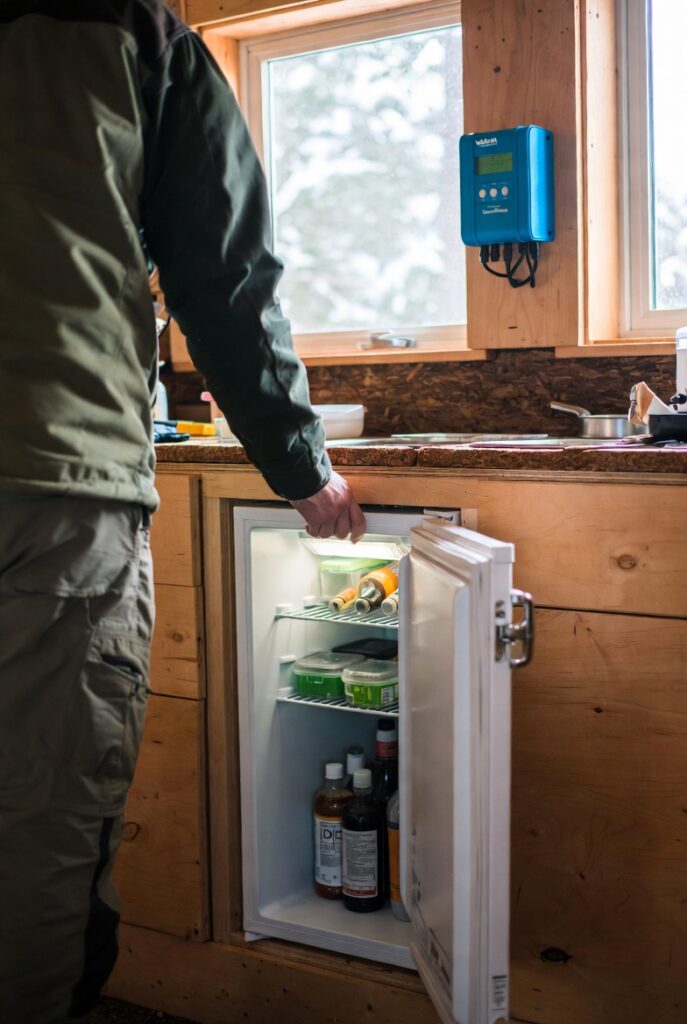
The off grid fridge is the load that never stops, it runs 24 hours a day, 7 days a week, and every watt-hour it consumes comes from the same battery bank that powers everything else in the system. A homeowner on Edinburgh Road North in Guelph, Wellington County brought a standard 120V AC dorm-style fridge from his garage to his off-grid workshop shed system in spring 2023.
His system was a 200W panel array and a 100Ah LFP battery at 12V, approximately 960Wh of usable capacity. The AC fridge drew approximately 1,200Wh per day in summer, requiring his inverter to run continuously to supply the 120V AC power. In July the system ran adequately, the fridge consumed most of the production but the bank held at approximately 40 to 60% SoC through clear-day cycling.
January changed the calculation entirely. His 200W array produced approximately 240Wh on a clear January day at 1.5 peak sun hours. His fridge consumed approximately 1,200Wh per day. The daily deficit was approximately 960Wh, the fridge was drawing five times what the array could produce in January. By the end of day 2 of any gray streak the bank was at its low-voltage cutoff. He spent three consecutive months of January, February, and March running his generator for 3 to 4 hours per day just to keep the off grid fridge running. The generator fuel cost over those three months exceeded the price of the DC fridge that would have solved the problem.
I reviewed the correct off grid fridge specification with him at the spring commissioning check. The Danfoss-compressor 12V DC fridge he replaced the AC unit with drew approximately 40W running at 50% duty cycle, approximately 480Wh per day in summer conditions. In January that same fridge draws approximately 180Wh per day because the duty cycle drops in a cold shed as the ambient temperature does most of the cooling work.
His rebuilt system handles the off grid fridge load on clear January days with approximately 60Wh to spare and survives gray streaks of 3 to 4 days without a generator. The Victron SmartShunt confirmed the duty cycle improvement immediately in the first week of January after the switch. See our Ontario solar sizing guide before finalising any system design around a refrigeration load.
The off grid fridge baseline: why it defines your minimum system size
| Fridge type | Daily consumption | Inverter required | Jan production match (200W) | Ontario verdict |
|---|---|---|---|---|
| 12V DC Danfoss fridge | 180Wh (Jan) / 480Wh (July) | No | 240Wh > 180Wh ✓ | Year-round ✓ |
| 120V AC fridge | 720 to 1,440Wh/day | Yes (8-35W idle) | 240Wh vs 1,200Wh ✗ | Tier 3+ only |
| Propane absorption fridge | 0Wh electrical | No | Full production freed | Tier 1 solution ✓ |
The off grid fridge is the only appliance in the system that runs without discretion, unlike lighting or laptop charging, you cannot turn it off during a gray streak. The daily fridge load must be subtracted from daily solar production before any other load is considered. A 200W array producing 240Wh in January with a 1,200Wh AC fridge is in a permanent 960Wh daily deficit regardless of how carefully every other load is managed. The fridge defines the minimum viable system size before a single additional appliance is added.
Running a 120V AC fridge requires the inverter to stay on continuously. Most pure sine wave inverters draw 8 to 35W in idle, which adds 192 to 840Wh per day just to keep the inverter running between compressor cycles. On a 200W Ontario January system, that idle draw alone represents 80 to 350% of total daily production. A DC off grid fridge connects directly to the battery bank with no inverter required, the idle draw disappears entirely, and the system gains those watt-hours back for every other load. See our Ontario winter solar output guide for the January production figures by array size.
DC vs AC: the off grid fridge efficiency gap that changes the battery math
The efficiency gap between a quality DC fridge with a Danfoss compressor and a standard AC fridge is approximately 750 to 1,020Wh per day in Ontario summer conditions. AC fridges consume approximately 720 to 1,440Wh per day. DC fridges with efficient compressors consume approximately 180 to 480Wh per day depending on ambient temperature and duty cycle. A cottage owner on James Street North in Milton, Halton County replaced his AC bar fridge with a 12V DC Danfoss model in fall 2024.
His Victron SmartShunt showed the daily refrigeration load drop from approximately 1,200Wh to approximately 180Wh, a 1,020Wh daily saving. That saving added 2.1 days of gray streak autonomy to his 200Ah 24V bank without a single additional battery or panel.
The DC fridge duty cycle changes with Ontario seasons in a way that benefits the system most when production is lowest. In January at 5 to 10C ambient in a cold shed, a quality DC fridge runs its compressor approximately 15 to 25% of the time, drawing approximately 180Wh per day. The ambient cold does most of the cooling work. In July at 25 to 30C ambient, the same fridge runs approximately 50 to 60% of the time, drawing approximately 360 to 480Wh per day.
The worst-case Ontario sizing scenario is the summer peak duty cycle, not the winter. Size the battery bank for the summer 480Wh figure using the 3-day reserve formula and the winter performance takes care of itself. See our solar battery bank sizing guide for the full 3-day gray streak formula.
The 3-day reserve calculation: how to size the battery bank for a fridge
The battery bank sizing formula for any off grid fridge: (daily fridge Wh x 3 days) divided by DoD percentage = rated battery capacity in Wh. The DoD division is mandatory, a formula without DoD produces an undersized bank that depletes faster than planned. DC fridge at 200Wh summer peak: (200 x 3) divided by 0.80 = 750Wh rated = 62.5Ah at 12V, rounded up to one Battle Born 100Ah LFP at 12V. AC fridge at 1,200Wh: (1,200 x 3) divided by 0.80 = 4,500Wh rated = 375Ah at 12V or 187.5Ah at 24V.
Wellington County and Halton County experience gray streaks of 3 to 7 consecutive days from November through February. A battery bank sized for 3 days of fridge-only reserve covers the median gray streak comfortably. The DC fridge reserve requirement is 750Wh versus the AC fridge requirement of 4,500Wh, a 3,750Wh difference in required rated capacity. At approximately $800 per 100Ah Battle Born battery, the AC fridge sizing requires approximately $2,400 more in battery investment than the DC fridge sizing for the same 3-day gray streak performance. The DC fridge pays for its own cost in avoided battery purchases within the first winter. See our Ontario off-grid roadmap for how the fridge load feeds into the full six-step system design sequence.
Propane absorption: the zero-watt fridge option for Tier 1 systems
A propane absorption fridge draws zero watts from the battery bank. Absorption fridges use a propane flame to drive a refrigerant cycle through heat exchange rather than a compressor. For a Tier 1 Ontario system with 100 to 200W of solar producing 120 to 240Wh per day in January, even a DC fridge at 180Wh consumes most of the daily production. A propane off grid fridge removes the refrigeration load from the battery bank entirely, leaving the full January production for lighting, phone charging, and router or Starlink.
For year-round Ontario property owners already using propane for heat and hot water, the propane absorption fridge is a natural extension of the existing supply. One standard 20 lb propane tank runs a residential-size absorption fridge for approximately 3 to 4 weeks at an operating cost of approximately $0.15 to $0.25 per day. The installation requirement: propane absorption fridges must be mounted level within approximately 3 degrees of vertical and require vented propane supply with proper clearances per TSSA standards. For seasonal cottage owners away for the winter, the propane fridge eliminates battery SoC concerns during extended absence, the fridge runs off the propane supply regardless of how many weeks the panels have sat under snow.
Pro Tip: Before purchasing any off grid fridge, spend one week with the SmartShunt monitoring your current refrigeration load at the circuit level. On a system with an existing AC fridge, note the daily consumption on the SmartShunt history graph, the repeating step pattern of compressor on-cycles is visible as regular current spikes throughout the day. Add up all the on-cycle energy over 24 hours to get the true daily fridge consumption including inverter idle. Then calculate what a DC fridge at 180Wh would cost over 3 Ontario winters in avoided generator fuel, reduced battery wear from fewer deep cycles, and avoided battery capacity upgrades. In most Tier 1 and Tier 2 Ontario systems, that calculation returns a payback of 8 to 14 months on a $600 to $900 DC fridge. The Edinburgh Road North homeowner’s three-month generator bill alone covered the cost of the DC fridge he should have bought at the start.
NEC and CEC: Ontario requirements for off-grid refrigeration circuits
NEC 690 governs the solar PV portion of an off-grid system. A DC fridge connected directly to the battery bank via a fused DC circuit is part of the DC load system that must be protected under NEC 690 DC wiring requirements. The DC circuit feeding the off grid fridge must be sized for the fridge’s maximum current draw plus a 25% safety factor, with an appropriately rated fuse or circuit breaker at the battery terminal.
An AC fridge connected to the inverter output must comply with NEC 422 appliance circuit requirements on the AC side, including a dedicated 20A circuit breaker on the inverter output panel. Contact the NFPA at nfpa.org for current NEC requirements for DC load wiring and AC appliance circuits in residential off-grid solar PV systems.
CEC Section 64 governs solar PV installations in Ontario. The DC load wiring connecting the battery bank to DC appliances such as a DC off grid fridge must be included in the ESA permit application for the off-grid system. The permit must identify the DC fridge load, the circuit protection at the battery, and the wire gauge for the DC run. A propane absorption fridge requires a separate TSSA-compliant installation for the gas connections and venting in addition to the ESA electrical permit covering any wiring associated with the system. Contact the Electrical Safety Authority Ontario at esasafe.com before wiring any refrigeration load circuit in a permitted Ontario off-grid solar installation.
The off grid fridge verdict: DC, AC, or propane for Ontario systems
- Ontario off-grid owner with a Tier 2 or Tier 3 system (800W or more of panels, 200Ah or more of LFP): a 12V or 24V DC fridge with a Danfoss-style compressor is the correct specification. The Milton James Street North result quantifies the benefit: 1,020Wh per day saved versus a comparable AC fridge, 2.1 additional days of gray streak autonomy from the existing battery bank at no additional hardware cost. Size the battery bank for the summer 480Wh peak duty cycle: (480 x 3) divided by 0.80 = 1,800Wh = 150Ah at 12V or 75Ah at 24V. The DC off grid fridge pays for itself in reduced generator run time within the first Ontario winter.
- Ontario Tier 1 owner with 100 to 200W of solar and January production below 300Wh per day: a propane absorption fridge is the correct specification. A DC fridge at 180Wh consumes most of the January production, leaving nothing for other loads through a gray streak. A propane off grid fridge removes the refrigeration load from the battery bank entirely. Propane fridge plus propane heat plus propane hot water is the correct Tier 1 combination, solar handles lights, phone charging, and small electronics, and the battery bank never sees a refrigeration draw.
- Ontario off-grid owner experiencing chronic January battery depletion who currently runs an AC fridge: review the SmartShunt daily logs, calculate the fridge contribution, then replace with a DC fridge. The Edinburgh Road North result confirms the impact: 960Wh daily winter deficit eliminated with a single appliance swap. Three months of daily generator operation in January, February, and March replaced with zero generator operation in the first post-swap winter. If the battery enclosure is in an unheated space below 0C, the Battle Born 100Ah LFP provides the stable voltage a Danfoss compressor needs to start reliably in cold conditions without voltage sag shutdowns.
Frequently Asked Questions
Q: How many watts does a 12V DC fridge use per day for an off-grid system?
A: A quality 12V DC fridge with a Danfoss compressor draws approximately 180Wh per day in a cold Ontario January shed at ambient temperatures of 5 to 10C, and approximately 360 to 480Wh per day in July at 25 to 30C ambient. The winter duty cycle drops because the ambient cold temperature does much of the cooling work, reducing compressor run time to approximately 15 to 25% of the day versus 50 to 60% in summer. For battery bank sizing purposes, use the summer peak figure of 480Wh, the winter performance will be better than planned, which is the correct direction for any Ontario off grid fridge sizing exercise.
Q: Can I run a regular AC fridge on my solar battery system in Ontario?
A: A standard AC fridge is not recommended for any Ontario off-grid system below Tier 3 (approximately 2,000W of panels and 10kWh of usable storage). The combined daily load of the fridge and inverter idle draw on a small system typically exceeds January solar production by 5 to 7 times. The Edinburgh Road North result confirms the consequence: three months of daily generator operation consuming more in fuel than a DC off grid fridge would have cost. On a properly sized Tier 3 system, an AC fridge is acceptable. On a Tier 1 or Tier 2 system, the DC fridge is the only viable off-grid refrigeration option that does not require chronic generator support through Ontario winters.
Q: How do I calculate how big my battery bank needs to be for my off-grid fridge?
A: Use the formula: (daily fridge Wh x 3 days) divided by your battery DoD percentage = rated bank capacity in Wh. The DoD division is mandatory, omitting it produces an undersized bank. For a DC off grid fridge at 200Wh per day (summer peak): (200 x 3) divided by 0.80 = 750Wh = 62.5Ah at 12V, rounded up to 75Ah or one Battle Born 100Ah LFP.
For an AC fridge at 1,200Wh per day: (1,200 x 3) divided by 0.80 = 4,500Wh = 375Ah at 12V or 187.5Ah at 24V. The 5x difference in bank size between DC and AC fridge requirements is the most compelling single argument for the DC off grid fridge in any Ontario system budget conversation.
This build is engineered within the 48V DC Safety Ceiling. Diagnostic logic is based on 20+ years of technical service experience. All structural and electrical installations must be verified by a Licensed Professional and comply with your Local AHJ.
About the Author
Robert Bertrand spent 20 years as a service advisor in the automotive industry (Lexus and Nissan), where precision diagnostics, wiring integrity, and documentation standards were non-negotiable. He brings that same technical discipline to GridFree Guide, where he researches, tests, and documents off-grid solar systems for Ontario conditions. Based in Rockwood, Ontario, every article is built on verified specifications, manufacturer data, and the real-world climate constraints of Canadian off-grid living.
As an Amazon Associate I earn from qualifying purchases. This site also contains affiliate links to other products and services. GridFree Guide earns a small commission at no extra cost to you.