
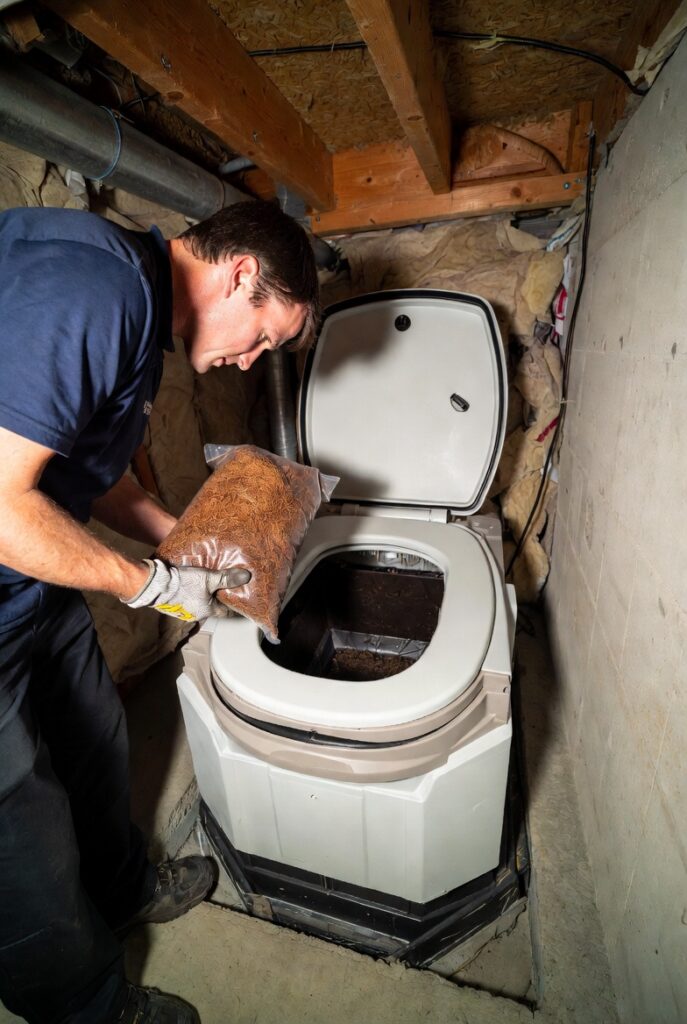
A composting toilet turns human waste into inert, odourless organic matter through aerobic decomposition, and it does it on approximately 10 to 20W of electrical draw from a vent fan, compared to the $15,000 to $25,000 cost of a conventional Ontario septic system installation. In spring 2023, a homeowner on Stone Road East in Guelph, Wellington County installed a self-contained composting toilet in his off-grid shed workshop.
He read the installation manual and confirmed the unit was producing no odour after the first two weeks of use. By week six he noticed a faint sour smell from the compost chamber, and by week eight the smell had become pronounced. The diagnosis from the manufacturer support line was immediate: his compost chamber had gone anaerobic from insufficient carbon material and excess liquid accumulation.
He had been adding the recommended amount of peat moss at each use but had not been managing the liquid diversion correctly. His unit’s liquid diversion tray had overflowed and wet the solid compost layer. Anaerobic decomposition produces hydrogen sulphide and methane, which are the source of the outhouse smell that composting toilets are specifically designed to avoid. The manufacturer’s correction took approximately two weeks of active management: drain the liquid tray, add dry coco coir at double the standard rate, increase vent fan airflow, and allow the aerobic bacteria to re-establish. His composting toilet has operated odour-free for two full Ontario seasons following the correction.
I reviewed the corrected installation with him at the commissioning check in September 2023. The composting toilet requires approximately the same ongoing attention as a battery bank: not daily monitoring, but regular checks to confirm correct operating conditions. Moisture level, carbon-to-nitrogen ratio, and temperature are the three variables. The vent fan at 12W continuous draws approximately 288Wh per day, a minor but permanent load on the solar system that must be included in the daily energy budget. The Victron SmartShunt showed the 12W vent fan as a flat baseline on his daily consumption graph, confirming it was running continuously as required. See our Ontario solar sizing guide before adding the composting toilet vent fan load to your daily energy calculation.
How a composting toilet works: aerobic decomposition vs the anaerobic failure mode
| Feature | Self-contained unit | Central/remote system |
|---|---|---|
| Capacity | 2 to 4 people, part-time | 4 to 8 people, full-time |
| Emptying frequency | Every 2 to 4 weeks (seasonal) | Every 6 to 12 months |
| Cost (CAD) | $1,000 to $3,000 | $3,000 to $6,000 installed |
| Best for | Bunkies, small cabins, vans | Full-time off-grid residences |
| Installation complexity | Half-day, no excavation | Requires crawlspace or basement |
A composting toilet uses aerobic decomposition: oxygen, carbon material, and naturally occurring bacteria convert human waste into inert, odourless organic matter. Quality units separate urine from solids, urine is the primary source of ammonia odour and excess moisture. Carbon sources such as peat moss or coco coir are added at each solid waste deposit to maintain the correct carbon-to-nitrogen ratio. The vent fan draws 10 to 20W continuously, pulling air through the chamber and exhausting it outdoors. A correctly operating aerobic composting toilet produces no detectable odour inside the bathroom.
The failure mode occurs when the compost chamber tips from aerobic to anaerobic conditions due to insufficient oxygen, excess moisture, or inadequate carbon addition. Anaerobic decomposition produces hydrogen sulphide, which is the source of the outhouse smell. The tipping point can happen within 7 to 14 days of neglected moisture-carbon management. Once anaerobic, the smell is immediate and correction takes 1 to 3 weeks of active daily management to re-establish aerobic conditions.
Prevention is the correct approach: add one full cup of peat moss or coco coir at every deposit, empty the liquid tray before it overflows, and check chamber moisture weekly during the first Ontario season. See our off-grid shower guide for how to manage grey water from sinks and showers separately from the composting toilet system.
Self-contained vs central system: which category fits your Ontario property
A self-contained composting toilet places all components, toilet bowl, compost chamber, liquid tray, and vent fan, in a single unit. Capacity is 2 to 4 people at part-time seasonal use, with emptying every 2 to 4 weeks during the season. Cost is approximately $1,000 to $3,000 CAD, and installation takes approximately half a day without excavation or specialist labour. Self-contained units are the correct choice for bunkies, vans, small seasonal cabins, and off-grid workshops where part-time use and limited space are the primary constraints.
A cottage owner on James Street South in Milton, Halton County installed a central composting toilet system with a remote composting chamber in her semi-insulated crawlspace in 2024, avoiding an $18,000 conventional septic installation. Her crawlspace ambient temperature in January drops to approximately 2 to 4C, just below the 5C minimum for active composting. She installed a 40W heating pad around the composting chamber exterior, drawing approximately 960Wh per day from her battery bank.
The Battle Born heated LFP batteries maintain charge acceptance in the cold crawlspace environment where standard LFP batteries would require low-temperature protection cutoffs. She removes the processed compost once per year in late May, approximately 45 minutes with a garden cart. Her total system cost was approximately $5,200, a saving of approximately $12,800 against the two septic quotes she received from Wellington County contractors. See our solar battery bank sizing guide for how to calculate the composting chamber heating load in the 3-day gray streak reserve formula.
The Ontario winter challenge: keeping the compost active below 5C
Composting bacteria are most active above 15C and slow significantly below 10C. Below 5C the composting process effectively stops and the unit becomes a holding tank. In an unheated Ontario crawlspace at -20C ambient, the compost chamber will freeze and biological activity ceases entirely. A composting toilet in a conditioned living space with year-round heating requires no additional winter measures. A unit in an unheated shed, crawlspace, or seasonal cottage closed in winter requires active temperature management.
The solution for unheated Ontario winter enclosures is insulation combined with supplemental heat. Insulate the composting chamber with 50 to 100mm of rigid foam on all exterior surfaces and add a 25 to 50W heating pad to maintain the chamber above 10C. At 40W continuous, the heater draws approximately 960Wh per day, add this to the 288Wh vent fan load for a total composting toilet electrical draw of approximately 1,250Wh per day in January. A well-insulated chamber in a semi-conditioned crawlspace at 2 to 4C ambient typically requires approximately 40W of continuous heat input to maintain above 10C. This is a significant solar load that must be sized for before selecting a composting toilet for an unheated Ontario enclosure.
Pro Tip: The fastest way to confirm your composting toilet vent fan is running correctly is to check the SmartShunt daily consumption graph. A correctly operating composting toilet produces a perfectly flat 10 to 20W baseline load that appears as a constant line across the full 24-hour graph. If the baseline shows gaps, the vent fan is losing power intermittently, which is the first condition that allows the chamber to tip toward anaerobic. A missing 12W baseline for even 4 to 6 hours can begin the anaerobic process if the chamber is near the moisture-carbon tipping point. Check the graph once a week during the first Ontario season of operation and any time a sour smell appears, the fan runtime data will tell you whether the failure is mechanical or maintenance-related before you open the chamber.
The composting toilet moisture-carbon rule: the maintenance your system cannot skip
The single most important composting toilet operating rule is maintaining the correct moisture level in the compost chamber. The target consistency is moist but not wet, similar to a wrung-out sponge. A standard carbon addition rate is one full cup of peat moss or coco coir per solid waste deposit. Check chamber moisture weekly during the first Ontario season and adjust the carbon addition rate based on observation. Signs of a chamber that is too wet: sour or sulphur smell, dark liquid pooling at the base, slimy or dark compost appearance. Signs of a chamber that is too dry: white powdery surface, slow decomposition, possible odour from insufficient biological activity.
Correcting an anaerobic composting toilet chamber follows the Stone Road East Guelph protocol: drain any accumulated liquid, add two to three times the normal carbon rate for seven to ten days, check the vent fan for blockages and confirm continuous operation, and monitor daily until the smell clears. Aerobic bacteria re-establish within 7 to 14 days when chamber conditions return to correct moisture and carbon balance. The correction required two weeks of daily attention in the Guelph case versus the five-minute weekly check that prevents the problem. Prevention is the correct maintenance posture for any composting toilet installation in Ontario.
NEC and CEC: Ontario requirements for off-grid waste system installations
NEC does not directly govern composting toilet installations as waste systems, but the electrical components, the vent fan and any heating pad, must comply with NEC requirements for residential electrical circuits. A 120V AC vent fan connected to the inverter output must be on a properly protected 15A branch circuit with appropriate overcurrent protection under NEC Article 210. A 12V DC vent fan connected directly to the battery bank must be fused at the battery terminal with a fuse rated for the fan’s maximum current draw.
Any permanent wiring for a composting toilet vent fan or heating element in an Ontario off-grid system must comply with the applicable NEC wiring requirements for the circuit type. Contact the NFPA at nfpa.org for current NEC requirements for residential electrical circuits in off-grid solar PV installations.
CEC Section 64 governs solar PV installations in Ontario, and local Ontario Building Code requirements govern composting toilet installations as waste management systems. An Ontario composting toilet installation requires contact with the local building department before purchase to confirm permit requirements. Wellington County and Halton Region each have different policies, some areas permit composting toilets as primary waste systems with a grey water management plan, while others require a conventional or alternative septic system for all waste including grey water.
Grey water from sinks, showers, and laundry must be managed separately from the composting toilet and may require a grey water treatment system or holding tank under local health unit requirements. Contact the Electrical Safety Authority Ontario at esasafe.com before wiring any permanent electrical components of a composting toilet installation in Ontario.
The composting toilet verdict: which Ontario property profile fits each system
- Ontario seasonal cottage owner with spring through fall occupancy and no existing septic system: a self-contained composting toilet is the correct starting point. Cost is $1,000 to $3,000 CAD, installation takes half a day without excavation, and the unit handles 2 to 4 person seasonal occupancy with emptying every 2 to 4 weeks during the season. Grey water from the kitchen sink requires a separate grey water system, confirm local requirements with the Wellington County or Halton Region building department before purchasing. The self-contained composting toilet in a closed seasonal cottage from November through April will be dormant and will resume composting in May without any special startup procedure beyond confirming the vent fan is running and adding a fresh dose of carbon material.
- Ontario full-time off-grid residential owner needing a primary waste system: a central composting toilet with a remote composting chamber is the correct specification. The James Street South Milton result confirms the economics: $5,200 total system cost versus an $18,000 septic quote, $12,800 saved, one annual compost removal in late May. Size the composting chamber for household occupancy and acceptable removal frequency. If the crawlspace drops below 5C in winter, budget the 40W heating pad load into the solar system sizing alongside the 12W vent fan for approximately 1,250Wh per day total composting toilet electrical draw in January. See our Ontario off-grid roadmap for how waste management fits into the full six-step off-grid system design sequence.
- Ontario off-grid owner who has attempted a composting toilet and is experiencing odour problems: apply the Stone Road East Guelph correction protocol immediately. Drain the liquid tray, double the carbon addition rate for 7 to 10 days, and confirm the vent fan is running continuously using the Victron SmartShunt daily consumption graph to verify the 10 to 20W fan baseline is present around the clock. If the chamber is in an unheated space below 5C, add a Battle Born heated LFP battery to ensure the bank maintains charge acceptance through the cold months required to restore the chamber to correct operating temperature and re-establish aerobic conditions.
Frequently Asked Questions
Q: Does a composting toilet smell bad?
A: A correctly operating aerobic composting toilet produces no detectable odour inside the bathroom. Odour occurs when the compost chamber tips from aerobic to anaerobic conditions due to excess moisture, insufficient carbon addition, or inadequate vent fan airflow. The Stone Road East Guelph result shows how quickly this can happen: two weeks of insufficient carbon management produced a pronounced sour smell by week eight. The correction took two additional weeks of active management. Proper weekly maintenance of the moisture-carbon balance and confirmation that the vent fan is running continuously at 10 to 20W prevents the anaerobic failure mode that produces odour in a composting toilet.
Q: What permits do I need for a composting toilet in Ontario?
A: Permit requirements vary by municipality and there is no single Ontario province-wide answer. Contact the local building department and the local health unit before purchasing a composting toilet and present a complete waste management plan that includes grey water handling for sinks, showers, and laundry. Wellington County and Halton Region have different policies, some areas approve composting toilets as primary waste systems with a grey water management plan, while others require a conventional or alternative septic system for all waste streams. The grey water portion of the waste management plan is typically the deciding factor in municipal approval for a composting toilet as a primary system.
Q: How much power does a composting toilet use on a solar system?
A: The vent fan draws 10 to 20W continuously, which is approximately 240 to 480Wh per day. A 12W vent fan produces approximately 288Wh per day as a permanent baseline load that must be included in the solar system daily energy budget. If the composting toilet is in an unheated Ontario enclosure that drops below 5C in winter, a 25 to 50W heating pad is required to maintain the chamber above the 10C minimum for active composting. At 40W continuous, the heating pad adds approximately 960Wh per day, bringing the total composting toilet electrical draw to approximately 1,250Wh per day in January. Include both loads in the 3-day gray streak battery bank sizing formula.
This build is engineered within the 48V DC Safety Ceiling. Diagnostic logic is based on 20+ years of technical service experience. All structural and electrical installations must be verified by a Licensed Professional and comply with your Local AHJ.
About the Author
Robert Bertrand spent 20 years as a service advisor in the automotive industry (Lexus and Nissan), where precision diagnostics, wiring integrity, and documentation standards were non-negotiable. He brings that same technical discipline to GridFree Guide, where he researches, tests, and documents off-grid solar systems for Ontario conditions. Based in Rockwood, Ontario, every article is built on verified specifications, manufacturer data, and the real-world climate constraints of Canadian off-grid living.
As an Amazon Associate I earn from qualifying purchases. This site also contains affiliate links to other products and services. GridFree Guide earns a small commission at no extra cost to you.