
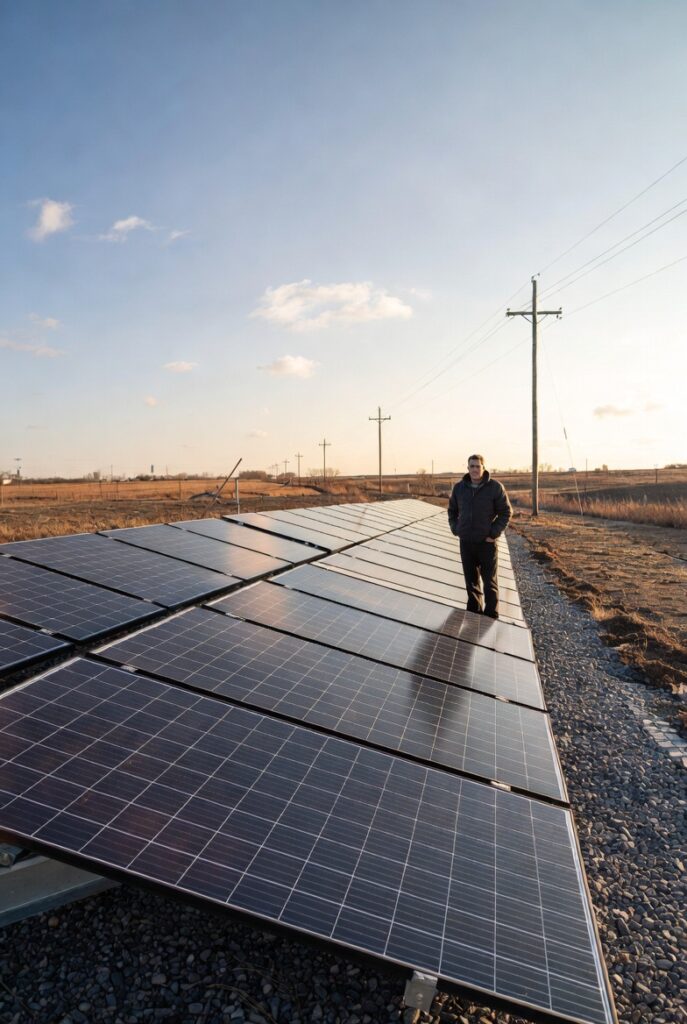
Going off grid ontario is no longer just a lifestyle choice for remote bush properties, for rural Wellington and Halton County property owners it has become a straightforward financial decision when Hydro One quotes $15,000 to $80,000 for a rural service extension that the property owner will never own. In spring 2023, a rural property owner on Woodlawn Road North in Guelph, Wellington County received a Hydro One service extension quote of approximately $47,000 for a new build on an unserviced 5-acre lot approximately 400 metres from the nearest active service pole.
The owner had budgeted approximately $8,000 for the electrical system. He reviewed the quote with me and asked whether solar was a realistic alternative for a daily load of approximately 40Ah at 12V.
We ran the load calculation, battery bank sizing, and array sizing for Wellington County at 1.5 PSH January production. His system specification: two Renogy 100W monocrystalline panels, one Battle Born 100Ah LFP battery, a 600W pure sine wave inverter, and a Victron SmartShunt for monitoring. Total component cost: approximately $1,200. Installed with ESA permit and inspection: approximately $1,800.
I commissioned the system in August 2023 and the ESA inspection was completed in September. The system has operated for two full Ontario winters without generator supplementation for his planned loads. His SmartShunt January logs showed the bank staying above 55% SoC on clear days and recovering to above 80% SoC within one clear day after any gray streak. His total off grid ontario investment: $1,800 installed versus the $47,000 Hydro One quote for grid connection. See our Ontario solar sizing guide before calculating whether off grid ontario makes financial sense for your property.
The off grid ontario financial case: Hydro One connection costs vs system ownership
| Option | Upfront cost | Monthly charges | Who owns the infrastructure? | Ontario verdict |
|---|---|---|---|---|
| Hydro One rural extension (400m) | $20,000 to $47,000+ | Delivery charge every month ✗ | Hydro One ✗ | Correct only when <$10,000 |
| Off grid ontario solar system | $1,500 to $8,000 | $0 forever ✓ | You ✓ | Correct when grid quote >$10,000 ✓ |
Hydro One rural extension costs run approximately $1,000 to $2,500 per pole with one pole needed every 50 metres, plus approximately $5,000 to $10,000 for the meter base, connection hardware, and ESA permit. A 400-metre extension requires 8 to 10 poles at approximately $1,500 average plus fixed costs, totalling approximately $20,000 to $23,000 at minimum, and terrain, road crossings, and permit escalations can push a specific quote to $47,000 or more. The property owner pays all of this and owns none of the resulting infrastructure. Hydro One retains ownership of the poles, wires, and service equipment.
An off grid ontario system costs approximately $1,500 to $8,000 and the property owner owns it entirely with zero monthly delivery charges. Even after paying $47,000 for grid connection, Ontario Hydro One customers pay fixed monthly delivery charges regardless of consumption, a seasonal cottage using grid power 5 months per year pays delivery charges 12 months per year. An off grid ontario system eliminates this permanently. The Woodlawn Road North Guelph result: $1,800 total installed system cost versus $47,000 grid connection quote plus ongoing delivery charges for the life of the property.
The four Ontario property profiles: which system tier applies to you
Profile 1 is a seasonal cottage with May through October occupancy. Standard LFP is acceptable if the cottage is fully closed from October through April and the battery bank is stored in a conditioned space or brought indoors. System size is Tier 1 to Tier 2 depending on summer load. Profile 2 is a year-round rural residence requiring January-floor sizing, 3-day gray streak battery reserve, and heated LFP for any unheated utility enclosure.
System size is Tier 2 to Tier 3 with propane appliances reducing the electrical load. Profile 3 is a detached outbuilding, garage, or workshop where solar eliminates the $2,000 to $8,000 trench from the main house panel. System size is Tier 1 to Tier 3 depending on tool loads. Profile 4 is a remote property with no grid option: Tier 3 minimum for year-round primary residence, generator backup for extended gray streaks.
Choosing the correct profile before purchasing is the single most important off grid ontario planning step. A property owner who buys a Tier 1 system for a Profile 2 year-round residence will have an undersized system that fails in January. A property owner who buys a Tier 3 system for a Profile 1 seasonal cottage overspends by $3,000 to $5,000. Identify the profile first, size the system to the January-floor load, then purchase in that order. See our solar garage guide for the three-tier Tier 1/2/3 workshop specification and our off grid appliances guide for how to reduce the load before sizing any profile.
Pro Tip: Before comparing solar system quotes to a Hydro One connection quote, add up the total 20-year cost of the grid connection option: the connection fee plus 20 years of monthly Hydro One delivery charges. In Ontario, the Hydro One delivery charge for a low-usage rural account is typically $40 to $80 per month regardless of consumption. At $60/month x 240 months, that is $14,400 in delivery charges on top of the $47,000 connection fee, for a 20-year total of approximately $61,400. A $1,800 off grid ontario system maintained over the same 20 years requires approximately one battery replacement at year 10 to 13 (approximately $1,000 to $1,200 for a 100Ah LFP), for a 20-year total of approximately $3,000. The SmartShunt tracks battery health in real time and will confirm when the replacement is approaching, the SoC at a known load starts declining as the battery approaches end of cycle life.
The off grid ontario production reality: sizing for January, not July
Wellington and Halton County sit at approximately 43.5 to 44°N latitude. July peak sun hours: approximately 4.5 PSH per clear day. January peak sun hours: approximately 1.5 PSH per clear day. The 3:1 seasonal ratio means summer produces three times more energy per day than winter at the same array size. Every off grid ontario system must be sized for 1.5 PSH January production, not 4.5 PSH July production. A 400W array sized for July average produces approximately 1,440Wh on a clear July day but only approximately 480Wh on a clear January day. If the daily load requires 600Wh, the July-sized system fails every Ontario January day before even accounting for gray streak days.
The correct off grid ontario sizing sequence: calculate the daily load in Wh, apply the 3-day gray streak battery reserve at the chosen chemistry DoD, then size the array to fully recharge that bank at 1.5 January PSH. Accept that the system will produce three times more than needed from May through September, this is correct and expected for any Ontario latitude system. Summer overproduction is not a problem; it simply means the battery reaches 100% SoC by midday and the charge controller diverts the excess. January underproduction is the only production failure mode that matters for an off grid ontario system. See our battery bank sizing guide for the full gray streak reserve formula and the January sizing calculation.
The 6-step commissioning sequence: from load audit to ESA permit
The 6-step off grid ontario commissioning sequence: Step 1 is the load audit, list every electrical load with wattage and daily hours, calculate total Wh per day. Step 2 is battery bank sizing, apply the 3-day gray streak rule at chosen chemistry DoD. Step 3 is array sizing, size panels to recharge the bank at Ontario 1.5 PSH January. Step 4 is inverter selection, pure sine wave only, surge-rated for any motor loads. Step 5 is mounting, fixed tilt 35 to 40 degrees or two-position 25/60 degrees seasonal protocol. Step 6 is the ESA permit, file before permanent installation, inspect after commissioning. These six steps in order prevent every common off grid ontario sizing and installation mistake.
A first-time property owner near Campbellville in Halton Region was overwhelmed by off grid ontario planning in spring 2024 after 6 hours of conflicting online research. Together we ran the 6-step sequence: load audit confirmed 65Ah per day at 12V. Battery sizing: 65 x 3 = 195Ah usable at 80% LFP DoD, rounded to 200Ah rated. Array: 200Ah x 12V / 0.80 = 3,000Wh to restore, at 1.5 PSH January = 208W minimum panel, rounded to 400W for safety margin. Inverter: 2,000W/4,000W surge PSW inverter-charger. Mount: 40-degree fixed tilt ground mount. ESA permit filed. He ran the 6-step sequence Saturday morning, commissioned Sunday afternoon, and his Victron SmartShunt showed 100% SoC by Sunday evening. Zero generator. Zero Hydro One invoice.
NEC and CEC: Ontario requirements for off-grid solar installations
NEC 690 governs solar PV installations. A permanently installed off grid ontario solar system must comply with NEC 690 requirements for panel mounting, DC wiring, overcurrent protection at the battery terminal and each circuit, disconnecting means, and battery storage. NEC 690 requires a clearly labelled DC disconnect at the battery bank and an AC disconnect at the inverter output. The panel array wiring must be sized for the panel short-circuit current (Isc) plus a 25% safety factor, with appropriate fusing at the array output and at the battery terminal. Contact the NFPA at nfpa.org for current NEC 690 requirements for standalone off-grid solar PV systems.
CEC Section 64 governs solar PV installations in Ontario. A permanently installed off grid ontario solar system requires an ESA permit identifying the complete system: panel array, mounting method, DC wiring and overcurrent protection, charge controller, battery bank chemistry and rated capacity, inverter, and AC output wiring. The permit application must be submitted to the ESA before installation of any permanent wiring. An ESA inspector verifies the installation against the Ontario Electrical Safety Code before approving the permit. An ESA-inspected off grid ontario installation protects the property owner’s home insurance coverage, provides documentation for property resale value, and confirms code compliance. Contact the Electrical Safety Authority Ontario at esasafe.com before permanently installing any off grid ontario solar system.
The off grid ontario verdict: which property profile fits your situation
- Ontario rural property owner who received a Hydro One rural service extension quote over $10,000: the financial case for off grid ontario is clear. Run the load audit, apply the 6-step sequence, and compare the total system cost against the grid connection quote. The Woodlawn Road North Guelph result: $1,800 off-grid system versus $47,000 grid connection, two full Ontario winters without generator supplementation, bank above 55% SoC on January clear days. Add the 20-year Hydro One delivery charge accumulation to the connection fee before making the final comparison. File the ESA permit, commission the system, and own the infrastructure outright.
- Ontario first-time off-grid property owner overwhelmed by the planning process: follow the 6-step sequence in order without skipping steps. The Campbellville Halton result: 6 hours of online confusion resolved by applying the sequence on a Saturday morning, system commissioned and at 100% SoC by Sunday evening. Use the Victron SmartShunt as the instrument panel from day one. It confirms when the system is correctly sized: the bank recovers to above 80% SoC within one clear day after any Ontario gray streak on a correctly sized off grid ontario system.
- Ontario property owner considering off grid ontario for a detached garage, workshop, or outbuilding: the capital cost is typically well below the trench quote for connecting to the main panel. A Profile 3 detached outbuilding system ranges from Tier 1 for basic lighting and charging at $300 to $700, to Tier 2 for active workshop use at $700 to $1,500. See the solar garage guide for the three-tier specification, the compressor motor surge rule, and the inverter sizing calculation. Pair with the off grid appliances guide to reduce the workshop load before sizing the battery bank and array.
Frequently Asked Questions
Q: Is going off-grid legal in Ontario?
A: Yes, going off grid ontario is legal. Any permanently installed off-grid solar PV system requires an ESA (Electrical Safety Authority) permit for code compliance and to protect the property owner’s home insurance coverage. A portable system not permanently mounted does not typically require an ESA permit. The ESA permit confirms the installation meets the Ontario Electrical Safety Code and provides documentation for property resale. Contact esasafe.com for current permit requirements specific to your off grid ontario installation configuration.
Q: How much does an off-grid solar system cost in Ontario?
A: An off grid ontario system ranges from approximately $1,500 for a basic Tier 1 seasonal system (100 to 200W panel, 50 to 100Ah LFP, 300W inverter) to approximately $8,000 for a Tier 3 full-service system (600W+ panel, 200Ah+ LFP, 2,000W/4,000W surge inverter). The Woodlawn Road North Guelph result: $1,800 installed with ESA permit for a 200W/100Ah/600W system serving a 40Ah/day cabin load. Compare this total against the full Hydro One connection quote plus 20 years of monthly delivery charges before concluding that grid connection is cheaper.
Q: Do I need a permit for an off-grid solar system in Ontario?
A: Any permanently installed off grid ontario solar system requires an ESA permit. The permit must be filed before permanent wiring installation and the system must pass ESA inspection after commissioning. An uninspected permanent installation typically voids Ontario homeowner insurance coverage for electrical faults. The permit adds approximately $300 to $600 to the system cost and approximately 2 to 4 weeks for inspection scheduling. File the permit application at Step 6 of the commissioning sequence, after the system design is finalised, to confirm the configuration meets ESA requirements before purchasing all components.
This build is engineered within the 48V DC Safety Ceiling. Diagnostic logic is based on 20+ years of technical service experience. All structural and electrical installations must be verified by a Licensed Professional and comply with your Local AHJ.
About the Author
Robert Bertrand spent 20 years as a service advisor in the automotive industry (Lexus and Nissan), where precision diagnostics, wiring integrity, and documentation standards were non-negotiable. He brings that same technical discipline to GridFree Guide, where he researches, tests, and documents off-grid solar systems for Ontario conditions. Based in Rockwood, Ontario, every article is built on verified specifications, manufacturer data, and the real-world climate constraints of Canadian off-grid living.
As an Amazon Associate I earn from qualifying purchases. This site also contains affiliate links to other products and services. GridFree Guide earns a small commission at no extra cost to you.