
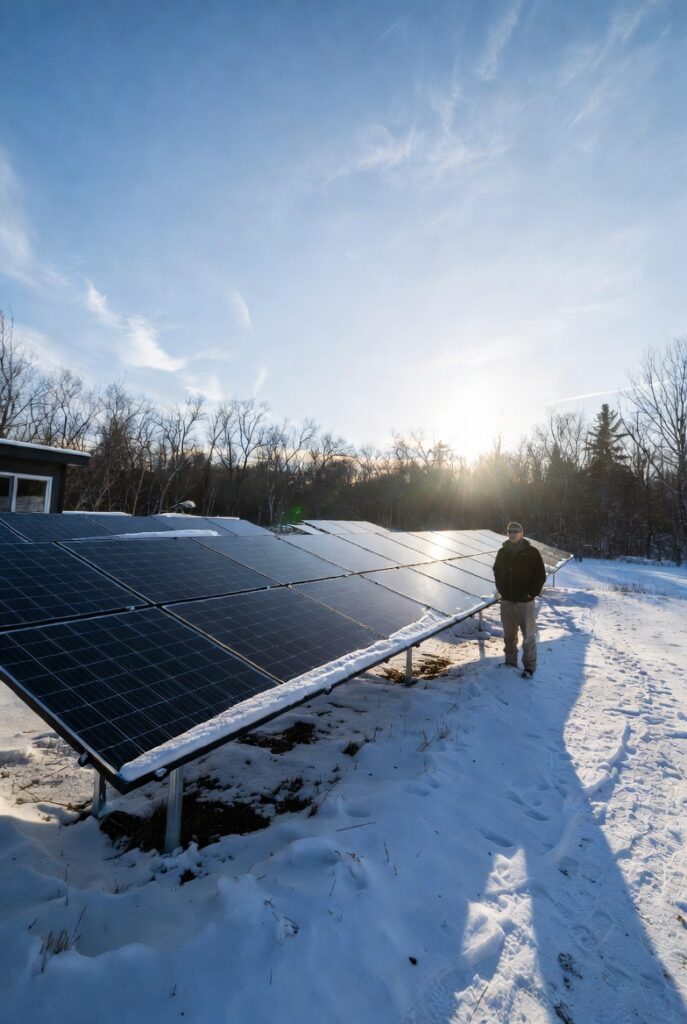
A 100W solar panel watt rating is a lab measurement taken at 1000W/m² irradiance and 25°C cell temperature, conditions that exist in a test chamber, not on a rooftop in Guelph on a January morning at -12C with 1.5 peak sun hours available. In fall 2022, a homeowner on Elmira Road in Guelph, Wellington County purchased a 400W panel array for a weekend cabin system. He had calculated his daily load at approximately 1,000Wh and decided 400W of panels was sufficient, reasoning that 400W multiplied by 6 hours of daylight would produce 2,400Wh per day. The system performed well through October.
By the second week of November the bank was reaching 0% SoC by early evening on cloudy days. By mid-January his system was producing approximately 480Wh on a clear day. His actual January production was 400W × 1.5 PSH × 0.80 system efficiency = 480Wh, not the 2,400Wh he had assumed. His daily load of approximately 1,000Wh exceeded his peak clear-day January production by 520Wh, meaning the bank depleted by at least 520Wh each day regardless of weather.
I reviewed the system in February 2023. His Victron SmartShunt production logs confirmed the 400W array had averaged approximately 310Wh per day across January, clear days at 480Wh, overcast days at 80 to 160Wh. The system required a minimum 1,000W array to meet his daily load on a clear January day at 1.5 PSH and 0.80 efficiency: 1,000Wh ÷ 1.2Wh per watt = 833W minimum, × 1.25 safety margin = 1,041W, rounded to 1,200W. Understanding the solar panel watt production formula before purchasing the array would have prevented the undersizing and the two-month generator dependency. See our Ontario solar sizing guide before calculating any solar panel watt requirement.
The solar panel watt rating explained: what STC means and what it hides
| Month | PSH (Wellington/Halton) | 100W panel daily output | Ontario context |
|---|---|---|---|
| July | 4.5 PSH | 360Wh (100 × 4.5 × 0.80) | Bank full by midmorning |
| October | 2.5 PSH | 200Wh (100 × 2.5 × 0.80) | The warning light phase |
| January | 1.5 PSH | 120Wh (100 × 1.5 × 0.80) | The Ontario sizing standard ✓ |
STC (Standard Test Conditions) are the lab conditions used to measure every solar panel watt nameplate rating: 1,000W/m² irradiance, 25°C cell temperature, and air mass 1.5. These represent peak summer solar noon on a clear day at approximately 40°N latitude. Ontario January conditions are fundamentally different: irradiance of 200 to 600W/m² on clear days (not 1,000W/m²), cell temperatures from 0 to -20°C, and sun angle 20 to 30 degrees above the horizon instead of the 60 to 70 degrees at summer noon. The result: Ontario January production from a 100W solar panel watt nameplate is approximately 120Wh per clear day, not the 800Wh (100W × 8 hours) most beginners assume.
The 0.80 efficiency derate is not optional in any Ontario solar panel watt calculation. It accounts for wiring losses (3 to 5%), MPPT conversion losses (3 to 5%), and real-world irradiance variation below STC. A 400W array at 1.5 PSH without the derate appears to produce 600Wh per January clear day (400 × 1.5). With the derate: 400 × 1.5 × 0.80 = 480Wh. The missing 120Wh represents real system losses in every installation, every day. Ignoring the 0.80 derate in solar panel watt calculations consistently produces arrays that are 25% undersized for any production target.
The solar panel watt production formula: watts × PSH × 0.80 = what you actually get
The Ontario solar panel watt production formula: daily Wh = panel watts × peak sun hours × 0.80. For Wellington/Halton County: July clear day = rated watts × 4.5 × 0.80 = 3.6Wh per rated watt. October clear day = rated watts × 2.5 × 0.80 = 2.0Wh per rated watt. January clear day = rated watts × 1.5 × 0.80 = 1.2Wh per rated watt. January is the Ontario sizing standard because it produces the least energy per rated solar panel watt of any month. The 3:1 ratio between July and January means a system sized for July average production is 3x undersized for January loads.
A 400W array in Wellington County produces approximately 1,440Wh on a clear July day (400 × 4.5 × 0.80), approximately 800Wh on a clear October day (400 × 2.5 × 0.80), and approximately 480Wh on a clear January day (400 × 1.5 × 0.80). The 3:1 ratio is the Ontario reality that every solar panel watt calculation must be built on. See our solar panel angle guide for how the 60-degree winter tilt adds approximately 12% to January production and our solar battery storage guide for how to size the battery bank for the gray-streak days when production falls short of the daily load.
Pro Tip: Before purchasing any solar panel array, run the nameplate sanity check. Take the total array watts, multiply by 1.5 PSH, then multiply by 0.80. The result is the maximum Wh the array will produce on a clear Ontario January day. If that number is less than your daily load, the array is undersized for January regardless of any other consideration. The Elmira Road check: 400W × 1.5 × 0.80 = 480Wh. Daily load: 1,000Wh. Result: 480 is less than 1,000, the system fails every Ontario winter day, with or without a gray streak. This 30-second calculation would have prevented a $2,000+ generator fuel bill and two months of daily generator runs through the first Ontario winter.
The three Ontario sizing mistakes that produce the November blackout
Mistake 1: the nameplate solar panel watt × daylight hours error. Treating 6 hours of Ontario January daylight as 6 hours of STC 1,000W/m² irradiance assumes full production for every minute of daylight. In reality, Ontario January daylight accumulates only approximately 1.5 PSH equivalent, the sun is low, irradiance is reduced for most of the day, and only a short window around solar noon approaches STC conditions.
The Elmira Road result: 400W × 6 hours = 2,400Wh assumed, 400 × 1.5 × 0.80 = 480Wh actual, a 5x shortfall. Mistake 2: sizing for July average instead of January floor. Mistake 3: ignoring the 0.80 efficiency derate, which consistently produces arrays 25% undersized for any production target. All three mistakes compounded in the Elmira Road system.
Most Ontario off-grid systems fail in November for the first time, not January, because October is the last month where production consistently exceeds load at typical system sizes. November drops production from 2.5 PSH to approximately 1.8 to 2.0 PSH as cloud cover increases and sun angle drops further. A system that barely meets its load in October runs out of reserve capacity during the second gray stretch of November.
The Elmira Road result: October was fine, bank hitting 0% SoC by the second week of November. January simply continued what November began. A correctly specified solar panel watt calculation prevents November from being the first warning sign. See our solar power system integration guide for the complete system sizing sequence that prevents all three mistakes.
The working-backwards calculation: from daily load to minimum array size
The 4-step formula. Step 1: complete the load audit and calculate total daily Wh. Step 2: divide the daily load by 1.2, this is the minimum solar panel watt total needed to fully recharge on a clear January day. Step 3: multiply by 1.25 to add the 25% safety margin. Step 4: round up to the nearest panel increment. For the Elmira Road 1,000Wh/day load: Step 1 = 1,000Wh, Step 2 = 833W, Step 3 = 1,041W, Step 4 = 1,200W (twelve Renogy 100W monocrystalline panels or three 400W panels). The same formula works for any Ontario daily load at any system tier.
A first-time buyer near Derry Road in Milton, Halton County asked me in spring 2023 how many solar panel watts he needed for his weekend cottage. His daily load: DC fridge 180Wh, LED lighting 60Wh, laptop 50Wh, satellite internet 250Wh, phone charging 30Wh, total 650Wh. Step 1: 650Wh. Step 2: 650 ÷ 1.2 = 542W. Step 3: 542 × 1.25 = 677W. Step 4: 700W rounded up, purchased eight 100W panels = 800W array.
Commissioned June 2023. First Ontario January: 800 × 1.5 × 0.80 = 960Wh clear-day production against a 650Wh load. SmartShunt: bank never below 42% SoC after any gray streak that winter. For roof or low-profile installations, Renogy 100W flexible panels carry the same watt rating and apply the same 1.2Wh per watt Ontario January formula.
NEC and CEC: Ontario requirements for solar array installations
NEC 690 governs solar PV installations. A solar panel watt rating determines the panel’s contribution to the DC array output, and NEC 690 requires that the DC wiring from the array to the charge controller be sized for the array short-circuit current (Isc) plus a 25% safety factor. The array Isc depends on the number of panels in parallel and the individual panel Isc specification from the datasheet. NEC 690 also requires overcurrent protection at the array output rated for the array Isc. Contact the NFPA at nfpa.org for current NEC 690 requirements for solar array wiring based on panel watt ratings and configuration.
CEC Section 64 governs solar PV installations in Ontario. A permanent solar panel installation requires an ESA permit filed before wiring begins. The permit application must identify the panel array wattage and configuration, the DC wiring gauge and overcurrent protection, the charge controller, and the complete system through to the inverter output. A system installed without an ESA permit is uninsured and may not meet Ontario home insurance coverage requirements, the permit cost is a mandatory component of every Ontario solar panel installation budget. Contact the Electrical Safety Authority Ontario at esasafe.com before permanently installing any solar panel array in Ontario.
The solar panel watt verdict: the 4-step formula that sizes every Ontario array
- Ontario property owner who purchased a solar array based on panel watt × daylight hours and is now experiencing the November blackout: run the SmartShunt production audit before adding any equipment. Check the average daily production across any 7-day January period, this is the actual Wh output at Ontario winter conditions. Divide that average by 0.80 and by 1.5 PSH to get the effective rated watts actually contributing (effective watts = actual Wh ÷ 1.5 ÷ 0.80). If effective rated watts match nameplate but production still falls short of the load, the system is correctly specified but undersized, apply the 4-step formula to calculate the additional solar panel watt capacity required. If effective rated watts are significantly below nameplate, check for MC4 connector degradation, panel soiling, or shading before purchasing additional panels.
- Ontario property owner pricing their first solar array who wants to calculate the correct solar panel watt count: apply the 4-step formula to the load audit result. Load audit first using the five-category framework from the off grid appliances guide. Divide daily load by 1.2. Multiply by 1.25. Round up to the nearest panel increment. The Derry Road Milton result: 650Wh/day load, 800W array, 960Wh January clear-day production, bank never below 42% SoC after any gray streak. The nameplate sanity check confirms the sizing before purchase: 800 × 1.5 × 0.80 = 960Wh, which exceeds the 650Wh load. See our solar panel cost guide for current Ontario retail pricing per solar panel watt at each tier.
- Ontario property owner who is correctly sized for summer but still experiences January depletion despite using the formula: the 1.5 PSH January figure assumes clear-sky conditions, not average January weather. Ontario January averages approximately 8 to 12 clear or mostly-clear days per month in Wellington/Halton County, the remaining days produce 10 to 50% of clear-day solar panel watt output. The battery bank must provide the 3-day gray streak reserve to bridge the overcast periods between clear days. Correctly sized solar panel watt capacity recharges the bank on clear days; the battery bank absorbs the gray streak deficit. See our solar battery storage guide for the 3-day reserve formula and our off grid living guide for the full January performance review protocol.
Frequently Asked Questions
Q: How many watts of solar panels do I need in Ontario?
A: Use the 4-step formula. Step 1: calculate your daily load in Wh using a load audit. Step 2: divide the daily load by 1.2 (Ontario January production is 1.5 PSH × 0.80 = 1.2Wh per rated watt per clear day). Step 3: multiply by 1.25 to add the 25% safety margin. Step 4: round up to the nearest panel increment. For a 650Wh/day load: 650 ÷ 1.2 = 542W × 1.25 = 677W, rounded up to 700W or 800W depending on available panel sizes. The Derry Road Milton result confirms the formula: 800W array, 650Wh/day load, bank never below 42% SoC after any January gray streak.
Q: What does a 100W solar panel actually produce in Ontario in January?
A: A 100W solar panel produces approximately 120Wh on a clear Ontario January day at Wellington/Halton County latitude: 100W × 1.5 PSH × 0.80 efficiency = 120Wh. On overcast January days, production drops to approximately 10 to 25% of the clear-day output, or approximately 12 to 30Wh per 100W of nameplate rating. The solar panel watt nameplate rating of 100W is the STC (Standard Test Conditions) maximum, a lab measurement at 1,000W/m² irradiance and 25°C that Ontario winter conditions do not approach. The correct Ontario January planning figure is 1.2Wh per rated watt per clear day, not the panel nameplate watt multiplied by hours of daylight.
Q: Why is my solar panel not producing as much as the watt rating says?
A: The solar panel watt nameplate rating is a STC lab measurement that Ontario winter conditions do not replicate. Three factors reduce Ontario production below the nameplate: (1) irradiance at 200 to 600W/m² in January versus the STC 1,000W/m², (2) sun angle at 20 to 30 degrees above horizon versus the STC reference angle, and (3) the 0.80 real-world efficiency derate from wiring and MPPT conversion losses. Combined, these factors reduce Ontario January production to approximately 120Wh per 100W of nameplate rating on a clear day. If production is below even this reduced expectation, check the SmartShunt for MC4 connector resistance issues, panel shading, or soiling on the panel surface.
This build is engineered within the 48V DC Safety Ceiling. Diagnostic logic is based on 20+ years of technical service experience. All structural and electrical installations must be verified by a Licensed Professional and comply with your Local AHJ.
About the Author
Robert Bertrand spent 20 years as a service advisor in the automotive industry (Lexus and Nissan), where precision diagnostics, wiring integrity, and documentation standards were non-negotiable. He brings that same technical discipline to GridFree Guide, where he researches, tests, and documents off-grid solar systems for Ontario conditions. Based in Rockwood, Ontario, every article is built on verified specifications, manufacturer data, and the real-world climate constraints of Canadian off-grid living.
As an Amazon Associate I earn from qualifying purchases. This site also contains affiliate links to other products and services. GridFree Guide earns a small commission at no extra cost to you.