
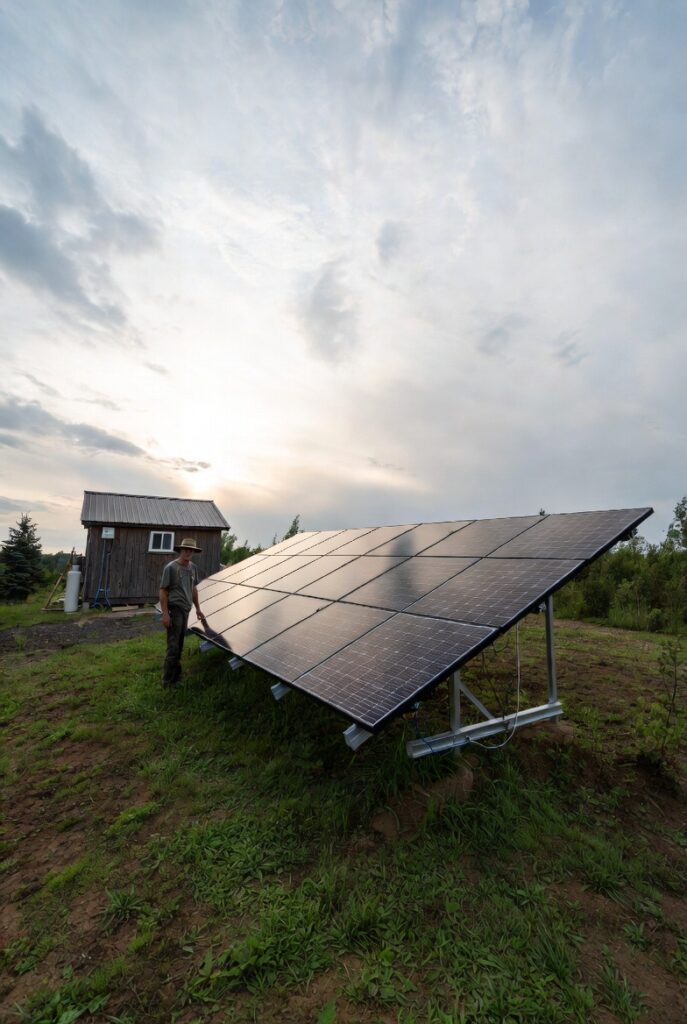
Off grid living in Ontario is not an escape from responsibility, it is a transfer of responsibility from a utility company to the property owner, with a battery bank as the instrument panel and January as the annual performance review. In spring 2022, a couple near Trafalgar Road in Milton, Halton County received a Hydro One rural service extension quote for their new build on an unserviced 4-acre lot approximately 350 metres from the nearest active service pole. The quote was approximately $52,000 for the extension, including pole installation, wire run, and meter base. They had planned to spend approximately $15,000 on the complete electrical system for the property.
They contacted me in May 2022 after reading about off grid living options. I reviewed their planned load list: LED lighting, a DC compressor fridge, laptop charging, satellite internet, and a propane cooktop. Total daily electrical load after propane substitution: approximately 55Ah per day at 12V. Their system specification: 400W panels, 200Ah LFP battery bank at 24V, 1,500W/3,000W surge PSW inverter with search mode, MPPT charge controller, and SmartShunt. Total component cost: approximately $3,200. Installed with ESA permit: approximately $3,650.
I commissioned the system in August 2022 and the ESA inspection passed on the first visit. They have been living off grid on that property since commissioning and have never paid a Hydro One bill. Their Victron SmartShunt January logs show the bank staying above 45% SoC on clear days and recovering to above 80% SoC within one clear day after any gray streak. Their off grid living investment: $3,650 installed versus the $52,000 Hydro One quote. See our Ontario solar sizing guide before designing any off grid living system.
The off grid living decision: what Ontario property owners actually sign up for
Off grid living is legal in Ontario for all property types. Permanent year-round residences must comply with the Ontario Building Code (OBC), including minimum insulation, domestic hot water provision, and a primary heat source independent of the solar system. Seasonal cottages and recreational properties have reduced OBC requirements for non-permanent occupancy. An ESA permit is required for any permanently installed solar electrical system. Rural properties in organized municipalities must comply with local zoning bylaws, and unorganized territories in Northern Ontario have fewer zoning restrictions, but the OBC still applies to habitable structures. A correctly built and permitted off-grid property carries standard property insurance and title registration, the same as any grid-connected property.
The four management habits that off grid living requires and grid-connected living does not. First: daily SoC check during November through February gray streak periods. Second: load shedding protocol for extended gray streaks, what to turn off on day 2 and day 3 to protect the reserve. Third: seasonal array management, 60-degree winter tilt versus 25-degree summer tilt (see our solar panel angle guide). Fourth: annual battery health check using the SmartShunt SoC calibration against a known load. A grid-connected property owner never thinks about any of these. An off grid living property owner does all four, and after the first year they take approximately 10 minutes per week combined.
The four Ontario property types: which system tier applies to your land
| Property type | Occupancy | System tier | DIY cost range | Key January requirement |
|---|---|---|---|---|
| Type 1: Seasonal cottage | May to October | Tier 1 to 2 | $1,500 to $7,000 | Battery stored in heated space |
| Type 2: Year-round rural residence | Year-round | Tier 2 to 3 | $3,650 to $12,000 | January-floor sizing mandatory |
| Type 3: Detached outbuilding | Variable | Tier 1 to 3 | $1,500 to $8,000 | ESA permit for permanent install |
| Type 4: Remote no-grid | Year-round | Tier 3 minimum | $7,000 to $15,000 | Generator backup essential |
Type 1 seasonal cottages operate May through October. Renogy 100W monocrystalline panels are the standard starting point for all four property types. Standard LFP batteries are acceptable for Type 1, the battery bank can be removed to a heated garage or basement during the winter closure if the cabin enclosure drops below 0C. Array sizing is based on the May-October production average rather than the January floor.
Type 2 year-round rural primary residences require January-floor array sizing at 1.5 PSH, propane cooking and water heating to keep electrical load lean, and Battle Born 100Ah LFP batteries in a heated enclosure for any utility room that risks sub-zero temperatures. OBC compliance is required for all permanent habitation. Type 3 detached outbuildings eliminate the $2,000 to $8,000 trench from the main house panel and require an ESA permit for permanent wiring. Type 4 remote no-grid properties require Tier 3 minimum with propane generator backup for extended gray streaks.
The correct selection sequence: identify the property type first, then the occupancy plan, then calculate the daily load using the five-category framework from the off grid appliances guide, then size the battery bank for the 3-day gray streak reserve, then size the array for January 1.5 PSH floor production, then purchase equipment in that order. The Trafalgar Road Milton result confirms the sequence: Type 2 year-round, 55Ah/day after propane substitution, 200Ah LFP 24V bank, 400W array for January floor, $3,650 total installed. See our off grid cabin guide for the full four-season vs three-season specification and our off grid appliances guide for the five-category load audit.
The off grid living financial case: Hydro One connection vs system ownership
Hydro One rural service extension costs range from $15,000 to $80,000 depending on distance and terrain. A 350-metre extension in Wellington/Halton County costs approximately $40,000 to $55,000, and the property owner pays the full amount while owning none of the resulting infrastructure. Off grid living Tier 2 DIY: approximately $3,650 installed with ESA permit, owned entirely by the property owner. The Trafalgar Road Milton comparison: $3,650 versus $52,000. Add 20 years of $60/month Hydro One delivery charges ($14,400) to the connection cost and the 20-year Hydro One total reaches approximately $66,400 on the $52,000 connection. The off grid living 20-year total: $3,650 plus one LFP battery replacement at year 10 (approximately $2,000) equals approximately $5,650.
The off grid living option is approximately $60,750 cheaper over 20 years in the Trafalgar Road Milton scenario, and the property owner owns the infrastructure at the end of it. The break-even point for off grid living versus grid connection occurs within the first month of commissioning when the Hydro One connection quote exceeds $10,000, the first month of avoided connection cost covers a significant portion of the Tier 1 system cost. See our solar panel cost guide for the full Ontario tier cost breakdown, and our off grid ontario guide for the connection cost analysis by property type.
Pro Tip: Before contacting any solar installer for a quote, complete the load audit yourself. List every electrical device in the property with its wattage and daily hours of use. Swap cooking to propane and the fridge to DC before totalling the load, these two swaps reduce the daily electrical load by 60 to 70% in most Ontario off grid living scenarios, which reduces the battery bank size by the same proportion, which reduces the single largest cost item in the entire system. The Trafalgar Road Milton load: 55Ah/day after propane and DC fridge substitution from an initial AC-habit load that would have required a $12,000 to $15,000 system. The load audit took 45 minutes and saved approximately $8,000 to $11,000 in system cost before a single component was purchased.
The first-year reality: what January tells you that July never will
The first summer of off grid living in Ontario produces one consistent reaction: property owners wonder why they worried. The system produces 3x more than needed from May through September, the bank reaches 100% SoC by midmorning most days, and the charge controller simply diverts the excess. October and November see production drop from 4.5 PSH to 2.5 PSH as the sun angle lowers, but the bank still recovers fully each day.
The first December-January is the real test: 1.5 PSH on clear days, near zero on overcast days, and gray streaks of 3 to 5 days that draw the battery bank down steadily. This is the period the system was sized for, and January is when the sizing quality becomes undeniable.
A first-time off grid living property owner on Kortright Road in Guelph, Wellington County commissioned a Tier 2 system in September 2023. His first summer was effortless, 100% SoC every morning, 1,400 to 1,800Wh of daily production against a 650Wh load. He told me in October that off grid living was “easier than expected.” His first January brought a 4-day gray streak that drew the bank from 90% SoC to 31% SoC.
He checked the Victron SmartShunt display on morning 4 and called me. The bank was at 31%, the 3-day gray streak reserve had absorbed the storm and 31% remained, exactly as designed. He has not started his backup propane generator once since commissioning. His 6-month review comment: “January is when you find out if your system works, not July.” The SmartShunt 6 AM reading after a 3-day gray streak is the annual off grid living performance review. Above 40% SoC: correctly sized. Below 20%: the system needs a larger battery bank or array before next winter.
NEC and CEC: Ontario legal requirements for permanent off-grid installations
NEC 690 governs solar PV installations. A permanently installed off grid living solar system must comply with NEC 690 requirements for panel array wiring, DC overcurrent protection, charge controller installation, battery storage, and inverter output wiring. NEC 690.12 requires rapid shutdown capability for any roof-mounted system on an occupied structure. The off grid living property owner who installs their own system is responsible for ensuring NEC 690 compliance in the wiring and overcurrent protection design before the ESA inspection. Contact the NFPA at nfpa.org for current NEC 690 requirements for residential off-grid solar installations.
CEC Section 64 governs solar PV installations in Ontario. A permanently installed off grid living solar system requires an ESA permit filed before wiring begins. The permit application identifies the complete system: panel array, charge controller, battery bank, inverter, and all wiring with overcurrent protection. For a Type 2 year-round primary residence, the off grid living installation must also comply with Ontario Building Code requirements for the building envelope, domestic hot water provision, and primary heat source, these requirements are separate from the ESA permit and must be confirmed with the local building department before construction begins. Contact the Electrical Safety Authority Ontario at esasafe.com before permanently installing any off grid living solar system in Ontario.
The off grid living verdict: which Ontario property type fits your situation
- Ontario rural property owner who received a Hydro One connection quote over $10,000 and is seriously considering off grid living: the financial case is almost certainly in favour of off-grid. Run the 20-year comparison: Hydro One quote plus $14,400 in delivery charges versus the correct DIY system tier plus one battery replacement at year 10. The Trafalgar Road Milton result ($3,650 versus $52,000) is not unusual for Wellington/Halton County rural properties. Confirm the property type (Type 1 seasonal through Type 4 remote), complete the load audit using the five-category framework, and size the system for January 1.5 PSH before purchasing any equipment. The 20-year saving in that scenario exceeds $60,000.
- Ontario property owner exploring off grid living for the first time who is overwhelmed by the research: start with the load audit, not the equipment list. List every electrical load, swap cooking to propane and the fridge to DC, and calculate the total daily Wh. That number determines the battery bank size, which is 40 to 50% of the entire system cost. The Trafalgar Road Milton result: a 45-minute load audit reduced the system requirement from a $12,000 AC-habit build to a $3,650 DC-and-propane build. Use the Victron SmartShunt from day one, the Kortright Road Guelph result confirms what correct sizing produces: 31% SoC remaining after a 4-day January gray streak with no generator required.
- Ontario property owner already living off grid who is managing through difficult January gray streaks with frequent generator use: the system is undersized for the winter load. Check the SmartShunt morning SoC after any 3-day gray streak, below 20% means the system needs a larger battery bank, a larger array, or a load reduction. Apply the three-step diagnostic in order: DC fridge swap (saves most Wh per dollar), search mode inverter (reduces standby drain), array expansion (recovers January production). See our solar power system integration guide for the full 4-component sizing sequence and our solar panel cost guide for current Ontario retail pricing on each upgrade.
Frequently Asked Questions
Q: Is off-grid living legal in Ontario?
A: Yes, off grid living is legal in Ontario for all property types. Permanent year-round residences must comply with the Ontario Building Code for insulation, domestic hot water, and primary heat source. An ESA permit is required for any permanently installed solar electrical system, filed before wiring begins. Rural properties in organized municipalities must comply with local zoning bylaws. A correctly permitted and built off-grid property carries standard property insurance and title registration. Off grid living does not mean unregistered or uninsured, it means the property owner manages the electrical supply rather than a utility company.
Q: How much does it cost to start living off-grid in Ontario?
A: The correct question is how much does the complete system cost at the chosen tier. A Tier 1 seasonal system costs approximately $1,900 DIY installed with ESA permit. A Tier 2 comfortable cottage or year-round rural system costs approximately $3,650 DIY installed with ESA, the Trafalgar Road Milton confirmed result. A Tier 3 four-season primary residence costs approximately $7,000 to $12,000 DIY installed. In every tier, the battery bank is 40 to 50% of the component cost. For a rural Ontario property owner facing a Hydro One connection quote over $10,000, the Tier 2 off grid living system almost always wins the 20-year cost comparison before year 1 is complete.
Q: What is the hardest part of off-grid living in Ontario?
A: January. Not the installation, not the permitting, not the component selection, the first January gray streak is the moment that reveals whether the system was correctly sized for Ontario winter production. A correctly sized off grid living system with the 3-day gray streak reserve handles most Ontario winters with no generator supplementation, as the Kortright Road Guelph result confirms: 31% SoC remaining after a 4-day gray streak. An undersized system depletes to 0% SoC during the same event. The SmartShunt 6 AM reading after a 3-day gray streak in January is the annual performance review. Above 40% SoC means the system is correctly sized. Below 20% means it needs an upgrade before next winter.
This build is engineered within the 48V DC Safety Ceiling. Diagnostic logic is based on 20+ years of technical service experience. All structural and electrical installations must be verified by a Licensed Professional and comply with your Local AHJ.
About the Author
Robert Bertrand spent 20 years as a service advisor in the automotive industry (Lexus and Nissan), where precision diagnostics, wiring integrity, and documentation standards were non-negotiable. He brings that same technical discipline to GridFree Guide, where he researches, tests, and documents off-grid solar systems for Ontario conditions. Based in Rockwood, Ontario, every article is built on verified specifications, manufacturer data, and the real-world climate constraints of Canadian off-grid living.
As an Amazon Associate I earn from qualifying purchases. This site also contains affiliate links to other products and services. GridFree Guide earns a small commission at no extra cost to you.