
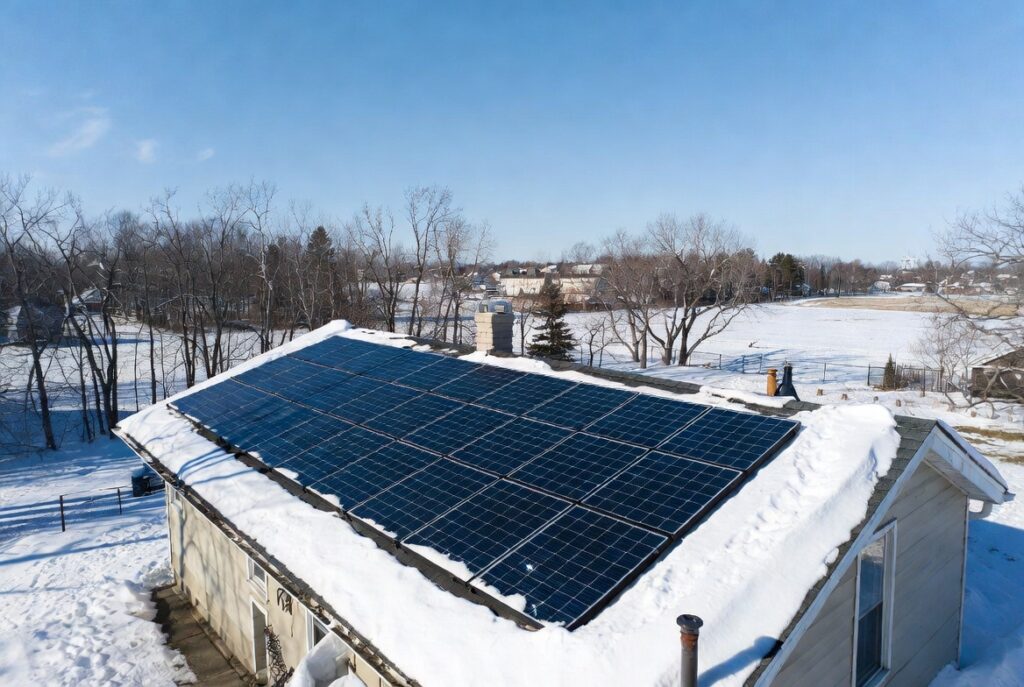
The most predictable off grid Ontario system failure happens in the second week of January when the property owner built his system from American YouTube content, sized his array for 4 PSH, installed standard (unheated) LFP in an outdoor cabinet, and discovers that the Victron SmartShunt is reading 10% SoC at 11 AM on a clear day because the battery bank has not accepted a charge current since the ambient temperature in the cabinet dropped below 0°C in early November, approximately 8 weeks before he noticed the problem.
A property owner in Guelph, Wellington County built a 400W off-grid system in fall 2022 using specifications from a popular US YouTube channel. The channel’s sizing calculator used 4 PSH as the January baseline, accurate for the US Mid-Atlantic region but approximately 2.7 times the actual 1.5 PSH January average for Guelph. He installed two standard 100Ah LFP batteries in an uninsulated outdoor cabinet beside the cabin.
By January 10th, 2023, his SmartShunt confirmed the bank at 10% SoC despite three consecutive clear days. The problem was not the panels, it was the batteries. Standard LFP chemistry stops accepting charge current at 0°C. The outdoor cabinet had been below 0°C since November 14th. The panels were producing current that the battery management system was rejecting to protect the frozen cells from damage.
I inspected the system in late January. The fix required two components: replace the two standard LFP units with Battle Born heated LFP (which self-heats at 2°C before accepting charging current), and move the battery cabinet to the interior of the heated cabin. After the fix, the SmartShunt confirmed the off grid Ontario system performing correctly: 215Wh clear January day production on the 400W array, bank reaching 100% SoC by 2 PM on the first clear day. See our Ontario solar sizing guide before specifying any off grid Ontario system.
The off grid Ontario PSH reality: why 1.5 January PSH requires 4x the array of an Arizona system
| Factor | US standard (YouTube guides) | Ontario standard (2026) | Why it matters |
|---|---|---|---|
| January PSH | 3.5 to 5.5 PSH (Southwest/Mid-Atlantic) | 1.5 PSH | Determines array size, 4× more panels needed |
| Design temperature | 0°C | -22°C | Mandates heated LFP for unheated spaces |
| Gray streak | 2 to 3 days | 4 to 8 days | Mandates 200Ah+ bank for 8.7-day autonomy |
| Insulation | R-12 typical | R-24/R-60 (SB-12) | Reduces heating load from 24,000Wh to 1,920Wh/day |
| Permitting | Optional/varies by state | ESA permit mandatory | Required for insurance coverage in Ontario |
Southern Ontario (Wellington County, Halton Hills, Guelph) averages approximately 1.5 PSH in January. A US YouTube channel based in the Mid-Atlantic or Southwest typically uses 3 to 4 PSH as the winter design baseline. This 2× to 3× difference completely invalidates the array sizing: 400W array at 4 PSH produces approximately 1,360Wh on a clear day, while the same 400W array in Ontario January produces only approximately 510Wh (400W × 1.5 × 0.85). A Guelph buyer using the US calculator installs an array that produces 62% less than the spec assumed and expects his 100Ah bank to compensate for the shortfall.
The off grid Ontario array sizing rule: use 1.5 PSH for January design, not the annual average and not any US regional figure. Design the battery bank for gray streak autonomy of 4 to 8 days at near-zero net production. A correctly specified off grid Ontario system coasts through an 8-day Wellington County January gray streak at 220Wh per day total load on a 200Ah LFP bank: 1,920Wh usable ÷ 220Wh = 8.7 days. The Erin Township result: 6-day gray streak, SmartShunt floor at 30% SoC, 576Wh of reserve remaining, zero generator required. See our solar battery ontario guide for the complete bank sizing standard.
The -22°C battery failure: why standard LFP stops charging in an Ontario winter
Standard LFP batteries include a BMS that prevents charging when cell temperature is below 0°C. The protection is correct, attempting to charge a lithium cell below 0°C causes lithium plating on the anode, permanently damaging the cell and creating a fire risk. In an Ontario winter, any unheated battery cabinet, garage, or outdoor enclosure drops below 0°C by mid-November and remains below 0°C until mid-March, approximately 18 to 20 weeks during which a standard LFP bank will not accept charge current. The panels produce current; the BMS rejects it entirely.
The Battle Born heated LFP self-heating element activates at approximately 2°C and warms the cells to 5 to 7°C before allowing any charging current, ensuring the bank charges normally through the entire Ontario winter regardless of ambient temperature. For any off grid Ontario battery bank in a heated interior space guaranteed above 5°C at all times, a standard LFP functions normally. The heated LFP premium of approximately $150 to $200 per 100Ah battery is the cost of the self-heating element that eliminates the need for a dedicated conditioned battery room. Install a Victron SmartShunt on the negative run to confirm the bank is accepting charge current on the first cold November morning.
Pro Tip: The SmartShunt commissioning check for any off grid Ontario system: on the first clear November day after temperatures drop below 0°C overnight, check the SmartShunt current reading at 10 AM with the panels facing the sun. A positive current reading (battery charging) confirms the heated LFP is functioning correctly. A zero or negative current reading with the sun out means the BMS has cut off charging due to cell temperature, the battery is either in a space colder than 2°C or the heating element has failed. The Guelph property owner’s SmartShunt showed zero charging current on January 10th despite clear skies, the diagnostic that revealed the frozen standard LFP bank. A battery in a heated interior space showing positive charging current at 11 AM on a clear Ontario January day is the confirmation that the off grid Ontario system is correctly specified.
The off grid Ontario five-point standard: heated LFP, ESA permit, 1.5 PSH sizing, gray streak math, and SB-12 insulation
The off grid Ontario five-point standard differs from every US-based guide. First: array sizing must use 1.5 PSH January, not 4 PSH. Second: battery bank must be heated LFP for any unheated location, or standard LFP in a guaranteed conditioned space. Third: battery bank size must provide at least 8 days of daily load autonomy at 80% DoD, for a 220Wh per day system, 200Ah minimum (1,920Wh ÷ 220Wh = 8.7 days). Fourth: ESA permit required before installation at $300 to $400. Fifth: Ontario Building Code SB-12 insulation (R-24 effective walls, R-60 attic) to reduce the heating load to a propane furnace blower level (1,920Wh per day) rather than electric supplemental heat (24,000Wh per day).
A property owner in Erin Township, Wellington County completed a new off grid Ontario cabin build in fall 2023 with all five requirements from day one. His array: 4× Renogy 100W mono PERC sized for 1.5 PSH. His bank: 2× Battle Born heated LFP 100Ah in a heated utility room. His controller: Victron MPPT 100/30 with LFP profile (14.2V absorption, 2A tail current, 13.5V float). ESA permit obtained before installation. R-24/R-60 insulation: total daily load 220Wh. First January: SmartShunt confirmed 215Wh clear day, 100% SoC by 1:30 PM. 6-day gray streak: SmartShunt floor 30% SoC, 576Wh reserve remaining, zero generator all winter. “It worked exactly as calculated.” See our off grid insulation guide for the complete SB-12 specification.
The Ontario gray streak calculation: 4 to 8 days at 0.63 PSH and what that means for bank size
The Ontario gray streak calculation is the single most important design input for any off grid Ontario system. A standard overcast Ontario January day produces approximately 215Wh from a 400W array (400W × 0.63 PSH × 0.85 efficiency). If the total daily load is 220Wh, the gray streak daily deficit is 5Wh, essentially neutral. If the total daily load includes an AC fridge through an inverter (380Wh per day), the gray streak daily deficit is 165Wh, and the battery bank depletes in 3 to 4 days. The gray streak calculation forces every appliance and insulation decision: every watt of daily load reduction extends gray streak autonomy proportionally.
The Ontario gray streak standard: design for 8 consecutive overcast January days at the correct daily load. For a 220Wh per day Tier 2 system: 200Ah × 80% DoD × 12V = 1,920Wh ÷ 220Wh = 8.7 days, the confirmed Erin Township result. For a system with an incorrectly specified AC fridge (380Wh per day) and no insulation upgrade (heating load adds 500Wh per day): total daily load = 880Wh per day, 1,920Wh ÷ 880Wh = 2.2 days. The SmartShunt’s SoC floor on day 3 of the first January gray streak is the diagnostic that reveals whether the off grid Ontario system was correctly specified. See our off grid setup guide for the SmartShunt commissioning protocol.
NEC and CEC: Ontario permit requirements for off-grid electrical installations
NEC 690 governs the solar PV system installation in any off grid Ontario project, array wiring, charge controller connections, battery bank fusing, and inverter AC output circuits. All battery cables must be sized for 125% of the maximum continuous current, fused at the battery positive terminal with a Class T fuse, and installed with appropriate overcurrent protection at the charge controller input. The inverter output must connect through a sub-panel with appropriately rated breakers. Contact the NFPA at nfpa.org for current NEC 690 requirements for residential off-grid installations.
CEC Section 64 governs electrical installations in Ontario. Any permanently wired off grid Ontario system requires an ESA permit before installation begins, this includes the inverter sub-panel, all AC wiring within the structure, the battery bank DC circuits, and the array wiring. The ESA permit at $300 to $400 is the document that makes the system legal, insurable, and confirmed safe. Attempting to install a permanent off grid Ontario system without an ESA permit invalidates the property insurance coverage for the structure. Contact the Electrical Safety Authority Ontario at esasafe.com before beginning any permanent off grid Ontario installation.
The off grid Ontario verdict: size for 1.5 PSH January, specify heated LFP, obtain the ESA permit first
- Ontario property owner who built an off-grid system from US YouTube content and is experiencing battery depletion in January: check the SmartShunt current reading on a clear January morning before replacing any hardware. If the bank is at 10% SoC on a clear day with panels facing south, the batteries are not charging. Check the battery cabinet temperature, if below 0°C, the BMS is protecting frozen cells by refusing charge current. The fix: replace with Battle Born heated LFP and relocate to a heated interior space. Then check array size: if the system was sized for 4 PSH, double the array for Ontario January. The Guelph result: both fixes applied, SmartShunt confirmed 215Wh clear January and 100% SoC by 2 PM.
- Ontario property owner planning a new Tier 2 off-grid cabin: build the specification in the correct Ontario order, insulation first, then heating load, then system size. R-24 walls and R-60 attic reduce the heating electrical load from 24,000Wh per day to 1,920Wh per day. Then size for 1.5 PSH January with 200Ah bank for 8.7-day autonomy. 4× Renogy 100W mono PERC panels through a Victron MPPT 100/30, 2× Battle Born heated LFP 100Ah, and a Victron SmartShunt is the confirmed Tier 2 Ontario standard. Obtain the ESA permit before purchasing any components, the process takes 2 to 4 weeks.
- Ontario property owner currently planning from any US-based off-grid resource: apply these five Ontario-specific corrections before finalizing any purchase. (1) Replace 4 PSH with 1.5 PSH for January array sizing. (2) Replace standard LFP with Battle Born heated LFP for any unheated battery location. (3) Add the ESA permit at $300 to $400 to the budget before any hardware purchase. (4) Add the R-24/R-60 insulation upgrade budget before sizing the battery bank. (5) Replace any AC fridge specification with a 12V DC compressor fridge connecting directly to the DC busbar. These five corrections convert any US-based off grid system specification into a correct off grid Ontario standard.
Frequently Asked Questions
Q: How is off-grid solar different in Ontario compared to the US?
A: Off grid Ontario systems face five climate and regulatory differences that US-based guides do not address. First: January PSH of 1.5 in Wellington County and Halton Hills versus 3.5 to 5.5 PSH in the US Southwest and Mid-Atlantic, requiring approximately 4× more array capacity for the same January daily output. Second: -22°C design temperature that makes heated LFP mandatory for any battery bank in an unheated space (standard LFP stops charging at 0°C).
Third: gray streaks of 4 to 8 consecutive overcast days that require a 200Ah minimum bank for a 220Wh per day Tier 2 system. Fourth: ESA permit mandatory for any permanently wired system, required for insurance coverage. Fifth: Ontario Building Code SB-12 insulation standard (R-24/R-60) that determines the heating electrical load and therefore the system size. A system built from US specifications will fail its first Ontario January on at least one of these five points.
Q: Do I need an ESA permit for an off-grid system in Ontario?
A: Yes, any permanently wired off grid Ontario system requires an ESA permit before installation begins, covering the inverter sub-panel, all AC wiring within the structure, the battery bank DC circuits, and the array wiring. The ESA permit at $300 to $400 is required for home insurance coverage on any habitable structure with a permanent electrical installation. An off grid Ontario system installed without an ESA permit will not be covered under the property insurance policy for any claim involving the electrical system. The permit process typically takes 2 to 4 weeks for a standard off-grid cabin installation, obtain the permit before purchasing any components. Contact esasafe.com to begin the application.
Q: What battery should I use for off-grid solar in Ontario?
A: For any off grid Ontario battery bank in an unheated space, outdoor cabinet, unheated garage, unheated utility room, or any location that drops below 0°C from November through March, the Battle Born heated LFP is the mandatory specification. Standard LFP stops accepting charge current at 0°C to protect the cells from lithium plating damage. Wellington County and Halton Hills battery locations in unheated spaces drop below 0°C by mid-November and stay below 0°C until mid-March, approximately 18 to 20 weeks of no charging if standard LFP is specified.
The heated LFP premium of approximately $150 to $200 per 100Ah battery covers the internal self-heating element that allows the bank to charge normally at any Ontario winter temperature. For battery banks in heated interior spaces guaranteed above 5°C at all times, standard LFP functions normally.
This build is engineered within the 48V DC Safety Ceiling. Diagnostic logic is based on 20+ years of technical service experience. All structural and electrical installations must be verified by a Licensed Professional and comply with your Local AHJ. See our legal and safety disclosure for full scope.
About the Author
Robert Bertrand spent 20 years as a service advisor in the automotive industry (Lexus and Nissan), where precision diagnostics, wiring integrity, and documentation standards were non-negotiable. He brings that same technical discipline to GridFree Guide, where he researches, tests, and documents off-grid solar systems for Ontario conditions. Based in Rockwood, Ontario, every article is built on verified specifications, manufacturer data, and the real-world climate constraints of Canadian off-grid living.
As an Amazon Associate I earn from qualifying purchases. This site also contains affiliate links to other products and services. GridFree Guide earns a small commission at no extra cost to you.