
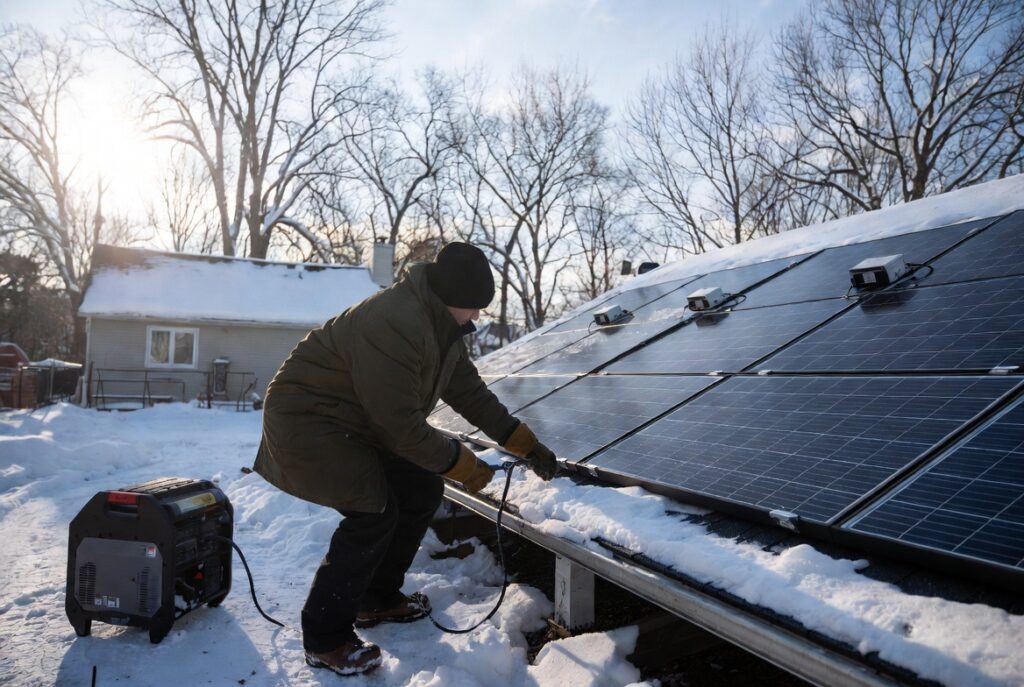
The most common solar generator ontario mistake is buying a unit based on the manufacturer’s “400W solar charges in 3 hours” claim, because that recharge time was calculated at 4 to 6 PSH, the solar resource of Arizona or the US Mid-Atlantic in July, and a property owner near Kortright Road in Guelph, Wellington County discovered in February 2024 that his 400W portable array was recharging only 510Wh per day into his Jackery HomePower 3000, which at 3,024Wh total capacity meant he was recovering approximately 17% of the bank per clear January day, a full recharge from empty requiring approximately 6 consecutive clear days.
He had bought the unit in November 2023 for ice storm backup. The product page stated “recharges in approximately 3 hours with 800W of solar.” He purchased a compatible 400W portable folding array specifically for fast solar recharging.
During the February 2024 Wellington County ice storm, the grid dropped for 28 hours. He depleted approximately 1,800Wh of the 3,024Wh bank running the furnace blower (80W), fridge (60W), and router (15W) for the full outage. After the outage, he connected his 400W array on the first clear morning. The Jackery app showed the battery gaining approximately 510Wh over the full clear day, approximately 17% of the 3,024Wh bank. With the bank at approximately 40% SoC (approximately 1,209Wh remaining), full recharge required approximately 3 more clear January days.
I reviewed his system setup after the event. The fix was not a hardware replacement, the Jackery HomePower 3000 had performed correctly for the 28-hour outage. The correct adjustment was expectations and recovery planning: assume 510Wh per clear January day from 400W of portable solar, plan for 6 clear days to full recharge from 0%, and maintain the unit at 100% SoC heading into storm season by charging from grid power in October before storage. See our Ontario solar sizing guide before specifying any solar generator ontario system.
The solar generator ontario recharge reality: 510Wh per clear January day and what that means for each unit
| Unit | Capacity | Ontario Jan. recharge (400W array) | Clear days from 0% |
|---|---|---|---|
| Jackery HomePower 3000 | 3,024Wh | 510Wh = 16.9%/day | ~6 clear days |
| EcoFlow DELTA Pro 3 | 3,600Wh | 510Wh = 14.2%/day | ~7 clear days |
| Bluetti Elite 200 V2 | 2,048Wh | 510Wh = 24.9%/day | ~4 clear days |
| Manufacturer spec (US-based) | n/a | 3,200Wh/day at 4 PSH | “3 hours” (not Ontario) ✗ |
Every major portable solar generator ontario unit uses the same manufacturer optimism: recharge times calculated at 4 to 6 PSH (US conditions). Ontario January delivers 1.5 PSH to a south-facing 400W array. 400W × 1.5 PSH × 0.85 efficiency = 510Wh per clear day. This is the only correct number to use for solar generator ontario recharge planning. The manufacturer spec assumes 800W of solar at 4 PSH = 3,200Wh input per day, approximately 6.3 times Ontario’s actual January production from a 400W array.
The Bluetti’s 2,048Wh bank recharges fastest at approximately 4 clear days from 0%, the correct choice if daily solar recharge speed is the priority and the load fits within 2,048Wh. The EcoFlow DELTA Pro 3 at 3,600Wh takes approximately 7 clear days from 0%, the largest capacity of the three, best for sump pump loads via its 12V DC output. The Jackery HomePower 3000 at 3,024Wh sits in between at approximately 6 clear days from 0%. In practice, a typical 28-hour Ontario outage consumes 800 to 1,500Wh, meaning post-outage solar recovery from 40% SoC takes approximately 2 to 3 clear January days for all three units. See our solar generator cost guide for the complete Ontario portable unit cost comparison.
The Ontario January recharge comparison: Jackery, EcoFlow, and Bluetti side by side
The manufacturer recharge specs for all three units assume 800W to 1,200W of solar at 4 to 6 PSH, conditions found in the US Southwest in July. The same manufacturers’ 400W compatible arrays produce approximately 510Wh per clear January day in Wellington County and Halton Hills. This is not a deficiency in the equipment, it is a climate reality that every solar generator ontario buyer must incorporate into their planning. A 28-hour Ontario ice storm outage typically consumes 800 to 1,500Wh from a portable unit running furnace blower, fridge, and router, meaning the bank is at 40 to 60% SoC at restoration, not 0%.
The practical Ontario solar generator ontario protocol for winter maintenance: charge the unit to 100% SoC from the grid in October before ice storm season. Store in a heated interior space (above 5°C). Check the app monthly from November through April. Disable wifi standby to eliminate the 8W continuous parasitic drain (at 8W × 24h × 15 days = 2,880Wh, enough to fully deplete a Bluetti Elite 200 V2 in standby). Using grid power for seasonal charging and reserving solar as the post-outage recovery strategy is the correct Ontario solar generator ontario approach.
Pro Tip: After any Ontario outage, do not wait for the solar generator ontario to reach 100% SoC from solar before the next potential storm. If the bank is at 40% after a 28-hour outage, plug into grid power the moment the grid restores, recovering 60% of the bank from grid power takes 2 to 3 hours at the unit’s AC input rate (1,200W to 2,400W typical), versus 2 to 3 clear January days from solar alone. Reserve solar recharge as the backup for when grid power is unavailable, not as the primary recharge method during storm season. The Kortright Road Guelph result: the Jackery was plugged into grid power the moment service restored and was at 100% SoC within 3 hours, fully ready for the next event before the solar option would have recovered even 510Wh.
The Ontario winter storage protocol: why the BMS blocks charging in an unheated garage
The Ontario winter storage protocol for any portable solar generator ontario unit follows the same LFP cold-charging rule: do not attempt to charge LFP cells below 0°C. The BMS in EcoFlow, Bluetti, and Jackery units blocks charging current when cell temperature is below 0°C, protecting the cells from lithium plating damage that permanent capacity reduction causes. An unheated Ontario garage drops to -15°C to -25°C on cold nights from November through March. A portable solar generator ontario stored in this environment will refuse all charging from solar or grid until the unit is brought into a heated space and the cells warm above the charge inhibit threshold.
The warming protocol: bring the solar generator ontario unit from the unheated garage into a heated interior space (above 5°C). Allow 2 to 4 hours for the LFP cells to reach above 5°C at room temperature. The unit’s app or display will show charging current resuming once the BMS confirms the cell temperature is above the charge inhibit threshold. In an Ontario ice storm scenario where the power is already out, a portable solar generator ontario that spent the winter in an unheated garage may need 4 to 6 hours of warming before it can accept solar recharge current.
Plan the staging location accordingly: store the unit in the heated living space from October through April, not in the unheated garage where it sits at ambient temperature.
The solar generator ontario hybrid standard: portable for mobility, MultiPlus-II for whole-home seamless transfer
The solar generator ontario hybrid standard: portable unit for mobile loads, Victron MultiPlus-II for whole-home seamless backup. The portable tier handles loads that need to physically move (sump pump in the basement, chest freezer in the garage) and provides a second power source independent of the home’s wiring. The permanent tier provides the less than 20ms seamless transfer that keeps furnace controllers, computers, and medical equipment running without reset. A property owner in Halton Hills, Halton Region runs this two-tier solar generator ontario strategy: EcoFlow DELTA Pro 3 for portable loads and Victron MultiPlus-II for whole-home critical loads.
On February 7, 2025, a transformer failure cut grid power at 7:23 PM. The Victron SmartShunt on the permanent bank confirmed 94% SoC at the moment of the outage (4,512Wh available from the 4,800Wh usable bank). The MultiPlus-II transferred all whole-home loads in less than 20 milliseconds. The EcoFlow DELTA Pro 3 handled the sump pump via 12V DC output, consuming approximately 600Wh for pump cycles over the 11-hour outage.
The MultiPlus-II bank dropped from 94% to 21% SoC, approximately 3,456Wh consumed from 4,800Wh usable. Hydro One restored service 11 hours 14 minutes later. Zero generator runtime. Her comment: “The portable unit handles what needs to move. The permanent system handles everything else.” See our solar battery ontario guide for the MultiPlus-II hybrid specification.
NEC and CEC: Ontario permit requirements for permanent solar generator installations
NEC 690 and the Ontario Electrical Safety Code govern permanent solar generator ontario installations. A portable solar generator ontario that plugs into standard outlets does not require an ESA permit. A permanently wired solar generator ontario system, including any hardwired inverter, battery bank, or sub-panel connection, requires an ESA permit covering all AC and DC wiring, sub-panel, and battery bank circuits. Any permanently wired Ontario system must comply with NEC 690 requirements for battery cable sizing (125% of maximum continuous current), Class T fusing at the battery positive terminal, and appropriate overcurrent protection throughout the DC circuit. Contact the NFPA at nfpa.org for current NEC 690 requirements.
CEC Section 64 governs electrical installations in Ontario. Any solar generator ontario system that connects permanently to the home’s electrical panel or sub-panel requires an ESA permit at $300 to $400 before installation begins. For HRSP-eligible grid-tied solar generator ontario systems using the Victron MultiPlus-II, the ESA inspection is a program requirement, the rebate is not released without proof of ESA and LDC final inspection. Portable solar generator ontario units that connect via standard household outlets do not require an ESA permit. Contact the Electrical Safety Authority Ontario at esasafe.com before beginning any permanent solar generator ontario installation.
The solar generator ontario verdict: Jackery for short outages, EcoFlow for sump pumps, MultiPlus-II for fortress reliability
- Ontario property owner using a portable solar generator ontario for ice storm backup: plan for 510Wh per clear January day from a 400W array and charge to 100% from grid before storm season. Jackery HomePower 3000 (3,024Wh): approximately 6 clear days from 0%, best for whole-home critical loads. EcoFlow DELTA Pro 3 (3,600Wh): approximately 7 clear days from 0%, best for sump pump via 12V DC output. Bluetti Elite 200 V2 (2,048Wh): approximately 4 clear days from 0%, fastest solar recharge of the three. After a typical 28-hour Ontario outage consuming 1,500Wh, solar recovery from 40% SoC takes 2 to 3 clear January days, not 6. Store in a heated interior space, disable wifi standby, check the app monthly November through April.
- Ontario property owner who wants seamless whole-home outage protection without visible interruption: the permanent Victron MultiPlus-II with 200Ah Battle Born heated LFP is the correct solar generator ontario upgrade. The system recharges from the grid at 3.9¢/kWh overnight, is always at or near 100% SoC before any outage, transfers in less than 20ms, and a Victron SmartShunt confirms the SoC in real time, no solar recharge wait after grid restoration. The Halton Hills result: 11-hour outage handled entirely without a generator, SmartShunt confirmed 21% SoC at restoration with 3,456Wh consumed from the 4,800Wh usable bank.
- Ontario property owner who wants maximum reliability for both portable and whole-home loads: run the two-tier solar generator ontario strategy. Portable EcoFlow DELTA Pro 3 for sump pump and mobile loads (12V DC output bypasses the inverter entirely for the pump). Permanent MultiPlus-II for whole-home critical loads at less than 20ms transfer. The Halton Hills configuration confirmed zero generator runtime through an 11-hour February outage with exactly this two-tier split. When backup capacity needs exceed approximately 5,000Wh, the Victron MultiPlus-II with 200Ah Battle Born LFP at approximately $3,500 to $5,000 installed is cost-competitive with stacking portable solar generator ontario units.
Frequently Asked Questions
Q: How long does it take to recharge a solar generator in Ontario in January?
A: With a 400W portable solar array in Ontario January (1.5 PSH), recharge is approximately 510Wh per clear day. A Jackery HomePower 3000 (3,024Wh) takes approximately 6 clear days from 0% SoC. An EcoFlow DELTA Pro 3 (3,600Wh) takes approximately 7 clear days from 0%. A Bluetti Elite 200 V2 (2,048Wh) takes approximately 4 clear days from 0%. In practice, most Ontario outages deplete the bank to 40 to 60% SoC rather than 0%, so post-outage solar recovery takes 2 to 3 clear days for typical outage scenarios.
The manufacturer recharge specs, often “3 hours with 800W”, assume 4 to 6 PSH (US Southwest or Mid-Atlantic conditions). Ontario January delivers 1.5 PSH. The Ontario-correct recharge rate is approximately 6 to 7 times slower than the manufacturer’s best-case specification.
Q: Can I use a portable solar generator outside in an Ontario winter?
A: The solar panels can be deployed outside, south-facing in a fixed or adjustable ground mount, but the solar generator ontario unit itself should be stored in a heated interior space above 5°C from November through April. LFP cells in all three major units (EcoFlow, Bluetti, Jackery) block charging current when cell temperature drops below 0°C. An unheated Ontario garage drops to -15°C to -25°C on cold winter nights.
A solar generator ontario stored in this environment will refuse all charging until brought into a heated space and allowed to warm for 2 to 4 hours. During an active power outage, a unit stored in an unheated garage may need 4 to 6 hours of warming before it can accept solar recharge current, store the unit in the heated living space all winter to avoid this delay.
Q: When should I upgrade from a portable solar generator to a permanent system in Ontario?
A: The transition point is approximately 5,000Wh of required backup capacity. A Victron MultiPlus-II with 200Ah 24V Battle Born heated LFP provides 4,800Wh usable at approximately $3,500 to $5,000 installed, comparable in cost to two Bluetti Elite 200 V2 units (2× 2,048Wh = 4,096Wh) plus their charging equipment. The permanent system recharges from the grid at 3.9¢/kWh (ULO overnight rate), is always at or near 100% SoC before any outage, and provides less than 20ms seamless transfer (versus approximately 20 to 30ms for portable units).
No 6-day solar recovery wait is required after grid restoration because the battery is recharged by the grid automatically. The Halton Hills result confirms the hybrid strategy: EcoFlow DELTA Pro 3 handles mobile loads, MultiPlus-II handles whole-home critical loads, zero generator runtime through an 11-hour outage.
This build is engineered within the 48V DC Safety Ceiling. Diagnostic logic is based on 20+ years of technical service experience. All structural and electrical installations must be verified by a Licensed Professional and comply with your Local AHJ. See our legal and safety disclosure for full scope.
About the Author
Robert Bertrand spent 20 years as a service advisor in the automotive industry (Lexus and Nissan), where precision diagnostics, wiring integrity, and documentation standards were non-negotiable. He brings that same technical discipline to GridFree Guide, where he researches, tests, and documents off-grid solar systems for Ontario conditions. Based in Rockwood, Ontario, every article is built on verified specifications, manufacturer data, and the real-world climate constraints of Canadian off-grid living.
As an Amazon Associate I earn from qualifying purchases. This site also contains affiliate links to other products and services. GridFree Guide earns a small commission at no extra cost to you.