
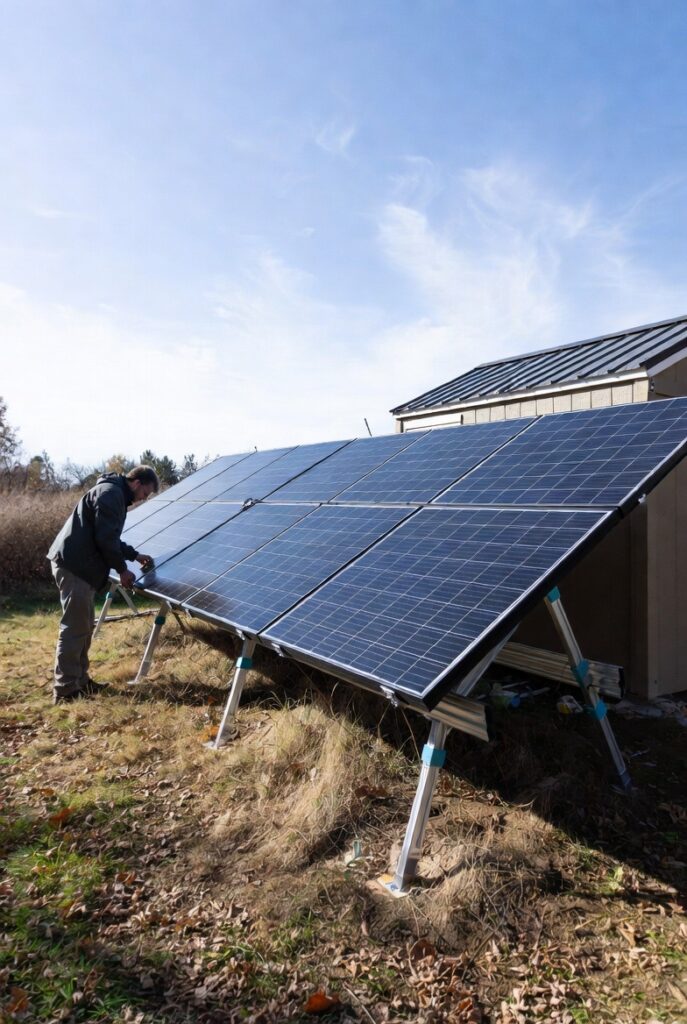
The correct solar panel angle for an Ontario property is not a single number, it is a seasonal decision that determines whether the system produces enough power in January to matter or barely enough to keep the fridge running. In spring 2024, a homeowner on Edinborough Road in Guelph, Wellington County installed four 200W panels on his detached shed roof at a 3/12 pitch, approximately 14 degrees, using a flush-mount racking system for its clean look. His summer production from April through September was close to the expected output and he felt satisfied with the system. The satisfaction lasted until November.
His production declined faster than the expected seasonal reduction. By January he was producing approximately 40% less power than the sizing calculations had predicted for a 200W array in Wellington County. His battery bank dropped below 50% SoC on consecutive overcast days and he ran the generator more frequently than the system design had anticipated. He contacted me for a commissioning review in February 2024.
I identified the flush mount as the primary issue. At Ontario latitude 44°N, the December sun reaches a maximum elevation of approximately 22 degrees above the horizon at solar noon. A panel mounted at 14 degrees is nearly parallel to the incoming December sun, reducing production to approximately 55 to 65% of rated output at an optimal solar panel angle. The shallow tilt also meant snow accumulated and stayed with no surface angle to encourage sliding.
His Victron SmartShunt logs confirmed January production was consistent with a 14-degree panel facing Ontario’s December sun. He retrofitted adjustable tilt legs to bring the panels to 55 degrees for the winter months. See our Ontario solar sizing guide before selecting any panel mounting approach.
The solar panel angle options: fixed, two-position, and flush roof mount compared
| Mounting approach | Angle | Annual production | Snow shedding | Ontario verdict |
|---|---|---|---|---|
| Two-position seasonal | 25° summer / 60° winter | Maximum (+12% vs fixed) | Excellent at 60° ✓ | Best for ground mount ✓ |
| Fixed year-round | 35° to 40° | 10-15% below two-position | Good above 35° ✓ | Correct for roof mount ✓ |
| Flush roof mount | Follows pitch 18-27° | 40-50% below optimal in Jan ✗ | Snow stays below 30° ✗ | Not for off-grid use ✗ |
The fixed 35 to 40 degree solar panel angle suits most Ontario residential installations where seasonal adjustment is not practical. This angle provides balanced production across all seasons, approximately 10 to 15% below the theoretical maximum achievable with two-position adjustment, and panels above 35 degrees shed most Ontario snow loads with moderate wind. Most Ontario residential roofs have a 4/12 to 6/12 pitch, translating to 18 to 27 degrees, significantly shallower than the 35-degree minimum for good year-round production. A flush roof mount on a standard Ontario roof is not an adequate solar panel angle for any off-grid system that relies on January production.
The correct approach for roof-mounted systems is a tilt-frame ballasted mount that brings the panel to 35 to 40 degrees over the existing roof pitch. For properties with accessible ground space, a ground mount offers full solar panel angle control at every season without the roof penetration and structural loading considerations of a roof tilt frame. The Edinborough Road result is the cost of ignoring this: 40% below expected January production, excess generator use, and a retrofit that could have been built correctly from the start. See our solar garage guide for how the panel angle decision applies to detached workshop installations.
The two-position protocol: April and October adjustments for 12% annual gain
The two-position seasonal adjustment protocol delivers the best annual production from a solar panel angle perspective for any Ontario property with an accessible ground mount. Spring and summer position from April through September: 25 degrees, capturing the high-angle Ontario summer sun and maximising production during the longest and brightest days. Autumn and winter position from October through March: 60 degrees, facing the low-horizon December sun directly and maximising production during Ontario’s critical winter period. Annual production gain versus a fixed 35-degree mount: approximately 12%.
A cottage owner on James Street in Milton, Halton County installed an adjustable ground-mount rack for four Renogy 100W monocrystalline panels in fall 2023. She set the rack to 60 degrees in October 2023 and monitored her bank through the winter. Her neighbour had a similar array fixed at approximately 25 degrees roof pitch. In January 2024 her bank maintained above 75% SoC through a 5-day gray streak that pushed her neighbour’s fixed-mount system to low-voltage cutoff. In April 2024 she adjusted the rack to 25 degrees for summer. Her SmartShunt year-over-year production logs confirmed a 12% annual gain compared to her own prior season’s fixed-mount baseline at 35 degrees. The two adjustments took approximately 25 minutes combined.
Pro Tip: The fastest way to verify that a solar panel angle change has improved production is to check the SmartShunt during the first clear day after the adjustment. On the day of the October tilt adjustment from 25 degrees to 60 degrees, note the SmartShunt’s peak midday production current in amps. On the following clear day at the same time, compare. A correctly executed tilt adjustment from 25 to 60 degrees for October Ontario conditions typically produces a 15 to 25% increase in peak midday current on equivalent irradiance days. If the peak current does not increase, the panels may still have a snow or shade obstruction, or the adjustment was not made correctly. This is a two-minute verification that confirms the adjustment was successful before closing the racking hardware.
The solar panel angle azimuth rule: true south, roof compromise, and the east-west penalty
Compass direction determines annual production as significantly as the solar panel angle tilt in Ontario. True south-facing at 43.5 to 44°N latitude is optimal. A 15-degree east or west offset from true south reduces annual production by less than 2%, negligible. A 45-degree offset to southeast or southwest reduces annual production by approximately 6 to 8%, which is meaningful but acceptable for a roof that does not face true south. East or west-facing panels at 90 degrees from true south lose approximately 15 to 20% of annual production compared to a true south orientation at the same tilt angle.
For non-south-facing roofs, size the system array to compensate for the azimuth loss. A southeast-facing array at 6 to 8% reduction requires approximately 7 to 9% more panels to match a true south array’s production. East and west-facing roofs at 15 to 20% annual reduction are not good candidates for off-grid roof-mount arrays, ground mount with true south azimuth is the correct specification for those properties. Never force a system onto a north-facing roof regardless of tilt angle. See our solar battery bank sizing guide for how to incorporate azimuth and tilt adjustments into the daily production calculation.
The December 21 10 AM shade rule: Ontario’s winter solstice diagnostic
December 21 is the winter solstice and the lowest sun angle of the year. At Ontario latitude 44°N, the sun reaches approximately 22 degrees elevation at solar noon and approximately 15 to 17 degrees at 10 AM. Any chimney, tree, dormer, or neighbouring structure that casts a shadow on any part of the array at 10 AM on December 21 blocks production during the most critical period of the Ontario solar year. The shade cascade applies: without power optimisers, a shadow on one panel in a string reduces the entire string to the shaded panel’s output level, regardless of whether the other panels in the string are in full sun.
The Milton Trafalgar Road result from the solar inverter types article confirms the cost: a chimney shadow from 2 PM to 4 PM in November through February cost 20 to 25% of winter production on a string inverter without optimisers. Power optimisers at $40 per panel recovered the loss. The same principle applies to any shadow from the December 21 10 AM horizon. The diagnostic: physically stand at the array location at 10 AM on December 21 and observe. If any obstruction falls between the array and the sun, add power optimisers to the affected panels or relocate the array. See our solar inverter types guide for the power optimiser vs microinverter comparison.
NEC and CEC: Ontario requirements for solar panel mounting and installation
NEC 690 governs solar PV installations. A permanently installed solar panel system must comply with NEC 690 requirements for mechanical mounting, DC wiring, overcurrent protection, and grounding. The racking system must be rated for the specific panel weight and the local Ontario snow and wind load. NEC 690.12 mandates rapid shutdown capability for roof-mounted systems on occupied structures. The DC cable runs from the panel junction boxes to the charge controller must comply with NEC 690 wiring requirements for exposed rooftop or exterior DC wiring. Contact the NFPA at nfpa.org for current NEC 690 requirements for residential solar PV panel mounting.
CEC Section 64 governs solar PV installations in Ontario. A permanently mounted solar panel array requires an ESA permit identifying the panel configuration, mounting method, DC wiring, and structural attachment to the building or ground mount support. Ground mount systems require a permit specifying the foundation, racking structure, and electrical wiring from the array to the charge controller and battery bank. O. Reg. 903 governs well installations in Ontario; for panel installations, the Ontario Building Code may require a building permit for ground mount structures above a certain footprint, confirm with the local building department before installing any ground mount racking. Contact the Electrical Safety Authority Ontario at esasafe.com before installing any permanently mounted solar panel array in Ontario.
The solar panel angle verdict: which mounting approach fits your Ontario property
- Ontario off-grid property owner with a ground-mountable area and full access to the racking system: use the two-position protocol. Set the solar panel angle to 60 degrees in October and 25 degrees in April. The Milton James Street result confirms the outcome: 12% more annual production than a fixed 35-degree mount, bank above 75% SoC through a 5-day January gray streak that pushed a nearby fixed-mount system to low-voltage cutoff. The 25-minute twice-yearly adjustment is the highest-return maintenance task in the entire Ontario off-grid system. Run the December 21 10 AM shade check before commissioning to confirm no winter obstruction will reduce the gain.
- Ontario off-grid property owner with a roof-mounted array where seasonal access is not safe or practical: set the fixed solar panel angle to 40 degrees using a tilt-frame over the existing roof pitch. The 40-degree tilt sheds most Ontario snow loads above -5C and produces balanced annual output at approximately 10 to 15% below the two-position protocol maximum. Run the December 21 10 AM shade diagnostic before commissioning and add power optimisers at $40 per panel if any winter chimney or dormer shadow is present. Do not accept a flush roof mount at the existing pitch as the final solar panel angle for any system that depends on January production.
- Ontario off-grid owner whose flush-mounted panels are underperforming in January: diagnose with the SmartShunt before retrofitting. Check the Victron SmartShunt January production logs against the sizing calculation prediction. If January production is 30 to 40% below the calculated figure and the panels have a pitch below 30 degrees, the solar panel angle is the primary cause. Retrofit adjustable tilt legs to bring the array to 55 to 60 degrees for the October through March period. The SmartShunt confirms the improvement on the first clear day after the adjustment, compare midday peak current before and after tilt correction.
Frequently Asked Questions
Q: What is the best solar panel angle for Ontario?
A: The optimal solar panel angle for Ontario at latitude 43.5 to 44°N depends on whether you use a fixed or seasonal two-position approach. For a fixed year-round mount, 35 to 40 degrees provides balanced production with adequate snow shedding above 35 degrees. For a two-position seasonal mount with access twice per year, 25 degrees from April through September and 60 degrees from October through March produces approximately 12% more annual energy than the fixed approach. The Milton James Street result confirms the 12% gain in SmartShunt year-over-year logs. Never use the existing flush roof pitch as the final solar panel angle for an off-grid system relying on January production.
Q: How much production do I lose with a flush roof mount in Ontario winter?
A: A flush roof mount at a typical Ontario pitch of 18 to 27 degrees produces approximately 40 to 50% less December output than a panel at the optimal winter solar panel angle of 55 to 60 degrees. The Edinborough Road Guelph result confirms the consequence: January production was 40% below the sizing calculation at 14 degrees pitch, pushing the battery bank below 50% SoC on consecutive overcast days and requiring unplanned generator use. Snow accumulation compounds the problem, panels below 30 degrees do not self-clear in Ontario winter, requiring manual clearing after every significant snowfall. A tilt leg retrofit to 55 degrees for the winter period restores production immediately.
Q: Do I need to adjust my solar panels seasonally in Ontario?
A: Only if you can safely access the array from the ground or a secure fixed ladder. The two-position seasonal adjustment adds approximately 12% annual production and is worth 25 minutes twice per year for any ground-mounted or shed-roof-accessible array. Rooftop arrays where safe October and April access requires scaffolding are better left at a fixed 40-degree tilt, the production gain does not justify the fall and injury risk. If you do adjust seasonally, confirm the adjustment worked by checking the SmartShunt midday peak current on the first clear day after the tilt change and comparing it to the pre-adjustment baseline at the same time of day.
This build is engineered within the 48V DC Safety Ceiling. Diagnostic logic is based on 20+ years of technical service experience. All structural and electrical installations must be verified by a Licensed Professional and comply with your Local AHJ.
About the Author
Robert Bertrand spent 20 years as a service advisor in the automotive industry (Lexus and Nissan), where precision diagnostics, wiring integrity, and documentation standards were non-negotiable. He brings that same technical discipline to GridFree Guide, where he researches, tests, and documents off-grid solar systems for Ontario conditions. Based in Rockwood, Ontario, every article is built on verified specifications, manufacturer data, and the real-world climate constraints of Canadian off-grid living.
As an Amazon Associate I earn from qualifying purchases. This site also contains affiliate links to other products and services. GridFree Guide earns a small commission at no extra cost to you.