
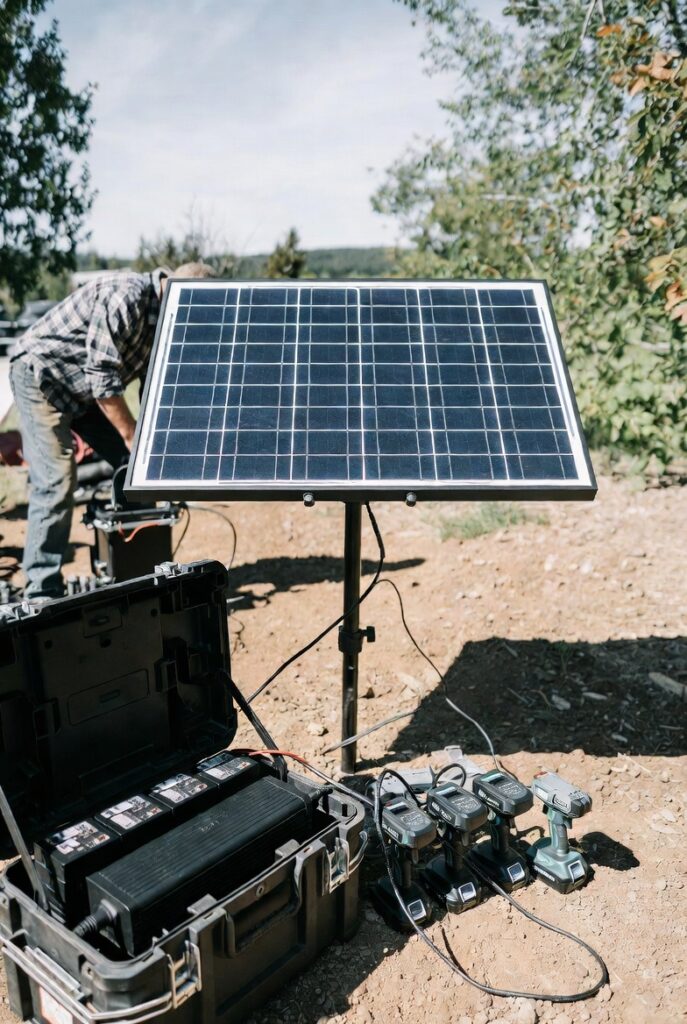
Solar power tools in Ontario means charging the 18V and 20V battery packs that run the tools, not attempting to run a circular saw or angle grinder directly from a panel array. A carpenter on Victoria Road North in Guelph, Wellington County was building a timber frame structure on a remote rural property in summer 2024. The property had no electrical service, and his previous approach had been a 3,500W gasoline generator running approximately 1.5 hours per day to charge his cordless tool battery packs. Five 18V batteries for his circular saw, drill, and impact driver cost approximately $12 to $15 per day in fuel and required fuel transport to the remote site.
He replaced the generator charging with a solar power tools charging station: two Renogy 100W panels mounted on a portable ground frame, a 100Ah LFP battery, and a 600W pure sine wave inverter. His five 18V 4Ah battery packs each hold approximately 72Wh, five packs totalling 360Wh. His 200W array on a clear Ontario July day produces approximately 720Wh at 4.5 peak sun hours. The 720Wh production covered the 360Wh of battery pack charging with approximately 360Wh remaining for LED site lighting and his radio.
I reviewed his solar power tools station at the site visit in August 2024. His charging cycle: packs go on the charger during the lunch break and slower morning periods, off when tools are in active use, and back on as each pack depletes. The Victron SmartShunt showed the 100Ah bank never dropping below 65% SoC across a full 10-hour July work day. His daily generator fuel cost dropped from approximately $12 to $15 to zero. See our Ontario solar sizing guide before designing any solar power tools charging station.
The solar power tools charging math: sizing for 18V and 20V battery platforms
| Battery pack | Rated capacity | Charge time at 80W | System draw (85% eff) |
|---|---|---|---|
| 18V 4Ah | 72Wh | ~60 min | ~85Wh |
| 18V 5Ah | 90Wh | ~75 min | ~106Wh |
| 20V 4Ah (18V nominal) | 80Wh | ~67 min | ~94Wh |
| 5-pack job site kit (18V 4Ah) | 360Wh total | ~5 hrs staggered | ~424Wh system draw |
An 18V 4Ah battery pack holds 72Wh of rated capacity. A fast charger draws 50 to 100W continuously, producing a charge time of approximately 60 minutes per pack at 80W and 85% charger efficiency. Charging five packs draws approximately 424Wh from the system. A 200W array at Ontario July production of 4.5 PSH produces 200 x 4.5 x 0.80 = 720Wh per clear day, covering all five packs and site lighting with 296Wh to spare. A 400W array produces 1,440Wh per clear July day, handling 8 to 10 packs conservatively after accounting for partial cloud and mid-day break periods when the charger is off.
The January production caveat applies to every solar power tools calculation. A 200W array at 1.5 January PSH produces 200 x 1.5 x 0.80 = 240Wh on a clear winter day, enough for approximately 2 to 3 battery packs rather than the 5 to 7 achievable in July. Ontario contractors sizing a winter job site solar power tools station should base the array on January production at their site latitude, not summer peak. For a winter site that requires 5 fully charged packs daily, a 400W array and 100Ah buffer bank is the correct minimum specification. See our solar battery bank sizing guide for the full seasonal production table.
The inverter specification: why pure sine wave is mandatory for smart chargers
Cordless tool chargers are switching power supply loads with no motor surge, entirely different from the 1HP compressor startup in the solar garage article. A single 80W smart charger requires a minimum 100W inverter with 25% headroom. Running two chargers simultaneously draws 160W, four chargers 320W. A 600W pure sine wave inverter handles up to seven simultaneous 80W chargers at 560W, operating at 93% of rated capacity with the remaining headroom for startup transients. Pure sine wave is non-negotiable for smart chargers: the microprocessor-controlled charging circuits in modern 18V/20V battery chargers contain logic board capacitors rated for clean sine wave input.
Modified sine wave distortion at 25 to 45% THD causes the same capacitor damage that destroyed the Waterloo Avenue CPAP machine in the solar inverter types article. A cordless tool smart charger’s logic board can fail within hours to days of MSW use, destroying a $60 to $120 charger rather than the battery packs. Most modern 18V/20V fast chargers accept 100 to 240V input, making them compatible with any 120V North American inverter output. A 600W inverter running four 80W chargers at 320W operates at 53% of rated capacity, providing excellent efficiency and silent operation throughout the charging window. See our solar inverter types guide for the full PSW vs MSW comparison.
The solar power tools battery buffer rule: why clouds kill cuts without storage
The battery buffer is what separates a solar power tools station that works on clear days only from one that works reliably under Ontario partly cloudy conditions. Without a battery buffer, cloud-induced panel voltage drops interrupt smart charger operation, the charger detects low input voltage, pauses the charge cycle, and requires a reset when sun returns. A homeowner on Derry Road in Milton, Halton County connected a single 200W panel directly to a micro-inverter and ran an angle grinder to cut patio stones in spring 2024.
Direct noon sun produced full grinder power. The first cloud that reduced panel output below the inverter’s minimum input threshold stopped the grinder mid-cut, scoring the stone in an arc. Two stones were ruined at approximately $12 each, $24 total.
He added a 50Ah LFP battery buffer between the panel and the inverter. The 50Ah buffer provides 12V x 50Ah x 0.80 DoD = 480Wh of usable energy, absorbing cloud-induced voltage dips and delivering stable inverter input through any normal Ontario partly cloudy afternoon. The grinder has completed every cut without interruption since the addition. The 50Ah buffer cost approximately $180 and prevented further material waste. For a full workshop with 10 or more battery packs and intermittent high-draw tool use, a Battle Born 100Ah LFP battery at 12V (960Wh usable) provides enough buffer to charge all packs through a 4-hour partly cloudy Ontario afternoon without charger interruption.
Pro Tip: Before deploying any solar power tools station to a job site, run a one-hour cloud simulation test at home. Fully charge the battery buffer, connect the inverter and charger with a battery pack on charge, then disconnect the solar panels and watch the SmartShunt. The buffer alone should sustain charging at 80W for at least 6 hours at 100% SoC. If it drops below 50% SoC in under 3 hours, the buffer is undersized for a full Ontario work day with afternoon cloud cover. Add buffer capacity before the job site deployment, a ruined patio stone or a stopped mid-cut on a remote property costs significantly more than an additional 50Ah of LFP battery.
What solar cannot do: high-draw stationary tools and the direct-run trap
Running high-draw stationary tools continuously from a solar power tools panel array without a large battery bank is not practical for Ontario job sites. A 15A table saw draws 1,800W continuously, requiring 18 x 100W panels in perfect full sun with zero cloud cover or shading to run directly. A 1,400W angle grinder requires 17 x 100W panels under the same conditions. These are not realistic job site arrays. The correct approach is to charge battery packs from solar during the day, run cordless tools on those battery packs, and run the table saw from the inverter and battery bank for short individual cuts with recharge time between extended sessions.
The hybrid Ontario job site approach splits the load correctly. The solar power tools charging station handles all cordless battery charging silently at zero fuel cost. A small 2,500W propane generator handles occasional table saw, miter saw, or dust collector use. The Victoria Road North result demonstrates the split: no generator required for cordless tool charging, generator reserved for stationary AC tool use only. This reduces daily generator run time from 1.5 hours to approximately 20 to 30 minutes, cutting fuel cost from $12 to $15 per day to approximately $3 to $5 per day. See our solar garage guide for the full Tier 2 and Tier 3 workshop specifications.
NEC and CEC: Ontario requirements for portable and permanent solar charging stations
NEC 690 governs solar PV installations. A solar power tools charging station permanently installed in a workshop or on a structure must comply with NEC 690 requirements for panel mounting, DC wiring, overcurrent protection, and battery storage. The DC circuit from the panel to the charge controller and battery must be sized for the panel short-circuit current plus a 25% safety factor, with appropriate fusing at the panel and battery terminal.
The 120V AC inverter output circuit feeding the tool chargers must comply with NEC 240 branch circuit requirements with appropriate overcurrent protection for the connected charger loads. A portable solar power tools charging station not permanently wired to a structure does not require an ESA permit in Ontario, but any permanent installation does. Contact the NFPA at nfpa.org for current NEC 690 requirements.
CEC Section 64 governs solar PV installations in Ontario. A permanently installed solar power tools charging station requires an ESA permit identifying the panel array, charge controller, battery bank, inverter, and overcurrent protection at each circuit. A portable solar charging station used on a job site without permanent structural wiring does not typically require an ESA permit, the portable classification applies when the panel array is not permanently attached to a structure and the wiring is not run through walls or conduit.
Confirm the portable vs permanent classification with the local building department before deploying a solar power tools station on any Ontario job site that may later become a permanent installation. Contact the Electrical Safety Authority Ontario at esasafe.com before permanently wiring any solar charging station in Ontario.
The solar power tools verdict: job site and workshop specifications for Ontario
- Ontario contractor or tradesperson needing a portable silent charging station for remote job sites without electrical service: two 100W panels, 100Ah LFP, 600W pure sine wave inverter. The Victoria Road North Guelph result: five 18V 4Ah packs fully charged through every clear and partly cloudy July day, bank never below 65% SoC, $0 daily fuel cost versus $12 to $15 generator fuel. Total system cost approximately $700 to $1,000. Portable ground mount, no permit required for non-permanently-mounted use. January job sites require a 400W array minimum to maintain five packs per day at 1.5 Ontario PSH.
- Ontario workshop owner who wants to eliminate generator noise for cordless tool charging in a permanent detached garage: a 200 to 400W array with a 100Ah LFP buffer and a 600W PSW inverter dedicated to the charger station. The 100Ah buffer absorbs Ontario partly cloudy afternoon dips and keeps all chargers running without interruption. Size the array to cover January production at minimum, a 400W array at 1.5 PSH produces 480Wh on a clear winter day, enough for 4 to 5 battery packs through the work session. The ESA permit covers the permanent installation; the portable classification does not apply to a workshop fixed installation.
- Ontario homeowner or hobbyist cutting a one-time patio stone or landscaping project without running a generator: size the buffer first, not the array. A 50Ah LFP buffer at 12V costs approximately $180 and prevents the Milton Derry Road result: two ruined stones at $24 each from a mid-cut cloud-induced grinder stop. A complete starter system, one 100W panel, one 50Ah buffer, one 300W PSW inverter, costs approximately $400 total and completes every cut regardless of cloud conditions. The buffer simulation test takes one hour before the job site deployment and confirms the buffer is sized correctly before the first stone is cut.
Frequently Asked Questions
Q: Can solar power charge 18V and 20V cordless tool batteries?
A: Yes, directly and efficiently. An 18V 4Ah battery pack holds 72Wh of rated capacity. A standard fast charger at 80W recharges it in approximately 60 minutes, drawing approximately 85Wh from the solar system at 85% charger efficiency. A 200W Ontario array on a clear July day produces 720Wh, enough to fully charge five 18V 4Ah packs plus run LED site lighting and a radio. The critical requirements: a pure sine wave inverter (modified sine wave destroys the smart charger logic board), a battery buffer to absorb cloud-induced voltage dips, and a system sized on January production rather than July if the job site operates in winter.
Q: What size solar system do I need to charge cordless tools on a job site?
A: For a five-pack 18V job site (360Wh total): 200W array, 50Ah LFP buffer, 300 to 600W PSW inverter. For a 10-pack workshop: 400W array, 100Ah LFP, 600W PSW inverter. For winter Ontario job sites at 1.5 PSH: size the array at 400W minimum for five packs per day. The battery buffer is not optional, without it, cloud cover interrupts every charge cycle and may halt tool use mid-cut. The Victoria Road North result: a 200W array with a 100Ah buffer charged five packs across a full 10-hour July day without the bank ever dropping below 65% SoC.
Q: Why does my tool stop working when a cloud passes over my solar panel?
A: Without a battery buffer between the panel and the inverter, panel output drops instantly when cloud cover reduces solar irradiance. The inverter detects the voltage drop below its minimum input threshold and shuts down. This is the Milton Derry Road result: a direct panel-to-inverter-to-angle-grinder connection with no buffer stopped mid-cut on the first cloud, ruining two patio stones at $24 total. A 50Ah LFP buffer ($180) absorbs the voltage dip and maintains stable inverter input through any normal Ontario cloud-cover event. Add the 50Ah buffer before the next cut, the $180 buffer cost is less than two replacement patio stones at current Ontario landscaping supply prices.
This build is engineered within the 48V DC Safety Ceiling. Diagnostic logic is based on 20+ years of technical service experience. All structural and electrical installations must be verified by a Licensed Professional and comply with your Local AHJ.
About the Author
Robert Bertrand spent 20 years as a service advisor in the automotive industry (Lexus and Nissan), where precision diagnostics, wiring integrity, and documentation standards were non-negotiable. He brings that same technical discipline to GridFree Guide, where he researches, tests, and documents off-grid solar systems for Ontario conditions. Based in Rockwood, Ontario, every article is built on verified specifications, manufacturer data, and the real-world climate constraints of Canadian off-grid living.
As an Amazon Associate I earn from qualifying purchases. This site also contains affiliate links to other products and services. GridFree Guide earns a small commission at no extra cost to you.