
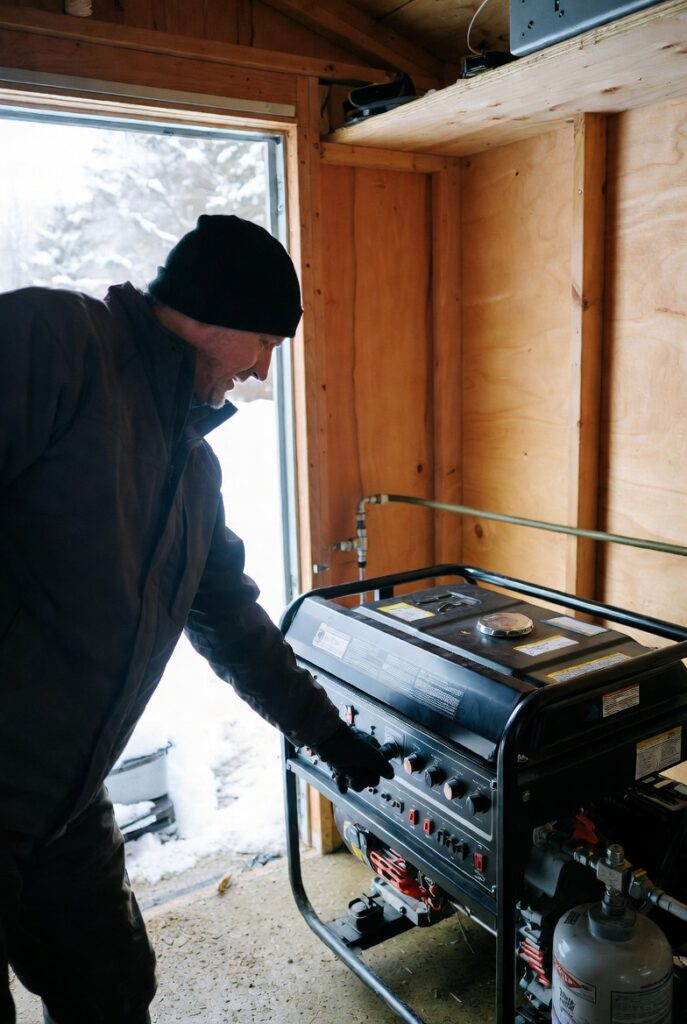
The most common off grid generator mistake in Ontario is purchasing a 6,500W gasoline unit for “whole-house backup” and discovering on the second January of ownership that the carburetor has gummed from 3 months of idle storage, the engine will not start in -20°C weather, and the battery bank is at 18% SoC with a 5-day gray streak in progress. This scenario played out for a property owner on Arkell Road in Guelph, Wellington County, who installed a 6,500W gasoline generator as emergency backup for her year-round off-grid cabin in October 2022.
Her reasoning: the bigger the generator, the more protection she had. She stored the generator in her utility shed after the first November test run and did not touch it until January 14, 2023, the start of a 5-day gray streak that dropped her battery bank to 18% SoC.
The generator would not start. She contacted me that afternoon. The root cause was carburetor varnish: gasoline begins to oxidize and leave gum deposits in carburetor passages after approximately 30 days without a fuel stabilizer. Her generator had sat for 75 days on untreated gasoline. Her Victron SmartShunt confirmed the bank was at 18% SoC and dropping at approximately 80Wh per hour with minimal solar input. She had heat from propane, but her LED lighting, fridge, and phone charging were all drawing from a bank that would reach 10% SoC in approximately one hour.
I specified a propane conversion kit for her existing 6,500W generator and a permanent 3/8-inch propane line from her 420L bulk tank to the utility shed. Her propane furnace and on-demand water heater were already connected to the same tank, so the generator line was an additional branch off the main supply. The propane conversion resolved the storage problem entirely: propane is a pressurized gas that does not degrade in the fuel system and does not leave deposits in the carburetor regardless of storage duration.
Her off grid generator fired on the first pull the following January after 9 weeks of idle storage at -22°C ambient, and she has never experienced a startup failure since. See our Ontario solar sizing guide before specifying any off grid generator backup system.
The off grid generator fuel decision: why propane survives 3 months idle and gasoline does not
| Factor | Gasoline generator | Propane generator | Ontario verdict |
|---|---|---|---|
| Fuel shelf life | 30 days without stabilizer | Indefinite (pressurised gas) | Propane for 3-month idle duty ✓ |
| Cold start at -20°C | Unreliable, carb icing | Reliable to -42°C | Propane wins in Wellington/Halton ✓ |
| Refuelling | Manual gas cans in snow | Permanent bulk tank line | Propane saves your back ✓ |
| Carburetor deposit | Gum varnish after 60-90 days | Zero deposits | Propane fires when needed ✓ |
| Fuel cost at 1,500W | ~2L/hr at 23% load | ~1.2L/hr at 60% load | Correctly sized propane saves 40% ✓ |
Propane is the superior fuel for an Ontario off grid generator used in the Life Support role, sitting idle from October through January and firing reliably in a January emergency. Propane is a pressurised inert gas that does not degrade in storage, does not leave gum deposits in the carburetor, and remains in gaseous phase down to approximately -42°C ambient. Gasoline begins oxidising in 30 days without stabiliser, leaves varnish in carburetor passages at 60 to 90 days of storage, and is unreliable in cold starts below -10°C due to carburetor icing. For a generator that may sit idle for 3 months between October and January, the fuel choice is a reliability specification, not a preference.
The Ontario-specific fuel argument reinforces the propane choice further. A 420L bulk propane tank at the Arkell Road Guelph property supplies the furnace, the on-demand water heater, and the generator from a single permanent supply. The generator branch is a 3/8-inch line added when the propane system was originally installed, no separate fuel storage, no gas cans, no fuel management in winter conditions. The generator adds approximately 1.2L per hour of run time to the total propane budget, typically 10 to 15 hours per gray streak event, approximately 12 to 18L per event from a 420L tank.
One practical note: at ambient temperatures below approximately -30°C, a low propane tank (below 20% full) may experience reduced vaporization pressure and deliver less gas to the generator than expected. This is rare in Wellington/Halton County but possible during extreme cold snaps , the 90-day minimum tank sizing rule from the propane tank Ontario guide keeps the tank above the threshold where vaporization becomes an issue.
The off grid generator sizing rule: match to charger amps, not peak loads
The correct off grid generator sizing formula: battery charger output (Wh) ÷ charger efficiency = generator output required. For a 100A charger at 12V: 100A × 12V = 1,200W battery input. At 80% charger efficiency: 1,200 ÷ 0.80 = 1,500W generator output required to operate the charger at full rate. A 2,500W generator running at 60% load delivers this 1,500W output while operating in the correct combustion load range. A 6,500W generator running at the same 1,500W output operates at 23% load, well below the 30% minimum threshold for healthy combustion and accumulating cylinder glazing damage with every session.
A year-round off-grid property owner near Guelph Line in Milton, Halton County purchased a 6,500W gasoline generator for backup in spring 2021. His 60A battery charger required approximately 900W of generator output. His 6,500W generator ran at approximately 14% of rated capacity during every charging session. Fuel consumption: approximately 2L per hour. After two winters he had spent approximately $380 on gasoline for gray streak events that a correctly sized 2,500W propane off grid generator would have handled for approximately $90 in propane.
His generator also required a carburetor rebuild from cylinder glazing after two seasons of low-load operation. I specified a 2,500W propane replacement connected to his existing bulk tank. His comment: “I can’t believe I spent $380 on gas when I needed maybe $90 of propane and a smaller machine.” See our solar battery bank guide for the SoC calculation that determines when to start the generator.
The cylinder glazing problem: why oversized generators fail early
A gasoline or propane generator running below 30% of its rated output exhibits incomplete combustion with every firing cycle. Unburned fuel washes past the piston rings into the crankcase oil, diluting the lubricant and accelerating bearing wear. Carbon deposits accumulate on the cylinder walls, a process called cylinder glazing, which increases ring-to-wall clearance, reduces compression, and permanently reduces the engine’s power output over subsequent seasons. A 6,500W generator running a 1,500W charger load operates at 23% of rated output, guaranteed cylinder glazing accumulation over multiple Ontario winter seasons of use.
The correct operating load range for a portable generator is 50 to 80% of rated output for optimal combustion and engine longevity. A 2,500W generator running a 1,500W charger load operates at 60%, firmly in the correct range. The fuel consumption comparison at matched output: the correctly sized 2,500W unit burns approximately 1.2L/hr of propane at 60% load; the oversized 6,500W unit burns approximately 2L/hr at 23% load, a 67% fuel premium for identical charging output, plus accelerated engine wear as a bonus. The correctly sized off grid generator pays back the initial cost difference in fuel savings within two Ontario winters.
Pro Tip: The SmartShunt SoC reading is the correct trigger for starting the off grid generator, not intuition, not a voltage sag on the lights. Set a hard trigger threshold of 30% SoC for LFP batteries or 55% SoC for AGM. At 30% SoC on a 200Ah 12V LFP bank, approximately 720Wh of usable capacity remains above the LVD floor. A 2,500W generator running a 100A/12V charger at 1,500W output recovers the bank from 30% to 90% in approximately 72 minutes at 1.2L of propane. The Arkell Road Guelph cabin runs on exactly this protocol: SmartShunt hits 30%, generator starts, 72 minutes later the bank is at 90% SoC and the generator shuts off. Total propane cost per gray streak event: approximately 1.5L.
The EasyStart requirement: well pump and compressor startup on generator power
A well pump or air conditioning compressor draws 3 to 7 times its running wattage on startup due to motor inrush current. A well pump with a 600W running load draws approximately 2,800W on startup for 400 milliseconds. A 2,500W generator has a continuous rating of 2,500W and a surge rating of typically 4,000 to 5,000W. It is the surge capacity, not the running watt rating, that determines whether the generator can handle simultaneous motor startup during battery charging.
Under ideal conditions this surge capacity is sufficient for a single well pump start. However, at cold ambient temperatures below -10°C, generator output dips by approximately 10 to 15%, and a simultaneous pump startup during battery charging can push the total instantaneous load above the generator’s surge capacity. The EasyStart reduces the well pump startup surge from approximately 2,800W to approximately 900W, eliminating the overload risk entirely.
The EasyStart requirement applies to any off grid generator system where the generator must run simultaneously with a well pump, pressure pump, or compressor. Without EasyStart, a correctly sized 2,500W generator may stall on motor startup under winter derating conditions, defeating the purpose of the gray streak backup. The EasyStart installs at the motor and requires no modification to the generator or electrical panel. Installation takes approximately 30 minutes. See our off grid water guide for the full well pump surge calculation and EasyStart sizing verification.
Critical Safety Warning: Carbon Monoxide Risk. Portable generators produce deadly carbon monoxide. Never run a generator indoors, in a garage, basement, or within 3 metres of any window, door, or fresh air intake. Generator-related CO poisonings occur every winter in rural Ontario when people bring units inside to escape the cold. Install working CO detectors on every level of the home and test them monthly. CO detectors are mandatory under the Ontario Fire Code when a fuel-burning generator is present. A permanently wired generator requires an ESA permit and a properly rated transfer switch or interlock to prevent backfeed to the grid, which can electrocute utility workers. Never use a “suicide cord” (male-to-male extension cord), this is illegal and extremely dangerous.
NEC and CEC: Ontario permit requirements for permanent generator installations
NEC 702 governs optional standby systems, the correct classification for an off grid generator used as a battery bank backup. The generator’s output circuit to the battery charger must comply with NEC 702 requirements: a properly rated transfer switch or interlock is required to prevent simultaneous connection of the generator and any other power source to the same AC load circuit. The generator’s AC output wiring, transfer switch, and connection to the inverter or battery charger must be sized for the generator’s maximum continuous current output, protected by appropriately rated overcurrent protection, and installed with outdoor-rated cable where exposed to weather. Contact the NFPA at nfpa.org for current NEC 702 requirements for optional standby generator installations in off-grid residential applications.
CEC Section 64 governs electrical installations in Ontario. A permanently installed off grid generator connected to the home electrical system, including any connection to the battery charger input, requires an ESA permit. The permit application must identify the generator’s rated output, the transfer switch specifications, the AC wiring run from the generator to the transfer switch and charger, and the overcurrent protection on all branch circuits. A portable generator used exclusively with extension cords to plug-in loads may not require a permit, but any hardwired connection does. Contact the Electrical Safety Authority Ontario at esasafe.com before beginning any permanent off grid generator electrical installation in Ontario.
The off grid generator verdict: 2,500W propane, EasyStart, SmartShunt trigger, CO detectors
- Ontario off-grid cabin owner whose gasoline generator has failed to start during a January gray streak: convert to propane before next winter. The Arkell Road Guelph result confirms the gasoline failure mode: 75 days of idle storage on untreated fuel, bank at 18% SoC on the SmartShunt, generator will not start. A propane conversion kit at approximately $150 to $300 permanently eliminates carburetor varnish. Set a 30% SoC trigger threshold on the Victron SmartShunt so the generator start decision is based on data, not guesswork.
- Ontario off-grid property owner designing a new system who needs gray streak backup: specify a 2,500W dual-fuel or propane-only generator connected to the existing bulk propane tank, sized to charger current, not peak loads. For a 100A/12V charger: 1,500W output required, 2,500W generator at 60% load is the correct specification. Install the EasyStart if a well pump is on the same system. Connect the Battle Born heated LFP batteries to a Victron SmartShunt and set a 30% SoC hard floor as the generator trigger. Let the correctly sized generator recover the bank from 30% to 90% in approximately 72 minutes, do not start early at 50% SoC out of caution and waste propane.
- Ontario off-grid property owner with an oversized generator running at low load: calculate the actual load percentage and correct the specification before the engine accumulates further cylinder glazing damage. Load percentage: charger output Wh ÷ generator rated Wh × 100. If the result is below 30%, the off grid generator is oversized and accumulating damage. The Guelph Line Milton result: 6,500W at 14% load, $380 in fuel over 2 winters, carburetor rebuild from cylinder glazing, 2,500W propane replacement at 60% load with $90 in propane and no service in two Ontario winters. Install the EasyStart if a well pump is on the same circuit and the generator must handle simultaneous motor startup.
Frequently Asked Questions
Q: What size generator do I need for an off-grid cabin in Ontario?
A: Size the off grid generator to the battery charger current, not peak appliance loads. For a 100A/12V charger: 100A × 12V = 1,200W battery input at 80% charger efficiency = 1,500W generator output required. A 2,500W generator running at 60% load is the correct specification for this charger. An oversized 6,500W generator running the same 1,500W charger load operates at 23% load, below the 30% minimum for healthy combustion, and accumulates cylinder glazing damage with every charging session. The Guelph Line Milton result confirms the cost: $380 in gasoline over 2 winters versus $90 in propane from a correctly sized 2,500W unit.
Q: Is propane or gasoline better for an off-grid generator in Ontario?
A: Propane is the correct fuel for any Ontario off grid generator used in the Life Support role, idle from October through January. Propane does not degrade in storage regardless of idle duration, does not leave carburetor deposits, and remains reliable in cold starts to -42°C ambient. Gasoline begins oxidising in 30 days without stabiliser, leaves varnish in carburetor passages at 60 to 90 days, and is unreliable below -10°C due to carb icing.
The Arkell Road Guelph result: a gasoline generator stored 75 days on untreated fuel would not start at -22°C when the bank was at 18% SoC. The same generator after a propane conversion fired on the first pull after 9 weeks idle storage in the same conditions.
Q: Do I need a permit for a generator in Ontario?
A: Yes, if the off grid generator is permanently wired into your home electrical system. CEC Section 64 requires an ESA permit for any hardwired generator connection, including a permanent line to the battery charger input. A portable generator used exclusively with extension cords to plug-in loads may not require a permit, but any hardwired connection does. A properly rated transfer switch is also mandatory for any hardwired connection, never connect a generator to your electrical panel without one. Contact the Electrical Safety Authority Ontario at esasafe.com before beginning any permanent wiring. Budget approximately $200 to $500 for the ESA permit application and inspection.
This build is engineered within the 48V DC Safety Ceiling. Diagnostic logic is based on 20+ years of technical service experience. All structural and electrical installations must be verified by a Licensed Professional and comply with your Local AHJ.
About the Author
Robert Bertrand spent 20 years as a service advisor in the automotive industry (Lexus and Nissan), where precision diagnostics, wiring integrity, and documentation standards were non-negotiable. He brings that same technical discipline to GridFree Guide, where he researches, tests, and documents off-grid solar systems for Ontario conditions. Based in Rockwood, Ontario, every article is built on verified specifications, manufacturer data, and the real-world climate constraints of Canadian off-grid living.
As an Amazon Associate I earn from qualifying purchases. This site also contains affiliate links to other products and services. GridFree Guide earns a small commission at no extra cost to you.