
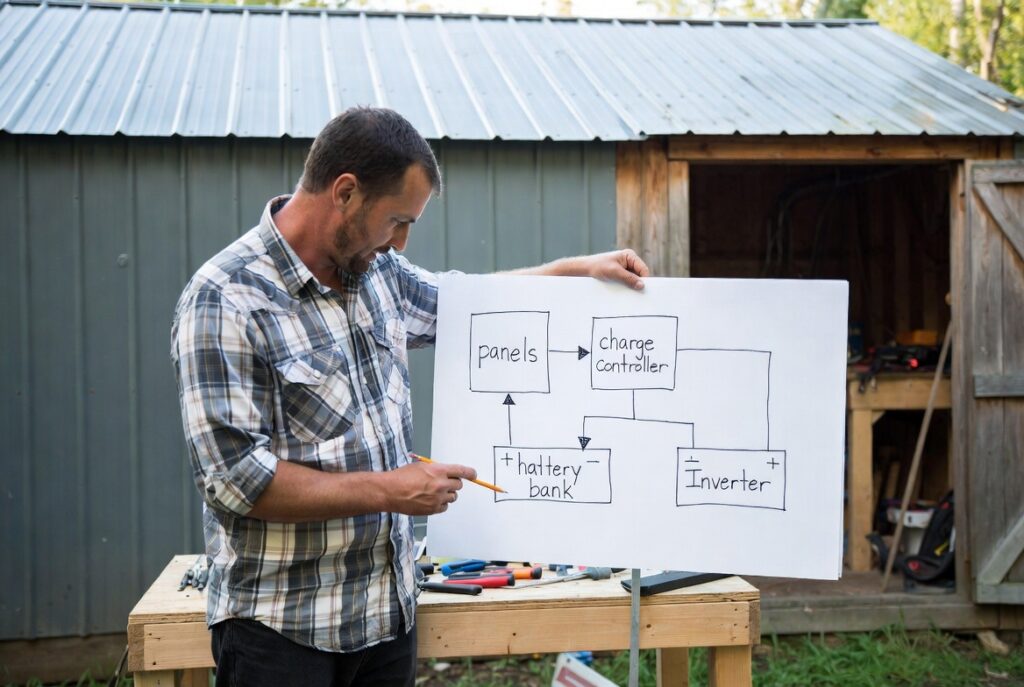
The most common Ontario solar power system mistake is buying a 3,000W inverter because it looks powerful, then wiring it to a 100Ah battery and two 100W panels and wondering why the battery voltage crashes to 11.4V every time the coffee maker runs, even when the Victron SmartShunt shows 85% SoC, the 100Ah battery is physically unable to deliver the 250A instantaneous current that a 3,000W inverter draws from a 12V bank, and no amount of charge controller settings or battery software can change the physics of ampere-hours.
A property owner on Garafraxa Street in Fergus, Wellington County assembled a solar power system in fall 2021 using the largest inverter he could afford: a 3,000W PSW unit. He paired it with two 100W Renogy panels in series through a Victron MPPT 100/30, and a single 100Ah LFP battery at 12V. His reasoning: the big inverter would handle any load he wanted to run. His daily load at the cabin was approximately 480Wh, LED lighting, a laptop, a DC fridge, and a propane furnace blower.
His Victron SmartShunt confirmed the mismatch immediately. On the first day of operation, every time he ran the coffee maker (approximately 1,200W at 120V = 100A from the 12V bank), the battery voltage dropped from 13.2V to 11.3V within 2 seconds, below the inverter’s low-voltage protection threshold of 11.5V. The inverter shut down. The battery was at 80% SoC when this happened. The battery was not discharged, it was undersized for the peak current demand of the load. A 100Ah LFP battery has a maximum continuous discharge rate of approximately 100A (1C rate). A 3,000W inverter at 12V draws 250A, 2.5 times the battery’s continuous current capacity.
I specified a replacement: two 100Ah Battle Born heated LFP batteries wired in parallel to reach 200Ah (capable of 200A continuous, sufficient for the inverter’s peak draw), and a correct array sizing exercise starting from the January load. His 480Wh daily load at 1.5 PSH requires 480 ÷ (1.5 × 0.85) = approximately 376W of array, rounded to 400W. The 400W array, 200Ah LFP bank, and 2,000W inverter correctly sized to his 1,600W peak load is the correct solar power system specification. His SmartShunt confirmed the bank reached above 55% SoC minimum through his first January gray streak. See our Ontario solar sizing guide before specifying any solar power system for an Ontario property.
The solar power system mismatch: why component size does not equal system performance
| Mismatch symptom | Root cause | SmartShunt signal | Ontario fix |
|---|---|---|---|
| Voltage sag to LVD under any load | Battery undersized for inverter current | Voltage drop at peak draw | Add battery capacity to match inverter ✓ |
| Bank never reaches 100% SoC | Array undersized for daily load | Daily harvest below daily load | Size array for 1.5 PSH January ✓ |
| Bank drains even on partial-sun days | Parasitic load or inverter idle draw | SoC trending down on partial-sun days | Check inverter idle, add search mode ✓ |
| Inverter trips surge starts | Inverter surge rating below motor inrush | Sudden current spike at motor start | Add SoftStart or upsize inverter ✓ |
Important Safety and Permit Note: Any permanently installed solar power system in a habitable Ontario structure requires an ESA permit. All electrical work , including array wiring, charge controller connections, battery bank wiring, inverter installation, and all AC output circuits , must comply with CEC Section 64 and be inspected. Never attempt to install or modify the electrical system yourself. Contact esasafe.com before beginning any work. ESA documentation is required for home insurance coverage on any habitable structure with a permanent off-grid electrical system.
A 3,000W inverter at 12V draws 250A peak. A 100Ah LFP battery has a maximum continuous discharge of approximately 100A (1C rate). Voltage sag is inevitable when the load demands more current than the battery can deliver. The SmartShunt SoC reading is not the failure, it measures stored energy, not peak current delivery. A 100Ah bank cannot sustain 250A regardless of what the SoC meter shows.
The correct ratio: inverter continuous watt rating ÷ system voltage = required battery continuous amp capacity. For a 2,000W inverter at 12V: 2,000 ÷ 12 = 167A required continuous capacity, a 200Ah LFP bank (capable of 200A continuous) is the correct minimum pairing. For a 3,000W inverter at 12V: 250A required, 300Ah minimum bank or a 24V system that halves the current requirement. Most Tier 2 Ontario off-grid solar power systems specify 2,000W inverter with 200Ah LFP as the matched pair. See our solar charge controller guide for the cold Voc calculation that protects the MPPT from the Ontario -22°C design temperature.
The four component roles: array, MPPT controller, battery bank, and inverter
The four components of any solar power system each perform a specific function in sequence. The array converts photons to DC current at panel Vmp (approximately 18.9V for a Renogy 100W at STC, approximately 19.5V in Ontario January). The Victron MPPT 100/30 tracks the panel’s maximum power point, accepting the high-voltage array input and converting it to the correct battery charging voltage (approximately 14.2V for LFP absorption). The battery bank stores the harvested energy as chemical potential energy and releases it at load demand current. The inverter converts the battery’s DC output to 120V AC at the current required by the connected loads.
A mismatch at any stage propagates downstream. An undersized array cannot fill the battery bank. An undersized battery bank cannot sustain the inverter’s peak current draw. An oversized inverter on an undersized bank causes voltage sag that trips undervoltage protection regardless of SoC reading. An oversized charge controller wastes cost without improving performance, the MPPT 100/30 is the correct specification for a 400W array at 12V; upgrading to the MPPT 100/50 only makes sense when the array exceeds 400W. See our solar battery bank guide for the full bank sizing methodology.
Pro Tip: The fastest way to identify which component is mismatched is to run the SmartShunt diagnostic in sequence. First: check daily harvest on a clear January day, should equal or exceed daily load. For 480Wh load at 400W array: expect approximately 510Wh. Second: check voltage at peak load, should not drop below 12.0V on a 12V system. If it does, the battery is undersized for the inverter. Third: check SoC trend over 3 overcast days, should stay above 30% with no generator run. The Garafraxa Street Fergus system failed the second test (voltage to 11.3V at coffee maker load) while passing the first. That single signal identified the battery-to-inverter mismatch without any other diagnosis needed.
The solar power system sizing sequence: January load, battery bank, array, inverter, in that order
The Ontario sizing sequence for any solar power system. Step 1: calculate the January daily load in Wh, not the summer load, not the peak design load. For the Tower Street South Fergus property: LED 30W × 4h = 120Wh, laptop 45W × 3h = 135Wh, DC fridge 60W average across 24h duty cycle contributes approximately 144Wh, bringing the combined load to approximately 480Wh per day.
Step 2: battery bank = 480 × 3 ÷ 0.80 = 1,800Wh minimum = 150Ah at 12V, specify 200Ah for margin. Step 3: array = 480 ÷ (1.5 × 0.85) = 376W, specify four Renogy 100W panels (400W) in 2S×2P. Step 4: inverter sized to peak simultaneous load, 2,000W PSW for this load profile.
A property owner on Tower Street South in Fergus, Wellington County built a complete Ontario solar power system in spring 2023 following the sizing sequence from scratch. Her January daily load: 480Wh. Bank: 480 × 3 ÷ 0.80 = 1,800Wh = 150Ah minimum, specified 200Ah. Array: 400W in 2S×2P through a Victron MPPT 100/30, cold Voc at -22°C = 51.7V for 2-panel series, within the 100V controller limit. Inverter: 2,000W PSW, sized last. Her first January SmartShunt: 510Wh clear-day harvest, 52% SoC minimum through a 4-day gray streak. Her comment: “I built it on paper first. The system never surprised me.” See our off grid costs guide for the full cost breakdown of a correctly matched Ontario solar power system.
The SmartShunt mismatch diagnostic: reading the four failure signatures
The SmartShunt monitors four signals that confirm whether the solar power system is correctly matched. Signal 1, daily harvest: the Wh harvested each day should equal or exceed the daily load on clear January days. If the harvest consistently falls below the daily load even on clear days, the array is undersized. Signal 2, bank SoC trend: the bank should trend toward 100% SoC on clear days.
If it trends downward even on partially clear days, either the array is undersized or a parasitic load is draining the bank. Signal 3, voltage sag at peak load: if the voltage drops below the inverter’s low-voltage threshold under any normal load event, the battery bank is undersized for the inverter’s current demand. Signal 4, daily minimum SoC: should stay above 30% through any 3-day Ontario gray streak at the specified daily load.
The Garafraxa Street Fergus result: SmartShunt showed voltage sag to 11.3V on every coffee maker run at 80% SoC, Signal 3, battery undersized for inverter. The Tower Street South Fergus result: SmartShunt showed 510Wh clear-day harvest, 52% minimum SoC through 4-day gray streak, Signals 1, 2, and 4 all confirmed. The difference between the two results is entirely the sizing sequence: one solar power system was built around the inverter, the other was built around the January load. A Victron SmartShunt installed at commissioning identifies mismatches in the first week of operation, before a gray streak event does it for you.
NEC and CEC: Ontario permit requirements for permanent off-grid system installations
NEC 690 governs the solar PV system, the array wiring, charge controller connections, battery bank wiring, inverter connections, and all AC output circuits. A complete Ontario solar power system installation must comply with NEC 690 requirements at every stage of the energy chain: array wiring sized for 125% of the short circuit current, overcurrent protection on each array string, battery bank wiring sized for the inverter’s maximum continuous current, and appropriately rated disconnect switches at the charge controller output and inverter input. Contact the NFPA at nfpa.org for current NEC 690 requirements for off-grid solar power system installations in residential applications.
CEC Section 64 governs electrical installations in Ontario. A permanently installed solar power system in any habitable Ontario structure requires an ESA permit covering the complete energy chain: array wiring, charge controller, battery bank, inverter, and all AC output circuits. The permit application must document the system voltage, array configuration and cold Voc calculation, battery bank specifications, inverter model and rating, and all circuit overcurrent protection. Contact the Electrical Safety Authority Ontario at esasafe.com before beginning any permanent solar power system installation in Ontario.
The solar power system verdict: matched components, SmartShunt confirmed, January standard
- Ontario property owner whose solar power system is delivering poor performance, voltage sag, frequent LVD trips, or bank that never reaches 100% SoC: run the SmartShunt mismatch diagnostic before replacing any component. Voltage sag at any load event = battery bank undersized for inverter current demand. Bank never reaches 100% SoC = array undersized for daily load. Run the sizing sequence in order and identify which component is mismatched. The Garafraxa Street Fergus fix: replace 100Ah with 200Ah Battle Born heated LFP, replace 3,000W inverter with 2,000W, confirm with Victron SmartShunt. Total fix cost: approximately $2,100 in components.
- Ontario property owner building a new solar power system: follow the sizing sequence in order, January load first, inverter last. January daily load calculation first. Battery bank: daily load × 3 ÷ 0.80 = minimum Wh. Array: daily load ÷ (1.5 × 0.85) = minimum watts, specify four Renogy 100W panels in 2S×2P through a Victron MPPT 100/30. Inverter last: sized to peak simultaneous load plus 20% margin. The Tower Street South Fergus result: 510Wh clear-day harvest, 52% SoC minimum January gray streak, “the system never surprised me.”
- Ontario property owner who has been given a component list without a sizing calculation: ask one question before purchasing anything, what is the January daily load? If the answer is not a specific Wh number, the system has not been sized correctly. Every other component specification flows from that number. A solar power system specified without a January load calculation is not a system, it is a parts list. Install the Victron SmartShunt at commissioning and confirm the four signals in the first clear January week before relying on the system through a gray streak.
Frequently Asked Questions
Q: What components make up an off-grid solar power system?
A: An off-grid solar power system consists of four matched components in sequence: the solar array (converts sunlight to DC current), the MPPT charge controller (converts panel voltage to battery charging voltage), the battery bank (stores energy and delivers peak current to loads), and the inverter (converts battery DC to 120V AC for connected loads). Each component must be sized to match the others, a mismatch at any stage propagates downstream. The most common Ontario failure is specifying the inverter first (often oversized) and then pairing it with an undersized battery bank that cannot deliver the inverter’s peak current demand, causing voltage sag and LVD trips regardless of the bank’s SoC reading.
Q: How do I size a solar power system for Ontario winters?
A: Follow the Ontario sizing sequence. Step 1: calculate the January daily load in Wh. Step 2: size the battery bank using the 3-day gray streak formula, daily load × 3 ÷ 0.80 = minimum usable Wh (for 480Wh load: 1,800Wh minimum = 200Ah at 12V). Step 3: size the array to recover the bank on a clear January day, daily load ÷ (1.5 PSH × 0.85 MPPT efficiency) = minimum array watts (for 480Wh: 376W minimum, specify 400W). Step 4: size the inverter to the peak simultaneous load plus 20% margin. The Tower Street South Fergus result confirms this sequence delivers 510Wh clear-day harvest and 52% SoC minimum through a 4-day January gray streak on a 480Wh daily load.
Q: Why does my battery drain so fast even when it shows a high charge?
A: A high SoC reading on the SmartShunt measures stored energy, it does not guarantee the battery can deliver peak current to the load. If the battery bank is undersized for the inverter’s current demand (for example, a 100Ah bank paired with a 3,000W inverter at 12V requires 250A peak, 2.5 times the battery’s 100A continuous capacity), the voltage will sag to the inverter’s LVD threshold under any heavy load regardless of SoC. The Garafraxa Street Fergus result confirmed this: 80% SoC showing on the SmartShunt, voltage crashing to 11.3V within 2 seconds of running a coffee maker. The fix is to match the battery bank capacity to the inverter’s current demand, not to charge the battery more aggressively.
This build is engineered within the 48V DC Safety Ceiling. Diagnostic logic is based on 20+ years of technical service experience. All structural and electrical installations must be verified by a Licensed Professional and comply with your Local AHJ. See our legal and safety disclosure for full scope.
About the Author
Robert Bertrand spent 20 years as a service advisor in the automotive industry (Lexus and Nissan), where precision diagnostics, wiring integrity, and documentation standards were non-negotiable. He brings that same technical discipline to GridFree Guide, where he researches, tests, and documents off-grid solar systems for Ontario conditions. Based in Rockwood, Ontario, every article is built on verified specifications, manufacturer data, and the real-world climate constraints of Canadian off-grid living.
As an Amazon Associate I earn from qualifying purchases. This site also contains affiliate links to other products and services. GridFree Guide earns a small commission at no extra cost to you.