
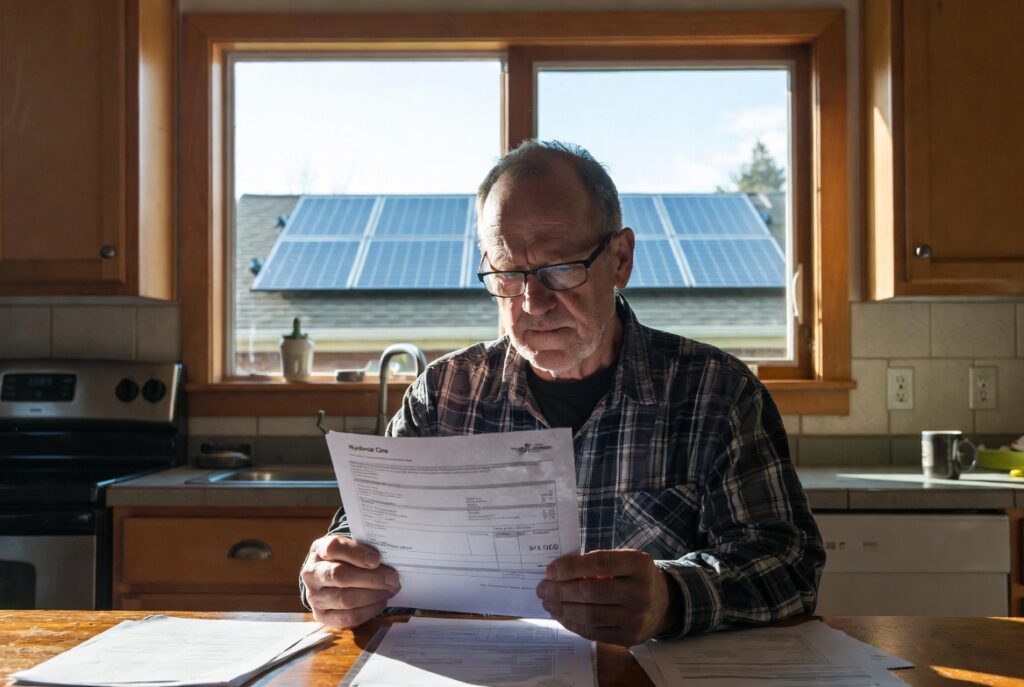
The solar energy ontario decision in 2026 starts with one document that most property owners never think to request before researching panels and inverters: the Hydro One rural connection quote, because a couple on Sideroad 10 in Guelph, Wellington County received a $67,000 Hydro One connection estimate for a property 1.8 kilometres from the nearest distribution line in 2023, compared that to a Tier 2 off-grid system at $3,650 installed, and had their answer in approximately 15 minutes.
They had been planning a grid-connected hybrid solar energy ontario system and had already researched HRSP rebates, net metering credits, and battery backup options for several months. Their daily load was approximately 480Wh for the workshop and guesthouse on the property. When the Hydro One estimate arrived at $67,000 for poles, transformer, and connection infrastructure, the grid-connected path became economically irrelevant.
I reviewed their system options with the $67,000 Hydro One quote as the baseline. A Tier 2 off-grid system, 400W monocrystalline array, 200Ah Battle Born heated LFP battery bank, 2,000W PSW inverter, Victron MPPT 100/30, had an installed cost of approximately $3,650 including the ESA permit. The $67,000 Hydro One connection cost plus 20 years of Ontario delivery charges at approximately $100 per month minimum totalled approximately $91,000 in baseline grid costs before any electricity consumption. The off-grid system at $3,650 with one battery replacement at year 12 (approximately $1,200) equalled approximately $4,850 over 20 years.
They built the Tier 2 off-grid system. Their Victron SmartShunt confirmed 510Wh harvested on clear January days and a minimum of 52% SoC through a 4-day January gray streak in 2024, consistent with the Tier 2 Ontario off-grid standard across this series. At $4,850 total cost, the system paid for itself in avoided delivery charges alone in approximately 13 months. Their comment at the one-year mark: “The Hydro One quote was the best thing that could have happened to us.” See our off grid costs guide for the complete 20-year Ontario grid versus off-grid comparison.
Important Safety and Permit Note: Any permanently installed solar energy system, grid-connected or off-grid, in a habitable Ontario structure requires an ESA permit before work begins. All electrical work, including array wiring, charge controller, battery bank, inverter, and AC output circuits, must comply with CEC Section 64 and be inspected by a licensed professional. Never attempt to install or modify the electrical system yourself. Contact esasafe.com before beginning any work. Proper ESA documentation is required for home insurance coverage on any habitable structure with a permanent electrical installation.
The solar energy ontario decision framework: Hydro One connection cost determines the correct path
| Hydro One rural quote | Recommended path | HRSP eligible? | 20-year verdict |
|---|---|---|---|
| Already connected | HRSP or net metering | Yes (load displacement) | Choose HRSP for $10,000 rebate ✓ |
| Under $15,000 | Connect, then HRSP | Yes | Run 20-year comparison ⚠️ |
| $15,000 to $30,000 | Compare carefully | Yes if connected | Off-grid may still win |
| Over $30,000 | Off-grid Tier 2 | No (no grid connection) | Off-grid wins clearly ✓ |
| $67,000 (Sideroad 10) | Off-grid Tier 2 | No | $4,850 vs $91,000, no comparison ✓ |
The solar energy ontario decision tree in 2026 starts with two questions: does the property have a grid connection, and if not, what does a new connection cost? For grid-connected properties, the comparison is between the HRSP load displacement rebate path (up to $10,000 upfront) and the net metering path (ongoing bill credits, no rebate). For unconnected rural properties, the Hydro One connection quote determines whether connecting to access HRSP makes financial sense, or whether the Tier 2 off-grid system wins before any incentive calculation is needed.
The $30,000 threshold is the approximate break-even point. A Tier 2 off-grid system costs approximately $4,850 over 20 years including one battery replacement. A $30,000 Hydro One connection plus $24,000 in delivery charges over 20 years (at $100/month) equals approximately $54,000 in baseline grid costs before any electricity is consumed. At $50,000 or higher, the comparison requires no calculation. See our off grid living guide for the complete Ontario solar energy ontario lifestyle decision framework.
The Hydro One rural connection cost: when $67,000 makes the off-grid math obvious
The Hydro One rural connection cost varies significantly with distance from the nearest distribution line. A property 500m or less from a distribution line typically receives a connection quote of $15,000 to $25,000. A property 1 to 2km from the line, common in rural Wellington and Halton counties, typically receives a quote of $40,000 to $70,000. The Sideroad 10 Guelph result of $67,000 for 1.8km is typical for that distance in Wellington County. Properties further than 2km from the nearest line have received quotes above $80,000. The connection quote must be requested directly from Hydro One, it cannot be estimated from distance alone because terrain, right-of-way, and transformer requirements affect the final number.
The monthly delivery charge is a permanent cost that compounds the connection investment. Hydro One residential customers pay a fixed delivery charge of approximately $85 to $150 per month regardless of how much electricity they consume. Over 20 years at $100/month minimum, the delivery charge adds approximately $24,000 to the total grid cost beyond the initial connection investment. Ontario delivery charges increased in January 2026 across multiple local distribution companies and are expected to continue rising through 2028. The solar energy ontario off-grid path eliminates this ongoing cost permanently from the day the system is commissioned. See our solar power system guide for the Tier 2 component sizing that delivers the $4,850 20-year total.
The solar energy ontario HRSP rebate path: $10,000 for load displacement solar plus battery storage
The HRSP is the primary solar energy ontario incentive for grid-connected properties in 2026, administered jointly by the IESO and Enbridge Gas. The program pays $1,000 per kW of solar panels installed (maximum $5,000 for a 5kW system) and $300 per kWh of battery storage installed (maximum $5,000 for approximately 16.7kWh). The total maximum rebate is $10,000 for a solar plus battery installation. The HRSP requires load displacement configuration, the system must power the home directly and store excess energy in the battery rather than exporting it to the grid. A grid connection is required: off-grid properties do not qualify for the HRSP rebate. A critical restriction: HRSP and net metering are incompatible, you must choose one path at installation.
A property owner in Halton Hills, Halton Region already has a Hydro One connection. The November 2025 Ontario RPP rate increase of approximately 30% pushed her electricity costs significantly. She explored solar energy ontario options and chose the HRSP path over net metering: a 4kW solar array ($4,000 HRSP rebate at $1,000/kW) plus a 10kWh EcoFlow DELTA Pro 3 battery storage system ($3,000 HRSP rebate at $300/kWh).
Her total HRSP rebate was $7,000. After the rebate, her net system cost was approximately $5,000 for 4kW plus 10kWh of storage. Her system displaces on-peak Hydro One consumption at 39.1¢/kWh and charges the battery overnight at the ULO rate of 3.9¢/kWh, a 35.2¢/kWh spread that generates approximately $1,000 to $1,500/year in additional savings. She cannot combine this with net metering, she chose the rebate path and locked in the load displacement configuration at commissioning.
The HRSP requires a pre-installation application submitted by a licensed electrical contractor before any work begins. IESO issues a pre-approval notification before installation starts, no work may begin before this approval arrives. Self-installations are not eligible. The Canada Greener Homes Loan closed October 1, 2025 and is no longer an option. The HRSP is active through November 2026, property owners planning a solar energy ontario installation in 2026 should begin the contractor-submitted pre-installation application immediately at homerenovationsavings.ca.
Pro Tip: The HRSP and net metering decision cannot be reversed after installation. Before commissioning, confirm in writing with your contractor which path the system is configured for. An HRSP load displacement system requires a specific meter configuration and Micro Embedded Generation Application with your LDC, a net metering system requires a different configuration and a separate net metering agreement. The Halton Hills property owner made this decision before purchasing any components, which is the correct sequence. Changing from load displacement to net metering after the HRSP rebate has been claimed is not permitted under HRSP program rules.
The net metering alternative: bill credits without the HRSP rebate
Net metering is still available in Ontario for new applicants, it was not cancelled and is not restricted to legacy installations. A net metering solar system exports excess solar production to the grid during summer and receives bill credits that offset consumption during winter, a 12-month credit cycle that effectively pre-purchases winter electricity at summer solar production rates. Net metering does not provide an upfront rebate. A property owner on net metering with a 4kW solar array and a $12,000 installation cost receives no HRSP rebate and no upfront cash back. The system gradually offsets the monthly Hydro One bill through accumulated solar credits.
The net metering path suits grid-connected properties where the owner either already has battery storage from a previous installation (ineligible for HRSP as a repeat installation), prefers ongoing bill credits over a lump-sum rebate, or has a system configuration that does not meet HRSP load displacement requirements. The ULO overnight rate of 3.9¢/kWh versus on-peak at 39.1¢/kWh, a 35.2¢/kWh spread, is accessible primarily to HRSP load displacement properties with battery storage, not to net metering properties.
Net metering properties export during the day and draw from the grid overnight, rather than storing and dispatching. Both paths reduce electricity costs; the HRSP path provides the upfront rebate and ULO arbitrage access, and net metering provides the simplicity of grid credits without battery management.
NEC and CEC: Ontario permit requirements for permanent solar energy installations
NEC 690 governs solar PV installations for any solar energy ontario system, both grid-connected and off-grid. Array wiring, charge controller connections, battery bank wiring, inverter connections, and all AC output circuits must comply with NEC 690 requirements. Grid-connected HRSP systems additionally require compliance with the LDC’s interconnection requirements, including a Micro Embedded Generation Application, signed connection agreement, and LDC final inspection before the HRSP rebate is released. Off-grid systems require NEC 690 compliance at all stages of the DC energy chain. Contact the NFPA at nfpa.org for current NEC 690 requirements for residential solar PV installations in Ontario.
CEC Section 64 governs electrical installations in Ontario. Any permanently installed solar energy ontario system in a habitable structure requires an ESA permit before work begins. For HRSP-eligible systems, the ESA inspection is a program requirement, IESO requires proof of ESA and LDC final inspection before releasing the rebate. For off-grid systems, the ESA permit validates the installation for home insurance purposes. Contact the Electrical Safety Authority Ontario at esasafe.com before beginning any permanent solar energy ontario installation in Ontario.
The solar energy ontario verdict: connection quote first, then HRSP, net metering, or off-grid
- Ontario rural property owner without a grid connection considering solar energy ontario: request the Hydro One connection quote before purchasing any hardware. If the quote exceeds $30,000, the Tier 2 off-grid path is the correct economic decision. Four Renogy 100W panels, 200Ah Battle Born heated LFP bank, 2,000W inverter, MPPT 100/30, Victron SmartShunt, ESA permit, approximately $3,650 installed total. Off-grid properties do not qualify for the HRSP rebate, but they also never pay a Hydro One delivery charge again. The Sideroad 10 Guelph result: $4,850 over 20 years versus $91,000 baseline grid cost.
- Ontario property owner with an existing grid connection who wants to add solar energy ontario capacity: choose between HRSP load displacement ($10,000 rebate, no net metering) and net metering (bill credits, no rebate) before purchasing any equipment. For first-time solar installations in 2026, the HRSP plus load displacement plus ULO rate combination typically produces a higher 25-year return. The Halton Hills result: $7,000 HRSP rebate on a 4kW plus 10kWh EcoFlow DELTA Pro 3 system, net cost $5,000. Begin the HRSP pre-installation application at homerenovationsavings.ca, IESO pre-approval is required before purchase.
- Ontario property owner who received a modest Hydro One connection quote (under $20,000) and is evaluating whether to connect and pursue HRSP or stay off-grid: run the 20-year comparison with honest numbers first. Tier 2 off-grid: $4,850 total. Grid connection at $20,000 plus $24,000 delivery = $44,000 plus electricity costs over 20 years. At that gap, off-grid still wins unless the property has loads that require grid reliability beyond what the Tier 2 system and gray streak protocol can provide. If connecting for HRSP access, the $10,000 rebate partially offsets the connection cost, but the ongoing $100/month delivery charge begins from day one and never stops.
Frequently Asked Questions
Q: Is solar energy worth it in Ontario in 2026?
A: Yes, but the answer depends on whether the property has a grid connection. For rural properties without a connection, the Hydro One rural connection quote frequently exceeds $30,000 to $80,000, making a Tier 2 off-grid system at $3,650 installed the clear financial winner (the Sideroad 10 Guelph result: $4,850 over 20 years versus $91,000 baseline grid cost). For grid-connected properties, the HRSP pays up to $10,000 for a load displacement solar plus battery installation, and the ULO rate arbitrage adds approximately $1,000 to $1,500/year in bill savings. Solar energy ontario makes financial sense in 2026 across all three paths, the correct path depends on the connection cost and the property owner’s preference for upfront rebate versus ongoing credits.
Q: What is the HRSP solar rebate in Ontario?
A: The Ontario Home Renovation Savings Program (HRSP), administered by the IESO and Enbridge Gas, pays $1,000 per kW of solar panels installed (maximum $5,000) and $300 per kWh of battery storage installed (maximum $5,000), up to $10,000 total for a qualifying solar plus battery system. The HRSP requires load displacement configuration (system powers the home and stores excess in the battery rather than exporting to the grid) and cannot be combined with net metering on the same installation. Only first-time solar installations qualify. A licensed electrical contractor must submit the pre-installation application on the homeowner’s behalf before any work begins. The HRSP is active through November 2026. The Canada Greener Homes Loan closed October 1, 2025.
Q: Can I go off-grid instead of connecting to Hydro One?
A: Yes, and for rural Wellington/Halton County properties more than approximately 1km from the nearest distribution line, off-grid is frequently the superior financial decision. The Sideroad 10 Guelph result, $67,000 Hydro One connection quote versus $3,650 Tier 2 off-grid system, is a representative example of the comparison that many rural Ontario property owners face. Off-grid properties do not qualify for the HRSP rebate (which requires a grid connection), but they also permanently eliminate Hydro One delivery charges of approximately $85 to $150 per month. A Tier 2 system (400W array, 200Ah heated LFP bank, 2,000W inverter, ESA permit) pays for itself in avoided delivery charges in approximately 13 months at a $100/month delivery rate.
This build is engineered within the 48V DC Safety Ceiling. Diagnostic logic is based on 20+ years of technical service experience. All structural and electrical installations must be verified by a Licensed Professional and comply with your Local AHJ. See our legal and safety disclosure for full scope.
About the Author
Robert Bertrand spent 20 years as a service advisor in the automotive industry (Lexus and Nissan), where precision diagnostics, wiring integrity, and documentation standards were non-negotiable. He brings that same technical discipline to GridFree Guide, where he researches, tests, and documents off-grid solar systems for Ontario conditions. Based in Rockwood, Ontario, every article is built on verified specifications, manufacturer data, and the real-world climate constraints of Canadian off-grid living.
As an Amazon Associate I earn from qualifying purchases. This site also contains affiliate links to other products and services. GridFree Guide earns a small commission at no extra cost to you.