
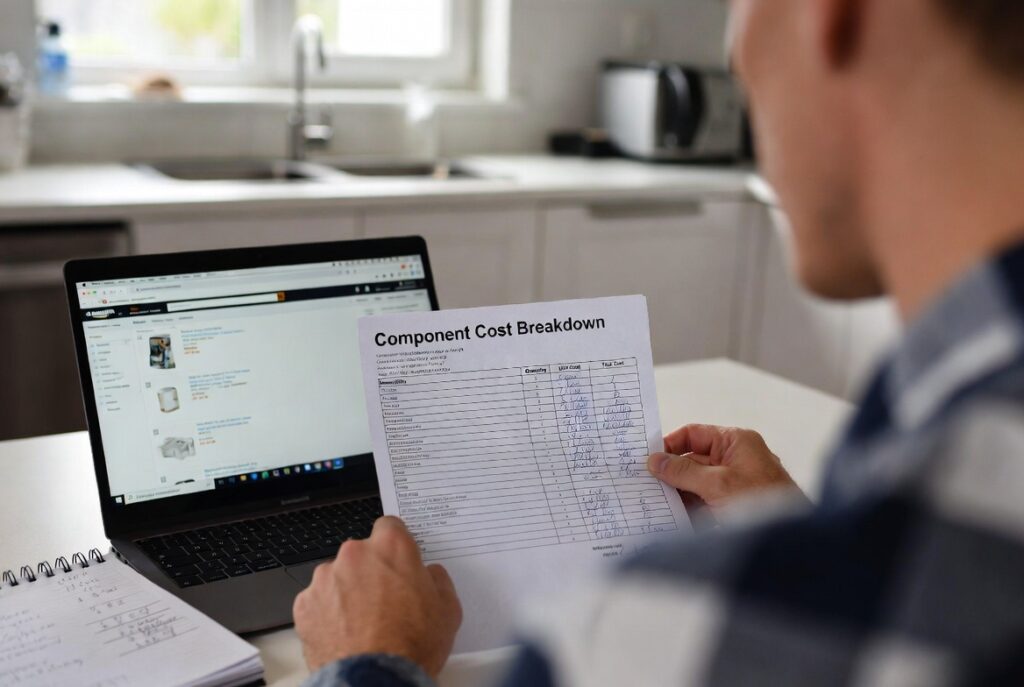
The most common Ontario solar system cost mistake is building a Tier 2 cabin budget using Amazon cart totals without including the ESA permit ($300 to $400) and the heated LFP premium ($150 to $200 per 100Ah battery over standard LFP), because a property owner on Eramosa Road in Guelph, Wellington County budgeted $3,200 for a Tier 2 off-grid cabin system in fall 2022 based on component prices he found online, then discovered these two Ontario-specific costs pushed his total to approximately $4,100, a 28% overrun, before he had paid for a single piece of wire or a ground mount frame.
His original $3,200 budget included 4× Renogy 100W panels ($320), generic 200Ah LFP batteries ($700), Victron MPPT 100/30 ($165), 2,000W PSW inverter ($280), miscellaneous wire ($100), and a Victron SmartShunt ($90). His first missed cost: the ESA permit came in at $340. His second: his unheated workshop required a 0°C self-heating battery, and two Battle Born heated LFP 100Ah units replaced the generic LFP, adding $400.
His revised Tier 2 component total: $3,200 original budget, plus $340 ESA permit, plus $400 heated LFP upgrade, plus $160 for 4/0 AWG battery cable and Class T fuse (his original wire budget was insufficient for the correct wiring standard) = approximately $4,100. He was not upset about the final number, he was upset that nobody had told him about these two costs upfront. The solar system cost planning error was predictable and avoidable.
I reviewed his final component list after commissioning. His Victron SmartShunt confirmed: 255Wh harvested on the first clear January day, 200Ah heated LFP bank reaching 100% SoC by 1:30 PM with tail current at 1.8A, and a confirmed 0.15V voltage drop across the correctly specified 4/0 AWG battery cable. The ESA inspector passed the system on the first visit. His comment: “I wish someone had told me about the heated LFP and the permit before I started pricing.” See our Ontario solar sizing guide before finalizing any Ontario solar system cost budget.
Important Safety and Permit Note: Any permanently installed solar system in Ontario requires an ESA permit before work begins. This includes array wiring, battery bank, charge controller, inverter, and all AC and DC connections. All installations must be verified by a licensed professional and comply with CEC Section 64. Never purchase or install components before obtaining the necessary permits. Contact esasafe.com before beginning any work. Proper ESA documentation is required for home insurance coverage on any habitable structure with a permanent electrical installation.
The Ontario solar system cost tiers: Tier 1 at $1,850, Tier 2 at $5,400, and Tier 3 at $14,000
| Tier | System | Key components | Installed cost |
|---|---|---|---|
| Tier 1, Workshop | 200W + 100Ah LFP + 1,000W PSW | 2× Renogy, Battle Born heated, MPPT 100/30 | ~$1,850 |
| Tier 2, Cabin | 400W + 200Ah LFP + 2,000W PSW | 4× Renogy, 2× Battle Born heated, MPPT 100/30 | ~$5,400 |
| Tier 3, Residence | 1,200W + 600Ah LFP + MultiPlus-II | 12× mono PERC, 6× Battle Born, MPPT 150/60 | ~$14,000+ |
| Two hidden costs | ESA permit | $300 to $400, all tiers | Mandatory for insurance ✓ |
| Two hidden costs | Heated LFP premium | $150 to $200 per 100Ah over standard LFP | Mandatory for unheated spaces ✓ |
The three Ontario solar system cost tiers are defined by their daily load capacity and the Ontario-specific specifications that determine reliability in January. Tier 1 at $1,850 is a workshop or outbuilding system: 2× Renogy 100W mono PERC ($160), Battle Born heated LFP 100Ah ($480 to $500), Victron MPPT 100/30 ($160), 1,000W PSW inverter ($160 to $180), Victron SmartShunt ($90), wire and hardware ($50 to $80), ESA permit ($300 to $400), total approximately $1,850. This tier powers LED lighting, tool battery chargers, and a single 120V outlet.
Tier 2 at $5,400 is the off-grid cabin: 4× Renogy 100W ($320), 2× Battle Born heated LFP 100Ah ($960 to $1,000), MPPT 100/30 ($160), 2,000W PSW ($280 to $350), SmartShunt ($90), 4/0 AWG cable plus Class T fuse plus busbar ($250 to $300), wire and connectors ($100), ESA permit ($300 to $400), ground mount frame ($200 to $300), total approximately $5,400. Tier 3 at $14,000 or more adds a Victron MultiPlus-II ($750 to $900), 12-panel array ($960), 6× Battle Born heated LFP ($2,880 to $3,000), engineered ground mount ($1,500 to $2,000), and generator integration wiring ($400 to $600).
For grid-tied Tier 3 HRSP builds, the $10,000 maximum HRSP rebate reduces the effective solar system cost by approximately $6,000 to $8,000. See our solar energy ontario guide for the HRSP pre-approval process.
The solar system cost hidden items: ESA permit and heated LFP premium are the two costs that cause the 28% overrun
The ESA permit at $300 to $400 for a standard off-grid installation is the first Ontario solar system cost that most Amazon-based budgets omit. The ESA permit is required for any permanently wired system in a habitable structure. Without it, the property insurance policy will not cover any claim involving the electrical system, fire, flood, or theft. This is the documented reason Ontario property insurers require ESA permits for all permanently wired electrical work. The $300 to $400 ESA line item is non-negotiable for any Ontario solar system cost budget; it is the document that makes the system legal, insurable, and inspectable.
The heated LFP premium is the second missed Ontario solar system cost. A standard LFP 100Ah battery costs approximately $280 to $350. The Battle Born heated LFP 100Ah costs approximately $480 to $500. The $150 to $200 premium per battery covers an internal self-heating element that activates at approximately 2°C and raises the cell temperature to 5 to 7°C before allowing charging current, ensuring the battery charges normally through the entire Ontario winter in an unheated space.
For any unheated outbuilding, garage, workshop, or cabin, this premium is the most cost-effective line item in the solar system cost budget. Skipping it means zero charging from November through March, the Speedside Road Guelph result confirmed exactly that failure in a previous system this series documented.
Pro Tip: Before finalizing any Ontario solar system cost budget, run through this three-item checklist: (1) ESA permit, is $300 to $400 included? (2) Heated LFP, is every 100Ah of battery in an unheated space specified as Battle Born heated LFP rather than generic standard LFP? (3) Correct wiring, is the battery cable budget $200 to $300 (4/0 AWG + Class T fuse + busbar) rather than $50 to $100? These three line items account for most of the 28% overrun gap between an Amazon cart total and the real Ontario solar system cost. The Eramosa Road Guelph system was missing all three, and the Erin Township system included all three from day one.
The Tier 2 component breakdown: $5,400 confirmed line by line
The Tier 2 cabin solar system cost confirmation from the Erin Township, Wellington County build in fall 2023. Component-by-component: 4× Renogy 100W mono PERC ($320), 2× Battle Born heated LFP 100Ah ($980), Victron MPPT 100/30 ($160), 2,000W PSW inverter ($300), Victron SmartShunt ($90), 4/0 AWG cable plus Class T fuse plus busbar ($260), wire and connectors ($100), ESA permit ($350), ground mount frame ($240). Total: approximately $5,390. SmartShunt commissioning confirmed: 257Wh clear January, 100% SoC by 1:30 PM, ESA pass first visit, zero surprises. His comment: “I set aside $5,400 and spent $5,400. That’s not an accident, that’s a budget.”
The wiring budget ($260 for 4/0 AWG plus Class T fuse plus busbar) is the third most commonly underestimated line item after the ESA permit and heated LFP. Most first-time buyers allocate $50 to $100 for wire and fuses based on home improvement store pricing for household wiring. The 4/0 AWG tinned copper cable for the battery-to-inverter run on a 2,000W system at 12V (167A continuous) costs approximately $8 to $12 per foot.
A 4-foot run requires approximately $35 to $48 in cable alone, plus $35 for the Class T fuse holder, plus $25 for the positive busbar, plus $15 for the negative busbar with SmartShunt connection. The correct solar system cost wiring budget for a Tier 2 installation: $200 to $300, not $50. See our off grid wiring guide for the complete wiring specification.
The SmartShunt as the $90 budget insurance policy
The Victron SmartShunt at $80 to $100 is the highest-value-per-dollar item in any Ontario solar system cost budget. Most solar system cost mistakes cannot be diagnosed without current monitoring. A battery bank that appears dead (loads not working, inverter shutting down) may have four distinct root causes: an LFP profile misconfiguration leaving the bank at 85% SoC; a cold cutoff that stopped charging in October; a functioning battery whose low-voltage alarm is triggering because inverter idle draw is too high; or an actual battery failure. Without a SmartShunt, each of these requires purchasing replacement components to guess which is the problem. With a SmartShunt, each condition produces a distinct current and voltage pattern that points directly to the fix.
The Eramosa Road result confirms the $90 insurance value. The SmartShunt showed the system reaching 100% SoC on the first clear January day after the battery profile was correctly configured to LFP settings, confirming that the original undercharging was a configuration issue, not a hardware failure. Without the SmartShunt, the logical next step would have been purchasing two replacement LFP batteries at $480 per unit: $960 in unnecessary cost. The SmartShunt cost at commissioning was $90. The ROI on the first avoided diagnostic error: 10.7×. See our solar charge ontario guide for the SmartShunt tail current configuration that confirms 100% SoC.
NEC and CEC: Ontario permit requirements for permanent solar installations
NEC 690 governs the solar PV installation in any solar system cost project, array wiring, charge controller connections, battery bank fusing, and inverter AC output circuits must all comply with NEC 690 requirements. All battery cables must be sized for 125% of the maximum continuous current and fused at the battery positive terminal with a Class T fuse. The inverter output must connect through a sub-panel with appropriately rated breakers. The ESA permit at $300 to $400 covers the ESA inspector’s review of all these requirements at the specific installation. Contact the NFPA at nfpa.org for current NEC 690 requirements for residential off-grid installations.
CEC Section 64 governs electrical installations in Ontario. The ESA permit is the documented confirmation that the solar system cost budget was correctly executed: correct component specifications, correct wiring gauge and fusing, correct labelling, and a passing inspection. The permit is not a bureaucratic formality, it is the document that the property insurance company requires to cover any claim involving the electrical system in the structure. Contact the Electrical Safety Authority Ontario at esasafe.com before beginning any permanent solar system cost installation in Ontario.
The solar system cost verdict: budget by tier, include the two hidden costs, confirm with SmartShunt
- Ontario buyer pricing a Tier 2 cabin system using Amazon totals and getting a number under $4,000: add the three hidden costs before finalizing any purchase. First: $300 to $400 for the ESA permit, no exceptions for any permanent installation. Second: add $150 to $200 per 100Ah of LFP for the Battle Born heated LFP premium if the installation space is unheated from October through April. Third: increase the wiring budget from $50 to $200 to $300 for 4/0 AWG battery cable, Class T fuse holder, and busbar. These three additions bring the typical $3,200 Amazon total to $4,100 to $4,400. Then add a Victron SmartShunt at commissioning to confirm the system performs correctly on the first clear January day.
- Ontario buyer planning a new Tier 2 off-grid cabin who wants to budget accurately from day one: set aside $5,400 and use the Erin Township component list as the specification. 400W mono PERC array (4× Renogy 100W) through a Victron MPPT 100/30, 200Ah heated LFP bank (2× Battle Born heated), 2,000W PSW inverter, SmartShunt, ESA permit, and ground mount frame. The Erin Township result: $5,390 actual, 257Wh clear January, ESA pass first visit, zero surprises. “I set aside $5,400 and spent $5,400. That’s not an accident, that’s a budget.”
- Ontario buyer planning a Tier 3 primary residence build or grid-tied hybrid system: budget $14,000 to $17,000 for the off-grid primary residence specification, and if the system is grid-tied, apply for HRSP before purchasing any components. For grid-tied HRSP builds, the $10,000 maximum HRSP rebate ($1,000 per kW solar + $300 per kWh battery) reduces the effective solar system cost by approximately $6,000 to $8,000. The HRSP requires pre-installation application submitted by a licensed electrical contractor, purchase cannot precede IESO pre-approval. See the solar energy ontario guide for the full HRSP detail.
Frequently Asked Questions
Q: How much does a solar system cost in Ontario in 2026?
A: Ontario solar system cost varies by tier. Tier 1 workshop system: approximately $1,850 installed (200W array, 100Ah heated LFP, 1,000W PSW inverter, MPPT 100/30, SmartShunt, ESA permit). Tier 2 off-grid cabin: approximately $5,400 installed (400W array, 200Ah heated LFP, 2,000W PSW inverter, MPPT 100/30, SmartShunt, ESA permit, ground mount). Tier 3 primary residence: $14,000 to $17,000 (1,200W+ array, 600Ah heated LFP, Victron MultiPlus-II, generator integration).
The two costs that most first-time buyers miss are the ESA permit ($300 to $400, mandatory for all permanent installations) and the heated LFP premium ($150 to $200 per 100Ah battery over standard LFP, mandatory for any unheated Ontario space). These two items account for most of the 28% gap between a typical Amazon cart total and the actual installed cost.
Q: What are the two solar system costs that most Ontario buyers miss?
A: The ESA permit ($300 to $400) and the heated LFP battery premium ($150 to $200 per 100Ah over standard LFP). The ESA permit is required for any permanently wired Ontario solar system and is mandatory for home insurance coverage on the structure. The heated LFP premium covers the self-heating element that allows the battery to charge at sub-zero temperatures, without it, a standard LFP bank will not charge from November through March in any unheated Ontario outbuilding.
On a $3,200 base Tier 2 budget, these two items plus the correct wiring budget (4/0 AWG + Class T fuse + busbar at $200 to $300 rather than the $50 placeholder most buyers use) account for the full $4,100 to $4,400 corrected total. The Eramosa Road Guelph result: exactly 28% overrun from missing these three items.
Q: Is DIY solar installation worth it in Ontario?
A: DIY installation saves $1,500 to $3,000 in licensed electrician labour on a Tier 2 system, but requires passing the ESA inspection on the first visit. A first-attempt pass requires correct component specifications (PSW inverter, heated LFP for unheated spaces, correct MPPT), correct wiring gauge and fusing (4/0 AWG battery cables, Class T 250A fuse at battery positive), and correct labelling of all circuits and breakers.
The Erin Township system was a DIY installation that passed ESA on the first visit, the property owner had used the GridFree wiring standard and had installed the SmartShunt to verify the system before the ESA visit. If the correct Ontario solar system cost budget is planned from day one and the installation follows the wiring standard, DIY is economically rational for most Ontario property owners with basic electrical competency.
This build is engineered within the 48V DC Safety Ceiling. Diagnostic logic is based on 20+ years of technical service experience. All structural and electrical installations must be verified by a Licensed Professional and comply with your Local AHJ. See our legal and safety disclosure for full scope.
About the Author
Robert Bertrand spent 20 years as a service advisor in the automotive industry (Lexus and Nissan), where precision diagnostics, wiring integrity, and documentation standards were non-negotiable. He brings that same technical discipline to GridFree Guide, where he researches, tests, and documents off-grid solar systems for Ontario conditions. Based in Rockwood, Ontario, every article is built on verified specifications, manufacturer data, and the real-world climate constraints of Canadian off-grid living.
As an Amazon Associate I earn from qualifying purchases. This site also contains affiliate links to other products and services. GridFree Guide earns a small commission at no extra cost to you.