
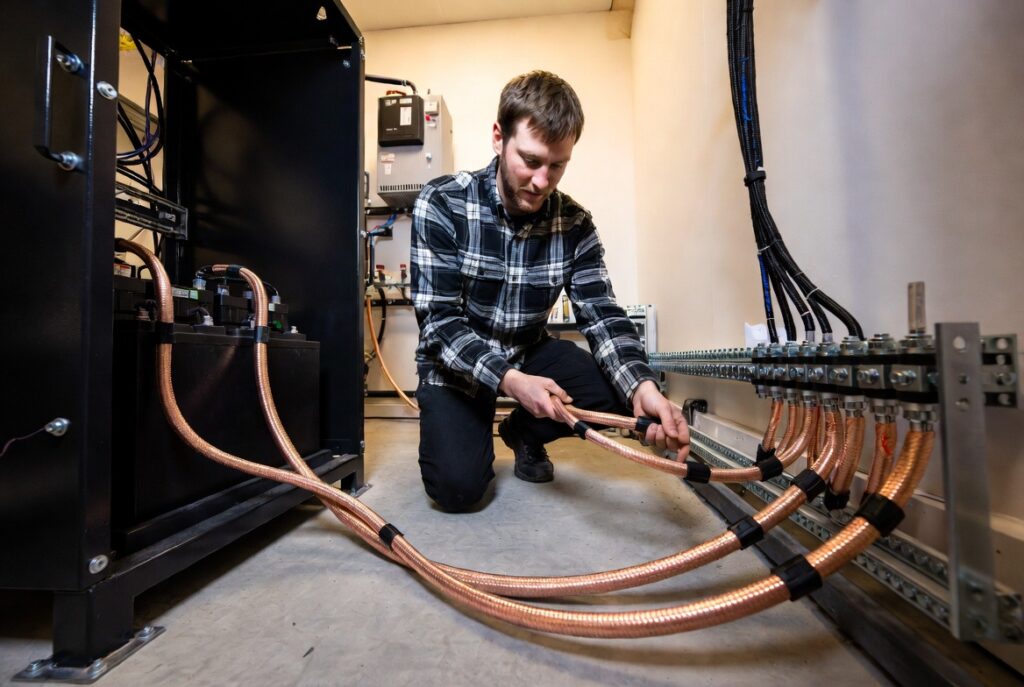
The most dangerous moment in any Ontario off grid wiring project is the one where the property owner picks up the positive battery cable before connecting the Class T fuse, because a Battle Born LFP battery at 12V can deliver approximately 3,000 to 5,000A of short-circuit current instantaneously, and when a cable lug contacts a grounded steel rack or enclosure wall for a fraction of a second, that current arc-welds the lug to the metal, vaporizes the cable insulation, and welds a crater into the battery terminal before anyone can react.
A property owner on Wellington Street East in Guelph, Wellington County was installing a 200Ah LFP battery bank in his utility room in October 2022. He had mounted the batteries and routed the cable but had not installed the Class T fuse before moving the positive cable into position. The cable lug swung and contacted the grounded steel battery rack.
The arc lasted approximately 0.3 seconds. The cable lug welded to the rack. The battery terminal surface was cratered and partially melted. The cable insulation within 80mm of the lug was destroyed. He was not injured, but the battery terminal required professional repair at a cost of approximately $340. The Class T fuse would have cleared the fault in approximately 8 milliseconds, preventing the arc entirely. The Class T fuse costs approximately $35.
I specified the correct off grid wiring sequence for the reinstallation: Class T fuse holder mounted to the battery positive terminal first, before any other connection. The fuse connects directly to the battery positive using a short 6-inch pigtail. Every subsequent positive cable connection goes through the fuse holder, the fuse is the first component installed and the last component removed during service. His Victron SmartShunt confirmed zero additional issues during commissioning: 167A at full 2,000W inverter load, no voltage sag above 0.2V, clean ESA inspection on the first attempt. See our Ontario solar sizing guide before planning any off grid wiring project.
The off grid wiring Class T fuse rule: why the battery positive terminal is the first and last connection
| Circuit | Wire gauge | Overcurrent protection | Ontario spec |
|---|---|---|---|
| Battery pos → positive busbar | 4/0 AWG (runs >1m) | Class T 250A, FIRST | Mounts directly to battery terminal ✓ |
| Positive busbar → inverter | 4/0 AWG (runs >1m) | Via Class T above | Pre-charge resistor before direct connect ✓ |
| Battery neg → SmartShunt → neg busbar | 4/0 AWG | None (shunt only) | Every negative in system goes here ✓ |
| Busbars → MPPT 100/30 | 10 AWG | 40A MIDI fuse on positive | 30A max charge current + 33% margin ✓ |
| Array → MPPT input | 10 AWG PV wire | 15A DC breaker per string | Verify cold Voc before connecting ✓ |
The Class T fuse must be the first off grid wiring connection made to the battery positive because an unfused LFP battery can deliver thousands of amps instantaneously. An automotive fuse cannot interrupt a DC arc at these current levels, it burns through and the arc continues. A Class T fuse is rated for DC arc interruption and clears the fault in approximately 8 milliseconds. For a 2,000W inverter at 12V, continuous current = 167A. Correct fuse rating: 167A × 1.25 = 208A minimum, next standard size is 250A Class T. The fuse holder mounts directly to the battery positive terminal on a 6-inch 4/0 AWG pigtail.
The off grid wiring installation sequence: (1) mount Class T fuse holder to battery positive first. (2) Connect fuse holder output to positive busbar using 4/0 AWG. (3) Connect inverter to positive busbar using 4/0 AWG. (4) Connect Victron MPPT 100/30 to busbars using 10 AWG with 40A inline MIDI fuse on positive. The Wellington Street East Guelph arc happened because step (1) was postponed, every other step was ready but the fuse holder was not mounted first. See our off grid setup guide for the complete battery-first commissioning sequence.
The off grid wiring four-circuit standard: gauge, fuse, and busbar layout for the Ontario Tier 2 system
The four-circuit off grid wiring standard for any Ontario Tier 2 system. Circuit 1: battery positive through Class T 250A to positive busbar, 4/0 AWG tinned copper, 230A rated at 167A continuous = 38% margin above the continuous load. Circuit 2: positive busbar to inverter, 4/0 AWG for any run over 1 metre. Circuit 3: battery negative through SmartShunt shunt to negative busbar, 4/0 AWG, carrying all negative current in the system. Circuit 4: positive and negative busbars to MPPT 100/30, 10 AWG with 40A MIDI fuse on positive. Array to MPPT: 10 AWG PV wire with 15A DC breaker per string.
A property owner in Erin Township, Wellington County followed the correct off grid wiring sequence from day one in spring 2023. Class T fuse first, 4/0 AWG tinned copper throughout, Victron SmartShunt on the negative run, 47-ohm 10W pre-charge resistor in series for 8 seconds before direct inverter connection. The ESA inspector passed the system on the first visit without any correction items. The SmartShunt confirmed 167A at full 2,000W load with a measured voltage drop of only 0.15V across the 1.2m 4/0 AWG battery-to-inverter run, within the 0.2V maximum. See our solar inverter ontario guide for the sub-panel and AC output circuit specifications.
Pro Tip: After commissioning, use the SmartShunt to measure the exact voltage drop across the battery-to-inverter cable at full load. Check the SmartShunt voltage reading while simultaneously checking the voltage at the battery terminals with a multimeter. The difference is the cable drop. Above 0.2V on a 4/0 AWG run means a connection problem at a lug, likely an under-crimped terminal or a lug that was installed without proper torque. The Erin Township result: 0.15V drop on a 1.2m run confirmed correct lug crimping and terminal torque at both ends. If the drop is above 0.2V, check each lug connection with an infrared thermometer under load, the hot lug is the bad crimp.
The 4/0 AWG standard: why voltage drop matters more than cost at 167 amps
Voltage drop across the battery-to-inverter cable is the invisible off grid wiring failure that causes inverter trips under load rather than a visible fault. Ohm’s law at 167A: 4 AWG cable has a resistance of approximately 0.52 milliohms per foot. At 167A: voltage drop = 167A × 0.52mΩ × 4ft (1.2m) = approximately 0.35V. A 12V system dropping 0.35V under full load = 11.65V at the inverter input, many 2,000W PSW inverters have a low-voltage cutoff at 11.5V, meaning the inverter trips on furnace blower startup in January when the bank SoC is at 40%. 4/0 AWG at 0.06 milliohms per foot: 167A × 0.06mΩ × 4ft = approximately 0.04V drop.
The cost comparison makes the decision easy. 4/0 AWG tinned copper for a 1.2m Tier 2 run: approximately $40 to $60 in cable plus $15 to $25 in terminal lugs. The 4 AWG alternative: approximately $8 to $12 in cable. The cost difference of $30 to $50 is the margin between a system that starts every load reliably and one that trips on the coldest morning of the year when reliability matters most. Upgrading undersized cable after installation requires disconnecting the Class T fuse, pulling the cable, and recrimping both ends, approximately 3 hours of work that the upfront $30 to $50 investment eliminates entirely.
The pre-charge protocol: eliminating the first-spark event before inverter connection
The pre-charge protocol protects the inverter’s internal capacitors and the battery bank’s BMS from inrush current at initial connection. An inverter’s internal capacitors appear as a near-short circuit for a fraction of a second when first connected to a charged LFP bank. This produces a large inrush current and a visible snap arc at the terminal. The arc can damage the terminal lug, the inverter’s internal pre-charge circuit, and the battery BMS’s overcurrent protection. The procedure: connect a 25 to 50 ohm, 10W resistor in series with the inverter positive cable for 5 to 10 seconds, then disconnect the resistor and make the direct connection without any spark.
The Erin Township result confirmed the procedure: 47 ohm, 10W resistor in series for 8 seconds, then direct inverter connection. Zero visible spark at the terminal. The ESA inspector noted the clean terminal as a sign of correct pre-charge procedure. Without pre-charge, the same connection produces a snap arc large enough to mark the lug and terminal, a visible issue that ESA inspectors note. The resistor costs approximately $2 and takes 30 seconds. The SmartShunt confirmed 0.15V drop at 167A immediately after connection, verifying correct cable sizing and terminal integrity. See our solar battery ontario guide for the heated LFP specification that pairs with this off grid wiring standard.
NEC and CEC: Ontario permit requirements for permanent off-grid wiring installations
NEC 690 governs DC wiring in any off grid wiring installation. All battery cables must be sized for 125% of the maximum continuous current (for a 2,000W inverter at 12V: 167A × 1.25 = 208A minimum, the 250A Class T fuse and 4/0 AWG cable rated at 230A both satisfy this requirement). All overcurrent protection must be rated for the system DC voltage and capable of interrupting the maximum prospective fault current. The Class T fuse is specifically designed for DC arc interruption at LFP fault current levels. Contact the NFPA at nfpa.org for current NEC 690 requirements for DC battery system wiring in residential off-grid installations.
CEC Section 64 governs electrical installations in Ontario. Any permanently installed off grid wiring system in a habitable structure requires an ESA permit before installation begins. The ESA inspector will verify cable sizing, fuse ratings, busbar connections, and proper labelling of all circuits. The permit documentation must identify the maximum continuous current in each circuit, the overcurrent protection rating, and the cable specification. Contact the Electrical Safety Authority Ontario at esasafe.com before beginning any permanent off grid wiring installation in Ontario.
The off grid wiring verdict: Class T first, 4/0 AWG, pre-charge, busbar, SmartShunt confirms
- Ontario property owner who has completed an off grid wiring installation without a Class T fuse: this is the highest priority fix in the system, an unprotected LFP bank is a fire and injury risk. Install the Class T 250A fuse holder as a direct pigtail to the battery positive terminal using 4/0 AWG, before making any other connection changes. Disconnect the existing positive cable, mount the fuse holder first, then reconnect through the fuse holder. The Wellington Street East Guelph result, $340 terminal repair from a 0.3-second arc, confirms the cost of a single unguarded contact. Install a Victron SmartShunt on the negative run simultaneously to confirm current levels and voltage drop.
- Ontario property owner planning a new off grid wiring installation: follow the four-circuit sequence in order, starting with the Class T fuse on the battery positive before any other connection is made. Class T fuse first, 4/0 AWG tinned copper for battery-to-inverter runs over 1 metre, SmartShunt on the negative run, Victron MPPT 100/30 from busbar through 10 AWG and 40A MIDI fuse, 25 to 50 ohm pre-charge before inverter direct connection. The Erin Township result: ESA pass on first visit, 0.15V measured drop at 167A, zero spark at inverter connection.
- Ontario property owner completing AC distribution wiring after DC circuits are confirmed: use WAGO connectors only for low-current AC connections, not for DC battery circuits. The WAGO 221-412 lever-lock connectors are appropriate for AC distribution connections in the sub-panel under 15A (lighting circuits, outlet circuits). They are not suitable for DC battery circuits where tinned copper cable and crimped lugs are the only correct termination method. Connect four Renogy 100W panels with 10 AWG PV wire to the MPPT input after the DC battery circuits are complete and confirmed on the SmartShunt.
Frequently Asked Questions
Q: What wire gauge do I need for an off-grid solar battery system?
A: For battery-to-inverter runs over 1 metre: 4/0 AWG tinned copper, rated at 230A continuous (167A at a 2,000W inverter = 38% margin). For runs under 1 metre: 2/0 AWG. The sizing rule: the cable must carry 125% of the maximum continuous current without exceeding 0.2V of voltage drop. At 167A and 0.06 milliohms per foot (4/0 AWG), a 1.2m run produces 0.04V drop, well within the limit. 4 AWG at 0.52 milliohms per foot produces 0.35V at 167A, enough to cause inverter low-voltage trips on startup. The SmartShunt measures voltage at the battery terminal; checking the SmartShunt reading versus the inverter input voltage under load reveals the actual cable drop.
Q: Do I need a Class T fuse for an off-grid LFP battery system?
A: Yes, Class T is the only correct overcurrent protection for an LFP battery bank. An LFP battery can deliver 3,000 to 5,000A of short-circuit current instantaneously. A Class T fuse clears the fault in approximately 8 milliseconds, preventing the arc-flash that occurs when a cable contacts a grounded surface. Automotive fuses cannot interrupt DC arcs at these current levels, they burn through and the arc continues.
The Class T 250A fuse for a 2,000W system at 12V costs approximately $35. The battery terminal repair from the Wellington Street East Guelph arc, which a correctly installed Class T fuse would have prevented, cost $340. The Class T fuse holder mounts directly to the battery positive terminal as the first connection in the off grid wiring sequence.
Q: What is the pre-charge resistor procedure for a solar inverter?
A: Connect a 25 to 50 ohm, 10W resistor in series with the inverter positive cable for 5 to 10 seconds before making the direct connection. The resistor limits the inrush current that would otherwise produce a visible snap arc as the inverter’s internal capacitors charge from the battery bank. After 5 to 10 seconds, the capacitors are charged and the resistor can be removed, the direct connection produces no arc.
The Erin Township result: 47 ohm, 10W resistor, 8 seconds, zero visible spark at the terminal. Without pre-charge, the same connection produces a snap arc large enough to mark the terminal lug and flag an ESA inspection concern. The resistor costs approximately $2 and is the least expensive step in the entire off grid wiring sequence.
This build is engineered within the 48V DC Safety Ceiling. Diagnostic logic is based on 20+ years of technical service experience. All structural and electrical installations must be verified by a Licensed Professional and comply with your Local AHJ. See our legal and safety disclosure for full scope.
About the Author
Robert Bertrand spent 20 years as a service advisor in the automotive industry (Lexus and Nissan), where precision diagnostics, wiring integrity, and documentation standards were non-negotiable. He brings that same technical discipline to GridFree Guide, where he researches, tests, and documents off-grid solar systems for Ontario conditions. Based in Rockwood, Ontario, every article is built on verified specifications, manufacturer data, and the real-world climate constraints of Canadian off-grid living.
As an Amazon Associate I earn from qualifying purchases. This site also contains affiliate links to other products and services. GridFree Guide earns a small commission at no extra cost to you.