
The Beginner Solar Guide Roadmap and Why Starting with a Plan Saves Thousands
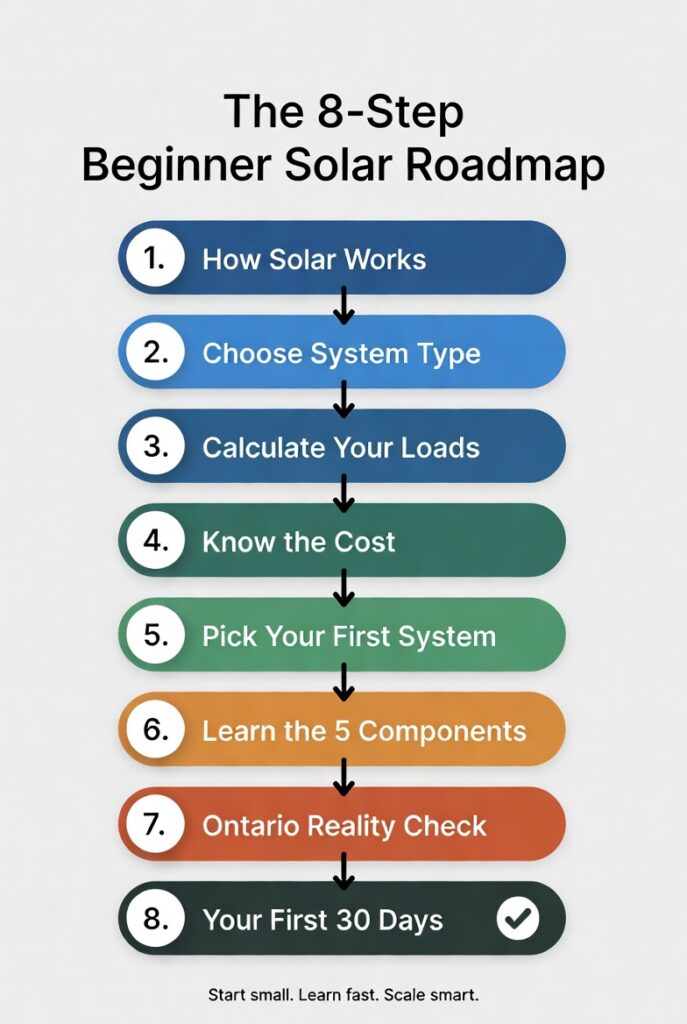
This beginner solar guide covers every decision from understanding how solar works to commissioning your first system because starting without a roadmap leads to oversized purchases and undersized results. Eight steps in plain language. No jargon without explanation. No assumed knowledge. A homeowner in Rockwood followed these 8 steps and built a $650 shed system that taught him everything he needed for his $5,000 cabin upgrade the following year.
A homeowner in Milton skipped the steps and spent $12,000 on a system that could not keep the lights on past 6 PM by December. The difference was not budget or skill. The difference was sequence. The Rockwood builder started at step 1 and worked forward. The Milton buyer started at step 5 (buying) and never completed steps 1 through 4 (understanding). Every dollar spent before understanding the basics is a dollar at risk.
This beginner solar guide is the master roadmap for the entire Beginner Guide category. Each section answers one question, summarizes the key decision, and links to the full detailed guide. For a broader system overview, see our solar generator Ontario guide.
How Solar Works and Which System Type Fits Your Situation
Step 1 is understanding how solar works. Sunlight hits a panel. The panel converts sunlight into direct current (DC) electricity. A charge controller sends the DC power to a battery for storage. An inverter converts the stored DC into alternating current (AC) for your appliances. That is the entire system in 4 components. For the complete explanation, see our how solar power works guide.
Step 2 is choosing your system type. Grid-tied systems sell excess energy back to Hydro One but shut down during outages. Off-grid systems operate independently with no utility connection. Hybrid systems have battery backup plus a grid connection for the best of both. Most Ontario beginners should start with an off-grid backup system, not full off-grid living. Start small, learn the technology, then scale. For the full comparison, see our what is off-grid solar guide and our off-grid Ontario guide.
The Beginner Solar Guide for Sizing Your System and Understanding the Real Cost
Step 3 is calculating how much power you need. List your critical loads in watts and multiply by the hours you need each one to run. A fridge at 80W for 24 hours needs 1,920Wh. A CPAP at 30W for 8 hours needs 240Wh. Phones at 10W for 4 hours need 40Wh. Add the totals and that is your minimum daily requirement. For the complete sizing method, see our how much solar power guide and our daily energy calculation guide.
Step 4 is understanding the real cost. A Tier 1 shed system costs $800 to $1,500 CAD. A Tier 2 cabin system costs $3,000 to $6,000 CAD. A Tier 3 whole-home system costs $15,000 to $30,000 CAD. A portable backup power station costs $400 to $4,500 CAD depending on capacity. The right tier depends on your loads from step 3, not on what a salesperson recommends. For the complete cost breakdown, see our off-grid solar cost guide and our solar panel cost guide.
Choosing Your First System and the Five Components Every Build Needs
Step 5 is picking your first system. Apartment and condo dwellers should start with a portable power station like a Jackery Explorer 300 Plus at $400 CAD. Workshop and garden shed builders should start with a Renogy 100W Starter Kit at $200 CAD plus a battery. Seasonal cabin owners need a Tier 2 system. Full independence requires Tier 3 with professional installation. For the setup sequence, see our off-grid setup guide and our off-grid shed guide.
Step 6 is learning the five components. Every solar system has panels, a charge controller, a battery, an inverter, and wiring. Nothing more. Nothing less. Understanding what each component does and how they connect prevents buying incompatible parts. For the complete breakdown, see our five components guide. For wiring details, see our off-grid electrical wiring guide. For battery selection, see our solar battery guide. For backup power options, see our backup power guide. For panel selection, see our solar panel guide.
The Rockwood Tier 1 Shed Success
A first-time builder in Rockwood followed this beginner solar guide and started with a Tier 1 shed system for his garden workshop. He bought a Renogy 100W Starter Kit for $200 CAD and a 100Ah 12V LFP battery for $400 CAD. His total investment was $650 CAD including wire and fuses. His goal was LED lights and phone charging in the workshop without running an extension cord from the house.
The 100W panel produced enough energy to run his LED lights for 6 hours every evening and charge his phone twice daily with capacity to spare. On weekends, he added a small radio and a laptop charger without any issues. After 3 months, he understood charge rates, SoC monitoring, and the January production drop firsthand. He upgraded to a Tier 2 system for his cottage the following year because he understood exactly what he needed, not what a salesperson told him he needed.
Starting with a Tier 1 shed system is like learning to drive in a parking lot before hitting the highway. You make your mistakes at low speed where they cost nothing. You learn throttle control, braking, and steering in a safe environment. This beginner solar guide recommends starting small because a $650 shed system teaches you more about solar than any $5,000 course.
The Milton Overbuy Mistake
A homeowner in Milton skipped the beginner solar guide steps and bought a $12,000 whole-home system based on a Facebook recommendation. He installed 2,400W of panels, a 400Ah 48V battery bank, and a 3,000W inverter. He hired a general contractor who was not ESA-certified to do the installation. He expected to go fully off-grid immediately.
The contractor wired the charge controller before connecting the battery, destroying a $350 controller on the first day. The battery bank was unheated standard LFP, which locked out charging in November when the garage hit 0 degrees C. He had no propane backup for heating, so his family used space heaters that drained the battery in 70 minutes. By December, he had a $12,000 system that could not keep the lights on past 6 PM.
Buying a whole-home system without understanding the basics is like buying a race car for your first vehicle. The car is fast. You do not know how to drive it. Every mistake at high speed is expensive. Following this beginner solar guide through steps 1 to 5 before purchasing would have saved him $4,000 in wrong-sized components, a $350 destroyed controller, and 4 months of frustration.
The Beginner Solar Guide for Ontario Reality and Your First 30 Days
Step 7 is the Ontario reality check. Ontario receives only 1.5 peak sun hours in January versus 5 PSH in July. Heated LFP batteries are mandatory for any system in an unheated space because the BMS locks charging at 0 degrees C. Propane backup is essential for heating because electric heaters drain any battery bank in under 2 hours. Plan your system for 3 to 5 days of gray streak autonomy. Any permanent installation connecting to household wiring requires an ESA permit. For the complete Ontario specification, see our solar power system Ontario guide.
Step 8 is your first 30 days. Assemble the system following the wiring sequence. Test every connection before powering up. Monitor State of Charge daily for the first month. Verify that actual charge rates match your calculated estimates. Compare real production to the numbers from step 3. The first month reveals every sizing error, every wiring mistake, and every gap in your understanding. An Anker SOLIX C1000 with UPS mode is the simplest way to start monitoring real-world performance. For the complete first-month protocol, see our first 30 days guide.
Frequently Asked Questions
Q: How much does a beginner solar system cost in Ontario?
A: A Tier 1 shed system starts at $650 to $1,500 CAD including panel, controller, battery, and wiring. A portable power station for apartment backup starts at $400 CAD. A full off-grid cabin system ranges from $3,000 to $6,000 CAD depending on capacity.
Q: Can I install solar panels myself in Ontario?
A: Yes, for small off-grid systems like sheds and portable setups that do not connect to the main electrical panel. Any system that connects to household wiring requires an ESA permit and must be inspected by a licensed electrician. Start with a standalone off-grid system to learn the basics before attempting a grid-connected installation.
Q: Is solar worth it in Ontario with our winters?
A: Yes, because Ontario electricity rates are among the highest in Canada and continue to rise. Even at 1.5 PSH in January, a properly sized system with 3 to 5 days of battery autonomy provides reliable off-grid power year-round. The 25-year lifespan of solar panels makes the cost per kWh lower than Hydro One rates within the first 5 to 7 years.
NEC Article 690 covers residential solar installation requirements including permit obligations, grounding, and overcurrent protection for both off-grid and grid-tied systems. All permanent installations must comply with local electrical code and inspection requirements. Current standards are published at nfpa.org.
CEC Section 64 governs renewable energy system installation requirements in Ontario including permit obligations and inspection standards. All systems connecting to household wiring require ESA approval. The Electrical Safety Authority (ESA) provides current compliance guidelines and permit applications at esasafe.com.
This build is engineered within the 48V DC Safety Ceiling. Diagnostic logic is based on 20+ years of technical service experience. All structural and electrical installations must be verified by a Licensed Professional and comply with your Local AHJ. See our legal and safety disclosure for full scope.
About the Author
Robert Bertrand spent 20 years as a service advisor in the automotive industry (Lexus and Nissan), where precision diagnostics, wiring integrity, and documentation standards were non-negotiable. He brings that same technical discipline to GridFree Guide, where he researches, tests, and documents off-grid solar systems for Ontario conditions. Based in Rockwood, Ontario, every article is built on verified specifications, manufacturer data, and the real-world climate constraints of Canadian off-grid living.
As an Amazon Associate I earn from qualifying purchases. This site also contains affiliate links to other products and services. GridFree Guide earns a small commission at no extra cost to you.