
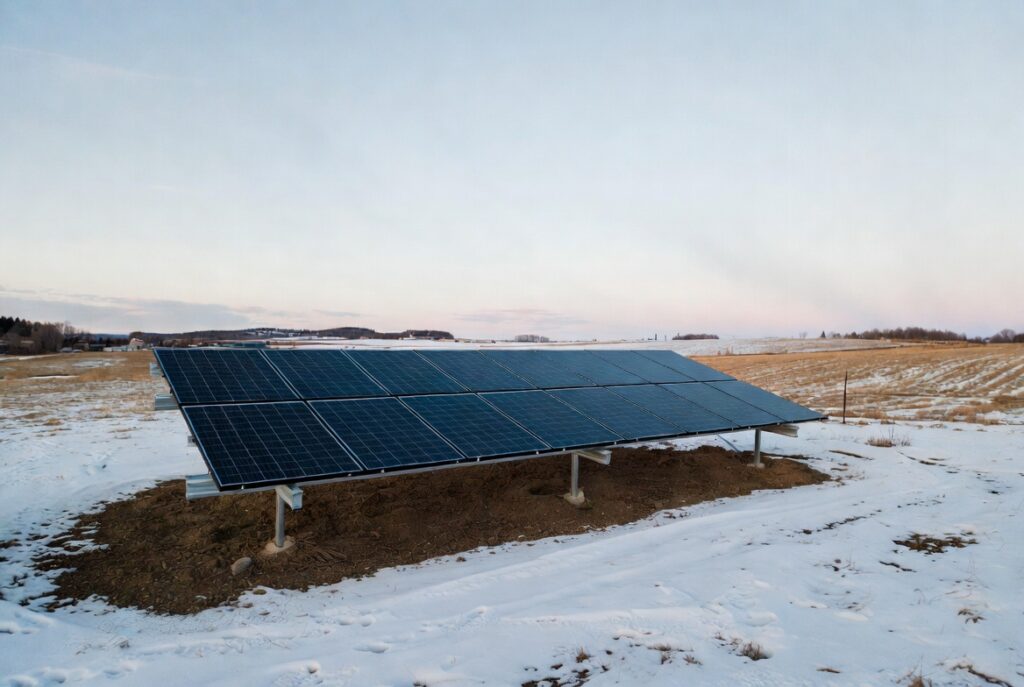
The most predictable Ontario off grid shed failure happens in late January when the property owner walks out to the detached workshop on a clear cold morning, flips the light switch, gets nothing, and eventually finds that the 12V automotive cranking battery he installed last fall has dropped to 10.5V, the PWM trickle charger has been unable to overcome the cold lead plates’ increased internal resistance during the gray streak, and the battery has sulfated permanently.
A property owner on Speedside Road in Guelph, Wellington County set up a 100W panel and a PWM controller connected to a group 27 marine starting battery in his detached workshop in October 2022. His daily load was approximately 180Wh: LED lighting for 4 hours (30W), a power tool battery charger for 2 hours (100W peak), and a phone charger (10W continuous). The 100W array at 1.5 PSH Ontario January theoretically provides 127.5Wh per day, already insufficient for his 180Wh load, with zero reserve.
The January 2023 gray streak began on January 8th. The battery was at approximately 60% SoC, approximately 40Ah used, though a starting battery delivers perhaps 20Ah of usable deep-cycle capacity before voltage collapses. By January 11th the battery was at 10.5V. The trickle charger could not deliver enough current to overcome the battery’s increased internal resistance at -5°C ambient. The battery sat at 10.5V for 6 days, then held there for the remainder of the streak.
I inspected the system in February. The battery showed a sulfate crust visible on the lead plates, sulfation from deep discharge at cold temperatures, which permanently reduces capacity. The battery’s measured capacity had dropped to approximately 18Ah from a nominal 100Ah. The fix was a complete system replacement: automotive battery discarded, PWM controller replaced with a Victron MPPT 100/30, and the off grid shed rebuilt to Tier 1 specification with a Battle Born heated LFP 100Ah. See our Ontario solar sizing guide before specifying any off grid shed system.
The off grid shed lead-acid failure: why a cranking battery sulfates in the first Ontario January gray streak
| Battery type | Usable capacity | Cold charging | Ontario off grid shed verdict |
|---|---|---|---|
| Automotive cranking battery | 15-25Ah realworld | Fails; sulfates in 3-4 weeks | Guaranteed January failure ✗ |
| AGM deep cycle 100Ah | ~50-60Ah usable | 0°C cutoff, no self-heat | Better but not Ontario standard ⚠️ |
| Battle Born heated LFP 100Ah | ~80Ah usable (80% DoD) | Self-heats at 2°C, charges all winter | Tier 1 Ontario standard ✓ |
| Tier 1 system total | 960Wh usable | Always charges | $1,850 installed, lights on in January ✓ |
Cranking batteries are designed for brief high-current starts (600 to 800A for 30 seconds), not deep cycle storage. Deep discharge below 50% SoC damages the thin lead plates, and cold temperatures accelerate this process into sulfation. The typical off grid shed failure sequence: summer installation, some use, November gray streak, deep discharge, sulfation, dead battery by February. Realworld deep cycle capacity of a group 27 cranking battery is approximately 15 to 25Ah, less than 25% of the nominal 100Ah, because the plates are not designed to withstand repeated deep discharge cycles.
The lead-acid deep cycle battery is a marginal improvement but not the Ontario off grid shed standard. A 100Ah AGM deep cycle battery provides approximately 50 to 60Ah of usable capacity without the sulfation risk. However, AGM still has a 0°C charging cutoff (the chemistry resists cold charging even without a BMS), requires a correctly sized MPPT controller rather than a PWM trickle charger, and offers no self-heating capability for an unheated shed. Any Wellington County shed that drops below 0°C in winter, which is most of them from November through March, needs a self-heating LFP battery to charge through the season.
The off grid shed Tier 1 standard: 200W mono PERC, 100Ah heated LFP, 1,000W PSW, $1,850 total
The Tier 1 off grid shed standard for any Ontario detached workshop or outbuilding: two Renogy 100W mono PERC panels on a south-facing 35° mount (roof or ground frame), a Victron MPPT 100/30 with LFP profile (14.2V absorption, tail current 2A, float 13.5V), one Battle Born heated LFP 100Ah, a 1,000W PSW inverter for the 120V outlet and tool chargers, and a Victron SmartShunt on the negative run. Total installed cost including ESA permit: approximately $1,850.
A property owner in Erin Township, Wellington County built the Tier 1 off grid shed system in spring 2023 at a total cost of $1,850 (components plus ESA permit). First January: SmartShunt confirmed 215Wh harvest on a clear January day (200W × 1.5 PSH × 0.85 × realworld). During a 3-day gray streak in late January, the bank SoC dropped to 48% but never triggered a low-voltage cutoff. LED lighting, chest freezer, and phone charging all maintained throughout the streak. His comment: “I walked out in January. The lights came on. That’s all I wanted.” See our off grid costs guide for the full Tier 1 component breakdown.
Pro Tip: The 1,000W PSW inverter is correctly sized for a standard off grid shed load profile, peak simultaneous load of approximately 140W leaves a 614% margin on the inverter rating. More importantly, a quality 1,000W PSW unit draws approximately 4 to 6W idle versus 8 to 10W for a 2,000W unit. At 24 hours idle, the 1,000W unit saves approximately 96Wh per day over the 2,000W alternative. Over a 4-day Ontario January gray streak, that 96Wh difference adds up to 384Wh of bank reserve that stays available for actual loads. Size the inverter to the load, not to a number that sounds safe. The Erin Township system was never inverter-limited in three years of operation.
The gray streak autonomy calculation: 960Wh usable versus 220Wh per day
The gray streak autonomy confirms whether the Tier 1 battery is correctly sized for the off grid shed load. 100Ah heated LFP at 80% DoD = 960Wh usable. Tier 1 base daily load without a freezer: approximately 220Wh (LED 120Wh + tool charger 80Wh + phone 20Wh). Autonomy at 50% DoD reserve (safe operating practice): 480Wh divided by 220Wh = 2.2 days without any solar input. Autonomy at 80% DoD (emergency): 960Wh divided by 220Wh = 4.4 days. The 3-day Erin Township gray streak was handled within the 50% reserve, SmartShunt confirmed the bank never dropped below 48% SoC.
The chest freezer option changes the off grid shed calculation significantly. A small chest freezer at 35W continuous draws approximately 210Wh per effective daily operating hours. Adding the freezer to the 220Wh base load brings the total to approximately 430Wh per day, more than double the 215Wh the 200W array produces on a clear January day. For any off grid shed that includes a chest freezer, the correct specification is a 400W array (4× Renogy 100W in 2S × 2P) and a 200Ah LFP bank. The cold Voc safety check still applies: 4× panels in 2S produces 52.6V at -22°C, safely under the MPPT 100/30’s 100V input limit.
The WAGO 221-412 advantage: lever-lock AC connections for Ontario temperature swings
The WAGO 221-412 lever-lock connectors are the correct choice for AC distribution connections in an off grid shed sub-panel. A Wellington County detached shed experiences a full annual temperature swing of approximately -30°C in winter to +35°C in summer, a 65°C range that causes thermal expansion and contraction in electrical connections. The WAGO 221-412 is rated from -40°C to +85°C and uses a spring-loaded lever mechanism that maintains consistent clamping force through temperature cycles, unlike wire nuts that rely on friction and can loosen after repeated thermal cycling.
WAGO connectors are not appropriate for the DC battery circuits in the off grid shed, those require crimped tinned copper lugs and Class T fusing as specified in the DC wiring standard. The WAGO’s correct scope in an off grid shed is the 120V AC side: the junction between the inverter output and the shed lighting circuit, the 120V outlet circuit, and any other AC connections under 15A. For loads above 15A, use terminal blocks rated for the specific amperage. See our off grid wiring guide for the Class T fuse and DC cable specifications.
NEC and CEC: Ontario permit requirements for permanent shed electrical installations
NEC 690 governs the solar PV array and battery system in any off grid shed installation. All DC battery cables must be sized for 125% of the maximum continuous current, fused at the battery positive terminal with a Class T fuse, and installed with appropriate overcurrent protection at the charge controller input. The inverter installation must comply with NEC 690 requirements for inverter output circuits, including appropriately rated breakers on the sub-panel main. Contact the NFPA at nfpa.org for current NEC 690 requirements for residential off-grid PV installations.
CEC Section 64 governs electrical installations in Ontario. Any permanently wired off grid shed system requires an ESA permit before installation begins, this includes the inverter sub-panel, all AC wiring within the shed, and the battery bank and array DC circuits. The ESA permit and inspection are required for home insurance coverage on the shed structure. Attempting to wire an off grid shed without an ESA permit can invalidate the property insurance coverage for the entire building. Contact the Electrical Safety Authority Ontario at esasafe.com before beginning any permanent off grid shed installation.
The off grid shed verdict: Tier 1 specification, SmartShunt confirmed, WAGO AC distribution
- Ontario property owner currently using a car battery and trickle charger in a shed: replace the system before the next January gray streak, the Speedside Road Guelph result confirms that sulfation to 18Ah is the standard outcome within one Ontario winter. Replace with the Tier 1 standard: 2× Renogy 100W mono PERC, Battle Born heated LFP 100Ah, Victron MPPT 100/30, 1,000W PSW inverter, and a Victron SmartShunt. Total installed cost approximately $1,850. The Erin Township result: 215Wh clear January, 48% SoC floor through a 3-day gray streak, all loads maintained.
- Ontario property owner planning a new off grid shed installation: build to the Tier 1 standard from day one and specify the heated LFP immediately, do not plan to add it later. 200W mono PERC array in 2S × 1P, 100Ah heated LFP, MPPT 100/30 with LFP profile, 1,000W PSW inverter, SmartShunt, ESA permit. Total approximately $1,850. If the shed will include a chest freezer, upgrade immediately to a 400W array (4× Renogy in 2S × 2P) and a 200Ah LFP bank, the freezer’s 210Wh daily load exceeds the 200W array’s Ontario January production and will deplete the 100Ah bank through any gray streak.
- Ontario property owner completing AC distribution wiring inside the shed: use WAGO 221-412 lever-lock connectors for lighting and outlet circuits under 15A, the -40°C rating handles Wellington County’s full annual temperature swing. Reserve crimped tinned copper lugs for all DC battery circuits. Install the SmartShunt at commissioning and verify: 215Wh production on the first clear January day, SoC floor above 40% through the first gray streak. If the SoC floor drops below 40% through a 3-day streak, the daily load exceeds the array production margin, add a second 100Ah LFP battery or reduce load.
Frequently Asked Questions
Q: How much solar do I need for an off-grid shed in Ontario?
A: For a standard off grid shed base load of approximately 220Wh per day (LED lighting, tool battery charger, phone charger), a 200W mono PERC array (2× Renogy 100W in 2S × 1P) is the correct Tier 1 specification. The 200W array at 1.5 PSH Ontario January produces approximately 215Wh per day realworld, matched to the 220Wh base load with the 100Ah LFP bank providing gray streak reserve.
If the shed includes a small chest freezer (35W continuous, approximately 210Wh per day additional load), upgrade to a 400W array (4× Renogy 100W in 2S × 2P) and a 200Ah LFP bank. The SmartShunt confirms January production on the first clear day, if realworld output is below 180Wh on a clear January day with 200W installed, verify the cold Voc configuration and panel tilt angle.
Q: Can I use a car battery for an off-grid shed system?
A: No, a cranking battery will sulfate and fail within one Ontario winter, typically during the first January gray streak. The Speedside Road Guelph result confirms the standard failure pattern: 100Ah nominal battery, 127.5Wh daily panel input (insufficient for 180Wh load), gray streak drives the battery to 10.5V, 6 days at deep discharge in cold temperatures, sulfation reduces measured capacity to 18Ah. The fix requires complete system replacement. A 100Ah AGM deep cycle battery is a marginal improvement but still has a 0°C charging cutoff and no self-heating capability. The correct off grid shed battery for any unheated Ontario outbuilding is the Battle Born heated LFP, it self-heats at 2°C and charges normally through the entire Ontario winter.
Q: What does a proper off-grid shed system cost in Ontario?
A: The Tier 1 off grid shed standard costs approximately $1,850 installed, including the ESA permit. Component breakdown from the Erin Township build: 2× Renogy 100W mono PERC ($160), Battle Born heated LFP 100Ah ($480), Victron MPPT 100/30 ($160), 1,000W PSW inverter ($180), Victron SmartShunt ($90), WAGO connectors, wire, fuse ($50), ESA permit ($350), ground mount frame ($180), total $1,850 approximately. This compares to the $120 automotive battery and PWM trickle charger setup that sulfated to 18Ah capacity within one winter. The Tier 1 system operates indefinitely on a single battery with a 10-year Battle Born warranty, no maintenance required.
This build is engineered within the 48V DC Safety Ceiling. Diagnostic logic is based on 20+ years of technical service experience. All structural and electrical installations must be verified by a Licensed Professional and comply with your Local AHJ. See our legal and safety disclosure for full scope.
About the Author
Robert Bertrand spent 20 years as a service advisor in the automotive industry (Lexus and Nissan), where precision diagnostics, wiring integrity, and documentation standards were non-negotiable. He brings that same technical discipline to GridFree Guide, where he researches, tests, and documents off-grid solar systems for Ontario conditions. Based in Rockwood, Ontario, every article is built on verified specifications, manufacturer data, and the real-world climate constraints of Canadian off-grid living.
As an Amazon Associate I earn from qualifying purchases. This site also contains affiliate links to other products and services. GridFree Guide earns a small commission at no extra cost to you.