
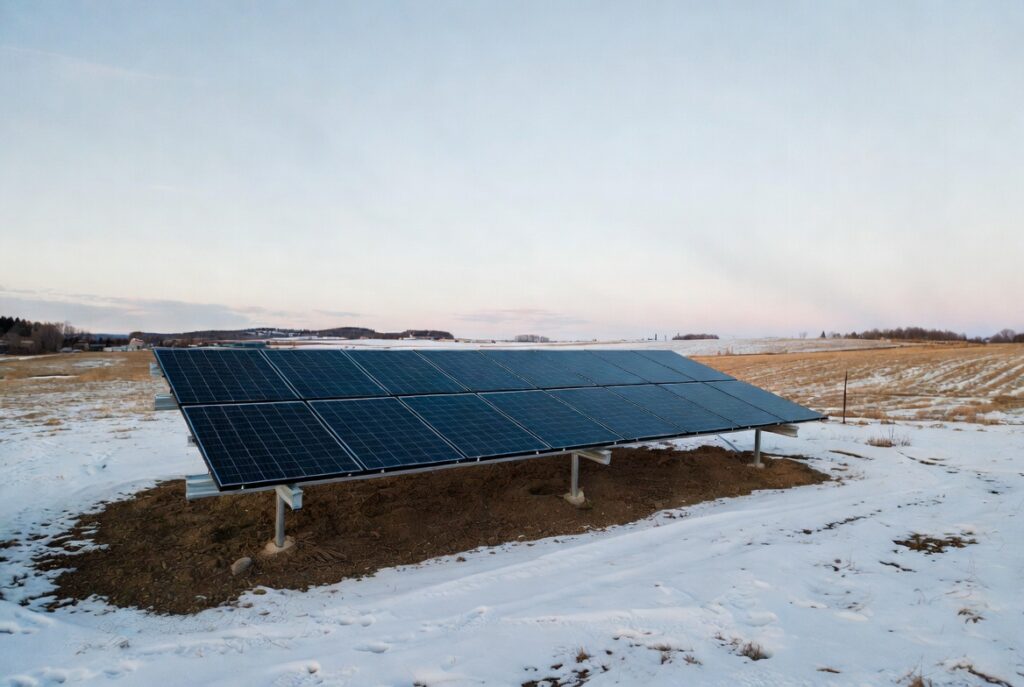
The solar panel ontario selection mistake that costs the most is choosing a panel based on rated watts rather than low-light efficiency, because a property owner on Tower Street South in Fergus, Centre Wellington installed four generic 100W polycrystalline panels in fall 2022, and his SmartShunt showed 180 to 220Wh per day through January 2023 on overcast days, approximately 40 to 50% less than the 340 to 380Wh that equivalent mono PERC panels would have produced on the same days. His January 2023 overcast days produced 200Wh on average, below the threshold needed to power his woodstove blower (80W), Starlink router (65W), and LED lighting (30W) for a combined daily load of approximately 440Wh.
The polycrystalline cells use lower-purity silicon than mono PERC cells, and their response to the diffuse blue-spectrum light of an Ontario overcast January is approximately 10 to 15% worse than mono PERC panels of the same rated watts. He replaced all four with Renogy 100W mono PERC panels in spring 2023. The following January 2024, his Victron SmartShunt confirmed the difference: mono PERC produced 340 to 380Wh on the same type of overcast January day that had previously yielded 180 to 220Wh, an improvement of approximately 160Wh per day. His system ran comfortably through January 2024 without a single low-SoC alert.
I reviewed his system specs after the SmartShunt confirmed the improvement. His Victron MPPT 100/30 was configured for a 2S × 2P array (two panels in series, two in parallel), with the cold Voc safety check applied before installation. Renogy 100W Voc = 22.5V at STC. Temperature coefficient = -0.36%/°C. At Ontario design temperature of -22°C, cold Voc = 22.5 × (1 + 47 × 0.0036) = 22.5 × 1.1692 = 26.3V per panel. In 2S: 52.6V, safely under the MPPT 100/30’s 100V input limit with 47V of margin. See our Ontario solar sizing guide before specifying any solar panel ontario system.
The solar panel ontario mono PERC standard: why low-light efficiency determines the correct January specification
| Panel type | Efficiency | Ontario January overcast | Ontario verdict |
|---|---|---|---|
| Mono PERC (Renogy 100W) | ~21-22% | 340-380Wh (Tower St. Fergus) | Ontario standard ✓ |
| Polycrystalline 100W | ~15-17% | 180-220Wh (same system, same days) | Large farms only ✗ |
| Thin-film flexible (Renogy) | ~12-14% | Poor, no tilt, snow packs | RV/boat surfaces only |
| Temp coeff (Voc) | Mono PERC: -0.36%/°C | Cold Voc 26.3V at -22°C | 2S = 52.6V safe ✓ |
| Ground vs roof (35°) | n/a | Ground: snow gone 4 hrs | Roof: buried 4 days ✗ |
PERC stands for Passivated Emitter and Rear Cell, a reflective layer added to the back of each silicon cell that gives photons a second absorption opportunity after passing through the cell. This design specifically improves response to diffuse light, which is the dominant condition in Wellington County from November through March. On a standard Ontario overcast January day with diffuse irradiance of approximately 100 to 150 W/m², a mono PERC panel produces approximately 10 to 15% more energy than a polycrystalline panel of the same rated watts. The PERC layer is the reason the Tower Street South Fergus system gained 160Wh per day on overcast days after the swap.
The rated watt comparison on a solar panel ontario specification sheet is a Standard Test Conditions (STC) measurement taken at 1,000 W/m² irradiance, 25°C cell temperature, and 1.5 air mass, conditions that occur in Ontario for approximately 60 to 80 hours per year. Ontario January off-grid systems operate on diffuse irradiance of 100 to 200 W/m² for approximately 4 to 5 hours per day. At those light levels, the mono PERC silicon outperforms polycrystalline silicon in the specific way that matters: converting the weak, scattered photons of an overcast Wellington County morning into usable current. See our solar panels ontario guide for the full cold Voc table and series/parallel configuration options.
The solar panel ontario cold Voc calculation: why 2S is safe and 4S exceeds the MPPT 100/30 input limit at -22°C
The cold Voc calculation determines whether a solar panel ontario configuration is safe for the MPPT 100/30’s 100V input limit at Ontario winter temperatures. The calculation uses plain arithmetic: cold Voc = Voc_STC multiplied by (1 plus delta_T multiplied by the temperature coefficient). For Renogy 100W mono PERC: Voc_STC = 22.5V, temperature coefficient = -0.36%/°C (meaning voltage rises as temperature falls), and delta_T = 47°C (the difference between STC standard 25°C and Ontario design temperature -22°C). Cold Voc = 22.5 × (1 + 47 × 0.0036) = 22.5 × 1.1692 = 26.3V per panel. In 2S: 52.6V, safely under 100V.
In a 4S configuration (four panels wired in series): 26.3V × 4 = 105.2V, exceeding the MPPT 100/30’s 100V input limit by 5.2V. At -22°C, the MPPT 100/30 enters overvoltage protection and shuts down, precisely when the system most needs to capture every available photon. The correct Tier 2 solar panel ontario configuration is 2S × 2P: two panels in series, two strings in parallel, producing 52.6V cold Voc at 400W total capacity. This is the configuration confirmed on the Tower Street South Fergus system: 52.6V cold Voc on the MPPT input, never tripped overvoltage through two full Ontario winters.
Pro Tip: Always do the cold Voc calculation from the manufacturer’s datasheet for the specific panel you are installing, do not use estimates or round numbers. Two panels from different manufacturers both labelled “100W” can have Voc values ranging from 21V to 24V and temperature coefficients ranging from -0.28%/°C to -0.42%/°C, producing cold Voc values from approximately 24V to 30V per panel at -22°C. The Renogy 100W (B07GF5JY35) datasheet confirms 22.5V Voc and -0.36%/°C, cold Voc 26.3V per panel. Run the calculation for your exact panel before wiring, not after. The MPPT 100/30’s 100V input limit is a hard cutoff, not a warning.
The ground mount snow advantage: why 35 degrees of tilt beats a roof mount in Ontario January
The 35° south-facing ground mount solves two Ontario solar problems simultaneously: snow management and winter sun angle optimization. Snow on a 35° glass-surfaced panel slides off naturally, the tilt angle exceeds the angle of repose for fresh snow on smooth glass (approximately 20 to 25°), so accumulation begins sliding as soon as enough weight builds. Most 10 to 15cm accumulations clear within 2 to 6 hours of the storm ending without any manual intervention. A roof-mounted panel at typical Ontario residential pitch (approximately 18 to 22°) sits below the natural sliding threshold and cannot be safely accessed for manual clearing.
A property owner on Garafraxa Street in Fergus, Centre Wellington installed four Renogy 100W mono PERC panels on a 35° ground mount frame in spring 2024. In January 2025, a 15cm storm deposited snow on both his ground mount and his neighbour’s roof-mounted polycrystalline panels 400m away. His ground mount cleared within 4 hours. The neighbour’s roof mount sat buried for 4 full days. His SmartShunt confirmed 360Wh on the clear day following his storm. His neighbour’s system: zero production for 4 consecutive days, approximately 1,440Wh in missed production. His comment: “I shovelled nothing. The tilt did it.” See our off grid costs guide for ground mount materials cost in a Tier 2 system.
Polycrystalline and thin-film: where each technology fits in Ontario conditions
Polycrystalline solar panel ontario installations have one appropriate context: large commercial or utility-scale ground-mounted systems where per-panel cost drives economics at scale and January production is not the primary design constraint. For small Ontario off-grid systems of 400W or less, polycrystalline panels cannot justify their lower cost through the winter months. The 10 to 15% low-light efficiency penalty compounds through the 120 to 140 overcast days per year in Wellington County. At 1.5 PSH Ontario January average, a 400W polycrystalline array produces approximately 480Wh on a clear day but 180 to 240Wh on the overcast days that dominate January.
The Renogy flexible 100W is appropriate for curved surfaces, boats, RV roofs, and structures where a rigid panel frame cannot be mounted. For Ontario off-grid fixed installations, flexible panels have two significant disadvantages: no airflow gap causes the panel surface to run significantly hotter in summer, reducing output; and without tilt clearance from the mounting surface, snow packs against the flexible membrane rather than sliding. The temperature coefficient for thin-film is approximately -0.24 to -0.29%/°C, better than mono PERC in theory, but the 12 to 14% base efficiency means total winter production is still well below mono PERC. See our solar charge ontario guide for the MPPT settings that maximize production from any solar panel ontario specification.
NEC and CEC: Ontario permit requirements for permanent solar panel installations
NEC 690 governs the solar PV array installation in any solar panel ontario system. All array wiring (PV wire from panels to charge controller) must be rated for outdoor UV exposure, sized for 125% of the short-circuit current, and protected by appropriately rated overcurrent protection at the charge controller input. The array cold Voc must be verified against the MPPT’s maximum input voltage before installation, a 4S configuration of Renogy 100W panels produces 105.2V at Ontario design temperature, exceeding the MPPT 100/30’s 100V limit, and this cannot be corrected after the array is wired. Contact the NFPA at nfpa.org for current NEC 690 requirements for residential solar PV arrays.
CEC Section 64 governs electrical installations in Ontario. Any permanently installed solar panel ontario system in a habitable structure requires an ESA permit covering the array wiring, overcurrent protection, and charge controller connections. The ESA inspector will verify that the cold Voc calculation has been completed for the specific panel and MPPT combination, and that the array configuration stays within the controller’s rated input voltage at Ontario design temperature. Contact the Electrical Safety Authority Ontario at esasafe.com before beginning any permanent solar panel ontario installation.
The solar panel ontario verdict: mono PERC, 2S wiring, 35-degree ground mount, SmartShunt confirms January output
- Ontario property owner currently running polycrystalline panels with poor January production: compare SmartShunt overcast-day production against the 340 to 380Wh mono PERC benchmark before purchasing replacements. If overcast production on a 400W array is consistently below 250Wh, replacing with Renogy mono PERC will produce a measurable improvement within the first overcast week. The Tower Street South Fergus result: 340 to 380Wh (mono PERC) versus 180 to 220Wh (polycrystalline) on identical overcast January days, a 60 to 70% improvement on the worst-case production days. Install a Victron SmartShunt on the new installation to baseline overcast production on day one and track the improvement.
- Ontario property owner specifying a new solar panel ontario system: specify four Renogy 100W mono PERC panels in 2S × 2P configuration through a Victron MPPT 100/30, with cold Voc verified before wiring. Cold Voc = 22.5 × (1 + 47 × 0.0036) = 26.3V per panel, 52.6V in 2S, safely under the 100V MPPT limit. Install on a 35° south-facing ground mount wherever site conditions allow. The Garafraxa Street Fergus result: snow shed within 4 hours, 360Wh the day after the storm, while a roof-mounted system 400m away missed 1,440Wh over 4 buried days.
- Ontario property owner with a curved or unusual surface requiring flexible panels: specify the Renogy flexible for that surface only, never substitute flexible for rigid in a fixed Ontario off-grid installation. Size the system with the understanding that flexible panels produce approximately 20 to 30% less than equivalent rigid mono PERC panels on Ontario January overcast days, due to lower base efficiency and the absence of snow-shedding tilt. Use a rigid mono PERC ground mount for any portion of the array where a frame is physically possible, and reserve flexible panels for the specialty surface only.
Frequently Asked Questions
Q: What solar panel is best for Ontario winters?
A: Monocrystalline PERC (mono PERC) is the correct solar panel ontario specification for Wellington and Halton County. The PERC layer improves diffuse light response by approximately 10 to 15% compared to polycrystalline panels of the same rated watts, the difference between 340 to 380Wh and 180 to 220Wh on an overcast January day (Tower Street South Fergus confirmed result). Renogy 100W mono PERC (B07GF5JY35) is the standard specification: 22.5V Voc, -0.36%/°C temperature coefficient, cold Voc = 26.3V per panel at -22°C. In 2S × 2P configuration, cold Voc = 52.6V, safely under the MPPT 100/30’s 100V input limit.
Q: What is the cold Voc calculation and why does it matter for Ontario solar?
A: The cold Voc calculation determines whether a solar panel ontario configuration is safe for the charge controller’s maximum input voltage at Ontario winter temperatures. At -22°C Ontario design temperature, the Renogy 100W panel’s Voc rises from 22.5V (STC) to 26.3V per panel: cold Voc = 22.5 × (1 + 47 × 0.0036) = 26.3V. Two panels in series (2S) = 52.6V, safely under the MPPT 100/30’s 100V input limit. Four panels in series (4S) = 105.2V, exceeds the 100V limit and causes the MPPT to shut down in overvoltage protection exactly when winter production is needed most. Always calculate from the specific panel’s datasheet Voc and temperature coefficient before wiring.
Q: Should I use a ground mount or roof mount for solar panels in Ontario?
A: A 35° south-facing ground mount is the correct solar panel ontario specification for any property where site conditions permit. At 35° tilt, snow slides off the smooth glass surface within 2 to 6 hours of a storm ending, the tilt exceeds the natural sliding angle for snow on glass. A roof mount at Ontario residential pitch (18 to 22°) sits below this threshold and can remain buried for 3 to 5 days with zero production. The Garafraxa Street Fergus ground mount comparison confirms the practical difference: his 35° ground mount cleared in 4 hours after a 15cm storm, while his neighbour’s roof mount sat buried for 4 full days, missing approximately 1,440Wh of production that the ground mount captured.
This build is engineered within the 48V DC Safety Ceiling. Diagnostic logic is based on 20+ years of technical service experience. All structural and electrical installations must be verified by a Licensed Professional and comply with your Local AHJ. See our legal and safety disclosure for full scope.
About the Author
Robert Bertrand spent 20 years as a service advisor in the automotive industry (Lexus and Nissan), where precision diagnostics, wiring integrity, and documentation standards were non-negotiable. He brings that same technical discipline to GridFree Guide, where he researches, tests, and documents off-grid solar systems for Ontario conditions. Based in Rockwood, Ontario, every article is built on verified specifications, manufacturer data, and the real-world climate constraints of Canadian off-grid living.
As an Amazon Associate I earn from qualifying purchases. This site also contains affiliate links to other products and services. GridFree Guide earns a small commission at no extra cost to you.