
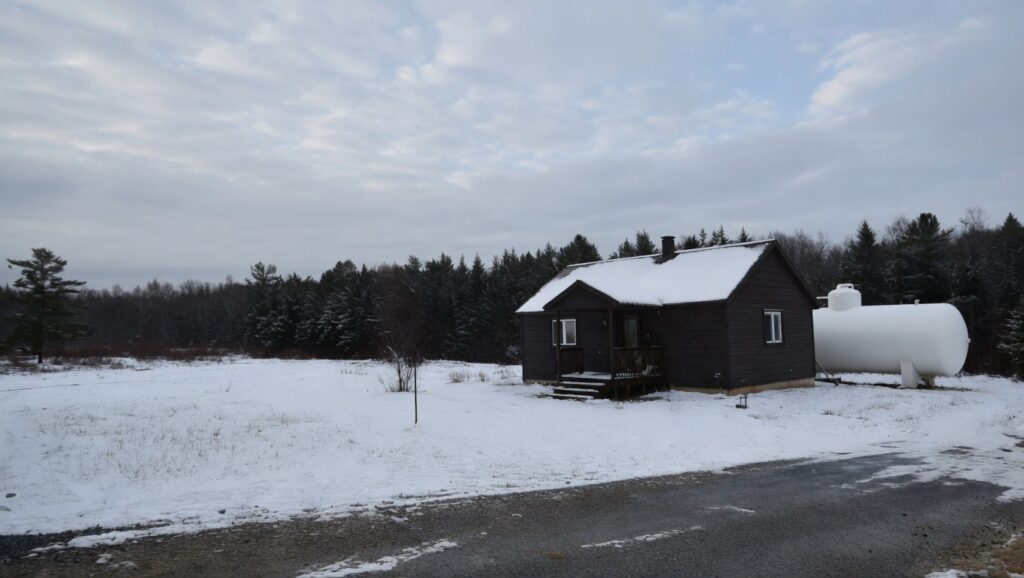
The most common Ontario off grid propane mistake is treating propane as a backup fuel rather than a primary heat fuel, and a property owner on Eramosa Road in Guelph, Wellington County discovered this when he tried to run his cooking, hot water, and supplemental electric space heating on his Tier 2 battery bank through the fall of 2022 and his Victron SmartShunt recorded evening battery depletion to the BMS protection threshold every day from October through December because the combined electric heat loads exceeded the 510Wh daily production available from his 400W array in Ontario November conditions.
He had correctly specified the solar system for intelligent loads: LED lighting at 30W, a chest freezer at 45W, a router at 10W, and phone charging at 15W. Those intelligent loads totalled approximately 100W continuous and were well within the Tier 2 system budget. The induction cooktop at 1,800W, the electric on-demand water heater at 6,000W, and the electric baseboard heater at 1,500W were collectively drawing more energy per day than the entire array could produce in October.
I reviewed his SmartShunt history in December 2022. The pattern was consistent: battery bank at 100% SoC at 8:00 AM after overnight recovery, dropping to the BMS protection threshold by 8:00 PM after a full day of heat load draws. The 400W array was producing correctly. The intelligent loads were within budget. The heat loads were consuming everything the system produced and then drawing down the reserve. The fix required one decision: move all heat loads from the battery bank to an off grid propane system.
The off grid propane conversion required three changes: a propane range to replace the induction cooktop, a propane on-demand water heater to replace the electric unit, and a propane space heater to replace the electric baseboard. All three required a TSSA G2 licensed technician for installation under the Ontario Technical Standards and Safety Act. After installation, the SmartShunt reading during evening meal preparation: zero amps. The Battle Born LFP bank reached 100% SoC every clear day by early afternoon and held that charge through the evening. See our Ontario solar sizing guide before specifying any off grid propane system.
The off grid propane rule: heat loads belong on propane, intelligent loads belong on the battery bank
| Load type | Appliance | Draw | SmartShunt reading | Correct fuel |
|---|---|---|---|---|
| Heat | Induction cooktop | 1,800W | 150A at 12V | Switch to propane range |
| Heat | Electric water heater | 6,000W | 500A at 12V | Switch to propane on-demand |
| Heat | Electric baseboard | 1,500W | 125A at 12V | Switch to propane heater |
| Heat | Propane range | 0 to 1W igniter | 0 to 1A | Correct specification ✓ |
| Intelligence | LED lighting | 25 to 30W | 2 to 3A | Battery bank ✓ |
| Intelligence | Chest freezer | 45W average | 3 to 4A running | Battery bank ✓ |
| Intelligence | Router, phone charging | 25W | 2A | Battery bank ✓ |
The rule that governs every Ontario off-grid system: off grid propane handles all heat loads, the battery handles all intelligent loads. Heat loads (cooking, hot water, space heating) are resistive energy consumers that draw hundreds to thousands of watts continuously. Intelligent loads (lighting, refrigeration, communications, controls) draw tens of watts and are the correct application for a Tier 2 battery bank. An Ontario January Tier 2 system produces 510Wh per clear day. A single 1,800W induction cooktop running for 2 hours consumes 3,600Wh, more than the entire daily production. The same cooking done on a propane range consumes 0 to 1W from the battery bank for the igniter spark.
The Victron SmartShunt makes the off grid propane advantage concrete. When you turn on the propane range and check the SmartShunt, the reading does not change, 0 to 1A for the igniter, then back to the baseline intelligent load draw. When the Guelph system ran the induction cooktop, the SmartShunt showed 150A at 12V (approximately 1,800W) during every active heating phase. That 150A draw was consuming the entire 200Ah Battle Born LFP bank in approximately 1 hour of continuous use. Switching to off grid propane made that 150A draw disappear from the SmartShunt reading permanently. See our off grid appliances guide for the complete Ontario Tier 2 appliance specification.
TSSA G2: Ontario law for all propane appliance installations
All propane appliance installations in Ontario, including propane range connections, propane on-demand water heater installations, propane furnace hookups, regulator installations, and tank connections, must be performed by a TSSA G2 licensed technician. This is a legal requirement under the Ontario Technical Standards and Safety Act. DIY propane installation is illegal in Ontario regardless of the property owner’s technical experience. An illegally installed off grid propane system invalidates property insurance coverage for any fire, explosion, or carbon monoxide incident. Verify a technician’s G2 license at tssa.org before authorizing any off grid propane installation work.
A property owner in Erin Township, Wellington County included the TSSA G2 installation cost in the off grid propane system budget from day one: approximately $2,400 total for three appliances (range, on-demand water heater, furnace) and the 1,000L tank placement. This represented approximately 50% of the total off grid propane installation cost, the other 50% was the appliances and the tank. The TSSA G2 technician tested all connections with leak detection fluid before commissioning, filed the required inspection paperwork, and confirmed the regulator pressure was correct for the appliance ratings. The $2,400 installation cost covered all of this and was not a surprise line item.
Ontario off-grid propane consumption: cooking, hot water, and space heating estimates
Ontario off grid propane consumption for a family of 4: cooking (propane range) approximately 1.5L per day, based on approximately 0.42L per hour at medium heat and approximately 3.5 hours of daily cooking across all meals. Hot water (propane on-demand water heater) approximately 7L per day, based on 1.8L per person per day for showers, dishwashing, and hand washing. Space heating (propane furnace or heater) is variable and insulation-dependent, a well-insulated Wellington County off-grid cabin at R-40 walls and R-60 ceiling may consume 10 to 30L per day during January.
Total non-heating off grid propane consumption (cooking plus hot water): approximately 8.5L per day for a family of 4.
The tank sizing follows directly from the consumption estimate. A 100L portable tank holds approximately 50L of usable off grid propane, approximately 6 days of cooking and hot water only. A 420L standard tank holds approximately 210L, approximately 25 days. A 1,000L bulk tank holds approximately 500L, approximately 59 days of cooking and hot water, or approximately 2 months between deliveries for non-heating use. Space heating adds significantly to these estimates: a full-time Wellington County off grid propane system typically requires a 1,000L bulk tank with scheduled deliveries every 4 to 8 weeks during heating season. See our solar water heater ontario guide for the propane on-demand hot water specification.
Pro Tip: Before your first winter with an off grid propane system, schedule a pre-season delivery in late October to fill the tank to capacity. Wellington County and Halton Hills propane suppliers can be booked 2 to 4 weeks in advance in fall, but same-week emergency deliveries in January can cost 15 to 25% more per litre and are not always available during severe weather. A 1,000L tank filled in late October at approximately 500L of usable off grid propane covers approximately 59 days of cooking and hot water without any winter delivery required. Add the space heating estimate for your specific building envelope to calculate whether a mid-winter top-up is needed. The Erin Township property owner scheduled two deliveries for the first winter: October fill and a February top-up. Total off grid propane cost for year one: approximately $480 for cooking and hot water alone at 2023 Wellington County propane rates.
Ontario off grid propane tank sizing: 100L portable, 420L standard, and 1,000L bulk
The 100L portable off grid propane tank holds approximately 50L of usable propane and can be transported to a refill station. For a family of 4 using 8.5L per day for cooking and hot water, a 100L tank provides approximately 6 days of supply. Transporting a 100L propane cylinder for refilling in January conditions is physically demanding and impractical for full-time off-grid properties. The 100L portable tank is correct for seasonal cabins and temporary backup applications, not for a full-time off grid propane system in Wellington County or Halton Hills.
The 420L standard off grid propane tank holds approximately 210L of usable propane, approximately 25 days of cooking and hot water for a family of 4. It is typically provided under a rental contract with a local propane supplier and delivered with the first fill. For full-time off-grid residences in Wellington County and Halton Hills, the 1,000L bulk off grid propane tank (approximately 500L usable, approximately 59 days of cooking and hot water) is the correct specification, it reduces the number of winter delivery visits and ensures supply during periods when road conditions make deliveries unpredictable.
The Erin Township property owner: 1,000L bulk tank installed fall 2022, two deliveries first winter, SmartShunt evening reading 0 to 1A all winter, battery bank at 80% SoC or above at 8:00 PM on every clear day. See our off grid costs guide for the complete off grid propane system cost breakdown.
NEC, CEC, and TSSA: Ontario permit requirements for off-grid propane systems
NEC 690 and CEC Section 64 govern the electrical components of any Ontario off grid propane appliance installation. Any hardwired electrical connection to a propane appliance, including igniter wiring, thermostat connections, and control circuit wiring, constitutes a permanent electrical installation requiring an ESA permit at $300 to $400 before work begins. A propane range with a hardwired 120V connection requires an ESA permit for the electrical circuit. A propane on-demand water heater with a hardwired thermostat connection requires an ESA permit for that connection. Contact the NFPA at nfpa.org and the Electrical Safety Authority Ontario at esasafe.com before beginning any off grid propane appliance wiring.
All propane work, including appliance installation, line connection, regulator installation, tank placement, and pressure testing, is governed by the Ontario Technical Standards and Safety Act and requires a TSSA G2 licensed technician. Contact the TSSA at tssa.org to verify any technician’s G2 license before authorizing off grid propane installation work. Installing propane appliances without a TSSA G2 licensed technician is illegal in Ontario and invalidates property insurance coverage for any propane-related incident. This requirement applies equally to portable 100L tanks connected with flexible hose and permanently piped 1,000L bulk systems.
The off grid propane Ontario verdict: TSSA installation, 1,000L bulk for full-time, SmartShunt confirms zero amps
- Ontario property owner experiencing evening battery depletion on an existing Tier 2 or Tier 3 system: check the SmartShunt history for high-amp draws during evening hours before replacing any solar component. If the SmartShunt shows 80A or above during cooking or hot water use, those loads are off grid propane conversion candidates. The Eramosa Road Guelph result: 150A during induction cooktop use converted to 0 to 1A after propane range installation by TSSA G2 licensed technician. SmartShunt confirmed battery bank holding 100% SoC through the evening on clear days after the off grid propane conversion. TSSA G2 installation required for all three appliance changes.
- Ontario property owner specifying a new full-time off-grid property: specify the off grid propane system before sizing the solar system, because the appliance list determines the tier. Cooking (1.5L per day), hot water (7L per day), and space heating (variable) all belong on off grid propane. The solar system is then sized only for intelligent loads at approximately 100 to 150W continuous, producing a correct Tier 2 system: 400W array, 200Ah Battle Born LFP, Victron MPPT 100/30, and SmartShunt. Install a 1,000L bulk off grid propane tank with TSSA G2 installation for full-time use. The Erin Township result: SmartShunt evening reading 0 to 1A all winter, bank at 80% SoC or above every clear evening.
- Ontario property owner asking whether a propane generator is the correct off grid propane backup for multi-day gray streaks: yes, for properties with an existing 1,000L bulk tank. The generator runs from the same 1,000L bulk off grid propane system, requires no separate fuel storage, and the SmartShunt confirms exactly when the battery bank needs a generator top-up. A propane generator connected to a TSSA G2 installed line is the most practical gray-streak backup for Wellington County properties. Budget approximately 5 to 10L of propane per hour of generator operation at the 2,000W to 3,500W generator size appropriate for a Tier 2 system top-up cycle.
Frequently Asked Questions
Q: Do I need a TSSA G2 technician to install propane appliances off-grid in Ontario?
A: Yes, without exception. All propane appliance installations in Ontario, including propane range connections, on-demand water heater hookups, furnace connections, regulator installations, and tank connections, must be performed by a TSSA G2 licensed technician under the Ontario Technical Standards and Safety Act. DIY off grid propane installation is illegal in Ontario and invalidates property insurance coverage for any fire, explosion, or carbon monoxide incident arising from the installation. The $2,400 TSSA G2 installation cost for the Erin Township three-appliance off grid propane system was approximately 50% of the total system cost and covered all connection work, pressure testing, inspection paperwork, and commissioning. Verify any technician’s G2 license at tssa.org before authorizing any work.
Q: How much propane does a family of 4 use per day off-grid in Ontario?
A: For cooking and hot water combined, approximately 8.5L per day: cooking (propane range) approximately 1.5L per day based on approximately 0.42L per hour at medium heat and approximately 3.5 hours of daily cooking, and hot water (propane on-demand water heater) approximately 7L per day based on 1.8L per person per day. Space heating consumption is variable and insulation-dependent, a well-insulated Wellington County cabin at R-40 walls and R-60 ceiling may consume 10 to 30L per day during January.
A 1,000L bulk off grid propane tank (approximately 500L usable) provides approximately 59 days of cooking and hot water without space heating, or approximately 4 to 6 weeks of all-in off grid propane use including moderate space heating during a standard Ontario winter.
Q: What size propane tank is best for an Ontario off-grid property?
A: For full-time off-grid residences in Wellington County and Halton Hills, the 1,000L bulk tank is the correct off grid propane specification. It holds approximately 500L of usable propane, provides approximately 59 days of cooking and hot water for a family of 4, and allows scheduled deliveries every 4 to 8 weeks during heating season rather than emergency winter refills. The 420L standard tank (approximately 210L usable, approximately 25 days of cooking and hot water) is correct for Tier 2 retreat cabins used primarily on weekends.
The 100L portable tank is only appropriate for seasonal or backup use, transporting it for refilling in January Wellington County conditions is impractical for any property where the off grid propane system is the primary heat fuel.
This build is engineered within the 48V DC Safety Ceiling. Diagnostic logic is based on 20+ years of technical service experience. All structural and electrical installations must be verified by a Licensed Professional and comply with your Local AHJ. See our legal and safety disclosure for full scope.
About the Author
Robert Bertrand spent 20 years as a service advisor in the automotive industry (Lexus and Nissan), where precision diagnostics, wiring integrity, and documentation standards were non-negotiable. He brings that same technical discipline to GridFree Guide, where he researches, tests, and documents off-grid solar systems for Ontario conditions. Based in Rockwood, Ontario, every article is built on verified specifications, manufacturer data, and the real-world climate constraints of Canadian off-grid living.
As an Amazon Associate I earn from qualifying purchases. This site also contains affiliate links to other products and services. GridFree Guide earns a small commission at no extra cost to you.