
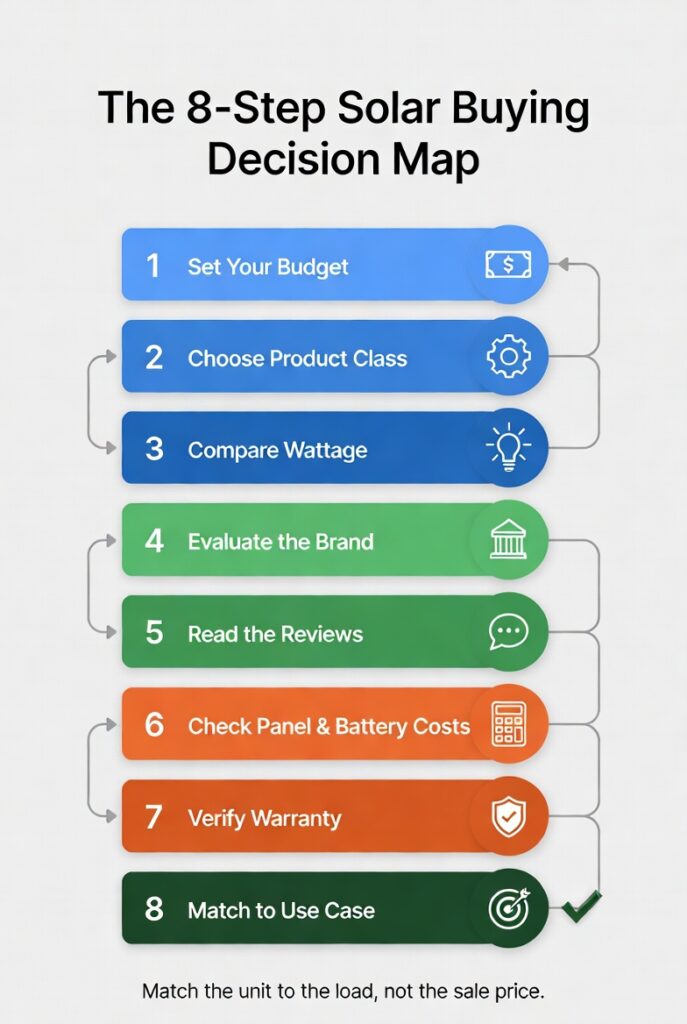
The Solar Buyers Guide Decision Map and Why Budget Comes Before Brand
This solar buyers guide covers every purchasing decision from budget to brand to warranty because spending $2,000 on the wrong unit costs more than spending $900 on the right one. Eight steps in a specific order. Budget narrows your options. Wattage class determines what appliances you can run. Brand determines whether you can expand later. Reviews confirm whether the unit performs in Ontario conditions, not just Arizona sunshine.
A homeowner in Rockwood followed these 8 steps and saved $2,300 by matching the unit to his actual loads instead of buying the most expensive option on YouTube. A homeowner in Milton skipped the steps, bought on Black Friday, and spent $1,800 on two incompatible units instead of $900 on one correctly sized unit. The difference was not luck. It was process.
This solar buyers guide is the master decision map for the entire Buyers Guide category. Each section covers one purchasing decision and links to the detailed guide or review. Follow the steps in order and you will buy the right product at the right price the first time. For a broader system overview, see our solar generator Ontario guide.
Budget Tiers and Product Class Selection for Ontario Buyers
Step 1 is setting your budget tier. Under $500 covers emergency backup for phones, CPAP, and LED lights. The $500 to $1,500 range handles a fridge, lights, and Starlink for 24 to 48 hours. The $1,500 to $3,000 range supports multi-day backup with expansion capability. Over $3,000 is whole-home backup with split-phase 240V and extended runtime. Each tier has a different recommended product class. For the entry-level options, see our budget solar generator guide.
Step 2 is choosing your product class. Portable power stations are all-in-one boxes ready out of the carton. Solar panel kits include a panel, controller, and cables for a DIY build. Battery bank components are individual cells, BMS, and wiring for custom builds. Complete system packages include everything for a specific tier. Most Ontario beginners should start with a portable power station because it requires zero wiring knowledge. For mid-range options, see our 1000W solar generator comparison and our best small solar generator guide.
The Solar Buyers Guide for Wattage Class Comparison and Brand Evaluation
Step 3 is comparing by wattage class. The 500W class covers CPAP and phone charging for $300 to $500. The 1000W class handles a fridge and lights for $800 to $1,200. The 2000W class runs a workshop and multiple appliances for $1,800 to $2,500. The 3000W class supports whole-home backup with a well pump for $3,500 to $5,000. For the complete comparisons, see our 500W comparison, our 1000W comparison, our 2000W guide, and our 3000W guide.
Step 4 is evaluating the brand. EcoFlow offers the best ecosystem with the most expansion options and app integration. Bluetti provides the best value at the 2000W level with direct MC4 solar input. Jackery has the simplest interface for non-technical users. Anker charges the fastest with 49-minute wall recharge on the C1000. Each brand locks you into their expansion ecosystem. Buying a Bluetti unit means Bluetti expansion batteries only. For the head-to-head comparison, see our Jackery vs EcoFlow comparison.
Product Reviews, Panel and Battery Costs, and Warranty Verification
Step 5 is reading individual product reviews with real Ontario performance data. The Anker SOLIX C1000 at $900 is the best mid-range with UPS mode and the fastest wall recharge. The Bluetti AC200L at $2,200 is the best value at the 2000W level with 2,048Wh and direct MC4 input. The EcoFlow DELTA Pro 3 at $4,500 is the best whole-home option with 4,096Wh and 240V split-phase capability. For full reviews, see our Anker SOLIX C1000 review, our Bluetti AC200L review, and our EcoFlow review.
Step 6 is checking panel and battery costs. 100W panels range from $120 to $200 CAD. 200W panels range from $200 to $350. 400W panels range from $350 to $500. LFP batteries cost $400 to $1,100 per 100Ah. AGM batteries cost $150 to $300 per 100Ah. A Renogy 100W Starter Kit at $200 is the best entry point for a DIY panel setup. For the complete cost breakdowns, see our solar panel cost guide and our solar battery cost guide. Step 7 is verifying warranty and support. All four major brands now offer 5-year warranties on current LFP models. No Ontario service centers exist. All claims ship cross-border to US distribution centers. For the complete warranty comparison, see our solar generator warranty guide.
The Rockwood Research-First Win
A homeowner in Rockwood followed this solar buyers guide before purchasing. He calculated his critical loads at 2,200Wh per day. He compared the 1000W class, 2000W class, and 3000W class options. He read the brand reviews and checked warranty coverage for cross-border claims from Ontario.
His research showed that a Bluetti AC200L at $2,200 CAD with 2,048Wh covered his loads with 25 percent headroom. He originally planned to buy an EcoFlow DELTA Pro 3 at $4,500 CAD because a YouTube reviewer called it the best. The AC200L handled his fridge, CPAP, and Starlink for 22 hours on a single charge. He saved $2,300 by matching the unit to his actual loads instead of buying the most expensive option.
Buying solar equipment without calculating your loads first is like buying a 3/4-ton truck to commute to work. The truck can do it. But a mid-size sedan does the same job at half the fuel cost and half the purchase price. This solar buyers guide matches the unit to the load, not the marketing. The $2,300 he saved bought 400W of solar panels and a 5-year supply of propane.
The Milton Impulse Buy Regret
A homeowner in Milton bought a solar generator on Black Friday because the deal was 40 percent off the regular price. He did not calculate his loads. He did not check the brand’s expansion ecosystem. He did not verify the warranty terms for Canadian buyers.
The unit was a 500W class power station from a brand with no expansion batteries. His fridge drew 80W average, which drained the 500Wh battery in 6 hours. He needed 24-hour runtime but had 6 hours. He could not add expansion batteries because the brand did not make them. He bought a second unit from a different brand 3 months later, spending $1,800 total for two incompatible units instead of $900 for one correctly sized Anker SOLIX C1000.
Buying a solar generator because it is on sale is like buying a car because the paint colour is right. The paint does not determine whether the car fits your family. The capacity, the expansion options, and the warranty determine whether the solar generator fits your household. Following this solar buyers guide through steps 1 to 4 before Black Friday would have saved him $900 and the frustration of owning two incompatible units.
The Solar Buyers Guide Verdict and Matching the Unit to Your Ontario Use Case
Step 8 is matching the unit to your specific use case. Emergency backup users need a Anker SOLIX C1000 at $900 with UPS mode. Weekend cottage users need a Bluetti AC200L at $2,200 with 400W+ of panels. Daily off-grid users need an EcoFlow DELTA Pro 3 at $4,500. RV and camping users need a Jackery Explorer 300 Plus at $400. Each use case has a different correct answer.
This solar buyers guide connects to every other decision on GridFree Guide. For backup power strategy, see our backup power guide. For beginners starting from zero, see our beginner solar guide. For panel selection, see our solar panel guide.
Frequently Asked Questions
Q: What is the best solar generator for Ontario?
A: There is no single best because it depends on your loads and use case. The Anker SOLIX C1000 at $900 is the best mid-range for emergency backup with UPS mode. The Bluetti AC200L at $2,200 is the best value for multi-day cottage use. The EcoFlow DELTA Pro 3 at $4,500 is the best for whole-home backup.
Q: Should I buy on sale or wait for the right unit?
A: Never buy a solar generator because it is on sale without calculating your loads first. A 40 percent discount on the wrong unit still wastes 100 percent of the purchase price. Use this solar buyers guide to identify the right product, then wait for a sale on that specific unit.
Q: Is it better to buy one large unit or two smaller ones?
A: One correctly sized unit is always better because it has a single BMS, single inverter, and single charging system. Two smaller units from different brands cannot share batteries or combine output. The only exception is if you need portable backup in two locations simultaneously like a home and an RV.
NEC Article 702 covers optional standby systems including consumer portable power equipment safety and installation requirements. All backup power equipment must carry UL or CSA certification for residential use. Current standards are published at nfpa.org.
CEC Section 64 governs consumer electrical equipment safety certification and warranty disclosure requirements in Ontario. All portable power equipment must comply with ESA guidelines for residential indoor use. The Electrical Safety Authority (ESA) provides current compliance guidelines at esasafe.com.
This build is engineered within the 48V DC Safety Ceiling. Diagnostic logic is based on 20+ years of technical service experience. All structural and electrical installations must be verified by a Licensed Professional and comply with your Local AHJ. See our legal and safety disclosure for full scope.
About the Author
Robert Bertrand spent 20 years as a service advisor in the automotive industry (Lexus and Nissan), where precision diagnostics, wiring integrity, and documentation standards were non-negotiable. He brings that same technical discipline to GridFree Guide, where he researches, tests, and documents off-grid solar systems for Ontario conditions. Based in Rockwood, Ontario, every article is built on verified specifications, manufacturer data, and the real-world climate constraints of Canadian off-grid living.
As an Amazon Associate I earn from qualifying purchases. This site also contains affiliate links to other products and services. GridFree Guide earns a small commission at no extra cost to you.