
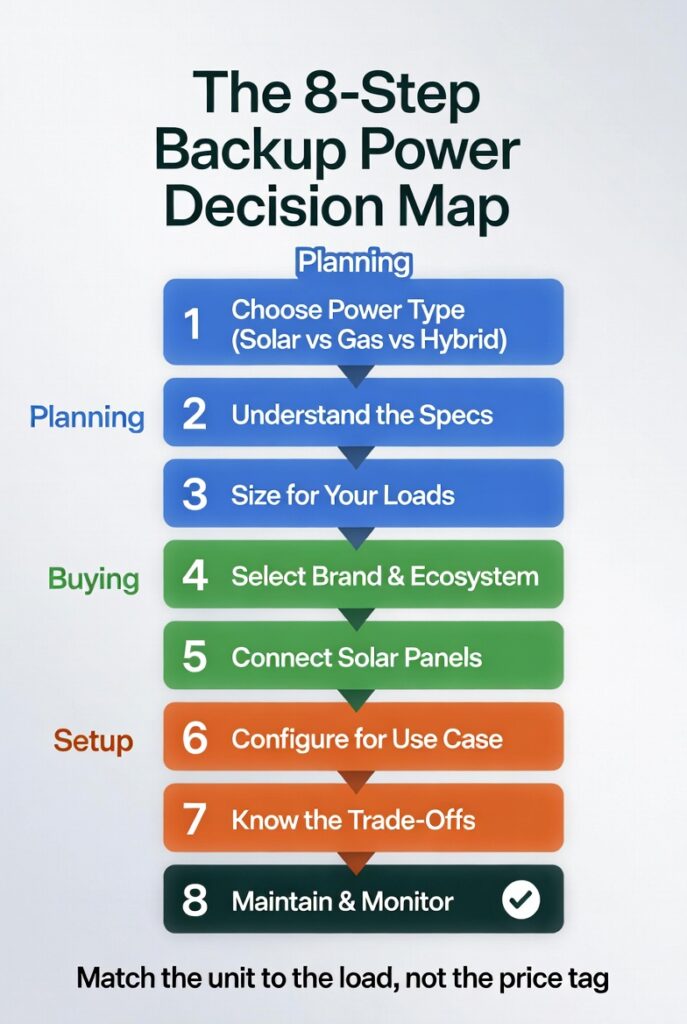
The Backup Power Guide Decision Map and Why Power Type Comes First
This backup power guide covers every decision from power type selection to long-term maintenance because choosing the wrong backup system wastes $1,000 to $4,500 and leaves your family without power when it matters most. Eight steps in a specific order. Each step depends on the previous one. Buying a unit before understanding the specs and sizing for your loads is the most expensive mistake in backup power.
The wrong choice shows up during the outage, not during the purchase. A $400 unit that cannot run your sump pump provides zero backup power during the storm that floods your basement. A $4,500 unit that sits uncharged in the garage because nobody checked it in 6 months provides zero backup power during the ice storm that knocks out your CPAP. The right choice requires 30 minutes of planning before the purchase and 5 minutes of maintenance every 90 days after.
This backup power guide is the master map for the entire Generators & Backup Power category. Each section summarizes a critical decision and links to the full detailed guide. Follow the 8 steps in order and you will buy the right unit at the right price for your specific household. For a broader system overview, see our solar generator Ontario guide.
Power Type Selection and Understanding the Specs That Determine Runtime
Step 1 is choosing your power type. Solar generators are indoor-safe, silent at 30 to 40 dB, and require zero maintenance. Gas generators offer unlimited runtime as long as you have fuel but produce carbon monoxide and operate at 70+ dB. The hybrid approach uses a solar generator for the first 24 to 36 hours and a propane generator for extended outages beyond battery capacity. For Ontario ice storms that last 3 to 5 days, the hybrid approach wins. For the full comparison, see our solar generator vs gas generator guide.
Step 2 is understanding the specs. Watts and watt-hours are different measurements. Watts determine the maximum continuous output. Watt-hours determine how long that output lasts. A 2,000W generator with 1,000Wh of battery runs a 500W load for 2 hours, not 4. Surge watts determine which appliances you can start. A fridge draws 80W continuous but needs a 1,500W surge to start the compressor. For the complete explanation, see our solar generator watt-hour guide and our solar generator surge wattage guide.
The Backup Power Guide for Sizing, Brand Selection, and Panel Connection
Step 3 is sizing for your critical loads. List every appliance you need during an outage. Multiply each appliance’s watts by the hours you need it to run. Add the totals. A fridge at 80W for 24 hours needs 1,920Wh. A CPAP at 30W for 8 hours needs 240Wh. Phones at 10W for 4 hours need 40Wh. Total: 2,200Wh minimum. Add 25 percent headroom and buy a unit with at least 2,750Wh. For medical device sizing, see our solar generator for CPAP guide.
Step 4 is brand and ecosystem selection. EcoFlow, Bluetti, Jackery, and Anker each have different expansion options, app ecosystems, and warranty terms. Some brands lock you into their proprietary expansion batteries. Others accept universal solar panels. Warranty coverage is now 5 years across all four major brands on current LFP models. For the full brand comparison, see our solar generator brand guide and our solar generator warranty guide. Step 5 is connecting solar panels for recharging. Each brand uses a different input connector. MC4 adapters bridge the gap. Always verify polarity with a multimeter and check voltage for cold weather before connecting. For the complete connection guide, see our connect solar panel guide.
Use Case Configuration and the Honest Trade-Offs
Step 6 is configuring the unit for your specific use case. A CPAP user needs UPS mode with 20ms automatic switchover so the machine never stops during a power failure. A Starlink user needs the same UPS protection to avoid 5-minute reboot cycles. A camper needs lightweight portability under 30 lbs. An elderly parent needs one-button operation with labeled outlets. Each use case has a different recommended unit. For the detailed guides, see our solar generator UPS guide, our solar generator elderly guide, and our solar generator camping guide.
Step 7 is understanding the honest trade-offs. Solar generators offer indoor safety, silent operation, zero maintenance, push-button start, solar recharging, LFP longevity, and portability. The cons are finite capacity, expensive upfront cost, slow winter recharging at 1.5 PSH in January, inability to run space heaters for more than 70 minutes, heavy large units, no expansion on some brands, and uselessness without pre-charging. For the complete breakdown, see our solar generator pros and cons guide. For wiring context, see our off-grid electrical wiring guide. For battery bank builds, see our solar battery guide.
The Rockwood Hybrid Success
A homeowner in Rockwood followed this backup power guide and chose a hybrid approach. He bought a Bluetti AC200L for indoor silent power and kept his existing propane generator for extended outages. He connected 400W of solar panels for daytime recharging. He stored the AC200L in his kitchen closet at 60 percent SoC and checked it every 90 days.
During a 4-day ice storm in January, he ran his fridge, CPAP, phones, and LED lights on the AC200L for the first 36 hours without touching the propane generator. The solar panels recovered 600Wh on day 2 during a brief sunny break. On day 3 when the battery hit 15 percent, he started the propane generator outside and recharged the AC200L to 100 percent in 4 hours via the AC input. He used 2 gallons of propane for the entire 4-day outage compared to his neighbor who burned 15 gallons running a gas generator continuously.
A hybrid backup power system is like a plug-in hybrid vehicle. You run on electric for daily driving and switch to gas for the long highway trip. The electric covers 90 percent of your needs silently and cheaply. The gas engine is the safety net for the 10 percent that exceeds battery range. This backup power guide recommends the hybrid approach for any Ontario household that experiences multi-day outages.
The Milton Undersized Purchase
A client in Milton bought a Jackery Explorer 300 Plus as his only backup power because the price was $400 and the reviews were positive. He did not calculate his critical loads before purchasing. His fridge draws 80W average. His sump pump draws 800W during startup with a 1,500W surge.
During a summer storm, his sump pump tripped the 300W inverter immediately on startup because the surge exceeded the unit’s capacity. He unplugged the sump pump and connected the fridge instead. The 288Wh battery ran the fridge for 3.5 hours before dying. His basement flooded because the sump pump never ran, and his fridge contents spoiled 4 hours into a 12-hour outage. A $400 unit that cannot run either of your two critical loads provides zero backup power.
Buying a 288Wh unit for a house with a sump pump and full-size fridge is like buying a compact car to tow a boat. The car is a fine vehicle. It is the wrong vehicle for the job. Following this backup power guide through step 2 and step 3 would have shown him that he needed a minimum of 2,000Wh with 1,800W+ continuous output. The right answer was an Anker SOLIX C1000 at $900, not the cheapest box on the shelf at $400.
The Backup Power Guide Verdict on Maintenance and Long-Term Ownership
Step 8 is maintenance and long-term ownership. Store your unit at 50 to 60 percent SoC when not in active use. Check the charge level every 90 days to prevent BMS lockout from self-discharge. LFP batteries last 3,000 to 3,500 cycles, providing 8 to 10 years of daily use, 30+ years for weekend cottage use, and functionally indefinite life for emergency-only use. For the complete maintenance protocol, see our solar generator maintenance guide.
The backup power guide ends where it begins: with the right choice for your specific household. Match the unit to the load, not the price tag. A $900 EcoFlow DELTA Pro 3 that runs your fridge for 48 hours is worth more than a $400 unit that dies in 3.5 hours. For the complete lifespan analysis, see our solar generator lifespan guide.
Frequently Asked Questions
Q: Should I buy a solar generator or a gas generator?
A: Solar for indoor use and outages under 48 hours because it is silent and produces zero CO. Gas for multi-day outages where unlimited runtime matters more than noise and fumes. The hybrid approach using both is the strongest answer for Ontario ice storms.
Q: What size backup power do I need for my house?
A: List your critical loads in watts and multiply by the hours you need coverage. A fridge at 80W for 24 hours needs 1,920Wh and a CPAP at 30W for 8 hours needs 240Wh. Add your loads together and buy a unit with at least 25 percent more capacity than your calculated total.
Q: How often should I check my backup power unit?
A: Check the state of charge every 90 days if the unit is in storage. Run a load test once per year to verify the inverter and battery are performing correctly. Update firmware through the manufacturer app whenever updates are available.
NEC Article 702 covers optional standby power systems including portable and permanent backup power equipment for residential use. All standby systems must comply with applicable installation, grounding, and overcurrent protection requirements. Current standards are published at nfpa.org.
CEC Section 64 governs emergency and standby power system requirements in Ontario. All backup power equipment must comply with ESA guidelines for safe residential installation and operation. The Electrical Safety Authority (ESA) provides current compliance guidelines at esasafe.com.
This build is engineered within the 48V DC Safety Ceiling. Diagnostic logic is based on 20+ years of technical service experience. All structural and electrical installations must be verified by a Licensed Professional and comply with your Local AHJ. See our legal and safety disclosure for full scope.
About the Author
Robert Bertrand spent 20 years as a service advisor in the automotive industry (Lexus and Nissan), where precision diagnostics, wiring integrity, and documentation standards were non-negotiable. He brings that same technical discipline to GridFree Guide, where he researches, tests, and documents off-grid solar systems for Ontario conditions. Based in Rockwood, Ontario, every article is built on verified specifications, manufacturer data, and the real-world climate constraints of Canadian off-grid living.
As an Amazon Associate I earn from qualifying purchases. This site also contains affiliate links to other products and services. GridFree Guide earns a small commission at no extra cost to you.