
Solar Generator for CPAP and Why the Humidifier Decides Everything
Choosing the right solar generator for cpap backup is a medical-grade decision because running out of power at 3:00 AM is not an inconvenience but a health risk. A CPAP motor draws 6W to 9W on its own. The heated humidifier draws 45W to 55W. That single setting changes runtime from 4 nights to 5 hours on the same battery.
The formula is straightforward. Runtime hours equals battery capacity in Wh multiplied by 0.85, divided by device wattage. The 0.85 factor accounts for inverter efficiency loss. A 1,000Wh battery with the humidifier off will run a CPAP for approximately 13 nights. With the humidifier on at 50W, it drops to approximately 2 nights on the same battery.
Most people do not discover this variable until their unit shuts off in the middle of the night. The difference between a successful backup and a failed one is not the generator. It is the humidifier setting. This solar generator for cpap guide provides the exact runtime math for every size class so you can make the right decision before the power goes out. For a broader look at medical backup power, see our home medical solar guide.
CPAP Power Draw With and Without Heated Humidifier
The ResMed AirSense 10 draws 1.5W in sleep mode and up to 53W at maximum settings with heated humidifier and heated tube. The ResMed AirSense 11 draws 1.2W in sleep mode and up to 48W at maximum. On average, the motor alone draws 6W to 9W without the humidifier. With the heated humidifier and tube on full, the draw jumps to 45W to 55W.
The humidifier is the load. The air motor is not. Turning off the heated humidifier cuts power draw by 75 percent or more. For runtime calculations in this solar generator for cpap guide, we use 8W as the baseline for humidifier-off operation and 50W as the baseline for humidifier-on operation. Those two numbers drive every sizing recommendation that follows.
Solar Generator for CPAP Runtime Comparison by Size Class
The table below shows runtime at both draw levels across four common generator size classes. All calculations use the formula: (Wh x 0.85) divided by watts. The results assume continuous overnight CPAP use at 8 hours per night.
| Generator Size | Example Unit | Runtime at 8W (Nights) | Runtime at 50W (Nights) | Recommendation |
|---|---|---|---|---|
| 300Wh | Jackery 300 Plus | 4 nights | Partial night | Summer camping only |
| 750Wh | EcoFlow DELTA 2 | 10 nights | 1.5 nights | Weekend backup |
| 1,000Wh | Anker SOLIX C1000 | 13 nights | 2 nights | Ontario minimum |
| 2,000Wh | Bluetti AC200L | 26 nights | 4 nights | Full peace of mind |
The 300Wh class works for summer camping if you turn off the humidifier. The 1,000Wh class is the Ontario minimum because it survives a 3-day outage without solar input at 8W draw. The 2,000Wh class is the only option that provides multi-day coverage with the humidifier running. For help choosing between these unit types, see our best small solar generator guide.
The Ontario Winter Reliability Rule for CPAP Backup
Ice storms cause 72-hour or longer outages in rural Ontario. At 1.5 peak sun hours in January, a 500Wh unit cannot recharge fast enough to sustain multi-day CPAP use. A 100W solar panel at 1.5 PSH produces approximately 127Wh per day. That is not enough to offset a 50W overnight CPAP draw of 400Wh. The solar generator for cpap math does not work at the 500Wh level during Ontario winters.
The 1,000Wh class is the minimum because it survives a 3-day gray streak without needing any solar input if the humidifier is off. At 8W draw over 8 hours per night, three nights consume approximately 204Wh. That leaves over 600Wh of reserve capacity for phone charging, LED lights, and margin. For multi-day outages with the humidifier running, the 2,000Wh class is required. For more on winter solar output, see our cloudy weather solar output guide and emergency solar guide.
The Grey County Ice Storm Success
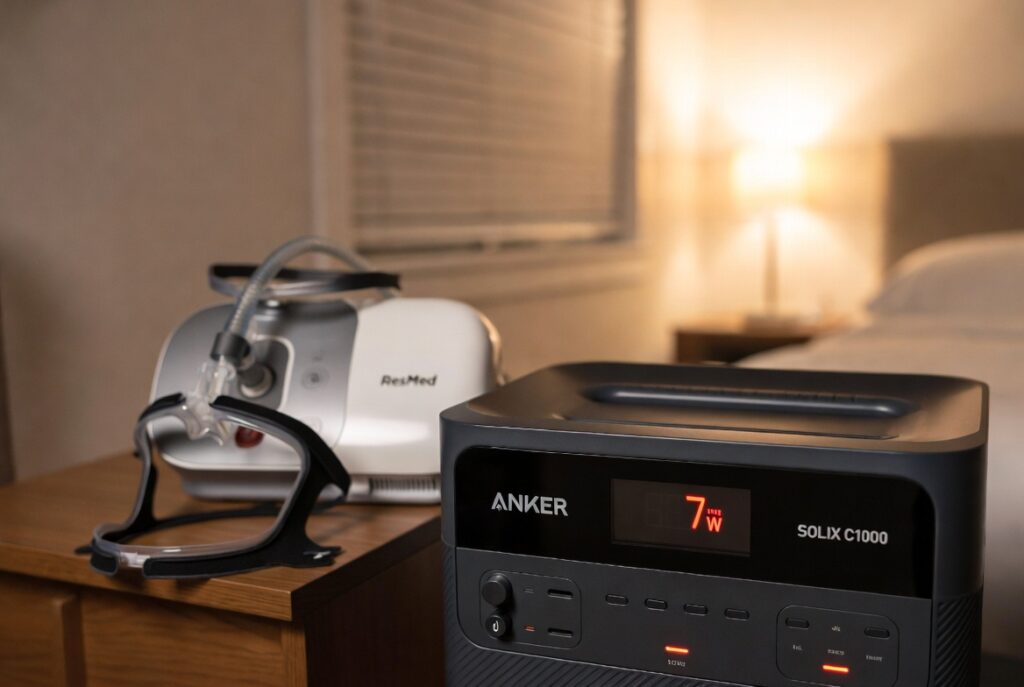
A client in Grey County used an Anker SOLIX C1000 to keep his ResMed AirSense 11 running during a 3-day power outage last March. Before the storm, he turned his heated humidifier setting to zero and switched to a standard unheated tube. He knew that the humidifier was the load, not the air motor. With the humidifier off, his ResMed pulled only 7W.
Over three nights totalling 24 hours of sleep, he used less than 20 percent of the C1000’s 1,056Wh capacity. The unit showed 168Wh consumed for 24 hours of continuous CPAP operation. He did not need to deploy his solar panels in the slush. He had enough remaining capacity to keep his phone charged and run a few LED lights until the hydro crews restored power.
By planning for the low-draw scenario, a single 1,000Wh solar generator for cpap provided more than enough runtime for a 3-day Ontario outage. The total cost of the backup was approximately $900 CAD for the Anker C1000. A single Battle Born 100Ah battery at $1,200 CAD would have provided similar capacity but required an inverter, wiring, and a charge controller. For CPAP-only backup, the all-in-one solar generator is the simpler and cheaper solution. For the full unit review, see our Anker SOLIX C1000 review.
The Haliburton Humidifier Failure
A camper in Haliburton tried to run his CPAP off a 300Wh portable unit while keeping his heated humidifier on maximum. He wanted the same comfort level he had at home. At 50W draw, his runtime math worked out to approximately 5 hours. He did not calculate this before leaving.
The unit hit zero percent charge at 3:15 AM. That was 5 hours into his sleep with approximately 3 hours remaining. Because the unit did not have a bypass mode, it did not just stop the heater. It shut off the air motor entirely, cutting all airflow to his mask.
He spent the rest of the night without CPAP therapy in a cold tent. The 300Wh unit was correctly sized for CPAP without humidifier at 8W draw, where it would have lasted 4 nights. The humidifier setting changed the runtime from 31 hours to 5 hours on the same battery. If you must have humidity while camping, you need at least a 1,000Wh solar generator for cpap to get through a full night at 50W draw with margin.
Solar Generator for CPAP Verdict and Which Size to Buy
This solar generator for cpap guide comes down to three buyer profiles. The right choice depends on your humidifier requirements, your outage risk, and your budget.
- Summer campers and short-trip users who can turn off the humidifier should start with a 300Wh unit. It handles 4 nights of CPAP at 8W draw. Keep it light and portable. Do not expect it to survive a full night with the humidifier on. Test it for one full night at home before relying on it in the field.
- Ontario home backup users preparing for ice storm outages should buy an Anker SOLIX C1000 at approximately $900 CAD. It provides 2 full nights with humidifier or 13 nights without. The 1,000Wh class is the minimum for Ontario winter reliability. For the full Ontario solar generator context, see our solar generator Ontario guide.
- Users who refuse to compromise on humidifier settings or need multi-day outage coverage should buy a Bluetti AC200L at approximately $2,200 CAD. It provides 4 nights with humidifier at full draw and 26 nights without. For extended outages, add a Renogy 100W panel for daytime recharge. For the full unit review, see our Bluetti AC200L review.
Frequently Asked Questions
Q: Can I use the DC car outlet instead of the AC plug on my solar generator?
A: Yes. Using a 12V or 24V DC converter for your CPAP is 15 to 20 percent more efficient because it bypasses the inverter conversion loss. Many ResMed and Philips units accept DC input directly with the right adapter. Check your CPAP manual for DC voltage compatibility before purchasing a converter.
Q: Will solar panels charge the generator while I use the CPAP?
A: Technically yes, but since CPAP is used at night, you will charge during the day and discharge at night. Ensure your solar panels can refill the battery in 4 to 5 hours of daylight. At 1.5 PSH in Ontario January, a 100W panel only produces approximately 127Wh, which is not enough to offset a 50W overnight draw of 400Wh.
Q: Are solar generators quiet enough to sleep next to?
A: Most high-quality units like the Anker C1000 and Bluetti AC200L have quiet modes where the fans are nearly silent at low draws like 8W to 50W. The fan typically only activates above 200W to 300W output. Test the unit for one full night before relying on it in an emergency to confirm the noise level is acceptable.
NEC Article 706 covers energy storage systems including portable battery stations used for medical equipment backup. All portable power station installations must comply with overcurrent protection and grounding standards published at nfpa.org for the current edition.
CEC Section 64 governs portable and stationary energy storage installations in Ontario. All medical backup power equipment must be CSA or UL certified. The Electrical Safety Authority (ESA) provides current standards and safe-use resources at esasafe.com.
This build is engineered within the 48V DC Safety Ceiling. Diagnostic logic is based on 20+ years of technical service experience. All structural and electrical installations must be verified by a Licensed Professional and comply with your Local AHJ. See our legal and safety disclosure for full scope.
About the Author
Robert Bertrand spent 20 years as a service advisor in the automotive industry (Lexus and Nissan), where precision diagnostics, wiring integrity, and documentation standards were non-negotiable. He brings that same technical discipline to GridFree Guide, where he researches, tests, and documents off-grid solar systems for Ontario conditions. Based in Rockwood, Ontario, every article is built on verified specifications, manufacturer data, and the real-world climate constraints of Canadian off-grid living.
As an Amazon Associate I earn from qualifying purchases. This site also contains affiliate links to other products and services. GridFree Guide earns a small commission at no extra cost to you.