
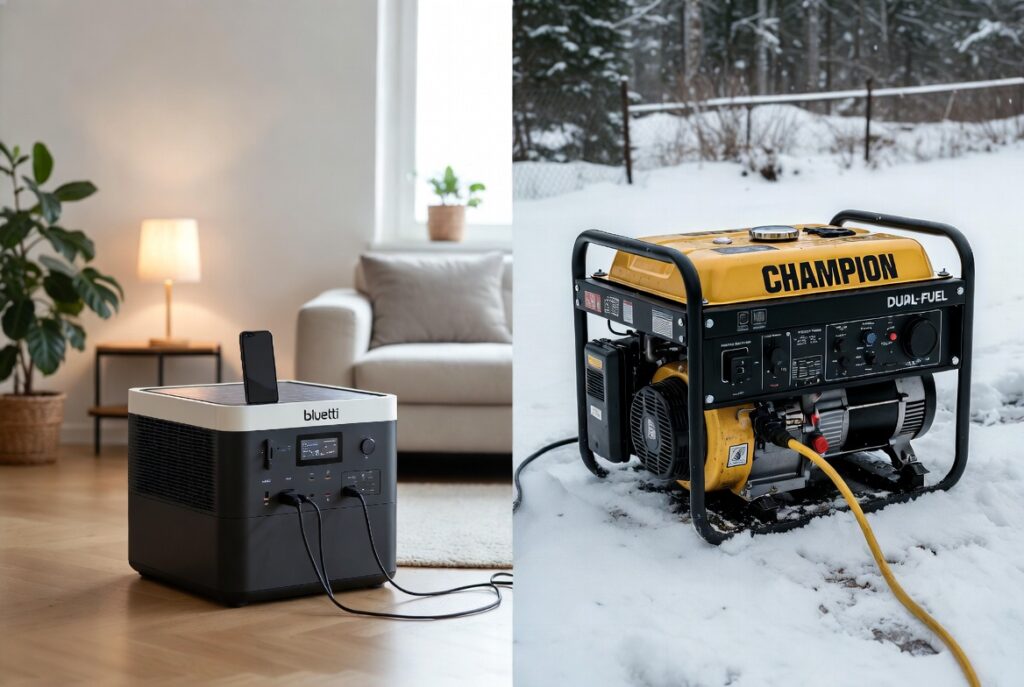
Solar Generator vs Gas Generator and Why Both Numbers Matter
The solar generator vs gas generator decision comes down to two numbers: how many watts you need and how many hours you need them. Gas generators win on sustained high-wattage output and cost per watt for heavy mechanical loads. Solar generators win on noise, maintenance, indoor safety, and long-term fuel cost. Neither tool replaces the other in every scenario.
A Honda EU2200i class gas unit runs 2,200W continuously for approximately $1,400 CAD upfront. Fuel costs $21 to $34 per 24-hour outage at 0.5 to 0.8 litres per hour. A Bluetti AC200L runs 2,400W with zero emissions for approximately $2,200 CAD upfront. The solar generator costs more to buy and less to run. The gas generator costs less to buy and more to run.
The real answer for most rural Ontario properties in 2026 is both. Solar handles daily essentials indoors in silence. Gas or propane handles the gray streak emergency and high-draw mechanical loads. This solar generator vs gas generator guide breaks down the exact numbers for each scenario. For a related comparison, see our solar generator versus battery bank comparison.
The Side-by-Side Comparison Table for 2026
The solar generator vs gas generator comparison becomes clear when you line up the specs side by side. Every advantage on one side comes with a trade-off on the other. No single unit wins every category.
| Feature | Gas/Propane Generator | Solar Generator (LFP) |
|---|---|---|
| Upfront Cost | $800 to $1,400 CAD | $900 to $4,500 CAD |
| Fuel Cost | Gas: $1.77/L, Propane: $1.26/L | Zero (solar) |
| Indoor Safe | NO (lethal CO) | YES (zero emissions) |
| Noise Level | 55 to 75 dB | 0 to 30 dB |
| Maintenance | Oil, plugs, fuel stabilizer | Zero |
| Runtime | Unlimited with fuel | Limited by battery and sun |
| Lifespan | 2,000 to 3,000 hours | 3,500+ cycles (10+ years) |
Gas generators are cheaper upfront and run indefinitely as long as fuel is available. Solar generators are silent, emission-free, and maintenance-free but limited by battery capacity and Ontario’s solar recharge reality. The table makes the trade-offs visible. The I-moments below make them real.
Solar Generator vs Gas Generator Fuel and Recharge Math for Ontario
Gas burns 0.5 to 0.8 litres per hour at $1.77 per litre in Ontario. A 24-hour outage costs $21 to $34 in gasoline. Propane at $1.26 per litre on a 20 lb tank provides approximately 14 hours of continuous runtime. Over a 72-hour ice storm, gas fuel costs total $63 to $102. Propane costs approximately $40 across two tank refills for the same period.
Solar recharge in January at 1.5 peak sun hours requires 800W of panels to refill 2,000Wh in a single day. If the gray streak lasts 4 days, the solar generator cannot recharge without AC wall power or generator input. That is the solar generator vs gas generator gap that matters most in Ontario. The solar unit is free to run but dependent on sun. The gas unit costs money to run but works in any weather. For more on seasonal output, see our cloudy weather solar output guide.
The Carbon Monoxide Rule and Why Gas Generators Cannot Come Inside
Gas and propane generators produce lethal carbon monoxide. They cannot be used indoors, in garages, or near open windows under any circumstances. Every winter, Ontario sees CO poisoning deaths from generators placed too close to living spaces. The TSSA and fire departments issue warnings every October, and the incidents still happen every January.
Solar generators produce zero emissions and operate safely inside the living space at any temperature above 0 degrees C. You can place a solar generator on your kitchen counter and run your fridge, phone, and Starlink without opening a single window. This is the single biggest safety advantage in the solar generator vs gas generator comparison. For essentials-only backup where the unit stays indoors, the solar generator eliminates a lethal risk. For more on emergency planning, see our emergency solar guide.
The Wellington County Ice Storm Silence
A family in Wellington County survived a 48-hour ice storm last February using an EcoFlow DELTA Pro 3 positioned in their kitchen. They ran an energy-efficient fridge, the Starlink router, and a small 12V heating blanket for the kids. The total load averaged approximately 180W continuous. The DELTA Pro 3 at 4,096Wh gave them over 19 hours of runtime per charge at that draw.
Because the unit was silent and emission-free, they kept it inside without opening a window or running an extension cord through the ice. They recharged it once during the 48-hour outage using a wall outlet at a neighbour’s house that had power restored on day two. Their neighbour’s gas generator roared at 68 dB fifty feet away and required refuelling every 8 hours in freezing conditions. The family slept in silence while the gas generator owner made 6 trips to the shed across 4 inches of ice.
For an essentials-only load under 200W continuous, the solar generator delivered a quality of experience the gas generator could not match. The total fuel cost for the gas generator over 48 hours was approximately $55 in gasoline. The total fuel cost for the solar generator was zero. However, if the family had needed to run a sump pump or well pump, the solar generator would not have had the sustained output or capacity to handle it.
The Bruce County Sump Pump Reality
A property owner in Bruce County has a basement that floods every spring during snowmelt. His 1/2 HP sump pump draws 1,200W every time it kicks on, with a startup surge of approximately 2,400W. During a power outage, the pump needs to cycle on and off continuously for 12 to 48 hours depending on water volume. He initially tried using a mid-sized 1,000Wh solar generator for the job.
The solar generator handled the first few pump cycles without issue. However, after three hours of heavy rain, the repeated 2,400W startup surges tripped the battery BMS protection. The solar generator could not sustain the cycling load over time. The 1,000Wh capacity was exhausted in under 4 hours of continuous pump operation at 1,200W average draw.
He switched to a Champion 3400W Dual Fuel generator running on a 20 lb propane tank. The propane provided 14 hours of continuous heavy-duty runtime at full load. He ran the sump pump for 36 hours across two propane tank refills at a total fuel cost of approximately $40. For high-torque mechanical loads that cycle continuously for days, the gas or propane generator remains the correct tool. For more on propane backup, see our propane generator backup guide.
Solar Generator vs Gas Generator Verdict and the Hybrid Strategy
This solar generator vs gas generator verdict splits into three buyer profiles. The correct answer depends on your load type, your outage duration, and whether you need indoor-safe operation.
- Essentials-only backup users running fridge, Starlink, lights, and phones should buy a solar generator. The Bluetti AC200L at $2,200 CAD or Anker SOLIX C1000 at $900 CAD handles this load in total silence indoors. No fuel, no maintenance, no CO risk. For more options, see our best solar generator for home backup guide.
- High-draw mechanical load users running sump pumps, well pumps, or power tools should buy a propane inverter generator. A Champion 3400W Dual Fuel at approximately $1,200 CAD runs heavy loads continuously for 14 hours on a single 20 lb propane tank. Propane does not degrade in storage, making it the correct fuel for a backup unit that sits unused for months. For more on propane systems, see our off-grid propane guide.
- Rural Ontario property owners should buy both. Use the solar generator daily for essentials kept indoors. Keep the propane generator in the shed for gray streak emergencies and heavy mechanical loads. Use the gas generator for 1 hour to fast charge the solar battery at 1,000W+ input, then shut it off for 10+ hours of silent runtime. This hybrid configuration is the correct 2026 setup for most rural Ontario properties. For the full Ontario context, see our solar generator Ontario guide.
Frequently Asked Questions
Q: Is a dual-fuel generator better for Ontario?
A: Yes. Propane does not degrade in storage like gasoline, which makes it the better fuel for a backup generator that sits unused for months between outages. Propane also produces slightly less CO than gasoline and burns cleaner. A dual-fuel unit gives you the option of either fuel depending on availability and pricing at the time of the outage.
Q: Can I charge my solar generator with my gas generator?
A: Yes. This is the hybrid strategy. Run the gas generator for approximately 1 hour to fast charge the solar battery at 1,000W+ AC input, then shut off the gas generator. The solar battery then provides 10+ hours of silent, emission-free runtime before needing another charge cycle.
Q: Will a solar generator work at minus 30 degrees C?
A: It will discharge and provide power down to approximately minus 20 degrees C. However, the BMS will block charging at 0 degrees C. Keep the solar generator inside where temperatures stay above freezing. If the battery cells reach 0 degrees C, the unit will not accept solar or AC input until it warms above freezing.
NEC Article 702 covers optional standby systems including portable generator grounding and transfer switch requirements. Portable generators must be grounded per NEC 250.34 and connected through a transfer switch to prevent backfeed hazards. All requirements are published at nfpa.org for the current edition.
CEC Section 64 governs generator installations and transfer switch requirements in Ontario. All portable generator use must comply with ESA guidelines for grounding, bonding, and transfer switching. The Electrical Safety Authority (ESA) provides current standards and safe-use resources at esasafe.com.
This build is engineered within the 48V DC Safety Ceiling. Diagnostic logic is based on 20+ years of technical service experience. All structural and electrical installations must be verified by a Licensed Professional and comply with your Local AHJ. See our legal and safety disclosure for full scope.
About the Author
Robert Bertrand spent 20 years as a service advisor in the automotive industry (Lexus and Nissan), where precision diagnostics, wiring integrity, and documentation standards were non-negotiable. He brings that same technical discipline to GridFree Guide, where he researches, tests, and documents off-grid solar systems for Ontario conditions. Based in Rockwood, Ontario, every article is built on verified specifications, manufacturer data, and the real-world climate constraints of Canadian off-grid living.
As an Amazon Associate I earn from qualifying purchases. This site also contains affiliate links to other products and services. GridFree Guide earns a small commission at no extra cost to you.