
How to Choose Solar Generator Brand and Why It Is a 10-Year Decision
Learning how to choose solar generator brand for your specific needs is a decision that locks you into one ecosystem for 5 to 10 years. When you buy a portable power station, you are not just buying a battery with an inverter. You are committing to that brand’s expansion batteries, solar panel compatibility, app ecosystem, and firmware update cycle. If you buy a Bluetti today, you cannot plug an EcoFlow battery into it two years from now when you need more capacity.
Expansion batteries use proprietary BMS communication via brand-specific cables and connectors. Bluetti uses aviation-style B-series connectors. EcoFlow uses Extra Battery ports. Anker and Jackery offer no expansion at all on most models. The brand you choose today determines your upgrade path for the next decade. Choosing on price alone without checking expansion options is the most common and most expensive mistake in portable solar.
This article compares the four major solar generator brands for Ontario home backup: Bluetti, EcoFlow, Jackery, and Anker. Victron is included separately as the professional-grade component brand for permanent installations. Each brand has a winning feature and a weakness. The comparison below helps you choose the ecosystem, not just the unit. For a broader look at Ontario options, see our solar generator Ontario guide.
The Brand Comparison Table for 2026
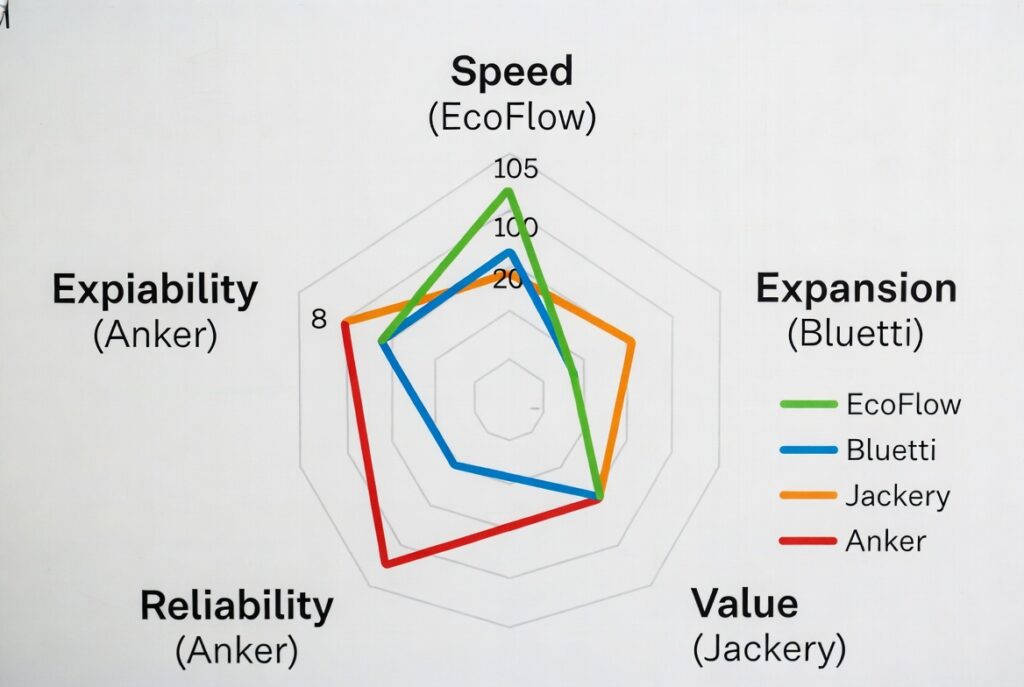
The table below ranks each solar generator brand by its strongest feature and its biggest limitation. No brand wins every category. The right choice depends on whether you prioritize expansion, surge power, simplicity, price, or professional-grade components for a permanent build.
| Brand | Winning Feature | Biggest Weakness | Best For |
|---|---|---|---|
| EcoFlow | Speed and surge (7,200W peak) | Highest price point | High-draw appliances |
| Bluetti | Expansion ecosystem (to 8,192Wh) | Heavier units | Long-term home backup |
| Jackery | Reliability and simplicity | Limited expansion | Camping and light kits |
| Anker | Price-to-value ($900 for 1,056Wh) | No expansion port | Budget-conscious starters |
| Victron | Pro-grade DIY components | Not an all-in-one unit | Off-grid cabins and vans |
The EcoFlow DELTA Pro 3 leads on surge at 7,200W and charges fastest from wall power. The Bluetti AC200L leads on expansion with three battery options up to 8,192Wh. The Jackery Explorer 300 Plus is the simplest and lightest entry point at 8.3 lbs. The Anker SOLIX C1000 offers the best dollar-per-watt-hour value at $900 CAD for 1,056Wh.
The Solar Generator Brand Ecosystem Lock-In Warning
Expansion batteries use proprietary BMS communication and proprietary cables. A Bluetti B300 at 3,072Wh only connects to Bluetti head units via an aviation-style data cable. An EcoFlow Extra Battery only connects to EcoFlow units via their proprietary port. You cannot cross brands regardless of how similar the connectors might look. The internal firmware must match for the BMS handshake to complete.
This means the solar generator brand you choose today determines the price and availability of every expansion battery you buy for the next 5 to 10 years. Choose the brand whose expansion batteries you can afford, not just the brand whose base unit is on sale this week. A $300 savings on the base unit costs $1,400 in trade-in losses when you switch brands two years later. For the full expansion guide, see our solar generator expansion guide.
How Each Brand Wins and Where Each Brand Loses
Expansion ecosystem: Bluetti wins with B210, B230, and B300 options up to 8,192Wh. EcoFlow is second with Extra Battery expansion to 11,600Wh on the DELTA Pro 3. Anker and Jackery offer no expansion on their most popular models. Surge rating: EcoFlow wins at 7,200W peak on the DELTA Pro 3. Bluetti is second at 4,800W on the AC200L. For surge details, see our solar generator surge wattage guide.
AC charging speed: EcoFlow wins with X-Stream technology refilling the DELTA Pro 3 in under 2 hours. App quality: EcoFlow and Bluetti are tied with firmware updates, remote monitoring, and detailed power analytics. Jackery is improving but simpler. Anker includes a useful quiet mode toggle. Price-to-capacity: Anker wins in the 1,000Wh class at $900 CAD. Bluetti wins in the 2,000Wh class at $2,200 CAD. Weight: Jackery wins in the small class at 8.3 lbs. Warranty: all major brands offer 5 years on LFP models.
The Milton Bluetti Expansion Success
A homeowner in Milton started with a single Bluetti AC200L two years ago. He was not sure whether he needed whole-home backup yet, but he wanted the option to expand later. He chose Bluetti specifically because the B-series expansion ecosystem offered three battery sizes up to 8,192Wh total. He paid $2,200 CAD for the base unit knowing the expansion path was available if he ever needed it.
Two years later, he decided he wanted to run his well pump through a 48-hour outage. Because he chose the Bluetti ecosystem, he bought two B300 expansion batteries at 3,072Wh each and plugged them into the AC200L. The system went from 2,048Wh to 8,192Wh without any rewiring, new inverters, or replacement purchases. He quadrupled his runtime by adding storage to a base unit he already owned.
He bought a truck with a high gross vehicle weight rating frame. When he needed to haul more, he did not need a new truck. He just needed a bigger trailer. The Bluetti ecosystem grew with his needs because the base unit was built with the expansion architecture from day one. Choosing the right solar generator brand at the start saved him from replacing the entire system two years later.
The Rockwood Anker Expansion Regret
A client in Rockwood bought an Anker SOLIX C1000 because it was on sale for under $900 CAD. The unit is excellent at 1,056Wh with 1,800W continuous output. He chose it purely on price-to-capacity ratio without checking the expansion options. Six months later, he realized 1,000Wh was not enough to get his fridge through a full day and night.
When he looked into buying an expansion battery, he discovered the Anker SOLIX C1000 has no expansion port. There is no physical connector and no firmware support for external batteries. He could not add capacity to the unit he owned. His only options were to buy a second standalone unit, sell the Anker and start over with an expandable brand, or accept the 1,000Wh limit permanently.
He bought a compact car and then realized he had a family of five. The car works perfectly for what it is, but there is no tow hitch and no roof rack option. He cannot add capacity. He has to trade in for a different platform. He sold the Anker at a loss and bought a Bluetti AC200L with a B300, spending $1,400 more than if he had chosen the expandable solar generator brand from the start. For the non-expandable warning, see our Bluetti AC200P review.
Solar Generator Brand Verdict and Which Ecosystem Fits Your Ontario Plan
This solar generator brand verdict splits into three profiles based on your expansion needs, budget, and how long you plan to own the system.
- Long-term home backup buyers who want expansion flexibility should choose Bluetti. Start with the AC200L at $2,200 CAD. Add B300 expansion batteries as budget allows. The ecosystem grows to 8,192Wh without replacing the base unit. This is the best solar generator brand for 5 to 10 year planning in Ontario.
- High-draw users who need maximum surge and fastest charging should choose EcoFlow. The DELTA Pro 3 at 3,600W continuous and 7,200W surge handles sump pumps and heavy loads that trip smaller inverters. X-Stream charging refills the 4,096Wh battery in under 2 hours from wall power. For more on heavy loads, see our 3000W solar generator guide.
- Budget starters and campers who need simplicity should choose Jackery for camping at the Explorer 300 Plus for $400 CAD. Choose Anker for home essentials at the SOLIX C1000 for $900 CAD. Accept that neither brand offers expansion. If you outgrow the unit, you start over with an expandable brand. For lightweight options, see our best small solar generator guide.
Frequently Asked Questions
Q: Do all brands use the same solar panel connectors?
A: Most brands use standard MC4 connectors, but the maximum input voltage varies by unit. Always check your specific unit’s max voltage before connecting panels in series. Exceeding the max voltage triggers overvoltage protection and blocks all charging until the panels are disconnected.
Q: Which brand has the best app?
A: EcoFlow and Bluetti are tied for the most feature-rich apps with firmware updates, remote monitoring, and detailed power analytics. Jackery’s app is simpler but functional for basic monitoring. Anker’s app includes a useful quiet mode toggle that reduces fan noise at moderate loads.
Q: Is one brand safer than the others?
A: All four major brands use LiFePO4 chemistry on their current flagship models, which is the safest lithium chemistry available. All are UL or TUV certified. As long as you buy an LFP model from any of these brands, the safety standards are equivalent across the board.
NEC Article 702 covers optional standby systems including portable power equipment certification requirements. All portable solar generators sold in North America must be UL or TUV certified to meet consumer safety standards. Current standards are published at nfpa.org.
CEC Section 64 governs portable power equipment safety certification and consumer protection requirements in Ontario. All units must carry CSA, UL, or TUV certification for residential use. The Electrical Safety Authority (ESA) provides current compliance guidelines and product safety resources at esasafe.com.
This build is engineered within the 48V DC Safety Ceiling. Diagnostic logic is based on 20+ years of technical service experience. All structural and electrical installations must be verified by a Licensed Professional and comply with your Local AHJ. See our legal and safety disclosure for full scope.
About the Author
Robert Bertrand spent 20 years as a service advisor in the automotive industry (Lexus and Nissan), where precision diagnostics, wiring integrity, and documentation standards were non-negotiable. He brings that same technical discipline to GridFree Guide, where he researches, tests, and documents off-grid solar systems for Ontario conditions. Based in Rockwood, Ontario, every article is built on verified specifications, manufacturer data, and the real-world climate constraints of Canadian off-grid living.
As an Amazon Associate I earn from qualifying purchases. This site also contains affiliate links to other products and services. GridFree Guide earns a small commission at no extra cost to you.