
Is a 3000W Solar Generator Overkill for Ontario Home Backup
Deciding if a 3000w solar generator is the right investment comes down to an honest audit of your essential loads and how many of them run simultaneously. Most Ontario homes run fridge, Starlink, LED lights, phones, and possibly a CPAP during an outage. That essentials load totals 200W to 300W continuous. A 2,000W unit handles it comfortably for approximately 8.5 hours on a single charge.
A 3,000W unit with a 4,096Wh battery runs the same 200W essentials load for approximately 17 hours. That is double the runtime for more than double the price. The extra $2,000+ buys surge capacity and runtime, not essential functionality. The inverter sits at 10 percent load most of the time. The question is not whether the unit can handle your loads. The question is whether your loads justify the cost.
The 3000w solar generator becomes necessary only in specific high-draw scenarios. Running a 1/2 HP sump pump alongside a fridge, powering a home office at 600W+ for a full workday, or bridging a 48-hour outage without solar recharge are the use cases where the extra capacity pays for itself. For everything else, a 2,000W unit does the same job for less. For a full load comparison, see our 2000W solar generator load guide.
The Sizing Comparison Table for 2,000W Versus 3,000W Class
The table below compares the two classes across five common Ontario outage scenarios. The verdict column tells you which class is the correct size for each load. In most rows, the 2,000W unit handles the job. The 3,000W unit becomes necessary only when simultaneous high-draw loads or extended runtime are required.
| Load Scenario | 2,000W Unit | 3,000W Unit | Verdict |
|---|---|---|---|
| Fridge + lights + phone (200W) | YES | YES | 2,000W is enough |
| Fridge + microwave (1,100W) | YES | YES | 3,000W has more margin |
| 1/2 HP sump pump (2,400W surge) | MAYBE | YES | 3,000W provides surge buffer |
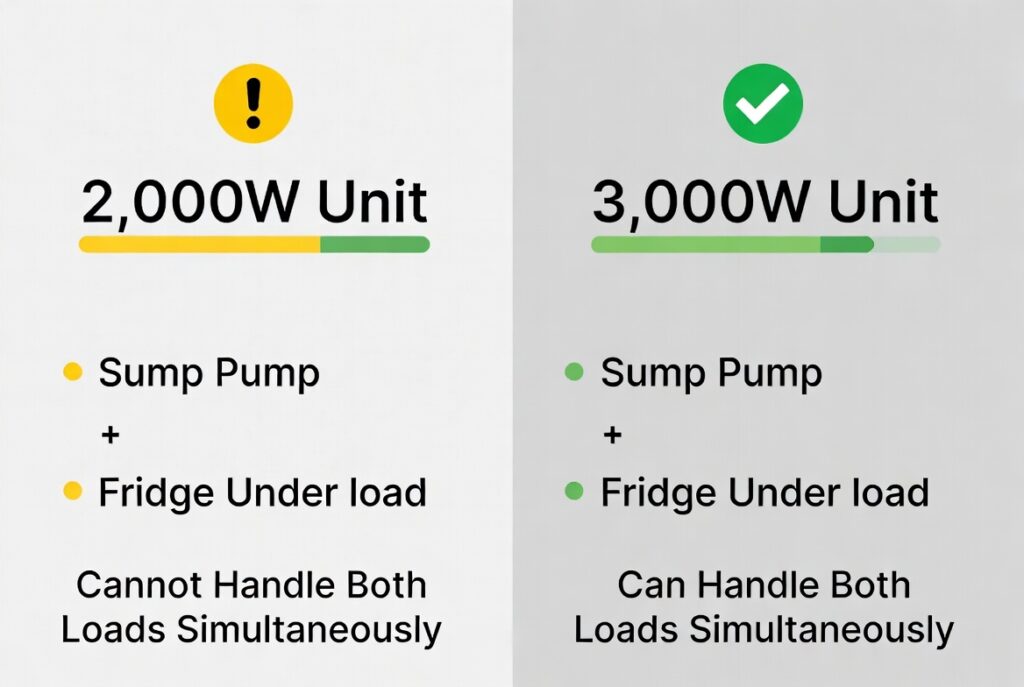
| Sump pump + fridge simultaneously | Likely trips | YES | 3,000W required |
| Home office at 600W (8 hours) | YES (5 hrs) | YES (11 hrs) | 3,000W provides 2x runtime |
The first two rows show that most Ontario essentials loads do not need 3,000W of inverter capacity. The sump pump rows are where the 3,000W class earns its price. A 2,400W startup surge alongside a running fridge compressor is the load combination that trips a 2,000W inverter. For the full outage protocol, see our solar generator outage protocol.
When a 3000W Solar Generator Is Not Overkill
Sump pump owners with 1/2 HP or larger pumps need the 3,000W class. The startup surge on a 1/2 HP pump reaches 2,400W to 3,000W. Running that surge simultaneously with a fridge compressor restart at 300W pushes the combined demand above 2,700W. A 2,000W inverter trips its overcurrent protection. A 3,600W inverter like the EcoFlow DELTA Pro 3 handles both loads without breaking stride.
Home office professionals drawing 600W+ for a full 8-hour workday benefit from the 4,096Wh capacity. A 2,000Wh unit runs a 600W office for approximately 3 hours. The DELTA Pro 3 runs the same office for approximately 6 hours, and with expansion batteries the runtime extends to 16+ hours. For preppers who need to bridge 48+ hour outages without solar recharge, the 4,096Wh capacity provides 17 hours at 200W essentials without touching a panel. For sustained pump runtime, see our solar generator versus gas generator comparison.
When a 3000W Unit Is Expensive Overkill
CPAP backup at 8W draw does not need a 3,000W inverter or a 4,096Wh battery. A $400 Jackery Explorer 300 Plus at 288Wh runs a CPAP for 4 nights. A fridge plus lights during a 12-hour outage at 200W draw does not need 3,000W. An Anker SOLIX C1000 at $900 CAD handles that scenario with capacity to spare.
Camping with a 3000w solar generator is impractical. Units in this class weigh 60 to 80 lbs. They have wheels and handles, but you are not carrying one from a parking lot to a campsite at Killarney. Condo and apartment dwellers face the same problem from a different angle. An 80 lb unit stored on P2 is useless on the 14th floor when the elevator is down. For apartment buyers, weight matters more than watts. For lighter alternatives, see our best small solar generator guide.
The Wellington County Sump Pump Win
A homeowner in Wellington County has a basement that relies on a heavy-duty 1/2 HP sump pump. During a spring thaw thunderstorm, the power went out just as the water level in the sump pit reached the critical mark. He had an EcoFlow DELTA Pro 3 staged in the basement. His fridge was already plugged into the same unit running at approximately 80W.
When the sump pump kicked on with a 2,400W startup surge, the DELTA Pro 3 handled both the pump surge and the running fridge simultaneously without tripping the inverter. The 3,600W continuous rating absorbed the surge while maintaining power to the fridge compressor. If he had used a 2,000W unit, the combined surge of 2,400W from the pump plus 80W from the fridge plus a possible 300W fridge compressor restart would have likely tripped the inverter protection, shutting down both appliances and leaving the basement to flood.
This is where you need the heavy-duty towing package. A half-ton truck can technically tow a boat, but when the hill gets steep and the load shifts, the engine strains and the transmission overheats. A one-ton with the tow package does the same job at half throttle. For homeowners with sump pumps, the 3000w solar generator is not overkill. It is the correct tool for a load that punishes undersized inverters.
The Toronto Condo Oversizing Mistake
A client in a Toronto condo bought a Jackery HomePower 3000 weighing nearly 80 lbs because he wanted to be the most prepared person in the building for a winter outage. He stored the unit in his building’s underground storage locker on the P2 level. His condo is on the 14th floor. He planned to bring the unit upstairs when needed.
During an actual outage, the building elevator was not running. He could not carry an 80 lb unit up 14 flights of stairs. Even after borrowing a dolly from the concierge, getting the unit through fire doors and up a stairwell took 45 minutes. Once in his condo, he used it to charge his laptop and run a single lamp for a total draw of 65W.
He bought a dump truck to move a single piece of furniture. The 65W load he actually ran would have been handled identically by a Jackery Explorer 300 Plus at 8.3 lbs that fits in a hallway closet. He spent $4,500 on capacity he could never practically move to where he needed it. For condo and apartment dwellers, the 3000w solar generator is overkill. Weight and portability matter more than inverter capacity in a high-rise. For expansion alternatives to buying bigger, see our solar generator expansion guide.
3000W Solar Generator Verdict and Who Should Buy This Class
This 3000w solar generator verdict splits into three profiles based on your loads, your living space, and your budget.
- Sump pump owners and high-draw simultaneous load users should buy the EcoFlow DELTA Pro 3 at 3,600W continuous and 4,096Wh. The surge capacity handles 1/2 HP pump startup alongside running appliances without tripping. This is the correct tool for homes where basement flooding is a real risk during power outages.
- 48-hour outage preppers who want maximum runtime on a single charge should buy the DELTA Pro 3 or Jackery HomePower 3000. The 4,096Wh capacity runs 200W essentials for 17 hours per charge. With expansion, the DELTA Pro 3 reaches 11,600Wh for multi-day coverage. For the full Ontario generator landscape, see our solar generator Ontario guide.
- Everyone else should buy a Bluetti AC200L at 2,048Wh and $2,200 CAD, or an Anker SOLIX C1000 at 1,056Wh and $900 CAD. For apartment and condo dwellers, buy a Jackery Explorer 300 Plus at 8.3 lbs and $400 CAD. The 3,000W class is the right tool for specific high-draw scenarios, not a general recommendation.
Frequently Asked Questions
Q: Can a 3000W solar generator run a furnace?
A: Yes, if you use a neutral-ground bonding plug adapter. Most gas and propane furnaces require a bonded neutral to fire the electronic igniter. Standard solar generators use floating neutral. Consult an electrician to verify your furnace requirements before relying on any solar generator for heating.
Q: Is a 3000W unit portable?
A: Moveable is a better description than portable. Most units in this class weigh 60 to 80 lbs and have wheels plus a retractable handle like a heavy suitcase. You can roll one between rooms on a flat surface, but you will not carry it up stairs or take it on a trail.
Q: Can I charge a 3000W unit from my car?
A: Technically yes, but it takes 30+ hours from a standard 12V car outlet. A 4,000Wh battery needs AC wall power or solar panels for practical recharging. Car charging is a last resort, not a primary method for units this large.
NEC Article 702 covers optional standby systems including overcurrent protection and surge load management for portable generator installations. All high-wattage portable equipment must comply with overcurrent protection sizing per NEC 702.10. Current standards are published at nfpa.org.
CEC Section 64 governs portable power equipment and overcurrent protection requirements in Ontario. All units must be CSA or UL certified with functional surge protection systems. The Electrical Safety Authority (ESA) provides current compliance guidelines and installation resources at esasafe.com.
This build is engineered within the 48V DC Safety Ceiling. Diagnostic logic is based on 20+ years of technical service experience. All structural and electrical installations must be verified by a Licensed Professional and comply with your Local AHJ. See our legal and safety disclosure for full scope.
About the Author
Robert Bertrand spent 20 years as a service advisor in the automotive industry (Lexus and Nissan), where precision diagnostics, wiring integrity, and documentation standards were non-negotiable. He brings that same technical discipline to GridFree Guide, where he researches, tests, and documents off-grid solar systems for Ontario conditions. Based in Rockwood, Ontario, every article is built on verified specifications, manufacturer data, and the real-world climate constraints of Canadian off-grid living.
As an Amazon Associate I earn from qualifying purchases. This site also contains affiliate links to other products and services. GridFree Guide earns a small commission at no extra cost to you.