
2000W Solar Generator What Can It Run and Why Watts and Watt-Hours Are Different Questions
A 2000w solar generator what can it run is the first question every Ontario buyer asks before committing to a unit in this class. The answer is not straightforward because watts and watt-hours are different questions. The 2,000W inverter rating tells you what the unit can start. The 2,048Wh battery capacity tells you how long it can sustain that load. A space heater at 1,500W runs for 75 minutes. A refrigerator at 80W runs for 24 hours. Same inverter, same battery, completely different outcomes.
Understanding this distinction is the key to managing a 2000w solar generator during an Ontario outage. The inverter handles the peak. The battery handles the duration. A 4,800W surge rating lets you start a sump pump that spikes to 1,500W at startup. But the battery only sees the 800W running draw after the motor settles. Thinking in watt-hours instead of watts is what separates a homeowner who runs out at midnight from one who makes it through a 30-hour outage.
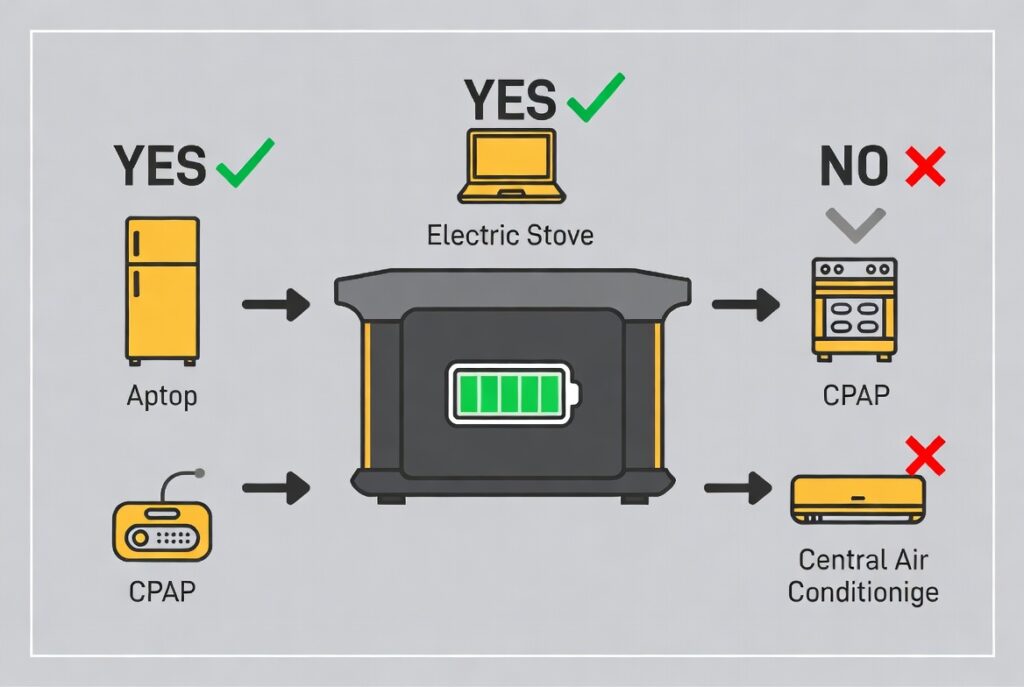
The appliance load matrix below rates every common household appliance as YES, NO, or MAYBE for the 2,000W class. Every runtime estimate uses the formula: (2,048Wh x 0.85) divided by appliance watts. The 0.85 factor accounts for inverter efficiency losses. For a broader look at Ontario generator options, see our solar generator Ontario guide.
The Full Appliance Load Matrix for the 2,000W Class
The table below covers every common appliance a homeowner might plug into a Bluetti AC200L or equivalent 2,000W class unit during an outage. The YES column means the inverter handles it and the battery sustains it for a practical period. The NO column means the appliance exceeds the inverter or drains the battery too fast to be useful.
| Appliance | Running Watts | Can It Run? | Estimated Runtime |
|---|---|---|---|
| Refrigerator | 60 to 150W | YES | 24 to 30 hours |
| Chest freezer | 30 to 80W | YES | 36 to 48 hours |
| Sump pump (1/3 HP) | 800W (1,500W surge) | YES | 2.5 hours continuous |
| Sump pump (1/2 HP) | 1,200W (3,000W surge) | MAYBE | Check unit surge rating |
| Starlink + WiFi router | 75 to 100W | YES | 18 to 20 hours |
| CPAP (no humidifier) | 8W | YES | 200+ hours |
| Coffee maker | 1,200W | YES | 1.5 hours total draw |
| Microwave (700W setting) | 1,000W actual | YES | 1.8 hours total |
| Space heater | 1,500W | YES but 75 min only | Emergency use only |
| Electric kettle | 1,200 to 1,500W | YES | 1.2 to 1.5 hours total |
| TV (55-inch LED) | 70 to 90W | YES | 20+ hours |
| Laptop | 45 to 65W | YES | 25+ hours |
| Hair dryer (low) | 800 to 1,000W | YES | Use sparingly |
| Hair dryer (high) | 1,500 to 1,875W | MAYBE | At inverter limit |
| Well pump (1/2 HP) | 1,200W (3,000W+ surge) | NO | Exceeds practical runtime |
| Electric stove | 2,000 to 5,000W | NO | Exceeds inverter |
| Electric dryer | 4,000 to 5,000W | NO | Exceeds inverter |
| Central AC | 3,000 to 5,000W | NO | Exceeds inverter |
The YES group covers every essential load an Ontario household needs during a storm. The NO group is limited to high-draw appliances that exceed the inverter or drain the battery in minutes. The MAYBE group depends on your specific unit’s surge rating and how long you need to run the appliance. For TV-specific runtime math, see our solar generator TV runtime guide.
The Inrush Current Rule and Why Starting Watts Matter More Than Running Watts
Motor-driven appliances like fridges, sump pumps, and AC units have a startup surge that runs 2x to 3x higher than their running watts. A refrigerator draws 400W for half a second at startup then drops to 80W running. A 1/3 HP sump pump surges to 1,500W at startup then settles to 800W. A window AC unit can spike to 1,500W at startup then run at 500W. These surges last less than one second but they must not exceed the inverter’s peak rating.
A 2,000W inverter with a 4,800W surge rating handles all of these startup spikes. The battery only sees the running watts after the motor stabilizes. This is why a 2000w solar generator can start a sump pump that surges above its continuous rating. The inverter absorbs the spike. The battery sustains the running load. For appliances without motors like space heaters, toasters, and kettles, the running draw equals the starting draw. There is no surge. The full wattage hits the battery from the first second.
2000W Solar Generator Ontario Essentials Strategy During an Ice Storm
During an Ontario ice storm, the 2000w solar generator becomes your essential load manager. Priority one is the refrigerator at approximately 80W average draw. Priority two is CPAP or medical devices at 8W to 50W. Priority three is communication including Starlink, WiFi router, and phone charging at 100W to 130W combined. The total essentials load runs 190W to 260W. At 200W average draw, the 2,048Wh battery lasts approximately 8.5 hours per charge.
Heat-based loads like space heaters, toasters, and kettles should not run during an outage unless solar recharge is available during the day. A 1,500W space heater drains the entire battery in 75 minutes. That 75 minutes of warmth costs you 8.5 hours of refrigeration, communication, and medical support. Use a propane portable heater for warmth and save the battery for electronics. For safe indoor placement, see our indoor solar generator guide.
The Orangeville Fridge and Freezer Save
A homeowner in Orangeville used a Bluetti AC200L during a 30-hour summer outage. He plugged in his main kitchen refrigerator and a full chest freezer in the garage using a heavy-duty 10AWG extension cord. The fridge drew approximately 80W running with 300W startup surges every 20 minutes. The freezer drew approximately 45W running with 150W startup surges.
While the unit handled both appliances easily at a combined 125W average, the auto-shutoff timer was enabled in the Bluetti app. Six hours into the outage, the generator shut itself off. The low average draw between compressor cycles made the software think nothing was connected. He lost 2 hours of cooling before discovering the setting.
Leaving the auto-shutoff timer enabled during a power outage is like having an auto-stop engine feature that stalls your car at a green light. It is designed to save energy during normal use, but it kills your performance when you need continuous operation. After disabling the timer in the app, the unit ran both appliances for the remaining 22 hours without interruption. His food stayed frozen for the duration on a combined draw of 125W average from a 2,048Wh battery.
The Muskoka Space Heater Disaster
A client at a Muskoka cottage tried to run a 1,500W electric space heater on a 2,000Wh solar generator during a hydro failure in November. He looked at the numbers and concluded that 2,000W is bigger than 1,500W. He plugged in the heater and it ran without tripping the inverter. He assumed the unit would last through the night.
The heater ran perfectly for exactly 75 minutes. Then the battery hit 0 percent and shut down completely. He was left with no heat and no battery reserve to run LED lights or charge his phone. The 1,500W continuous draw consumed the entire 2,048Wh battery in under 90 minutes after accounting for inverter efficiency losses.
Running a space heater on a solar generator is like driving your truck at redline in first gear. The engine can produce that power, but you burn through your fuel supply before you get anywhere useful. The correct approach is to use a propane portable heater for warmth and save the 2000w solar generator battery for electronics, communication, and refrigeration. Those loads draw 100W to 200W combined and last 10 to 20 hours on the same battery that a space heater drains in 75 minutes. For a full comparison of when gas or propane is the right choice, see our solar generator versus gas generator comparison.
2000W Solar Generator Verdict and Who Should Buy This Class
This 2000w solar generator verdict splits into three profiles based on load type, runtime needs, and budget.
- Suburban homeowners keeping fridge and internet alive during Hydro One outages should buy a Bluetti AC200L at $2,200 CAD. It runs fridge plus Starlink plus phone charging for 8 to 10 hours per charge. Disable the auto-shutoff timer in the app before the first outage. For more options, see our best solar generator for home backup guide.
- Sump pump owners who need motor-starting surge capacity should buy a unit with a 4,800W surge rating. The Bluetti AC200L or Bluetti AC200P handles 1/3 HP pump startup at 1,500W surge. For 1/2 HP pumps with 3,000W surge, verify the unit’s peak surge rating before purchasing. For sustained pump runtime, see our solar generator versus gas generator comparison.
- Users who need longer runtime than 10 hours at 200W should buy an EcoFlow DELTA Pro 3 at 4,096Wh. It doubles the runtime of a 2,000Wh unit on every load. For lighter loads at a lower budget, the Anker SOLIX C1000 at $900 CAD covers essentials for 5 to 6 hours. For portable use cases, see our solar generator for camping guide.
Frequently Asked Questions
Q: Can a 2000W solar generator run a window AC unit?
A: Yes, it can start and run a 500W window AC unit, but the battery drains in approximately 3.5 hours at that draw. Treat it as a cool-down-before-bed solution, not a 24-hour climate control system. For sustained cooling, you need a gas generator or a much larger battery bank.
Q: Can a 2000W solar generator run a hair dryer?
A: Only on low or cool settings where the draw stays under 1,000W. On high, most hair dryers pull 1,500W to 1,875W, which is dangerously close to the inverter limit. Exceeding the continuous rating triggers overcurrent protection and shuts down the unit.
Q: Can I charge it while using it?
A: Yes. This is called passthrough or simultaneous charge and discharge. Connecting solar panels while running appliances extends your effective runtime significantly. This is the recommended configuration for daytime use during multi-day Ontario outages. For CPAP-specific runtime, see our solar generator for CPAP guide.
NEC Article 702 covers optional standby systems including portable generator load management and extension cord safety requirements. All extension cords must be rated for the current they carry. Use 10AWG or 12AWG cords for high-draw appliances like refrigerators and sump pumps. Current standards are published at nfpa.org.
CEC Section 64 governs portable power equipment and load management requirements in Ontario. All cables and connectors must be properly rated to prevent overheating and electrical hazards. The Electrical Safety Authority (ESA) provides current compliance information and safe-use guidance at esasafe.com.
This build is engineered within the 48V DC Safety Ceiling. Diagnostic logic is based on 20+ years of technical service experience. All structural and electrical installations must be verified by a Licensed Professional and comply with your Local AHJ. See our legal and safety disclosure for full scope.
About the Author
Robert Bertrand spent 20 years as a service advisor in the automotive industry (Lexus and Nissan), where precision diagnostics, wiring integrity, and documentation standards were non-negotiable. He brings that same technical discipline to GridFree Guide, where he researches, tests, and documents off-grid solar systems for Ontario conditions. Based in Rockwood, Ontario, every article is built on verified specifications, manufacturer data, and the real-world climate constraints of Canadian off-grid living.
As an Amazon Associate I earn from qualifying purchases. This site also contains affiliate links to other products and services. GridFree Guide earns a small commission at no extra cost to you.