
How Long Will a Solar Generator Run TV and Why Screen Size Is Only Half the Answer
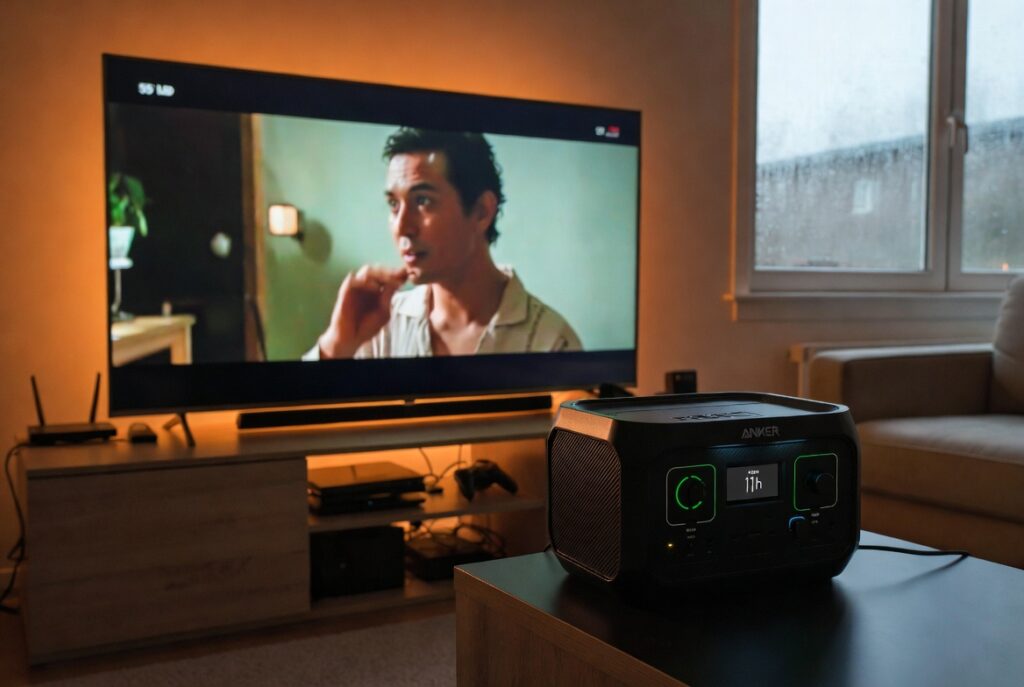
The question of how long a solar generator run tv lasts is the most common entertainment query during Ontario storm season and the answer depends entirely on your screen size and what else is plugged in. Modern LED TVs are surprisingly efficient. A 55-inch LED draws approximately 80W. That is less than two standard light bulbs. On a 1,000Wh solar generator, that TV runs for 11 hours on a single charge.
However, the entertainment stack around the TV changes the math. A Starlink Gen 3 dish draws 75W to 100W. A soundbar adds 15W to 30W. A streaming stick adds 4W. The total stack for a 55-inch LED with Starlink and a soundbar hits 175W to 220W. That is 2.5 times the TV draw alone. The solar generator run tv question is never just about the TV.
During an Ontario ice storm, the TV keeps the family occupied while the power stays down for 48 to 72 hours. The runtime math below covers every screen size from 32-inch LED to 75-inch OLED, with and without Starlink. For a broader look at Ontario generator options, see our solar generator Ontario guide.
TV Power Consumption by Size and Type
A 32-inch LED draws 35W to 45W. A 43-inch LED draws 40W to 55W. A 55-inch LED draws 70W to 90W. A 75-inch LED draws 130W to 160W. OLED panels draw 20 to 30 percent more than LED at the same screen size. A 55-inch OLED pulls 95W to 115W compared to 70W to 90W for the LED equivalent.
Reducing TV brightness by 50 percent cuts power draw by up to 20 percent. Turning off motion smoothing and local dimming saves additional watts per hour. Old plasma TVs draw 400W to 500W and should not be used with portable solar generators. A plasma TV drains a 1,000Wh unit in under 2 hours. Replace the plasma before investing in backup power.
The Entertainment Stack and Why Starlink Doubles the Draw
Most people run more than just a TV during a power outage. The Starlink Gen 3 dish draws 75W to 100W, making it the largest accessory load in a typical entertainment stack. A Roku or Fire Stick adds only 4W. A soundbar adds 15W to 30W over time. A cable box or PVR adds 15W to 25W. For more on managing Starlink power draw, see our off-grid Starlink setup guide.
The total entertainment stack for a 55-inch LED with Starlink and a soundbar hits 175W to 220W. Using 190W as the calculation baseline, a 1,000Wh generator runs that full stack for approximately 4.5 hours. That same generator runs the TV alone for 11 hours. The Starlink dish is the variable that cuts runtime in half. Every solar generator run tv calculation must account for what else shares the battery.
Solar Generator Run TV Runtime Estimates by Generator Size
The runtime table below uses a standard 55-inch LED TV at 80W as the baseline. The second column adds Starlink at 90W plus a soundbar at 20W for a total stack of 190W. All calculations use the 85 percent inverter efficiency rule.
| Generator Size | Example Unit | TV Only at 80W | TV + Starlink at 190W | Recommendation |
|---|---|---|---|---|
| 300Wh | Jackery Explorer 300 Plus | 3 hours | 1.3 hours | Single movie |
| 750Wh | Mid-size class | 8 hours | 3.4 hours | Rainy afternoon |
| 1,000Wh | Anker SOLIX C1000 | 11 hours | 4.5 hours | Full day |
| 2,000Wh | Bluetti AC200L | 21 hours | 9 hours | Full weekend |
The 300Wh class handles one movie on a small TV. The 1,000Wh class is the minimum for a full day of managed viewing during an Ontario ice storm. The 2,000Wh class covers a full weekend with Starlink streaming. For emergency planning beyond entertainment, see our emergency solar guide.
The Kawartha Rainy Day Success
A family at a cottage in the Kawarthas used a Jackery Explorer 300 Plus for a rainy Saturday afternoon. They connected a 43-inch LED TV drawing 45W and a Roku streaming stick drawing 4W. The total entertainment load was just under 50W. They did not connect a soundbar, satellite dish, or any other accessory.
The 288Wh unit delivered nearly 5 hours of runtime at that draw. That was enough for two Disney movies and a local news update before the rain cleared. The battery dropped to approximately 18 percent by the end of the afternoon. The unit never triggered a low-battery warning because the draw stayed well under the 300W output limit.
For light entertainment with a small TV and a streaming stick, the 300Wh class handles the job without stress. The family did not need a solar panel or a recharge during the afternoon. The total entertainment stack stayed under 50W because they kept the accessories minimal. For a solar generator run tv scenario with a small screen and no satellite dish, smaller is the correct answer. For more on small portable units, see our solar generator for camping guide.
The Dufferin County Starlink Drain
A homeowner in Dufferin County tried to run his 65-inch OLED TV and his Starlink Gen 3 dish off a 500Wh solar generator during a winter power outage. The OLED drew 110W. The Starlink dish drew 90W. The total entertainment stack hit 200W before he added anything else.
At 200W total draw, the 500Wh battery was exhausted in just over 2 hours. He barely finished one movie before the screen went black. He had not calculated the Starlink draw separately because he assumed it was a low-power device. The Starlink Gen 3 dish draws nearly as much power as the TV itself.
The solar generator run tv math changes dramatically when you add satellite internet. A 500Wh unit that runs a TV alone for 5 hours only lasts 2 hours with Starlink added. For streaming over Starlink during an Ontario outage, the minimum is a 1,000Wh unit like the Anker SOLIX C1000. For a full weekend of entertainment with Starlink, the 2,000Wh class is required. For more on how gas generators compare for heavy loads, see our solar generator versus gas generator comparison.
Solar Generator Run TV Verdict and Which Unit Handles Your Screen
This solar generator run tv verdict splits into three profiles based on screen size, accessories, and outage duration.
- Short outage or single movie during a storm. Buy a Jackery Explorer 300 Plus. It runs a 43-inch LED for 5 hours with a streaming stick. No Starlink, no soundbar. Keep the stack minimal and the unit handles one afternoon without a recharge.
- Full day of entertainment during an Ontario ice storm. Buy an Anker SOLIX C1000. It runs a 55-inch LED for 11 hours or a 55-inch LED plus Starlink for 4.5 hours. This is the right size for a typical Ontario outage of 24 to 48 hours with managed viewing hours. For more options, see our best solar generator for home backup guide.
- Full weekend of entertainment with a large TV and satellite internet. Buy a Bluetti AC200L or EcoFlow DELTA Pro 3. The 2,000Wh class runs a 55-inch LED plus Starlink for 9 hours. The 4,000Wh DELTA Pro 3 doubles that to 18 hours. For a 75-inch LED with a full sound system, the DELTA Pro 3 is the minimum.
Frequently Asked Questions
Q: Can I use a solar generator with an old plasma TV?
A: Not recommended. Older plasma TVs draw 400W to 500W, which drains a portable generator in under 2 hours on most units. Modern LED and OLED TVs are 3 to 5 times more efficient at the same screen size. Replace the plasma before investing in a solar generator for backup power.
Q: Does lowering the brightness help runtime?
A: Yes. Reducing TV brightness by 50 percent cuts power draw by up to 20 percent. On a 1,000Wh unit, that adds 1 to 2 hours of runtime. Turn off motion smoothing and local dimming for additional savings. Every watt saved extends the time before the screen goes dark.
Q: Will a solar generator damage my TV?
A: No. High-quality units from Anker, Bluetti, EcoFlow, and Jackery use pure sine wave inverters that deliver cleaner power than most residential grid outlets. Pure sine wave output is safe for all sensitive electronics including OLED panels and gaming consoles. Avoid modified sine wave inverters for any TV or monitor.
NEC Article 590 covers temporary power installations including overcurrent protection for portable generator connections to entertainment and household equipment. All connections must use appropriately rated circuit breakers and fuses. Current standards are published at nfpa.org.
CEC Section 64 governs portable electrical equipment and temporary installations in Ontario. All solar generators used for indoor entertainment backup must be CSA or UL certified. The Electrical Safety Authority (ESA) provides current compliance information and safe-use guidance at esasafe.com.
This build is engineered within the 48V DC Safety Ceiling. Diagnostic logic is based on 20+ years of technical service experience. All structural and electrical installations must be verified by a Licensed Professional and comply with your Local AHJ. See our legal and safety disclosure for full scope.
About the Author
Robert Bertrand spent 20 years as a service advisor in the automotive industry (Lexus and Nissan), where precision diagnostics, wiring integrity, and documentation standards were non-negotiable. He brings that same technical discipline to GridFree Guide, where he researches, tests, and documents off-grid solar systems for Ontario conditions. Based in Rockwood, Ontario, every article is built on verified specifications, manufacturer data, and the real-world climate constraints of Canadian off-grid living.
As an Amazon Associate I earn from qualifying purchases. This site also contains affiliate links to other products and services. GridFree Guide earns a small commission at no extra cost to you.