
Solar Generator Surge Wattage Explained and Why Your Fridge Trips the Inverter
Understanding solar generator surge wattage is the final piece of the sizing puzzle because continuous watts tell you what runs and surge watts tell you what starts. Continuous watts are the sustained output an inverter handles indefinitely. That is the number on the box. Surge watts are the brief spike the inverter handles for 0.5 to 1 second during motor startup. That number is usually 1.5x to 2x the continuous rating and it determines whether your fridge, sump pump, or AC unit actually turns on.
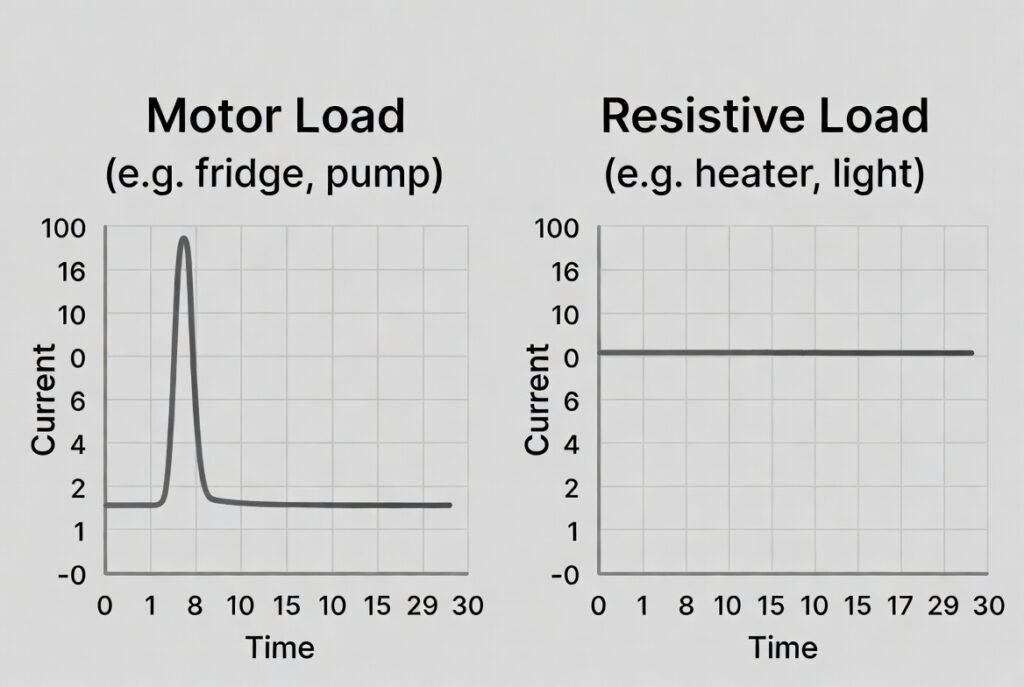
Motor-driven appliances like fridges and sump pumps surge 2x to 3x at startup then drop to their running watts. A full-size fridge runs at 80W but surges to 300W to 400W for half a second when the compressor restarts. A 1/2 HP sump pump runs at 1,200W but surges to 2,400W to 3,000W at startup. If the surge exceeds the inverter’s peak rating, it trips overcurrent protection and shuts down instantly. The appliance never starts.
Resistance loads like space heaters, coffee makers, and kettles behave differently. They draw full wattage from the first millisecond with no surge and no drop. A 1,500W space heater draws 1,500W from second one until you unplug it. The surge rating does not help with resistance loads. For the companion article on runtime math, see our solar generator watt-hour guide.
The Surge Comparison Table for Common Ontario Appliances
The table below shows running watts versus surge watts for every common appliance an Ontario homeowner might plug into a solar generator during an outage. The motor loads in the top rows surge at startup. The resistance loads at the bottom draw their full wattage continuously with no surge spike. This distinction determines whether your inverter handles the load or trips instantly.
| Appliance | Running Watts | Surge Watts | Notes |
|---|---|---|---|
| Full-size fridge | 80W | 300-400W | Compressor restarts every 20-30 min |
| Chest freezer | 50W | 150-200W | Lower draw, similar surge pattern |
| Sump pump 1/3 HP | 800W | 1,500W | Essential for basement flood prevention |
| Sump pump 1/2 HP | 1,200W | 2,400-3,000W | Highest surge in residential use |
| Window AC 5,000 BTU | 500W | 1,200-1,500W | Surges every cooling cycle |
| Circular saw | 1,400W | 2,400W | High startup torque from motor |
| Space heater | 1,500W | 1,500W | Zero surge. Resistance load. |
| Coffee maker | 1,200W | 1,200W | Zero surge. Resistance load. |
The fridge and freezer are the most common surge loads during an Ontario outage. Both compressors can restart simultaneously, combining for a 400W to 600W surge spike that lasts half a second. A generator with a 2,400W+ surge rating handles both without flinching. For the full appliance load list, see our 2000W solar generator load guide.
Motor Loads Versus Resistance Loads and Why the Distinction Matters
Motor loads are inductive. Fridges, sump pumps, AC units, and power tools all contain compressors or motors that require high inrush current to start spinning from a dead stop. The surge lasts 100 to 500 milliseconds as the motor accelerates to operating speed. Once spinning, the draw drops to the running watts and stays there. The inverter only needs to handle the surge for less than half a second. After that, it sustains the much lower running draw indefinitely.
Resistance loads convert electricity directly to heat with no motor. Space heaters, kettles, toasters, and coffee makers demand their full wattage from the first millisecond and sustain that draw until turned off. There is no startup spike and no drop to a lower running wattage. The solar generator surge wattage rating does not help with resistance loads. A coffee maker at 1,200W needs an inverter with a 1,200W continuous rating, not a 600W inverter with a 1,200W surge rating. The surge spec is for motors only.
Solar Generator Surge Wattage Ratings by Unit and the Ontario Sump Pump Standard
Surge ratings vary widely across portable solar generators. The Jackery Explorer 300 Plus handles 600W surge. The Anker SOLIX C1000 handles 2,400W surge. The Bluetti AC200L handles 4,800W surge. The EcoFlow DELTA Pro 3 handles 7,200W surge. The gap between 600W and 7,200W is the gap between starting a phone charger and starting a 1/2 HP sump pump.
In Ontario, the sump pump is the critical load that makes solar generator surge wattage a non-negotiable spec. A 1/3 HP pump needs a generator with at least a 1,500W surge rating. The Anker C1000 at 2,400W surge handles this with margin. A 1/2 HP pump needs a minimum of 3,000W surge. Only the DELTA Pro 3 class at 7,200W surge handles this reliably. For more on when the 3,000W class is necessary, see our 3000W solar generator guide.
The Rockwood Spring Thaw Sump Pump Success
A property owner in Rockwood was choosing between a cheaper 1,800W continuous unit and a Bluetti AC200L with 2,400W continuous and 4,800W surge. He has a 1/2 HP sump pump that runs at 1,200W with a startup surge of approximately 2,800W. The cheaper unit had a 2,400W surge rating. The AC200L had a 4,800W surge rating, which was double the pump’s startup demand.
During a massive spring rainstorm that knocked out the local grid, his sump pump engaged. The display showed the wattage spike to nearly 2,800W for a fraction of a second before settling to 1,200W running. The 4,800W surge buffer meant the inverter handled the spike at 58 percent of its peak capacity. If he had bought the cheaper unit with a 2,400W surge, the 2,800W pump startup would have exceeded the rating and tripped the overcurrent protection instantly.
Having a 4,800W surge rating to handle a 2,800W startup is like using a truck with a 10,000 lb towing capacity to pull a 5,000 lb trailer. You are not pushing the equipment to its absolute limit. The motor starts every time without straining the inverter. For sump pump owners in Ontario, the solar generator surge wattage rating is more important than the continuous rating because the pump either starts or it does not. There is no partial startup. For the full outage protocol, see our solar generator outage protocol.
The Guelph Coffee Maker Misconception
A client in Guelph bought a Jackery Explorer 300 Plus for his emergency kit. The unit is rated at 300W continuous and 600W surge. He saw the 600W surge number and assumed it could briefly handle his 1,200W Keurig coffee maker. He thought the surge rating meant the unit could accept short bursts above 300W.
The unit beeped and shut down immediately when he plugged in the Keurig. A coffee maker is a resistance load. It does not surge and then drop down. It demands the full 1,200W from the first millisecond and sustains that draw until the brew cycle completes. The 600W surge rating is designed for motor startup spikes that last half a second, not sustained draws that exceed the continuous rating.
Trying to run a 1,200W coffee maker on a 300W inverter is like trying to pull a loaded flatbed trailer with a lawn tractor. The tractor is not broken. It simply does not have the capacity to move that weight regardless of how briefly you ask it to try. The solar generator surge wattage spec handles motor startup spikes only. Resistance loads like coffee makers, kettles, and toasters need an inverter with a continuous rating equal to or above the appliance draw. For more on gas alternatives for heavy loads, see our solar generator versus gas generator comparison.
Solar Generator Surge Wattage Verdict and Which Rating Fits Your Loads
This solar generator surge wattage verdict splits into three profiles based on your heaviest motor load.
- Apartment dwellers running phones, laptops, and LED lights need 600W to 1,000W surge. These are all resistance or low-draw loads with zero surge. A Jackery Explorer 300 Plus at 600W surge handles everything in this category without approaching its peak capacity.
- Suburban homeowners with a fridge and chest freezer need 2,400W+ surge to handle simultaneous compressor restarts. The Anker SOLIX C1000 at 2,400W surge or the Bluetti AC200L at 4,800W surge covers this scenario. Both compressors can restart at the same time without tripping the inverter.
- Rural property owners with sump pumps, well pumps, or power tools need 4,000W+ surge. The Bluetti AC200L at 4,800W surge handles a 1/3 HP pump comfortably. For 1/2 HP pumps, buy the EcoFlow DELTA Pro 3 at 7,200W surge. That is the only portable unit in 2026 that reliably starts a 1/2 HP pump alongside a running fridge.
Frequently Asked Questions
Q: How long does a surge last?
A: Typically 100 to 500 milliseconds, or less than half a second. The inverter handles the spike and the draw drops to running watts once the motor reaches operating speed. If the surge exceeds the inverter peak rating, it trips overcurrent protection and shuts down immediately.
Q: Can a surge damage my battery?
A: No. The BMS manages the surge to protect the battery cells. If the surge exceeds the inverter rating, the BMS trips overcurrent protection and shuts down the output before any damage occurs. The shutdown protects both the inverter and the battery.
Q: Do LED bulbs have a surge?
A: Technically yes, but it lasts nanoseconds and measures in fractions of a watt. LED surge is never enough to affect any inverter rating. You can connect dozens of LED bulbs simultaneously without approaching even a 300W inverter limit.
NEC Article 440 covers motor-driven appliance loads including starting current requirements and overcurrent protection sizing for portable power equipment. All inverters must be rated to handle the locked-rotor current of any connected motor load. Current standards are published at nfpa.org.
CEC Section 64 governs motor starting loads and overcurrent protection requirements for portable power equipment in Ontario. All inverters must handle inrush current without tripping during normal motor startup cycles. The Electrical Safety Authority (ESA) provides current compliance guidelines at esasafe.com.
This build is engineered within the 48V DC Safety Ceiling. Diagnostic logic is based on 20+ years of technical service experience. All structural and electrical installations must be verified by a Licensed Professional and comply with your Local AHJ. See our legal and safety disclosure for full scope.
About the Author
Robert Bertrand spent 20 years as a service advisor in the automotive industry (Lexus and Nissan), where precision diagnostics, wiring integrity, and documentation standards were non-negotiable. He brings that same technical discipline to GridFree Guide, where he researches, tests, and documents off-grid solar systems for Ontario conditions. Based in Rockwood, Ontario, every article is built on verified specifications, manufacturer data, and the real-world climate constraints of Canadian off-grid living.
As an Amazon Associate I earn from qualifying purchases. This site also contains affiliate links to other products and services. GridFree Guide earns a small commission at no extra cost to you.