
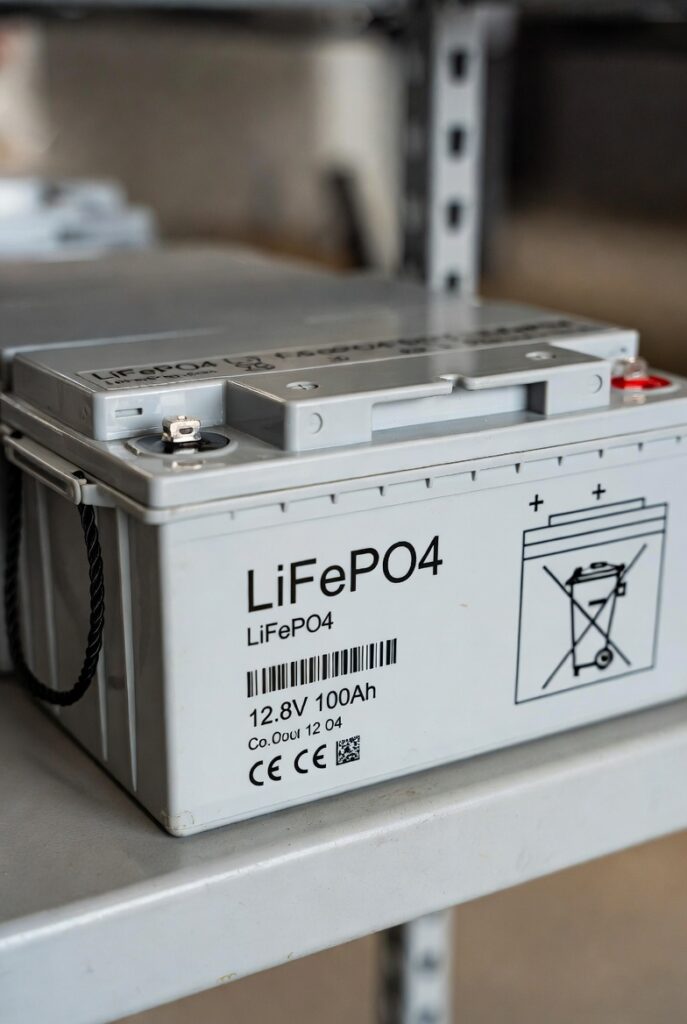
LiFePO4 self-discharge drains between 1 and 3 percent of your bank every month. In Ontario seasonal cabins, that invisible loss is the number one cause of spring BMS lockouts. A 300Ah bank left unattended for five months can trigger a hard BMS lockout costing $3,800 to fix. Understanding the real numbers is the first step toward protecting your investment.
The challenge in Ontario is that self-discharge is only part of the equation. Hidden parasitic loads from Bluetooth BMS modules and inverter standby circuits drain your bank faster than chemistry. Owners who blame LiFePO4 self-discharge usually discover an 8W inverter pulling 16Ah per day was the real cause. Separating true chemical loss from parasitic draw requires the right tools.
This guide covers the full diagnostic sequence for Ontario seasonal properties. For a broader overview of system sizing, start with the solar sizing guide. For battery selection and cold weather protection, refer to the Solar Battery Guide.
Understanding the Mechanics of LiFePO4 Self-Discharge
Every battery chemistry loses charge through internal chemical reactions even when no load is connected. LiFePO4 cells lose between 1 and 3 percent per month under controlled conditions. In contrast, AGM lead-acid batteries lose 5 to 8 percent monthly, and flooded lead-acid can lose 10 to 15 percent. The difference compounds dramatically over a typical Ontario storage season of five to six months.
A 100Ah 12V LFP battery holds 1,200Wh at full charge and delivers 960Wh at 80 percent depth of discharge. Over six months of pure chemical LiFePO4 self-discharge, an LFP bank loses roughly 6 to 18 percent of its capacity. A flooded lead-acid bank loses 60 to 90 percent over the same period. The table below shows the comparison across four common chemistries.
| Chemistry | Monthly Rate | 6-Month Loss (Est.) | Risk Level |
|---|---|---|---|
| LiFePO4 | 1 to 3% | 6 to 18% | Low |
| AGM Lead-Acid | 5 to 8% | 30 to 48% | Moderate |
| Flooded Lead-Acid | 10 to 15% | 60 to 90% | High |
| Lithium-Ion (NMC) | 2 to 5% | 12 to 30% | Low to Moderate |
The flat voltage curve of LiFePO4 cells creates a diagnostic blind spot. A fully charged cell reads 13.4V and a cell at 20 percent SoC reads 13.0V. That 0.4V gap is nearly impossible to catch with a standard multimeter. Without a coulomb-counting shunt like the Victron SmartShunt, the only warning you get is a full BMS lockout.
The BMS Vampire Draw That Looks Like Self-Discharge
An active Bluetooth BMS draws between 10 and 50mA constantly, even when no loads are connected. Over five months, that parasitic consumption totals 3.6Ah to 18Ah of drain. Meanwhile, an inverter left in standby mode draws 5 to 15W continuously. On a 12V system, that translates to 0.4A to 1.25A, which can empty a 300Ah bank in under 10 days.
Many Ontario cabin owners blame LiFePO4 self-discharge when the real problem is parasitic draw from devices they assumed were off. The inverter standby light, the Bluetooth BMS beacon, and the Cerbo GX heartbeat all consume power around the clock. Accurately diagnosing the source requires disconnecting each device individually and measuring the remaining drain with a shunt or clamp meter.
The Napanee Diagnosis
A cabin owner near Napanee in Lennox and Addington County left a 300Ah 12V LFP bank at 70 percent SoC. He assumed LiFePO4 self-discharge was negligible and left the inverter on standby. The inverter drew 8W continuously, pulling roughly 16Ah per day. Over 150 days that passive draw totaled 2,400Ah against a 300Ah bank.
By February the cells had dropped below 2.0V per cell and the BMS triggered a hard lockout. The owner did not discover the lockout until May. The $3,800 bank would not accept charge from panels or a benchtop charger. The extended time below safe voltage caused irreversible capacity loss in the cells.
This is the same failure mode as leaving a vehicle dome light on for five months in a parking garage. A car battery costs $200 in that situation, but this LFP bank cost $3,800. A $12 negative terminal disconnect would have stopped every amp of parasitic draw. The cells sat below safe voltage for over 90 days, and the total replacement cost was $3,812.
Temperature Effects on LiFePO4 Self-Discharge in Ontario
Cold temperatures slow the chemical reactions behind LiFePO4 self-discharge to below 1 percent per month at minus 10C. However, cold does not stop BMS parasitic draw at all. Some BMS units with internal heater contactors cycle more often in deep cold, adding 0.3Ah per event. Ontario cabins swing from minus 25C in January to plus 35C in July.
Heat above 30C accelerates chemical degradation and pushes the LiFePO4 self-discharge rate toward 3 percent monthly. A battery in an unventilated attic during a July heat wave degrades faster than one in a shaded basement. For Ontario seasonal properties, the ideal storage location stays between 5C and 20C year round. For more detail on cold weather management, refer to the Solar Battery Guide.
How to Measure Your Actual Self-Discharge Rate
To measure your true LiFePO4 self-discharge rate, record the exact SoC on your Victron SmartShunt when you disconnect all loads. Remove the negative terminal from the bank to eliminate every parasitic path. After 30 days, reconnect the shunt and record the new SoC. The difference is your true chemical self-discharge rate.
If you skip the physical disconnect and simply turn off the inverter, any remaining BMS draw contaminates your reading. A 50mA BMS draw over 30 days consumes 36Ah, mimicking 12 percent LiFePO4 self-discharge on a 300Ah bank. For guidance on how cycling depth affects capacity, see the LiFePO4 charge cycle guide. Before storing a new bank, complete the break-in cycling protocol to calibrate your shunt.
The Woodstock Protocol
A property owner near Woodstock in Oxford County stored a 200Ah 24V LFP bank at 55 percent SoC. He followed the storage voltage standard and disconnected the inverter and all loads. He left the Victron SmartShunt and Victron Cerbo GX powered through a dedicated 10W maintenance panel. He monitored LiFePO4 self-discharge weekly through the VRM portal.
After 120 days the bank read 52 percent SoC, confirming a true chemical rate below 1 percent monthly. The Cerbo GX also logged three brief voltage spikes during January temperature swings. Those spikes confirmed the BMS was cycling its heater contactor with no charge source connected. It consumed an additional 0.3Ah per cold event that would have been invisible otherwise.
This is the difference between driving with a full dashboard and driving with every gauge taped over. The $450 monitoring investment gave him 120 days of verified telemetry on a $4,200 bank. He returned in April to a system that accepted charge within 15 minutes. The monitoring solution cost less than 11 percent of the bank it protected.
Code Compliance for LiFePO4 Self-Discharge and Storage Systems
NEC Article 480 requires every battery installation to include a disconnect device for isolating all ungrounded conductors. This applies directly to seasonal storage because the disconnect prevents parasitic drain during long absences. Battery rooms must also have signage indicating stored energy presence. Compliance with NEC 480 is verified through the NFPA (National Fire Protection Association) code cycle.
CEC Section 64 governs battery installation and storage requirements specific to Ontario. The section mandates ventilation standards for battery enclosures, temperature monitoring provisions, and clearance distances from combustible materials. Ontario installations must be inspected by the ESA (Electrical Safety Authority) before commissioning. A Battle Born 100Ah Heated LFP meets CSA-listed requirements and provides built-in cold weather charging protection down to minus 20C.
Pro Tip: A SmartShunt and Cerbo GX setup costs $450, under 12 percent of a typical $3,800 LFP bank. Remote visibility catches parasitic draw, BMS heater events, and true LiFePO4 self-discharge from anywhere.
- Disconnect the negative terminal before storing your LiFePO4 battery. This eliminates all parasitic draw and limits total loss to 1 to 3 percent per month.
- Store at 50 to 60 percent SoC and check at the 90-day mark. A bank held below 2.0V per cell for 90 days risks irreversible capacity loss.
- Install a SmartShunt and Cerbo GX with a small maintenance panel. The $450 monitoring investment protects a $3,800 to $4,200 battery bank.
Frequently Asked Questions
How long can I leave a LiFePO4 battery without charging it?
A LiFePO4 battery stored at 50 to 60 percent SoC with all loads disconnected can sit safely for six months. In Ontario, where temperatures range from minus 25C to plus 35C, checking every 90 days is recommended. If SoC drops below 20 percent, connect a charger immediately to prevent BMS lockout.
Does cold weather stop LiFePO4 self-discharge completely?
Cold weather slows the chemical reaction behind self-discharge to below 1 percent per month. However, it does not stop BMS parasitic draw or heater contactor cycling. In deep Ontario cold, a BMS with an internal heater can consume 0.3Ah per activation event. Only a remote monitor can detect that additional drain.
Will disconnecting the negative terminal prevent all battery drain?
Disconnecting the negative terminal eliminates all external parasitic draw, including inverter standby, BMS Bluetooth beacons, and monitoring equipment. The only remaining loss is true internal chemical self-discharge at 1 to 3 percent per month. This single step is the most effective protection against BMS lockout during long-term Ontario storage.
This build is engineered within the 48V DC Safety Ceiling. Diagnostic logic is based on 20+ years of technical service experience. All structural and electrical installations must be verified by a Licensed Professional and comply with your Local AHJ.
About the Author
Robert Bertrand spent 20 years as a service advisor in the automotive industry (Lexus and Nissan), where precision diagnostics, wiring integrity, and documentation standards were non-negotiable. He brings that same technical discipline to GridFree Guide, where he researches, tests, and documents off-grid solar systems for Ontario conditions. Based in Rockwood, Ontario, every article is built on verified specifications, manufacturer data, and the real-world climate constraints of Canadian off-grid living.
As an Amazon Associate I earn from qualifying purchases. This site also contains affiliate links to other products and services. GridFree Guide earns a small commission at no extra cost to you.